Category Archives: News

Disaster Response in Nepal and The Zooniverse

Very soon after the recent magnitude-7.8 earthquake in Nepal, we were contacted by multiple groups involved in directly responding with aid and rescue teams, asking if we could assist in the efforts getting underway to crowdsource the mapping of the region. One of those groups was Rescue Global, an independent reconnaissance charity that works across multiple areas of disaster risk reduction and response. Rescue Global also works with our collaborators in machine learning here at Oxford, combining human and computer inputs for disaster response in a project called Orchid. And they asked us to help them pinpoint the areas with the most urgent unfulfilled need for aid.

And so we sprang into action. The satellite company Planet Labs generously shared all its available data on Nepal with us. The resolution of Planet Labs’ imagery – about 5 metres per pixel – is perfect for rapid examination of large ground areas while showing enough detail to easily spot the signs of cities, farms and other settlements. After discussions with Rescue Global we decided to focus on the area surrounding Kathmandu, with a bias westward toward the quake epicentre, as much of this area is heavily populated but we knew many other, complementary efforts were focusing on the capital itself. We sliced about 13,000 km2 of land imagery into classifiable tiles, and created a new project using brand new Zooniverse software (coming very very soon!) that allows rapid project creation.

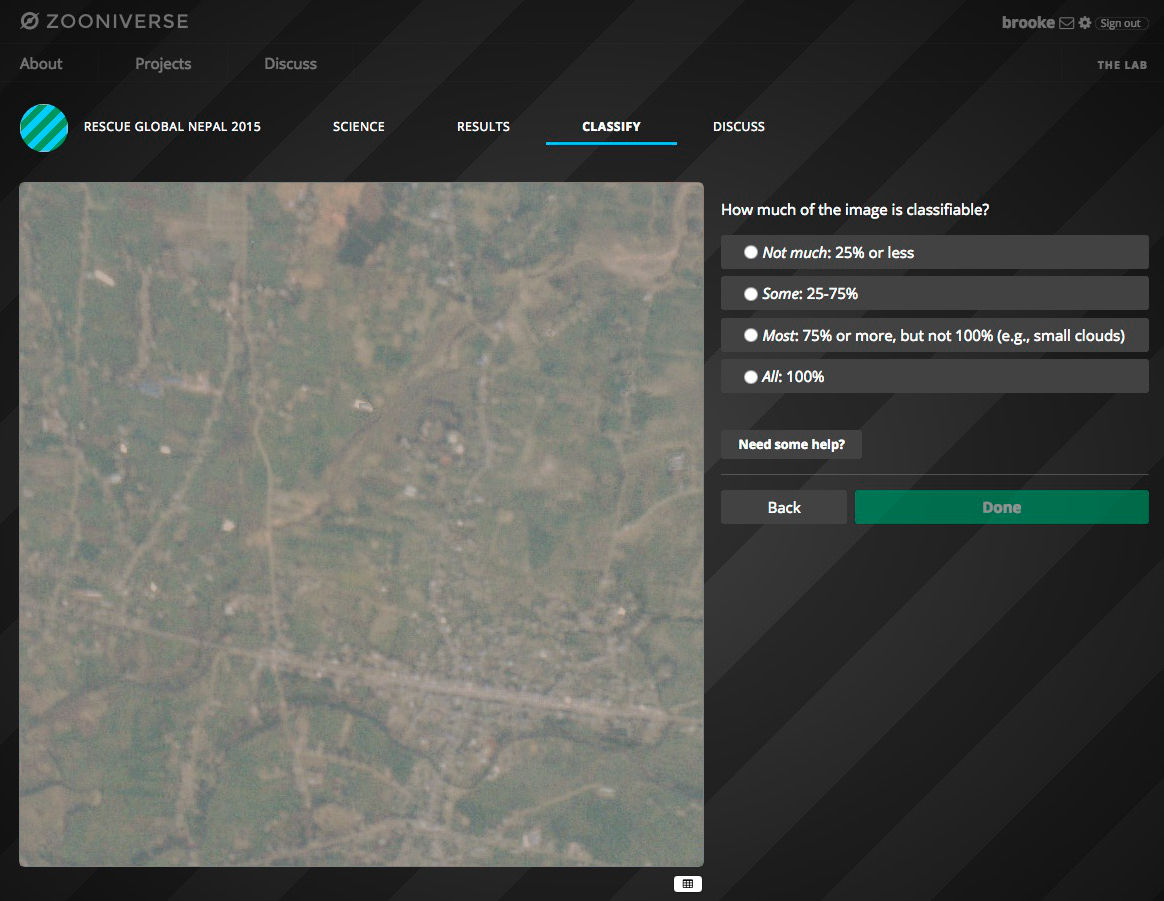
Screen Shot of the humanitarian project run by The Zooniverse for Orchid and Rescue Global
Once we had prepared the satellite images, we created the project in less than a day. Users were asked to indicate the strength of evidence of settlements in the area, and then how much of the image was classifiable.

We also realised that if we combined our work with the results of some of the aforementioned complementary efforts, we needn’t wait for the clouds to part so that we could get post-quake images. For example, the Humanitarian OpenStreetMap Team (HOT) is doing brilliant work providing exquisitely detailed maps for use in the relief efforts. But here’s the thing: Nepal is pretty big (larger than England). And accurate, detailed maps take time. So in the days immediately following the earthquake, our area of focus – which we already knew had been severely affected – hadn’t been fully covered by HOT yet. And by comparing rapid, broad classifications of a relatively large area of focus with the detailed maps of smaller areas provided by HOT efforts, we could still make very confident predictions about where aid would most be needed even with just pre-quake images.

Because our images were in the sweet spot of area coverage and resolution, we were able to classify the entire image set in just a couple of days with the combined effort of only about 25 people, comprising students and staff members from Oxford and Rescue Global staff. For each image, we asked each person about any visible settlements and about how “classifiable” the image was (sometimes there are clouds or artefacts).

After the classifications were collected, the machine learning team applied a Bayesian classifier combination code that we first used in the Zooniverse on the Galaxy Zoo: Supernova project. After comparing these results with the latest maps from the HOT team, we saw two towns that were outside the areas currently covered by other crisis mapping, but that our classifiers had marked as high priority.

map and satellite of 2 towns, 1 of which our classifications found quickly despite it not being mapped in detail.
Maps from OpenStreetMap (left) and satellite images from Planet Labs (right) for 2 regions in Nepal. The top area shows the Kathmandu Airport (already well mapped by other efforts) and the bottom shows a town southwest of Kathmandu that, at the time of Rescue Global’s request to us, had not yet been mapped.

We passed this on to Rescue Global, who have added it to the other information they have about where aid is urgently needed in Nepal. The relief efforts are now in a phase of recovery, cleanup, and ensuring the survivors have the basic necessities they need to carry on, like clean water and food. Now they are coping with the damage from the second earthquake too.

Those on the ground are still busy providing day-to-day aid, so it’s early days yet to properly characterise what impact we may have had, but the initial feedback has been very good. We will be analysing this project in the days and weeks to come to understand how we can respond even more rapidly and accurately next time. That likely includes much larger-scale projects where we will be calling on our volunteers to help with classification efforts. We believe the Zooniverse, Planet Labs, and partners like Rescue Global and Orchid (and QCRI, our partner on other in-the-works humanitarian projects) can make a unique and complementary contribution to the humanitarian and crisis relief sphere. We will keep you posted on the results of our Nepal efforts and those of other, future crises.

PS: This activity was carried out under a programme of, and funded by, the European Space Agency; we would also like to acknowledge our funders for the current Zooniverse platform as a whole, principally our Google Global Impact award and the Alfred P. Sloan Foundation. And, to our team of developers who worked so hard to make this happen: you rock.

Header image adapted from OpenStreetMap, © OpenStreetMap contributors.

Who Are The Zooniverse Community? We Asked Them…

We are often asked who our community are by project scientists, sociologists, and by the community itself. A recent Oxford study tried to find out, and working with them we conducted a survey of volunteers. The results were interesting and when combined with various statistics that we have at Zooniverse (web logs, analytics, etc) we can start to see a pretty good picture of who volunteers at the Zooniverse.

Much of what follows comes from a survey was conducted last Summer as part of Masters student Victoria Homsy’s thesis, though the results are broadly consistent with other surveys we have performed.  We asked a small subset of the Zooniverse community to answer an online questionnaire. We contacted about 3000 people regarding the survey and around 300 responded. They were not a random sample of users, rather they were people who had logged-in to the Zooniverse at least once in the three months before we emailed them.

The remaining aspects of this post involve data gathered by our own system (classification counts, log-in rates, etc) and data from our use of Google Analytics.

So with that preamble done: let’s see who you are…

https://vimeo.com/99664654

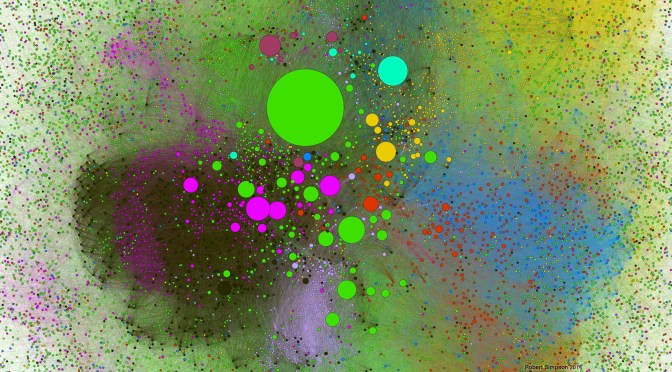
This visualisation is of Talk data from last Summer. It doesn’t cover every project (e.g. Planet Hunters is missing) but it gives you a good flavour for how our community is structured. Each node (circle) is one volunteer, sized proportionally according to how many posts they have made overall. You can see one power-mod who has commented more than 16,000 times on Talk near the centre. Volunteers are connected to others by talking in the same threads (a proxy for having conversations). They have been automatically coloured by network analysis, to reflect sub-networks within the Zooniverse as a whole. The result is that we see the different projects’ Talk sites.

talk-central

There are users that rise largely out of those sub-communities and talk across many sites, but mostly people stick to one group. You can also see how relatively few power users help glue the whole together, and how there are individuals talking to large numbers of others, who in turn may not participate much otherwise – these are likely examples of experienced users answering questions from others.

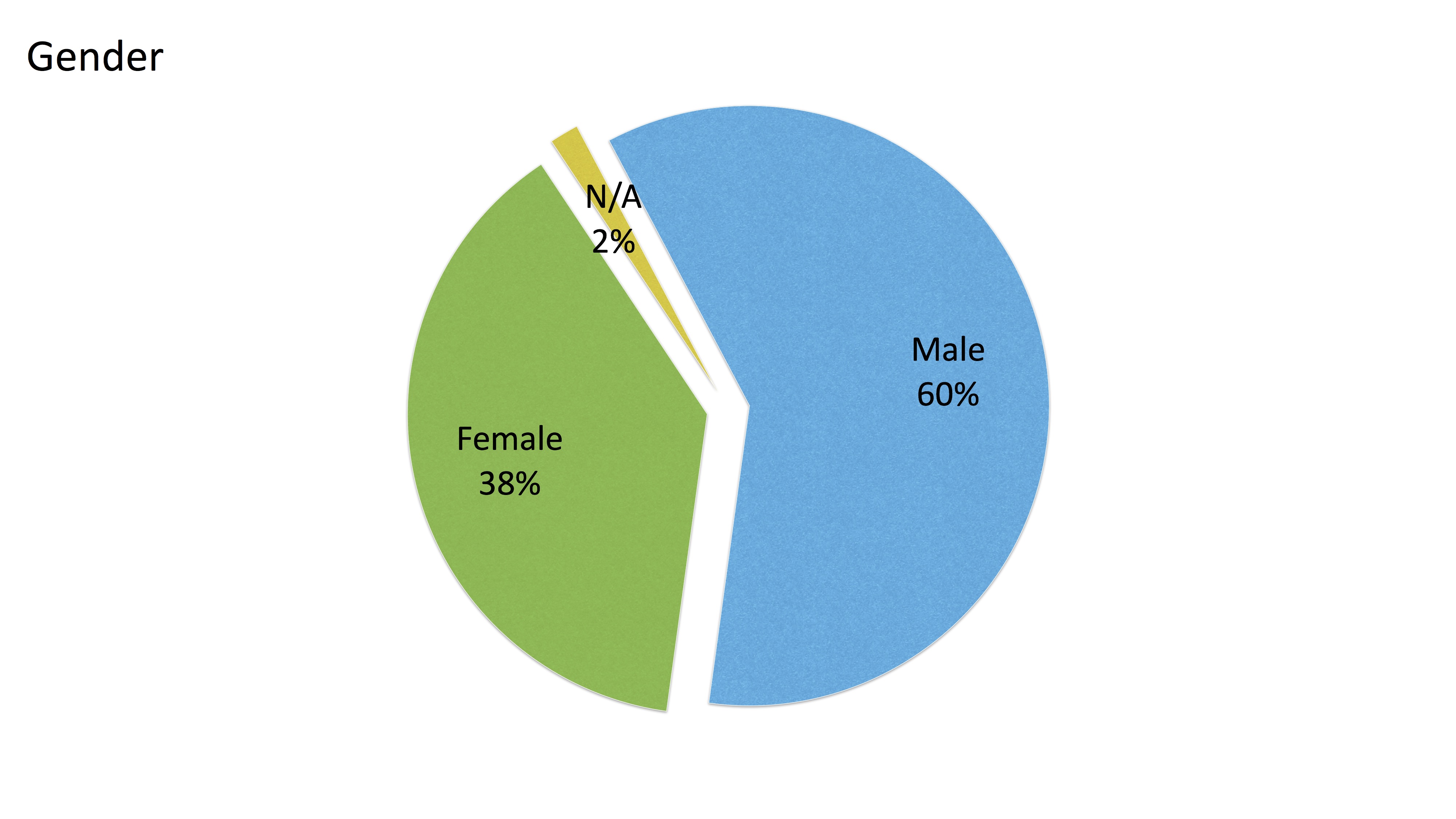
gender One thing we can’t tell from our own metrics is a person’s gender, but we did ask in the survey. The Zooniverse community seems to be in a 60/40 split, which in some ways is not as bad as I would have thought. However, we can do better, and this provides a metric to measure ourselves against in the future.
ages

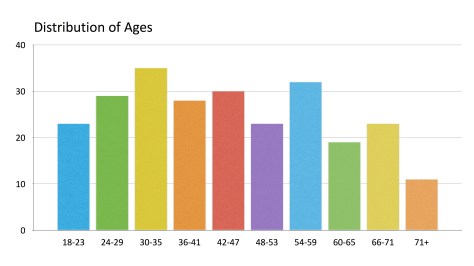
It is also interesting to note that there is very little skew in the ages of our volunteers. There is a slight tilt away from older people, but overall the community appears to be made up of people of all ages. This reflects the experience of chatting to people on Talk.
geo-pie

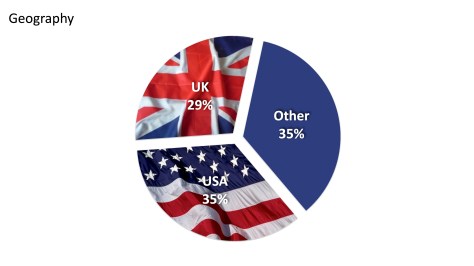
We know that the Zooniverse is English-language dominated, and specifically UK/US dominated. This is always where we have found the best press coverage, and where we have the most links ourselves. The breakdown between US/UK/the rest is basically a three-way split. This split is seen not just in this survey but also generally in our analytics overall.

geo-pie-dev

Only 2% of the users responding to our survey only came from the developing world. As you can see in a recent blog post, we do get visitors from all over the world. It may be that the survey has the effect of filtering out these people (it was conducted via an online form), or maybe that there is language barrier.
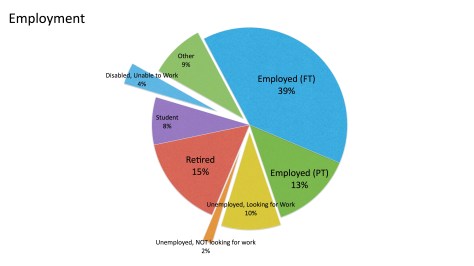
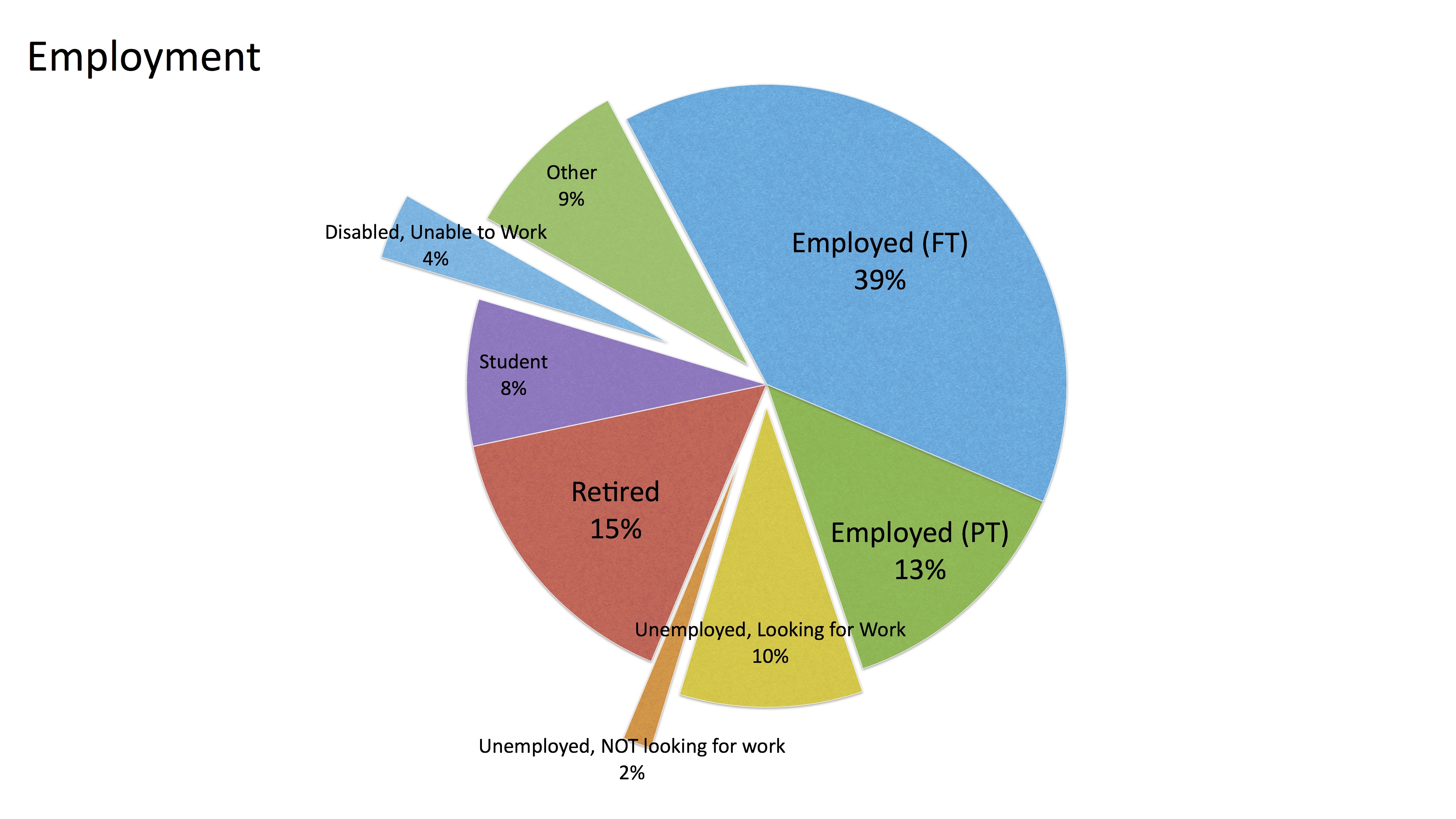
employmentemployment_cloudWe also asked people about their employment status. We find a about half of our community is employed (either full- or part-time). Looking at the age distribution, we might expect up a fifth or sixth of people to be retired (15% is fairly close). This leaves us with about 10% unemployed, nearly twice the UK or US unemployment rate, and about 4% unable to work due to disability (about the UK averaged, by comparison). This is interesting, especially in relation to the next question, on motivation for participating.

We also asked them to tell us what they do and the result is the above word cloud (thanks, Wordle!) which shows a wonderful array of occupations including professor, admin, guard, and dogsbody. You should note a high instance of technical jobs on this list, possibly indicating that people need to have, or be near, a computer to work on Zooniverse projects in their daily life.

motivation

When asked why they take part in Zooniverse projects we find that the most-common response (91%) is a desire to contribute to progress. How very noble. Closely following that (84%) are the many people who are interested in the subject matter. It falls of rapidly then to ‘entertainment’, ‘distraction’ and ‘other’. We are forever telling people that the community is motivated mainly by science and contribution, and for whatever reason they usually don’t believe us. It’s nice to see this result reproducing an important part of the Raddick et. al. 2009 study, which first demonstrated it.
when-to-classfy-routine

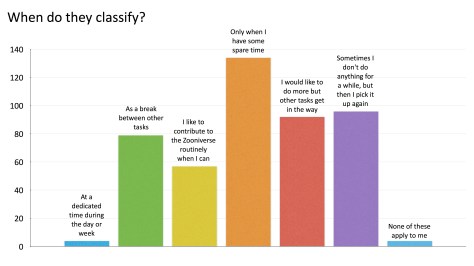
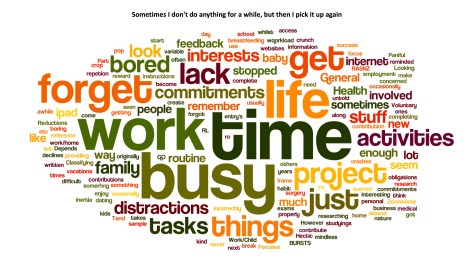
It is roughly what I would have expected to see that people tend to classify mostly in their spare time, and that most don’t have dedicated ‘Zooniverse’ time every day. It’s more interesting to see why, if they tend to stop and start, i.e. if they answered in the purple category above. Here is a word cloud showing the reason people stop participating in Zooniverse. TL;DR they have the rest of their life to get on with.
when-to-classfy-routine-cloud

We’ll obviously have to fix this by making Zooniverse their whole life!

This is my final blog post as a part of the Zooniverse team. It has been by pleasure to work at the Zooniverse for the last five years. Much of that time has been spent trying to motivate and engage the amazing community of volunteers who come to click, chat, and work on all our projects. You’re an incredible bunch, motivated by science and a desire to be part of something important and worthwhile online. I think you’re awesome. In the last five years I have seen the Zooniverse grow into a community of more than one million online volunteers, willing to tackle big questions, and trying and understand the world around us.

Thank you for your enthusiasm and your time. I’ll see you online…
Happy Halloween! Going Batty for Citizen Science

Sadly there don’t seem to be any scientifically valid citizen science projects about ghosts, poltergeists, hobgoblins, or werewolves.   There are, however plenty about that Halloween staple – the bat.

Bats get a bum wrap as blood sucking pests.  Nothing could further from the truth!   Bats are incredibly helpful to us humans because they are natural pollinators and pest controllers, but they are also an indicator species.  Indicator species are plants and animals that can be studied to give a snapshot of an ecosystem’s environmental health.

Here are a few ways that you as a citizen scientist can get involved with learning more about these amazing animals.

Bat Detective  – Zooniverse’s own bat project.  Bat calls are recorded by data collection citizen scientists and then uploaded on to the Bat Detective website.  Zooniverse volunteers classify the calls to give scientists a better idea about the distribution of these animals in Europe.

Alaska Bat Monitoring Program – Did you know that Alaska is home to five species of bats?   If you live in Alaska you can help the Alaska Department of Fish and Game collect learn more by making and sending in your observations of bats!

iBats (Indicator Bats Program) – This international effort recruits volunteers to record bat calls all around the world.  iBats is collaboration between the Zoological Society of London and the Bat Conservation Trust.


Know of other bat-related citizen science projects?  Please share them as a comment below!


Introducing Darren McRoy – Zooniverse Community Builder!

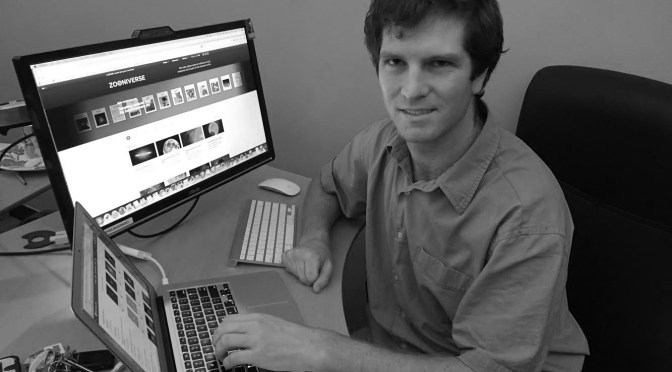
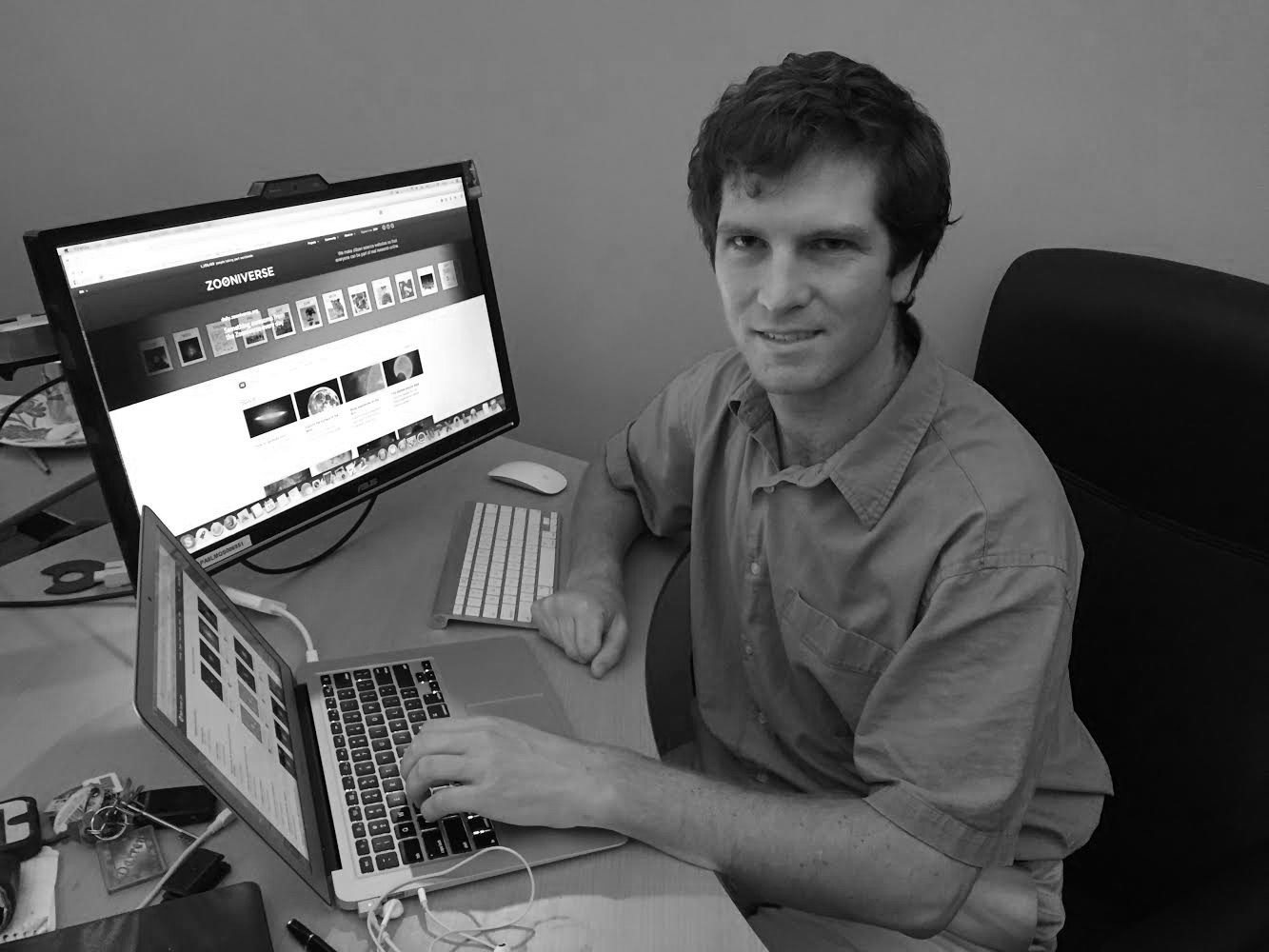
darren


Back in August I wrote about our search for someone we were calling a ‘community builder,’ which I said was ‘the most important job in the Zooniverse.’ The position was created because of the rapid expansion of the project, and the plans we have for the next year or two, which will mean we may be able to create hundreds or thousands of new projects. If the Zooniverse isn’t constrained by the slow process of project-by-project development, then we need to rethink how we choose what is hosted on our platform, what gets promoted—and how we talk about such things. We need, in fact, to try and build a broader Zooniverse community, capable of taking the choice of projects out of our hands. At the same time, we want the tools we use to engage with this community to let everyone have a say, from new classifiers on a single project to those who roam freely across all of our Talk discussion boards.

As many of you will have already discovered, we’ve found someone we can help us with this process — Darren McRoy. Darren is a 2010 graduate of Northwestern University’s Medill School of Journalism. He has worked as a reporter and editor and is an experienced writer and communicator with a strong focus on developing online communities and strategic digital content. One of his first projects will be gathering and compiling the feedback that will inform the upcoming rebuild of the Talk discussion system. He will be a regular presence on the forums, responding to users’ comments and concerns and seeking opportunities to spur additional conversation. He will also be contributing some written content for Zooniverse projects, blogs, websites, etc. when needed, and giving feedback to the development team.

You should see quite a lot of Darren, and we’d like to encourage you to talk to him if you have any questions, comments, concerns, or other feedback about the Zooniverse community. In particular, right now he is seeking feedback about how Talk can be improved to better serve both the science goals and the growing community of contributors and volunteers.

Darren can be reached via email at darren@zooniverse.org or DZM on Talk. Please feel free to contact him — he is looking forward to working with all of you!

Chris

We Need Us: Online Art, Powered by the Zooniverse

Screenshot 2014-10-09 12.08.31

The Zooniverse is the subject of a new artwork co-commissioned by the Open Data Institute (ODI) and The Space (a website for artists and audiences around the world to create and explore digital art). We Need Us is a ‘living’ dynamic artwork, powered by your activity on the Zooniverse, driven by the thriving mass of participation across various Zooniverse sites. You can learn more about it at www.thespace.org/weneedus

We Need Us has been created by artist Julie Freeman. She takes anonymised information from your clicks, counting the number of volunteers active on various Zooniverse projects, and classifications that you all create, every minute. She stores this in a new database as sets of values, while also recording the frequency of activity over an hour, a day, and a month. These sets of values create rhythms that are translated into moving shapes, and play different sounds.

The result is a set of living artworks – one for each of 10 Zooniverse projects – and more are on the way! The live data ensures constant change to the visual and sonic composition. The sounds are processed and manipulated just like the data.

Screenshot 2014-10-09 12.08.15

While many researchers have tried to analyse and understand the Zooniverse, We Need Us will be the first time someone has tackled the idea from the perspective of art. The Zooniverse community is an engine of discovery and a force unlike any other. We Need Us highlights its rhythms and patterns, showing how diverse and vibrant Zooniverse citizen scientists really are.

You can run the artwork in your web browser by visiting http://www.weneedus.org

Do you have what it takes to be a Zoomanities Developer?

The Zooniverse team is looking to recruit a Javascript/front-end developer as part of a joint project between Zooniverse, based in the Department of Physics at the University of Oxford, and Tate Britain (London).

Building on the success of high-profile research crowdsourcing projects such as Galaxy Zoo (www.galaxyzoo.org), Planet Hunters (www.planethunters.org), Operation War Diary (www.operationwardiary.org/) and the rest of the Zooniverse.org platform, the successful candidate will lead the development of a ‘citizen art history’ project, working closely with a team from Tate and Zooniverse.  As the lead front-end developer for the project you would have a background in excellent interface design and an understanding of user behaviour.

This is an exciting opportunity for a talented developer to work on a high-visibility project. This is a full-time position for 12 months (including benefits). Strong HTML/CSS/JavaScript skills are required including experience of working with third party REST APIs and modern JavaScript MVC frameworks like Backbone. A good understanding of user interface design is also a must. A background in developing highly-usable interfaces for web applications and experience of working with a modern web framework such as Ruby on Rails would be an advantage.

The application and further details can be found here.

The most important job in the Zooniverse

Job ad

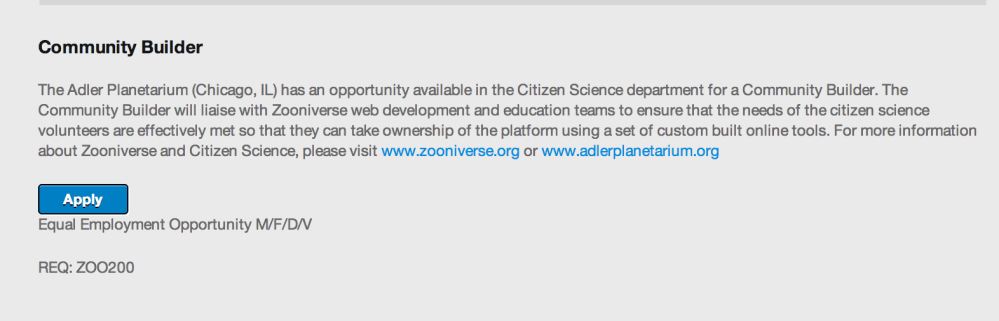
The Zooniverse team has, over the last five years or so, shown signs of growing uncontrollably like some sort of bacterial colony that requires feeding with grant money. The job we’ve just advertised (at Adler Planetarium) might, though, be the most important yet. As those who are eager followers of this blog will know, we’re currently working hard on rebuilding the Zooniverse platform so that it can support many more projects.

If the Zooniverse can get to the point where we’re no longer constrained by the number of projects that can be built, we will need to think about how projects get chosen to appear on the Zooniverse, and about who should make that decision. Our opinion is that you – our community – should be more involved, and to work out how to make that happen we’re looking for what we’re calling a ‘community builder’. As you’ll see from the job description, this isn’t a technical post, but rather we’re looking for someone who knows how to build a community that is capable of awesome things. If that sounds like you, please get in touch.

Chris

PS The post is funded by a new grant from our friends at the Alfred P. Sloan foundation, to whom we’re eternally* grateful.

* – or as near as we can make it

Thanks to the Forum – and Farewell

Today marks the end of an era for the Zooniverse: the closure of the Galaxy Zoo forum. Read all about it on the Zooniverse blog.

chrislintott's avatarGalaxy Zoo

Afbeelding1-500x499

After very nearly seven years online, and over 650,000 posts by its members, the time has come to shut the doors on the original Galaxy Zoo Forum. Originally an afterthought, created to deal with the fact that we couldn’t possibly deal with the volume of mail that we were getting, the Forum quickly established itself as a very special place. It generated science – the Voorwerp and its diminutive colleagues, the Voorwerpjes, the Peas and much more came from discussions amongst its boards, as well as such random fun things as the letters that power My Galaxies.

It was also a very civilized place – entirely due to the standards set by Alice and the team of moderators that followed, especially Graham and Hanny who have served most recently. The forum inspired much of what the Zooniverse tries to do today, but time has moved on and we…

View original post 176 more words

New Zooniverse digital humanities job

Here at Zooniverse we’re starting some exciting new work in the humanities!

We’re pleased to announce our new collaboration with Tate Britain, a world-leading institute for art in the modern era, based in London.

Zooniverse and Tate are teaming up to tackle the difficult task of crowd-powered full-text manuscript transcription. This project follows on from the success of projects like Operation War Diary and Old Weather and will no doubt feed into other humanities projects in the future.

The new transcription interface will enable volunteers to read and transcribe the personal papers of modern British artists. Volunteers will encounter letters, notebooks and sketches that reveal artists’ everyday lives, creative practices and the processes by which great works of art were made.

We are seeking a talented front end developer with a passion for art and the humanities to work alongside our humanities specialist and the Zooniverse and Tate teams to deliver the project.

The closing date for applications is 12 noon on 25 July, 2014. For more information and to apply, see here: http://www.jobs.ac.uk/job/AJB887/citizen-science-front-end-developer/


PS: We are also looking for a new web developer to join our team at the Adler Planetarium in Chicago. You can view the job description here.

Call for Proposals

conscicom


The Constructing Scientific Communities project (ConSciCom), part of the AHRC’s ‘Science in Culture’ theme, is inviting proposals for citizen science or citizen humanities projects to be developed as part of the Zooniverse platform.

ConSciCom examines citizen science in the 19th and 21st centuries, contrasting and reflecting on engagement with distributed communities of amateur researchers in both the historical record and in contemporary practice.

Between one and four successful projects will be selected from responses to this call, and will be developed and hosted by the Zooniverse in association with the applications. We hope to include both scientific and historical projects; those writing proposals should review the existing range of Zooniverse projects which include not only classification, but also transcription projects. Please note, however, ConSciCom cannot distribute funds nor support imaging or other digitization in support of the project.

Projects will be selected according to the following criteria:

  1. Merit and usefulness of the data expected to result from the project.
  2. Novelty of the problem; projects which require extending the capability of the Zooniverse platform or serve as case studies for crowdsourcing in new areas or in new ways are welcome.
  3. Alignment with the goals and interests of the Constructing Scientific Communities project. In particular, we wish to encourage projects that:
    1. Have a significant historical dimension, especially in relation to the history of science.
    2. Involve the transcription of text, either in its entirety or for rich metadata.

Note it is anticipated that some, but not necessarily all selected projects, will meet this third criterion; please do submit proposals on other topics.

The deadline for submissions is July 25th 2014. You can submit a proposal by following this link http://conscicom.org/proposals/form/