Celebrating citizen science day 2019, PT.2

This coming Saturday 13th April is Citizen Science Day, an ‘annual event to celebrate and promote all things citizen science’. Here at the Zooniverse, one of our team members will be posting each day this week to share with you their favourite Zooniverse projects. Today, we hear from our Biomedical Research Lead, Dr Helen Spiers:

I’m sure I’m not the only person who’d find it hard to pick a favorite Zooniverse project. Since the first Zooniverse project, Galaxy Zoo, was launched way back in 2007, we’ve launched over 150 different projects, so there are an awful lot of fantastic projects to get involved with, from helping to identify manatee calls to transcribing fragments of documents from the middle ages. So rather than trying to pick a single stand-out favorite, as Biomedical Research Lead, I thought I’d highlight a couple of the projects from this domain.

If you’ve ever wondered what a virus looks like we have the project for you! In Science Scribbler: Virus Factory you can join a growing community of volunteers who are helping advance science by identifying virus particles in images of the inside of a cell that has been infected with a virus. The aim of this project, which was launched earlier this year, is to help improve understanding of how viruses hijack their host cell’s internal machinery to create ‘factories’ where they replicate. Not only will this help improve understanding of how we can disrupt this process and better cure viral infections, the efforts of our volunteers in this project will also help researchers improve automated data analysis techniques so we can do more science faster! You can read more about this project here or get started and contribute some classifications here.

Screen Shot 2019-04-09 at 16.43.06

Images of a virus from Science Scribbler: Virus Factory

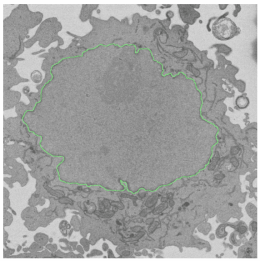
Continuing at the subcellular scale, in Zooniverse project Etch A Cell you can colour in for science! In the first edition of this project, a community of 5,546 volunteers have helped researchers based at the Francis Crick Institute in London study subcellular structures by drawing around the cell nucleus (a task known as ‘segmentation’) and their efforts have already produced some fantastic results which you can read more about here. If you’re in London soon, you can visit The Crick and see Etch A Cell featured in a free exhibition, ‘Craft & Graft: Making Science Happen’, running until 30th November 2019. Read more about the project here or start drawing for science here

Screen Shot 2019-04-09 at 16.37.51A segmented cell nucleus from the Etch A Cell project

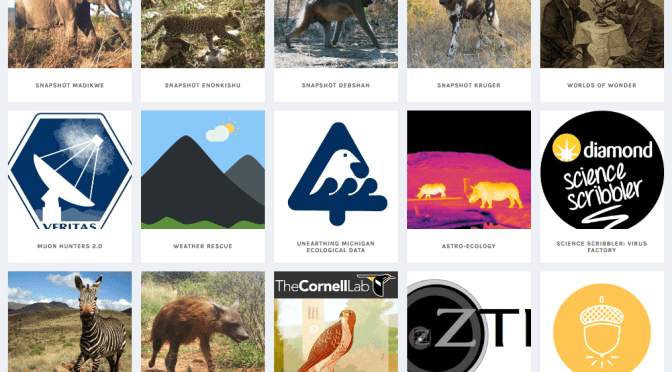
Both of these projects, Etch A Cell and Science Scribbler: Virus Factory, can be found on our Project Page along with all other current Zooniverse projects. We typically launch a new citizen science project each week, so chances are you’ll see a different project each time you visit – if you have a spare five minutes this Citizen Science Day why not take a look, and spend a few of your clicks on citizen science; you never know what you may discover!

Screen Shot 2019-04-09 at 16.35.40

Join us at Earth Fest!

The Zooniverse is going on the road!

To celebrate Earth Day 2019, members of the Zooniverse team will be at two events in Chicago the weekend of April 13 and 14.

First, visit us at the Adler Planetarium’s Earthfest on Saturday, April 13. Participate in a real-life version of our Floating Forests project, pick up some cool Zooniverse swag, and talk to members of the Zooniverse team about their work. The event is free with Adler admission and we’ll be there between 10 am and 4 pm.

If you can’t make it to the Adler, join us at the Chicago Botanic Garden for the Unearth Science Festival on Sunday April 14. There, we’ll be talking about all the fantastic Zooniverse projects you can contribute to online or via our app, as well as taking an in-depth look at the anatomy of flowers via the Rainforest Flowers project.

Hope to meet you there!


Celebrating Citizen Science Day 2019, pt. 1

To celebrate Citizen Science Day 2019, this coming Saturday 13th April, a different member of the Zooniverse team will be posting each day this week to share with you some of our all-time favourite Zooniverse projects. First off in the series is our Digital Humanities Lead, Dr. Samantha Blickhan.

From CitizenScience.org: “Citizen Science Day is an annual event to celebrate and promote all things citizen science: amazing discoveries, incredible volunteers, hardworking practitioners, inspiring projects, and anything else citizen science-related!”

Here at Zooniverse, we’re excited to participate by highlighting a series of projects that we enjoy. I want to kick things off by showing off a current project that does a great job illustrating one of my favorite things about this type of research: its ability to cross typical academic or discipline-specific boundaries.

Screen Shot 2019-04-08 at 1.56.53 PM
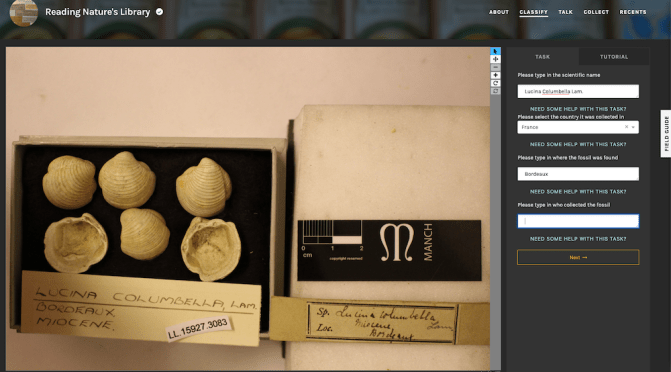
Reading Nature’s Library is a transcription project, launched in February 2018, that was created by a team at Manchester Museum. The project invites volunteers to help transcribe labels for the museum’s collections, which include everything from Archery to Numismatics to Zoology, so this project has something for everyone! In the 13 months since their project launched, a community of 2,669 registered Zooniverse volunteers have completed over 9,283(!) subjects.

Beyond the wide-ranging contents of their dataset, this project is a great way to show how projects can affect a range of disciplines. The results of this project could be used for research in a range of disciplines within the sciences (as varied as their collections), not to mention studies of history, archives, and collections management. Furthermore, large amounts of transcribed text can be a useful tool for helping to train machine learning models for Handwritten Text Recognition.

Today’s project selection also raises a good point about terminology and models for participatory research. Although this week we are celebrating ‘Citizen Science Day’, not all projects fit into the same ‘Citizen Science’ model, and the use of ‘citizen’ is not intended in a narrow, geographic sense. As we celebrate the efforts by project teams and their communities of volunteers, we also want to acknowledge the work being done to illuminate these differences and work to develop models for inclusivity and sustainability. The following article great place to start if you’re interested in learning more:

Eitzel, MV et al. (2017) Citizen Science Terminology Matters: Exploring Key Terms: https://theoryandpractice.citizenscienceassociation.org/articles/10.5334/cstp.96/

Citizen Science Day 2019

To celebrate Citizen Science Day 2019, which is this coming Saturday 13th April, a different member of the Zooniverse team will be posting each day this week to share with you some of our all-time favourite Zooniverse projects. Watch this space!

28 New Planet Candidates Discovered on Exoplanet Explorers

The team behind the Exoplanet Explorers project has just published a Research Note of the American Astronomical Society announcing the discovery of 28 new exoplanet candidates uncovered by Zooniverse volunteers taking part in the project.

Nine of these candidates are most likely rocky planets, with the rest being gaseous. The sizes of these potential exoplanets range from two thirds the size of Earth to twice the size of Neptune!

This figure shows the transit dips for all 28 exoplanet candidates. Zink et al., 2019

You can find out more about these exoplanet candidates in the actual research note at https://iopscience.iop.org/article/10.3847/2515-5172/ab0a02, and in this blog post by the Exoplanet Explorers research team http://www.jonzink.com/blogEE.html.

Finally, both the Exoplanet Explorers and Zooniverse teams would like to extend their deep gratitude to all the volunteers who took part in the project and made these amazing discoveries possible.

Panoptes Client for Python 1.1

I’ve just released version 1.1 of the Panoptes Client for Python. The changelog has a full list of what’s new, but there are a few things I wanted to highlight, the first two of which will make it substantially faster to create new subjects:

  • Multithreaded media uploads – the client will automatically use several threads to upload media when you first save a new subject. So, for example, if you create a subject which has three images they will all upload simultaneously (up to five simultaneous uploads, then it will queue them).
  • Multithreaded subject creation – you can also simultaneously create the subjects themselves. That means if you’re creating, say, a thousand subjects, the client can queue them all and create up to five of them simultaneously. This works in conjunction with the media uploads, using one combined queue for the subject creation and the media uploads, to avoid overloading the network and to make sure the subject creation doesn’t get too far ahead of the uploads. This one isn’t automatic – you’ll need to create your subjects with the new SubjectSet.async_saves() context manager to take advantage of it.
  • Retries for all GET requests – we’re quite proud of how reliable the Zooniverse platform is, but sometimes server-side errors do happen. The client will now automatically retry all GET requests (i.e. the ones that don’t modify any data) if an error occurs, improving reliability.
  • Retries for batch linking operations – similar to above, the client will retry any add/remove operations via the new LinkCollection class, which handles linking groups of objects (i.e. subjects to a subject set, subjects to a collection, etc.). This means you should see far fewer failures when linking thousands of subjects to a subject set, for example.
  • Context manager for multiple connections – the Panoptes class can now act as a context manager, providing a safe way to perform operations as multiple users (for example, in a web app).

You can install the update by running pip install -U panoptes-client. Any bugs or issues should be raised via GitHub.

Exoplanet Explorers Discoveries – A Small Planet in the Habitable Zone

This post is by Adina Feinstein. Adina is a graduate student at the University of Chicago. Her work focuses on detecting and characterizing exoplanets. Adina became involved with the Exoplanet Explorers project through her mentor, Joshua Schlieder, at NASA Goddard through their summer research program.

Let me tell you about the newly discovered system – K2-288 – uncovered by volunteers on Exoplanet Explorers.

K2-288 has two low-mass M dwarf stars: a primary (K2-288A) which is roughly half the size of the Sun and a secondary (K2-288B) which is roughly one-third the size of the Sun. The capital lettering denotes a star in the planet-naming world. Already this system is shaping up to be pretty cool. The one planet in this system, K2-288Bb, hosts the smaller, secondary star. K2-288Bb orbits on a 31.3 day period, which isn’t very long compared to Earth, but this period places the planet in the habitable zone of its host star. The habitable zone is defined as the region where liquid water could exist on the planet’s surface. K2-288Bb has an equilibrium temperature -47°C, colder than the equilibrium temperature of Earth. It is approximately 1.9 times the radius of Earth, which places it in a region of planet radius space where we believe planets transition to volatile-rich sub-Neptunes, rather than being potentially habitable super-Earth. Planets of this size are rare, with only about a handful known to-date.

Artist’s rendering of the K2-288 system.

The story of the discovery of this system is an interesting one. When two of the reaction wheels on the Kepler spacecraft failed, the mission team re-oriented the spacecraft to allow observations to continue to happen. The re-orientation caused slight variations in the shape of the telescope and temperature of the instruments on board. As a consequence, the beginning of each observing campaign experienced extreme systematic errors and initially, when searching for exoplanet transits, we “threw out” or ignored the first days of observing. Then, when we were searching the data by-eye for new planet candidates, we came across this system and only saw 2 transits. In order for follow-up observations to proceed, we need a minimum of 3 transits, so we put this system on the back-burner. The light curve (the amount of light we see from a star over time) with the transits is shown below.

Later, we learned how to model and correct for the systematic errors at the beginning of each observing run and re-processed all of the data. Instead of searching it all by-eye again, as we had done initially, we outsourced it to Exoplanet Explorers and citizen scientists, who identified this system with three transit signals. The volunteers started a discussion thread about this planet because given initial stellar parameters, this planet would be around the same size and temperature as Earth. This caught our attention. As it turns out, there was an additional transit at the beginning of the observing run that we missed when we threw out this data! Makennah Bristow, a fellow intern of mine at NASA Goddard, identified the system again independently. With now three transits and a relatively long orbital period of 31.3 days, we pushed to begin the observational follow-up needed to confirm this planet was real.

First, we obtained spectra, or a unique chemical fingerprint of the star. This allowed us to place better constraints on the parameters of the star, such as mass, radius, temperature, and brightness. While obtaining spectra from the Keck Observatory, we noticed a potential companion star. We conducted adaptive optics observations to see if the companion was bound to the star or a background source. Most stars in the Milky Way are born in pairs, so it was not too surprising that this system was no different. After identifying a fainter companion, we made extra sure the signal was due to a real planet and not the companion; we convinced ourselves this was the case.

Finally, we had to determine which star the planet was orbiting. We obtained an additional transit using the Spitzer spacecraft. Using both the Kepler and Spitzer transits, we derived planet parameters for both when the planet orbits the primary and the secondary. The planet radius derived from both light curves was most consistent when the host star was the secondary. Additionally, we derived the stellar density from the observed planet transit and this better correlated to the smaller secondary star. To round it all off, we calculated the probability of the signal being a false positive (i.e. not a planet signal) when the planet orbits the secondary and it resulted in a false positive probability of roughly 10e-9, which indicates it most likely is a real signal.

The role of citizen scientists in this discovery was critical, which is why some of the key Zooniverse volunteers are included as co-authors on this publication. K2-288 was observed in K2 Campaign 4, which ran from April to September back in 2015. We scientists initially missed this system and it’s likely that even though we learned how to better model and remove spacecraft systematics, it would have taken years for us to go back into older data and find this system. Citizen scientists have shown us that even though there is so much new data coming out, especially with the launch of the Transiting Exoplanet Survey Satellite, the older data is still a treasure trove of new discoveries. Thank you to all of the Exoplanet volunteers who made this discovery possible and continue your great work!

The paper written by the team is available here. It should be open to all very shortly.

Exoplanet Explorers Discoveries – A Sixth Planet in the K2-138 System

This is the first of two guest posts from the Exoplanet Explorers research team announcing two new planets discovered by their Zooniverse volunteers. This post was written by Jessie Christiansen.

Hello citizen scientists! We are here at the 233rd meeting of the American Astronomical Society, the biggest astronomy meeting in the US of the year (around 3000 astronomers, depending on how many attendees are ultimately affected by the government shutdown). I’m excited to share that on Monday morning, we are making a couple of new exoplanet announcements as a result of your work here on Zooniverse, using the Exoplanet Explorers project!

Last year at the same meeting, we announced the discovery of K2-138. This was a system of five small planets around a K star (an orange dwarf star). The planets all have very short orbital periods (from 2.5 to 12.8 days! Recall that in our solar system the shortest period planet is Mercury, with a period of ~88 days) that form an unbroken chain of near-resonances. These resonances offer tantalizing clues as to how this system formed, a question we are still trying to answer for exoplanet systems in general. The resonances also beg the question – how far could the chain continue? This was the longest unbroken chain of near first-order resonances which had been found (by anyone, let alone citizen scientists!).

At the time, we had hints of a sixth planet in the system. In the original data analysed by citizen scientists, there were two anomalous events that could not be accounted for by the five known planets – events that must have been caused by at least one, if not more, additional planets. If they were both due to a single additional planet, then we could predict when the next event caused by that planet would happen – and we did. We were awarded time on the NASA Spitzer Space Telescope at the predicted time, and BOOM. There it was. A third event, shown below, confirming that the two previous events were indeed caused by the same planet, a planet for which we now knew the size and period.

So, without further ado, I’d like to introduce K2-138 g! It is a planet just a little bit smaller than Neptune (which means it is slightly larger than the other five planets in the system, which are all between the size of Earth and Neptune). It has a period of about 42 days, which means it’s pretty warm (400 degrees K) and therefore not habitable. Also, very interestingly, it is not on the resonant chain – it’s significantly further out than the next planet in the chain would be. In fact, it’s far enough out that there is a noticeable gap – a gap that is big enough to hide more planets on the chain. If these planets exist, they don’t seem to be transiting, but that doesn’t mean they couldn’t be detected in other ways, including by measuring the effect of their presence on the other planets that do transit. The planet is being published in a forthcoming paper that will be led by Dr Kevin Hardegree-Ullman, a postdoctoral research fellow at Caltech/IPAC.

In the meantime, astronomers are still studying the previously identified planets, in particular to try to measure their masses. Having tightly packed systems that are near resonance like K2-138 provides a fantastic test-bed for examining all sorts of planet formation and migration theories, so we are excited to see what will come from this amazing system discovered by citizen scientists on Zooniverse in years to come!

We are also announcing a second new exoplanet system discovered by Exoplanet Explorers, but I will let Adina Feinstein, the lead author of that paper, introduce you to that exciting discovery.

Fixed Cross-Site Scripting Vulnerability on Project Page’s External Links

We recently fixed a security vulnerability that existed in the external/social links (e.g. to Twitter) of projects. Prior to this fix, it was possible for project owners to do two things: 1. create external links that ran malicious JavaScript code if they were clicked (e.g. allowing attackers to capture a user’s login session), and 2. create a link to a malicious website disguised as a “legitimate” link to a known Social website (e.g. a Twitter link that actually directed users to the spoof website “twiitteerrer.com”). Our patches fix both issues, and a follow up investigation revealed that there is no indication this vulnerability was exploited by anyone.

The security issue was discovered on 11 Dec 2018 during an internal security check. The first patch in the series (addressing the major JavaScript injection vulnerability) was deployed within 6 hours, and the final patch (addressing the relatively less harmful issue of spoof-able social links) deployed 2 days later.

The fixes for this vulnerability are contained in pull requests #5141, #5142, and #5148 of the Panoptes Front End project on GitHub. Anyone running their own hosted copy of this should pull these changes as soon as possible.

Additional notes on our investigation are as follows:

  • The vulnerability was introduced on 14 May 2015, in pull request 324.
  • Custom links for projects and organisations allowed project builders to cause a user’s browser to execute arbitrary javascript by entering URLs like javascript: alert('oh no'); if the user clicked on that link, the javascript would run.
  • Malicious javascript executed this way could do whatever it wanted on the site, i.e. it could have stolen logged-in users’ API tokens, logged users out and captured their passwords when re-logging in.
  • Theoretically, passwords may have been have been exposed if malicious Javascript captured them on login, though this would only impact users that click malicious links. Emails may have been exposed, notably if an admin user account was breached.
  • However, we audited the database but could find no evidence (other than our own tests) of this having been done by project owners.
  • Our current solution is to sanitise all external/social links – both when taking input from users and when rendering them on webpages – and only allowing standard website URLs to pass.

As a side effect of our fixes, project owners are now unable to add non-standard website URLs to their project’s external links – for example, https://example.com continues to work fine, but mailto:hello@example.com no longer does.

We apologise for any concern this issue may have caused.

Zooniverse Workflow Bug

We recently uncovered a couple of bugs in the Zooniverse code which meant that the wrong question text may have been shown to some volunteers on Zooniverse projects while they were classifying. They were caught and a fix was released the same day on 29th November 2018.

The bugs only affected some projects with multiple live workflows from 6th-12th and 20th-29th November.

One of the bugs was difficult to recreate and relied on a complex timing of events, therefore we think it was rare and probably did not affect a significant fraction of classifications, so it hopefully will not have caused major issues with the general consensus on the data. However, it is not possible for us to say exactly which classifications were affected in the timeframe the bug was active.

We have apologised to the relevant science teams for the issues this may cause with their data analysis, but we would also like to extend our apologies to all volunteers who have taken part in these projects during the time the bugs were in effect. It is of the utmost importance to us that no effort is wasted on our projects and when something like this happens it is taken very seriously by the Zooniverse team. Since we discovered these bugs we worked tirelessly to fix them, and we have taken actions to make sure nothing like this will happen in the future.

We hope that you accept our most sincere apologies and continue the amazing work you do on the Zooniverse. If you have any questions please don’t hesitate to contact us at contact@zooniverse.org.

Sincerely,

The Zooniverse Team

The world's largest and most popular platform for people-powered research. This research is made possible by volunteers—millions of people around the world who come together to assist professional researchers.