Tag Archives: Zooniverse

The Science of Citizen Science: Meetings in San Jose This Week

I and other Galaxy Zoo and Zooniverse scientists are looking forward to the Citizen Science Association (CSA) and American Association for the Advancement of Scientists (AAAS) meetings in San Jose, California this week.

As I mentioned in an earlier post, we’ve organized an AAAS session that is titled, “Citizen Science from the Zooniverse: Cutting-Edge Research with 1 Million Scientists,” which will take place on Friday afternoon. It fits well with the AAAS’s them this year: “Innovations, Information, and Imaging.” Our excellent line-up includes Laura Whyte (Adler) on Zooniverse, Brooke Simmons (Oxford) on Galaxy Zoo, Alexandra Swanson (U. of Minnesota) on Snapshot Serengeti, Kevin Wood (U. of Washington) on Old Weather, Paul Pharoah (Cambridge) on Cell Slider, and Phil Marshall (Stanford) on Space Warps.

And in other recent Zooniverse news, which you may have heard already, citizen scientists from the Milky Way Project examined infrared images from NASA’s Spitzer Space Telescope and found lots of “yellow balls” in our galaxy. It turns out that these are indications of early stages of massive star formation, such that the new stars heat up the dust grains around them. Charles Kerton and Grace Wolf-Chase have published the results in the Astrophysical Journal.

But let’s get back to the AAAS meeting. It looks like many other talks, sessions, and papers presented there involve citizen science too. David Baker (FoldIt) will give plenary lecture on post-evolutionary biology and protein structures on Saturday afternoon. Jennifer Shirk (Cornell), Meg Domroese and others from CSA have a session Sunday morning, in which they will describe ways to utilize citizen science for public engagement. (See also this related session on science communication.) Then in a session Sunday afternoon, people from the European Commission and other institutions will speak about global earth observation systems and citizen scientists tackling urban environmental hazards.

Before all of that, we’re excited to attend the CSA’s pre-conference on Wednesday and Thursday. (See their online program.) Chris Filardi (Director of Pacific Programs, Center for Biodiversity and Conservation, American Museum of Natural History) and Amy Robinson (Executive Director of EyeWire, a game to map the neural circuits of the brain) will give the keynote addresses there. For the rest of the meeting, as with the AAAS, there will be parallel sessions.

The first day of the CSA meeting will include: many sessions on education and learning at multiple levels; sessions on diversity, inclusion, and broadening engagement; a session on defining and measuring engagement, participation, and motivations; a session on CO2 and air quality monitoring; a session on CS in biomedical research;
and sessions on best practices for designing and implementing CS projects, including a talk by Chris Lintott on the Zooniverse and Nicole Gugliucci on CosmoQuest. The second day will bring many more talks and presentations along these and related themes, including one by Julie Feldt about educational interventions in Zooniverse projects and one by Laura Whyte about Chicago Wildlife Watch.

I also just heard that the Commons Lab at the Woodrow Wilson Center is releasing two new reports today, and hardcopies will be available at the CSA meeting. One report is by Muki Haklay (UCL) about “Citizen Science and Policy: A European Perspective” and the other is by Teresa Scassa & Haewon Chung (U. of Ottawa) about “Typology of Citizen Science Projects from an Intellectual Property Perspective.” Look here for more information.

In any case, we’re looking forward to these meetings, and we’ll keep you updated!

We Need Us: Online Art, Powered by the Zooniverse

Screenshot 2014-10-09 12.08.31

The Zooniverse is the subject of a new artwork co-commissioned by the Open Data Institute (ODI) and The Space (a website for artists and audiences around the world to create and explore digital art). We Need Us is a ‘living’ dynamic artwork, powered by your activity on the Zooniverse, driven by the thriving mass of participation across various Zooniverse sites. You can learn more about it at www.thespace.org/weneedus

We Need Us has been created by artist Julie Freeman. She takes anonymised information from your clicks, counting the number of volunteers active on various Zooniverse projects, and classifications that you all create, every minute. She stores this in a new database as sets of values, while also recording the frequency of activity over an hour, a day, and a month. These sets of values create rhythms that are translated into moving shapes, and play different sounds.

The result is a set of living artworks – one for each of 10 Zooniverse projects – and more are on the way! The live data ensures constant change to the visual and sonic composition. The sounds are processed and manipulated just like the data.

Screenshot 2014-10-09 12.08.15

While many researchers have tried to analyse and understand the Zooniverse, We Need Us will be the first time someone has tackled the idea from the perspective of art. The Zooniverse community is an engine of discovery and a force unlike any other. We Need Us highlights its rhythms and patterns, showing how diverse and vibrant Zooniverse citizen scientists really are.

You can run the artwork in your web browser by visiting http://www.weneedus.org

Penguin Watch: Top images so far

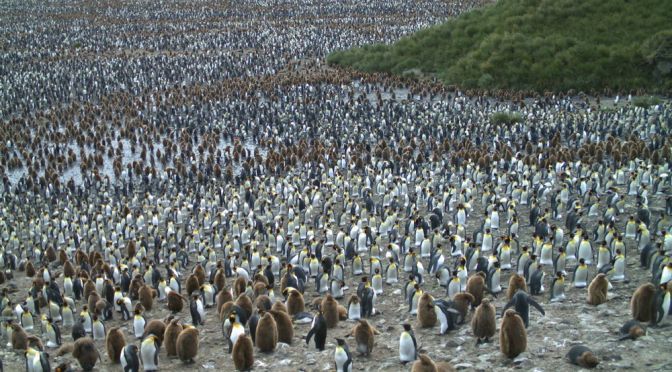
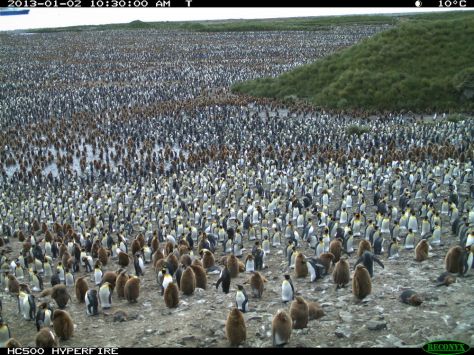
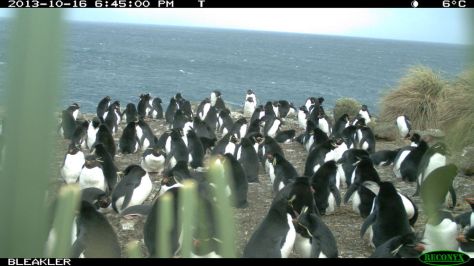
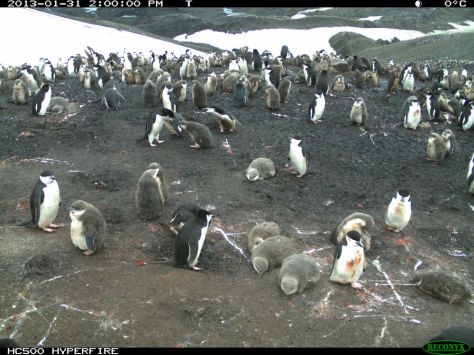
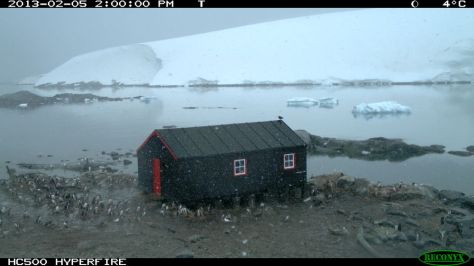
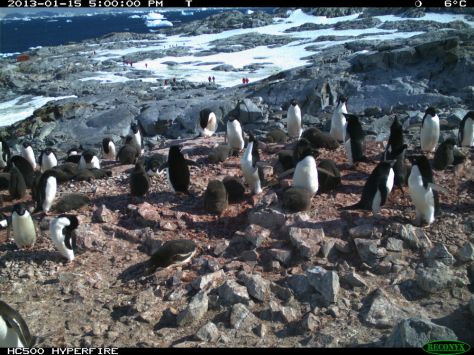
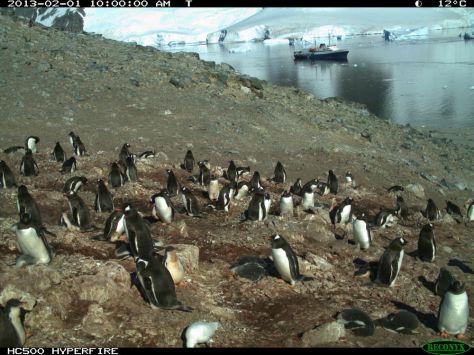
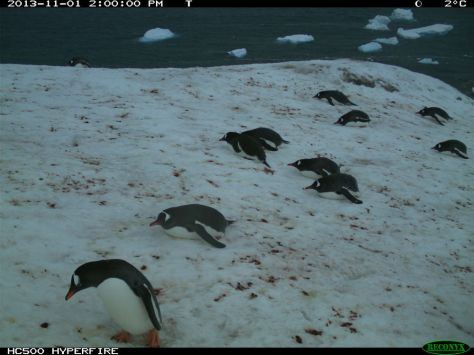
Yesterday we launched our latest project: Penguin Watch. It is already proving to be one of the most popular projects we run, with over one hundred thousand classifications in the first day! The data come from 50 cameras focussed on the nesting areas of penguin colonies around the Southern Ocean. Volunteers are asked to tag adult penguins, chicks, and eggs.

Here are my favourite images uncovered by our volunteers so far: (click on an image to see what people are saying about it on Penguin Watch Talk)

1st Rule of Penguin Watch - You don't have to count them all. But I dare you to!
1st Rule of Penguin Watch – You don’t have to count them all. But I dare you to!


Living on the edge
Living on the edge
Penguins aren't always only black and white...
Penguins are always only black and white…
I think they want in!
Spot the tourists
Spot the tourists
We're saved!
We’re saved!
Coming back from a refreshing afternoon swim


See what amazing pictures you can find right now at www.penguinwatch.org

ZooCon Portsmouth this weekend – remote participation invited!

We’re getting excited in Portsmouth to be welcoming some Zooites to the first ever “ZooCon Portsmouth”, which is happening this Saturday 13th September 2014 (An updated schedule is available on the Eventbrite page for the event).

The theme of this event is a Wiki-a-thon for Citizen Science – we have scheduled a working afternoon and improve the coverage of citizen science on Wikipedia. Mike Peel, Expert Wikimedian and astronomer from the University of Manchester will be joining us to lead this part of the event and get us all up to speed with how editing works.

We invite remote participation of the wiki-a-thon via this discussion thread on Galaxy Zoo Talk, or on Twitter with the hashtag #ZooConPort, and we also plan to livestream the morning talks via Google+.

In person attendees will have a treat in the afternoon – we’re all excited to have Chris Lintott narrate planetarium shows in the Portsmouth Inflatable Astrodome. And we plan to end the day with fish and chips at a pub by the sea. Keep your fingers crossed for nice weather.

AAAS Symposium in Feb. 2015: Cutting-Edge Research with 1 Million Citizen Scientists

Some colleagues and I successfully proposed for a symposium session on citizen science at the annual meeting of the American Association for the Advancement of Science (AAAS) in San Jose, CA in February 2015. (The AAAS is the world’s largest scientific society and is the publisher of the Science journal.) Our session will be titled “Citizen Science from the Zooniverse: Cutting-Edge Research with 1 Million Scientists.” It refers to the more than one million volunteers participating in a variety of citizen science projects. This milestone was reached in February, and the Guardian and other news outlets reported on it.

AAAS-logo

As we all know, the Zooniverse began with Galaxy Zoo, which recently celebrated its seventh anniversary. Galaxy Zoo has been very successful, and it led to the development of a variety of citizen science projects coordinated by the Zooniverse in diverse fields such as biology, zoology, climate science, medicine, and astronomy. Most of you are familiar with many of them, and the projects include, for example: Snapshot Serengeti, where people classify different animals caught in millions of camera trap images; Cell Slider, where they classify images of cancerous and ordinary cells and contribute to cancer research; Old Weather, where participants transcribe weather data from log books of Arctic exploration and research ships at sea between 1850 and 1950, thus contributing to climate model projections; and Whale FM, where they categorize the recorded sounds made by killer and pilot whales. And of course, in addition to Galaxy Zoo, there are numerous astronomy-related projects, such as Disk Detective, Planet Hunters, the Milky Way Project, and Space Warps.

Screen+Shot+2012-12-11+at+2.03.18+PM

We’re confirming the speakers for our AAAS session now, and the plan is to have six speakers from the US and UK who will introduce and present results from the Zooniverse, Galaxy Zoo, Snapshot Serengeti, Old Weather, Cell Slider, and Space Warps. I’m sure it will be exciting and we’re all looking forward to it! I’m also looking forward to the meeting of the Citizen Science Association, which will be a “pre-conference” preceding the AAAS meeting.

New Zooniverse digital humanities job

Here at Zooniverse we’re starting some exciting new work in the humanities!

We’re pleased to announce our new collaboration with Tate Britain, a world-leading institute for art in the modern era, based in London.

Zooniverse and Tate are teaming up to tackle the difficult task of crowd-powered full-text manuscript transcription. This project follows on from the success of projects like Operation War Diary and Old Weather and will no doubt feed into other humanities projects in the future.

The new transcription interface will enable volunteers to read and transcribe the personal papers of modern British artists. Volunteers will encounter letters, notebooks and sketches that reveal artists’ everyday lives, creative practices and the processes by which great works of art were made.

We are seeking a talented front end developer with a passion for art and the humanities to work alongside our humanities specialist and the Zooniverse and Tate teams to deliver the project.

The closing date for applications is 12 noon on 25 July, 2014. For more information and to apply, see here: http://www.jobs.ac.uk/job/AJB887/citizen-science-front-end-developer/


PS: We are also looking for a new web developer to join our team at the Adler Planetarium in Chicago. You can view the job description here.

Call for Proposals

conscicom


The Constructing Scientific Communities project (ConSciCom), part of the AHRC’s ‘Science in Culture’ theme, is inviting proposals for citizen science or citizen humanities projects to be developed as part of the Zooniverse platform.

ConSciCom examines citizen science in the 19th and 21st centuries, contrasting and reflecting on engagement with distributed communities of amateur researchers in both the historical record and in contemporary practice.

Between one and four successful projects will be selected from responses to this call, and will be developed and hosted by the Zooniverse in association with the applications. We hope to include both scientific and historical projects; those writing proposals should review the existing range of Zooniverse projects which include not only classification, but also transcription projects. Please note, however, ConSciCom cannot distribute funds nor support imaging or other digitization in support of the project.

Projects will be selected according to the following criteria:

  1. Merit and usefulness of the data expected to result from the project.
  2. Novelty of the problem; projects which require extending the capability of the Zooniverse platform or serve as case studies for crowdsourcing in new areas or in new ways are welcome.
  3. Alignment with the goals and interests of the Constructing Scientific Communities project. In particular, we wish to encourage projects that:
    1. Have a significant historical dimension, especially in relation to the history of science.
    2. Involve the transcription of text, either in its entirety or for rich metadata.

Note it is anticipated that some, but not necessarily all selected projects, will meet this third criterion; please do submit proposals on other topics.

The deadline for submissions is July 25th 2014. You can submit a proposal by following this link http://conscicom.org/proposals/form/


Helping the California Condor with ‘Condor Watch’

Today we’re launching a new, and hugely important Zooniverse project: Condor Watch. The are only around 200 California Condors living in the wild and they are in serious danger from lead poisoning, which they get by eating carcasses shot with lead bullets. Getting a better idea of how they interact and socialise is crucial to ongoing conservation efforts.

avatar_condors

Using camera traps, ecologists in the US have been observing them in the wild. However the sheer volume of images is now overwhelming. Starting today we need your help to look through the first set of data: 264,000 images of condors eating, socialising, and nesting. Ecologists need everyone’s help to identify the individual birds from their numbered tags. Your efforts on this project will help preserve an endangered species – and we think that’s really special.

Try it now at www.condorwatch.org

Zooniverse Translations Update

Screenshot 2014-02-27 12.15.25

Last week I put out a request for translators and the response has been fantastic! There are now 9 different Zooniverse projects being worked on in more than 11 languages (more are being added every day). Specifically the response from Germany and Spain has been enthusiastic and a team of volunteer translators have now completed work, or nearly completed it, on several projects.

Planet Four is now available in Traditional Chinese. The Milky Way Project, Disk Detective, and Sunspotter are now available in German. Disk Detective and Sunspotter are also available in Spanish.

Sunspotter only launched today – and we’re super excited that it can go live in three languages at once! A big thank goes to volunteer translators Katharina Doll from Munich, Germany; Fernanda Piñeiro from Mar del Plata, Argentina; Eva Bunge from Germany; Maite Alonso from Talavera, Spain;  Jasmin Hau from Fulda, Germany; and user Hanibal94. Thank you so much everyone!

Translations are still underway in many more languages and projects. For example we will soon have Spanish and German Radio Galaxy Zoo, Hungarian Disk Detective and Farsi (Persian) Galaxy Zoo.

Screenshot 2014-02-27 12.18.36

To access different languages in projects – look for the globe icon in the top-right of the site – as shown above. On Galaxy Zoo, projects are listed in he ‘Languages’ menu – though we hope to convert this to the globe icon to bring it inline with other projects.

We hope that these new languages will widen participation in citizen science, and help light up new parts of the globe on our live.zooniverse.org map of classifications.

Screenshot 2014-02-27 12.27.26

If you’re interested in translating one of our projects, please email rob@zooniverse.org with your Zooniverse username, the language you want to translate into, and the project you’d like to translate.

Introducing VOLCROWE – Volunteer and Crowdsourcing Economics

volcrowe

Hi everyone, I’d like to let you know about a cool new project we are involved with. VOLCROWE is a three year research project funded by the Engineering and Physical Sciences Research Council in the UK, bringing together a team of researchers (some of which are already involved with the Zooniverse, like Karen Masters) from the Universities of Portsmouth, Oxford, Manchester and Leeds. The PI of the project Joe Cox says “Broadly speaking, the team wants to understand more about the economics of the Zooniverse, including how and why it works in the way that it does. Our goal is to demonstrate to the community of economics and management scholars the increasingly amazing things that groups of people can achieve when they work together with a little help from technology. We believe that Zooniverse projects represent a specialised form of volunteering, although the existing literature on the economics of altruism hasn’t yet taken into account these new ways in which people can give their time and energy towards not-for-profit endeavours. Working together with Zooniverse volunteers, we intend to demonstrate how the digital economy is making it possible for people from all over the world to come together in vast numbers and make a contribution towards tackling major scientific problems such as understanding the nature of the Universe, climate change and even cancer.

These new forms of volunteering exemplified by the Zooniverse fundamentally alter the voluntary process as it is currently understood. The most obvious change relates to the ways in which people are able to give their time more flexibly and conveniently; such as contributing during their daily commute using a smart phone! It also opens new possibilities for the social and community aspects of volunteering in terms of creating a digitally integrated worldwide network of contributors. It may also be the case that commonly held motivations and associations with volunteering don’t hold or work differently in this context. For example, religious affiliations and memberships may or may not be as prevalent as they are with more traditional or recognised forms of volunteering. With the help of Zooniverse volunteers, the VOLCROWE team are exploring all of these issues (and more) with the view to establishing new economic models of digital volunteering.

To achieve this aim, we are going to be interacting with the Zooniverse community in a number of ways. First, we’ll be conducting a large scale survey to find out more about its contributors (don’t worry – you do not have to take part in the survey or give any personal information if you do not want to!). The survey data will be used to test the extent to which assumptions made by existing models of volunteering apply and, if necessary, to formulate new ones. We’ll also be taking a detailed look at usage statistics from a variety of projects and will test for trends in the patterns of contributions across the million (and counting) registered Zooniverse volunteers. This larger-scale analysis will be supplemented with a number of smaller sessions with groups of volunteers to help develop a more nuanced understanding of people’s relationships with and within the Zooniverse. Finally, we’ll be using our expertise from the economic and management sciences to study the organisation of the Zooniverse team themselves and analyse the ways and channels they use to communicate and to make decisions. In short, with the help of its volunteers, we want to find out what makes the Zooniverse tick!

In the survey analysis, no information will be collected that could be used to identify you personally. The only thing we will ask for is a Zooniverse ID so that we can match up your responses to your actual participation data; this will help us address some of the project’s most important research questions. The smaller group and one-to-one sessions will be less anonymous by their very nature, but participation will be on an entirely voluntary basis and we will only ever use the information we gather in a way in which you’re comfortable. The team would really appreciate your support and cooperation in helping us to better understand the processes and relationships that drive the Zooniverse. If we can achieve our goals, we may even be able to help to make it even better!”

Keep an eye out for VOLCROWE over the coming weeks and months; they’d love you to visit their website and follow them on Twitter.

Grant and the Zooniverse Team