Tag Archives: volunteers

Who translates Zooniverse?

All Zooniverse projects are created in English. But many of them are available in different languages – from Armenian and Chinese to Korean and Hungarian. Here is the latest list of translated projects.

The truth is, everyone can become a translator on Zooniverse! But how do you do that? We talked with some of our amazing volunteers who helped various research teams to translate their projects, and here is what we’ve learned.


Zooniverse translators come from all walks of life

Jiří Podhorecký (@trendspotter) lives in Cesky Krumov, a small beautiful town in the Czech Republic. He works in tourism and spends most of his free time supporting various IT projects focusing on ecology, nature conservation and virtual volunteering. Translating the Zooniverse platform and projects into Czech is one of these projects.

InoSenpai (イノ先輩) is a citizen scientist in her 20s in Japan. She studied astronomy in college, but now has another job. She has translated more than 30 Zooniverse space projects into Japanese and she even created a blog in order to introduce them to the Japanese people.

Aarush Naskar (@Sunray_2013) from India is the youngest translator on Zooniverse! He is an amateur astronomer. Story writing, sky watching, reading and coding are his main interests. 

Jason Richye is an international student from Indonesia. He is 18 years old and is a business major student. His hobbies are playing basketball, listening to music and watching movies, especially action, comedy and horror.

Louis Verhaeghe (@veragon) is a young French electrical technician passionate about astronomy and astrophysics. As an amateur astronomer, he loves immersing himself in the vastness of the universe and gaining a deeper understanding of what surrounds us.  In September 2024, he reached a major milestone: more than 50 projects fully translated into French! 

Aarush Naskar (@Sunray_2013) from India is the youngest Zooniverse translator

They translate to help more people discover Zooniverse

Jiří: “I wish that once in the future the whole Zooniverse was available to people in my language. I think that there is a huge and untapped potential in people of all ages, but especially in young people, to build a positive relationship with the world around us and to contribute to it in some way. Citizen science can be an enjoyable and unencumbered contribution to the community that will eventually process this citizen science into real science.”

イノ先輩: “Since Zooniverse is not well known in Japan, I am currently working as a Japanese translator for a number of projects to create a foundation for Japanese users to participate in Zooniverse without feeling any barriers.”

Aarush: ”I was attending a citizen science seminar hosted by the Kolkata Astronomy Club, which my father is the co-founder of, so naturally, I was also a part of it, when I heard about a boy who translated Einstein@Home: Pulsar Seekers to Bengali, so I decided to translate projects to Hindi. I know both Hindi and Bengali, but I am more comfortable with Hindi in terms of writing. It also motivated me that if I translated projects, more people would be able to do them. I also did it thinking I would know more Hindi words.”

Jason: “I’ve always wanted to be part of a research project and contribute in a meaningful way, even in a small role. When I saw one of the translation projects last winter in 2024, I remember feeling genuinely excited. I thought, “This is something I could actually help with.” So when I had the chance to volunteer, I was happy to be involved. Translating made me feel like I was part of something bigger, helping bridge gaps and support the research in a real, practical way.”

Louis (@veragon): “I have been contributing to the Zooniverse platform for almost nine years now. Initially, between 2017 and 2019, I focused exclusively on classifying images and scientific data. In fact, I have surpassed 12,900 classifications! But in late 2019, as my English improved, I asked myself: why not translate projects into French? This would allow more French speakers to get involved in citizen science and contribute to various research initiatives.

It is an immense source of pride for me to contribute, in my own way, to making science more accessible. It is important for me to translate these projects because science should be open to everyone. Many research projects rely on public participation, but the language barrier can be a major obstacle. By translating these projects, I enable thousands of people who are not fluent in English to contribute to scientific research. And the more participants there are, the more high-quality data researchers can gather. It’s a virtuous cycle!”

Louis Verhaeghe (@veragon) translated more than 50 Zooniverse projects into French

Translation expands your knowledge


Aarush: “It is funny that I make a lot (not that many!) mistakes when writing Hindi in real life but I make only some mistakes while translating.”

Jiří: “Fortunately for me, the process is already quite easy, not least because information technology helps us all to get in touch today. The enriching part is always the beginning, when you need to dig into the philosophy of the project and understand how best to use language to express yourself accurately.”

イノ先輩: “I love astronomy, but it has been difficult to love and have knowledge of all of this entire broad field equally. I have always been interested in the classification of light curves of variable stars and how to read radar observation data of meteors, but I had avoided them because they seemed difficult, but I was able to learn them in one week through translation.

The process of grasping all of that content in one’s own brain, reconstructing it in one’s native language, and outputting it is far more effective than simply reading and learning.”


And it makes you realise that your efforts really matter!

イノ先輩: “It is not only the light side of the researcher that we see when we do translations. Unfortunately, we also encounter projects that have been abandoned due to lack of bearers.

Behind this may be issues such as the reality of researchers being chronically overworked and the instability of their posts. But it is not only the beautiful and exciting top part, but also the glimpse into a part of the research project that makes us realize that we are not customers or students, but co-members of the project.”

Jiří: “Citizen science knows no boundaries! You can be all over the world. And it will give you back a strong sense of meaningful help, usefulness, confidence and joy.”

Jason: “You don’t need to be an expert to make a difference.”

Louis: “Together, we can make science more accessible and understandable for everyone. Every contribution matters, and the more of us there are, the greater our impact!”
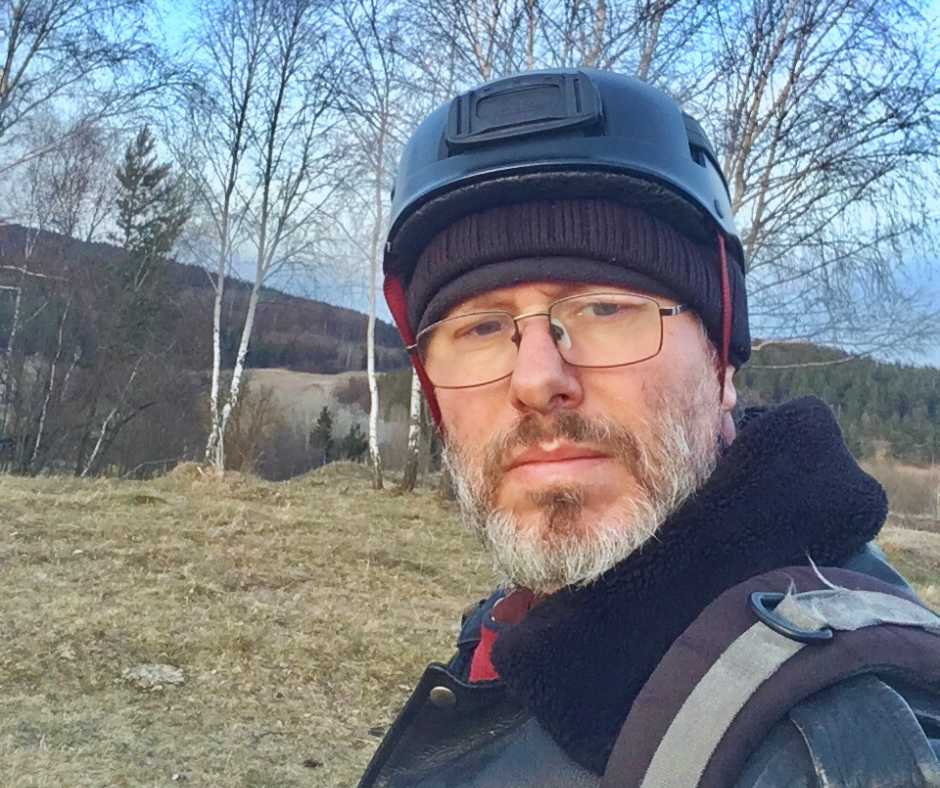
Jiří Podhorecký (@trendspotter) wishes that once in the future the whole Zooniverse was available to people in Czech.

We asked if they had any advice for aspiring translators

Jason: “Take your time, ask questions, and focus on clarity. It’s a fun way to learn and be part of something meaningful.”

イノ先輩: “Add a bit of playfulness to your project title when you rewrite it in your native language! Mix in parodies and phrases that are unique to the respective cultures of each linguistic area, but only to the extent that they do not detract from the essence of the project. The title of the project may be the reason why some people are interested in it.”

Louis: “If you believe you have a good enough understanding of the languages you’re translating, then go for it! Reach out to various projects that haven’t been translated into your language and offer to translate them. Help us make science more accessible to the entire world!”

Jiří: “Your translation will make it easier for people who may know a foreign language, but whose native language is still closest to them. Without it, they would hardly, if ever, know about the Zooniverse. Oddly enough, language and territorial barriers sometimes serve more as a tool to better divide society. Don’t give up and bring foreign ideas, experience and science to people who need to learn about it in their own language.”

It is easy to start!

Louis: “I started my first translations by directly reaching out to project leaders and offering to translate their projects into French. Over time, I learned how to use Zooniverse’s translation tool, which turned out to be quite intuitive. This approach allowed me to better understand the process and refine my working method.”


Are you interested in volunteering as a Zooniverse translator?

Then you should definitely try it! Here is how:

1. Choose the project you would like to translate

2. Send a message to one of the research team members (privately or on their Talk)*

3. They can then assign you the Translator role

4. After that, you can log into the Zooniverse translation interface and start translating!

5. When you are done, let the team know and they will activate your translation to be visible for everyone on Zooniverse!

*An example of a message: “Hello! I’ve enjoyed working on your project (title) and would love to help translate it into (language). Do you think it could be useful? If so, please assign me the Translator role and I will give it a try!”


Are you a researcher looking to set up translations for your project? Please read these instructions. Contact us at contact@zooniverse.org if you need additional support. Please note that the Zooniverse team cannot recommend volunteers translators for your project.

The Critical Role of U.S. Federal Funding in Zooniverse

As the U.S. Congress deliberates on next year’s budget, proposed 50% cuts to agencies like NASA and the National Science Foundation (NSF), and the deeply concerning layoffs at the Institute of Museum and Library Services (IMLS), the National Endowment for the Humanities (NEH), and the National Endowment for the Arts (NEA), jeopardize the work of organizations like Zooniverse that rely on federal funding.

Although Zooniverse is an international collaboration, with core institutional partners in both the U.S. and the UK, this post focuses on the vital role that U.S. federal support has played in enabling our impact. As these funding decisions are made, we wanted to share how essential this support has been to Zooniverse’s impact on research and public engagement. 

Zooniverse welcomes millions of people into the research process each year, lifting the veil on how science works and building bridges between the public and research. Volunteer efforts on Zooniverse have helped discover planets around distant stars, advance our understanding of wildlife populations, preserve human history, and much more.

From the start, federal grants have been a cornerstone of Zooniverse’s ability to innovate and scale. A seed grant from the NSF in 2009 helped us explore the integration of machine learning with participatory science, work that laid the foundation for Zooniverse to become one of the world’s most sophisticated platforms for AI-enhanced crowdsourced research. A grant from IMLS advanced our Digital Humanities efforts, and a follow-on NEH grant enabled us to build critical infrastructure, like our ALICE system, for reviewing and editing transcriptions across humanities projects. Most recently, support from the National Institutes of Health (NIH) enabled a new initiative to render three-dimensional subjects within Zooniverse, expanding the platform’s capabilities to advance biomedical research.

Federal support has also been instrumental in strengthening Zooniverse’s public impacts, from an NSF Improving Undergraduate STEM Education (IUSE) grant that led to the creation of classroom.zooniverse.org to an NSF Advancing Informal STEM Learning (AISL) grant that launched a multi-person Galaxy Zoo touch table exhibit at the Adler Planetarium in Chicago. This hands-on experience reaches tens of thousands of visitors each year and often serves as the first entry point for children and their families into the world of participatory science.

Crucially, these federal grants don’t just fund abstract ideas or technologies, they fund people. Federal support helps pay the salaries of the software engineers, researchers, and participatory science professionals who build and maintain the Zooniverse platform, collaborate with research teams, and support our community of nearly 3 million volunteers. 

Our current NASA grant, for example, enables over two dozen NASA research teams to unlock their datasets through Zooniverse and funds core platform maintenance efforts, an area of support notoriously difficult to secure. Our NASA grant also allowed us to respond directly to community needs through the implementation of new Group Engagement features and student service hours support, among the most requested tools from educators, classrooms, museums, and others using Zooniverse in group settings around the world. 

Today, Zooniverse is part of the core infrastructure of research and scholarship. We partner with more than 150 research institutions and nearly 3 million volunteers worldwide. Our platform is a critical tool in the modern researcher’s toolkit, including in fields relying on human-in-the-loop AI methods to analyze vast datasets. At the same time, we are a trusted platform for public engagement, helping build confidence in science and fostering a sense of shared purpose across disciplines, borders, and backgrounds.

Like many research and public engagement organizations, Zooniverse has deeply benefitted from federal grant support. We felt it was important to share with our communities just how vital this support has been. Much of what we’ve built — our infrastructure, partnerships, and public-facing tools — would not have been possible without it. Continued federal investment remains critical to sustaining and growing this work.

Freshening up the Zooniverse Homepage

The Zooniverse has come a long way since beginning our journey together in 2009 – from the launch of the Project Builder to supporting diverse task types across the disciplines, including transcription, tagging, and marking. This fall, we’re continuing our frontend codebase migration and design evolution with a fresh, modern redesign to some of our main pages – this update focuses on freshening up our homepage.

What’s New?

  • Your Stats: Now, you can more easily track your progress and goals. See all your classification stats on one page and filter by project or time frame.
  • Volunteer Recognition: We heard you! Create personalized volunteer certificates right on the homepage. Perfect for students needing proof of volunteer hours!
  • Group Engagement: Create your group, set up goals and see the impact you’re making together. Great for families, teams, classrooms, or friends working on projects together.
  • Easy Navigation: Click the Zooniverse logo in the upper-left corner of any page to return to your homepage easily.

Read on for more details.

Zooniverse Redesigned Homepage

The zooniverse.org homepage serves a broad audience of new and returning volunteers, educators, and researchers. We believe the homepage should be a central hub where these different audiences can find the tools they need to make their Zooniverse experience satisfying and worthwhile. Now you’ll be able to pick up where you left off classifying, see your stats at a glance, and follow up on your last classifications to add them to a collection, favorite, or comment.

A common request over the years has been better tools for capturing individual and group impact. Thanks to support from NASA, we’ve been working hard to implement improved personal stats and new features that allow you to see the collective impact of your groups – whether you’re a family, a corporate team, a classroom, or simply a group of friends passionate about participating in projects together. We’ve made significant strides in bringing these functionalities to life.

Key features of your new homepage:

Personalized Statistics: We’re making it a little easier to keep track of your progress and goals. Now all of your real-time classification stats can be found on one page and you can filter by project or by a specific time frame. Access detailed information about your contributions, including the number of classifications, projects you’ve worked on, and your impact over time. 

Zooniverse Personal Statistics

A foundational step in this effort was a complete overhaul of our stats infrastructure to ensure greater reliability and stability. Moving forward, zooniverse.org personal stats will pull data exclusively from our updated stats server, reflecting contributions from 2007 onwards.

Volunteer Recognition: Generate personalized volunteer certificates right from your Zooniverse homepage! Customizable to specific time periods and projects. An often requested feature for students fulfilling volunteer service hour requirements. 

Zooniverse Volunteer Certificate

Group Engagement: A new way to create and share group goals and tell the story of your collective impact. Read this blog post for more details. 

Zooniverse Group Engagement Statistics

Streamlined Navigation: Enjoy an easier flow by clicking the Zooniverse logo in the upper-left on any page to return to your homepage.

We value your feedback! We launched the new homepage in September of 2024. If you encounter any difficulties or have questions as you’re using the new homepage, please share them in this Talk thread and mention @support.

Happy New Year & YouTube livestream this Thursday

Happy New Year Everyone! We can’t thank you enough for making Zooniverse possible. Thank you, thank you, thank you!!!!

We have so much to celebrate from 2023. 

  • We welcomed our 2.5 millionth registered participant!
    • To date: 2.6 million registered participants from 190 countries
    • Top countries in 2023: US, UK, Germany, India, Canada, Australia
  • 400 Zooniverse projects publicly launched
    • 40 new projects in 2023 alone; ~90 active projects at any given time
    • Each led by a different research team. Zooniverse partners with hundreds of universities, research institutes, museums, libraries, zoos, NGOs, and more
  • 400 peer-reviewed publications (30 in 2023 alone)
  • 780 million classifications (65 million classifications in 2023 alone)
  • 5 million posts in the Zooniverse ‘Talk’ discussion forums (680K in 2023 alone)
  • 19.5 million hours of participation
    • 1.6 million hours in 2023 alone; equivalent to 780 FTEs

We welcome you to join us this Thursday for a YouTube LiveStream from 2:15pm-3:15pm CST (8:15pm GMT; Friday 1:15am in India) celebrating Zooniverse 2023 Milestones as part of a Press Conference for the American Astronomical Society Meeting happening this week in New Orleans.

Bonus: the Press Conference will include a slew of other astronomy related discoveries, mysteries, and intrigues. Connect via https://www.youtube.com/@AASPressOffice/streams (open to the public). Also, throughout the week we’ll post on https://twitter.com/the_zooniverse (with the hashtag #aas243) about our experiences at the conference. 

Milestones are great to celebrate, but we all know a deep magic is in the everyday moments – catching a penguin chick in the midst of a funny dance on Penguin Watch, hearing a coo that reminds you of your own little loves in Maturity of Baby Sounds, uncovering a lost genealogical clue in Civil War Bluejackets, connecting with someone from the other side of the globe who shares your interests in chimps and their fascinating behaviors through the Talk discussion forums, and more, and more. Wonderful if you’d like to share one of your everyday Zooniverse moments with us by tagging @the_zooniverse on X (formerly Twitter) or sharing via email at contact@zooniverse.org. Hearing your moments helps us better understand how the Zooniverse community creates meaning and impact from these experiences (and what we can do to nurture those moments). 

Wishing you a joyful and gentle 2024. Cheers to new beginnings and continued adventures together. 

Laura
Zooniverse PI, VP Science Engagement, Adler Planetarium in Chicago

Zooniverse Volunteers Discover More New Worlds

The volunteers on our Planet Hunters TESS project have helped discover another planetary system! The new system, HD 152843, consists of two planets that are similar in size to Neptune and Saturn in our own solar system, orbiting around a bright star that is similar to our own Sun. This exciting discovery follows on from our validation of the long-period planet around an evolved (old) star, TOI-813, and from our recent paper outlining the discovery of 90 Planet Hunters TESS planet candidates, which gives us encouragement that there are a lot more exciting systems to be found with your help!

Figure: The data obtained by NASA’s Transiting Exoplanet Survey Satellite which shows two transiting planets. The plot shows the brightness of the star HD 152843 over a period of about a month. The dips appear where the planets passed in front of the star and blocked some of its light from getting to Earth.


Multi-planet systems, like this one, are particularly interesting as they allow us to study how planets form and evolve. This is because the two planets that we have in this system must have necessarily formed out of the same material at the same time, but evolved in different ways resulting in the different planet properties that we now observe.


Even though there are already hundreds of confirmed multi-planet systems, the number of multi-planet systems with stars that are bright enough such that we can study them using ground-based telescopes remains very small. However, the brightness of this new citizen science found system, HD 152843, makes it an ideal target for follow-up observations, allowing us to measure the planet masses and possibly even probe their atmospheric composition.


This discovery was made possibly with the help of tens of thousands of citizen scientists who helped to visually inspect data obtained by NASA’s Transiting Exoplanet Survey Satellite, in the search for distant worlds. We thank all of the citizen scientists taking part in the project who continue to help with the discovery of exciting new planet systems and in particular to Safaa Alhassan, Elisabeth M. L. Baeten, Stewart J. Bean, David M. Bundy, Vitaly Efremov, Richard Ferstenou, Brian L. Goodwin, Michelle Hof, Tony Hoffman, Alexander Hubert, Lily Lau, Sam Lee, David Maetschke, Klaus Peltsch, Cesar Rubio-Alfaro, Gary M. Wilson, the citizen scientists who directly helped with this discovery and who have become co-authors of the discovery paper.


The paper has been published by the Monthly Notices of the Royal Astronomical Society (MNRAS) journal and you can find a version of it on arXiv at: https://arxiv.org/pdf/2106.04603.pdf.

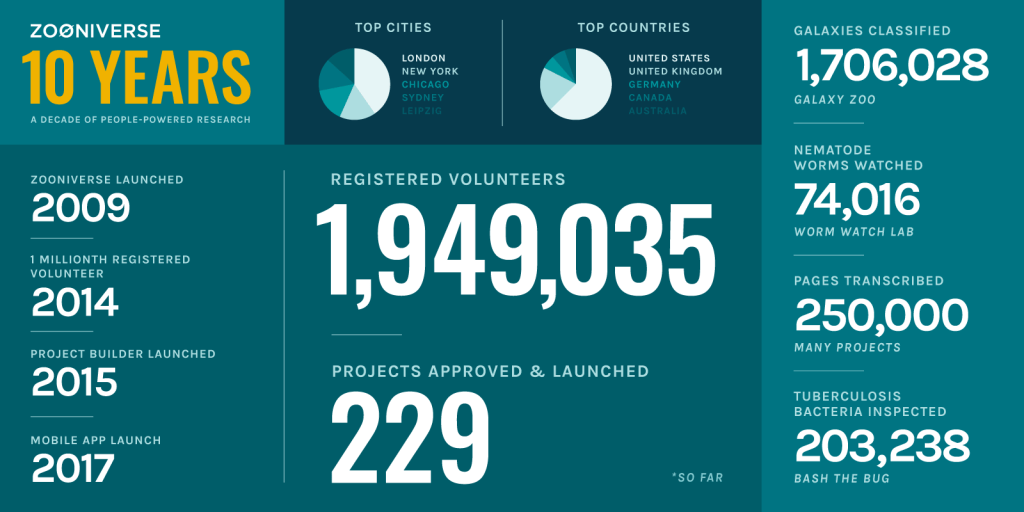
Zooniverse is 10 today!

Zooniverse is ten years old! On 12th December 2009, Zooniverse.org sputtered into life, celebrated with a post on this very blog (https://blog.zooniverse.org/2009/12/12/the-zooniverse-is-go/). Truth be told, there wasn’t a huge amount to show – the only project there was our first, Galaxy Zoo, which had been running for a couple of years by that point. What a contrast to today’s bustling home page, with 229 live projects for you to choose from. Early in 2010 two new projects – Solar Stormwatch and Moon Zoo – were launched, before Old Weather became our first project based here on Earth instead of out in the cosmos.

To celebrate, we’re redoubling our efforts to reach two million volunteers. We’re about 50,000 short, so if every one in twenty of you invites a friend to join in we’ll be there in no time. We have a prize lined up for the lucky two millionth, and anyone who classifies on any project on that auspicious day will go into a draw for some Zooniverse swag.

Birthdays are also time for reflection. To be honest, I was a bit surprised when I realised that we were approaching this milestone birthday. Galaxy Zoo had arrived with a big bang, a sudden explosion of effort, but as the above description suggests Zooniverse grew more slowly, as project after project was added to our nascent platform. Over the years, we rebuilt the codebase (more than once), projects came and went, and the army of Zooniverse volunteers grew in strength and in numbers. Looking back, though, the decision we made to launch Zooniverse set in stone some important principles that still guide us today.

For starters, it meant that we were committed to building a universe of projects which volunteers could move easily between. Projects which were lucky enough to get publicity – featuring on BBC Stargazing Live, for example – thus benefited other projects by bringing new people into the Zooniverse community. We built a shared codebase, so that funding for a particular project could support the development of code that benefited everyone. For most participants, their experience of the Zooniverse is limited to the project they’re participating in, whether it involves penguins, papyri or planets, but these network effects have been hugely important in sustaining such a rich variety of projects for a decade.

We’ve always tried to make it as easy as possible for researchers to build the best projects they can imagine, investing in the project builder tool that now supports all of the projects listed on our homepage. The choice – made early – to present the Zooniverse as a tool that’s free for researchers to use has caused problems; we are almost completely dependent on grant funding, which is a risky way to run a railroad, to say the least. But it has meant that those researchers, often early in their careers, have been able to turn to Zooniverse for help without reservation, and I think we’ve had better results – and more fun – as a consequence. 

There have been so many great moments over the last ten years, but just for a bit of fun here are my top 3 favourites:

  1. First hearing the Solar Stormwatch results were good – realising the method doesn’t just work for Galaxy Zoo.
  2. Climbing up a hill in the Antarctic to retrieve Penguin Watch data.
  3. The morning where we thought Higgs Hunters volunteers had discovered something truly remarkable (sadly it turned out they hadn’t).

So here’s to ten years of the Zooniverse. At any point in the last decade, I’d have been wrong if I’d tried to predict what the next few years would bring. I’m looking forward to more adventures and surprises in our second decade!

Chris

PS I can’t possibly list all of the people who were instrumental in building and guiding the project over the years, but I hope the team will forgive me for mentioning Arfon Smith, my co-founder and the technical genius behind the Zooniverse’s first few years, Lucy Fortson, whose wisdom we’ve relied on from the start, and Lauras Whyte and Trouille who have in turn led the Adler team in Chicago through this mad decade. Special thanks too to the volunteers – all of you – but especially Elisabeth Baeten, Jules Wilkinson, and PMason, whose spirit and generosity is a constant source of wonder and inspiration. 

CELEBRATING CITIZEN SCIENCE DAY 2019, PT. 5

This coming Saturday 13th April is Citizen Science Day, an ‘annual event to celebrate and promote all things citizen science’. Here at the Zooniverse, one of our team members will be posting each day this week to share with you their favourite Zooniverse projects. Today’s post is from Grant Miller, project manager of the Zooniverse team at the University of Oxford.

Having been at the Zooniverse for almost six years and helped over one hundred research teams launch their project on the Zooniverse platform I find it very difficult to choose just one of them as my favourtie. However, unlike Helen did on Tuesday, I’m going to give it a try 😛

For me it’s got to be the very first project that  was pitched to me on my first  day of the job back in 2013 – Penguin Watch! Over the last decade the lead researcher Tom Hart and his team have been travelling to the Southern Ocean and Antarctica to place time-lapse cameras looking at penguin nests. They now collect so many images each year the cannot do their science without the help of the Zooniverse crowd. This projecy perfectly demonstrates the key elements which go into making a truly great citizen science project:

  1. It has a clear and relatable research goal: Help count penguins so we can understand how over-fishing and climate change is affecting their populations, and then use that information to influence policy makers.
  2. It has an extremely simple task that for now can only be done accurate by human eyes: Click on the penguins in the image. It’s so simple we have 4-year-old children helping their parents do it!
  3. It has an amazing and engaged research team and volunteer community: Even though they are a very small team the scientists take plenty of time to communicate with their volunteer community via the Talk area of the project, newsletters, and social  media channels. There is also a fantastic core group of volunteer moderators who put in so much effort to make sure the project is running as well as it should.

Half a million king penguins at St Andrews Bay, South Georgia.

In addition to all of this I was lucky enough to join them on one of their Antarctic expeditions last year, as they went down to maintain their time-lapse cameras and collect the data that goes into Penguin Watch. You can see my video diary (which I’m posting once per day on the run up to World Penguin Day on the 25th April) at daily.zooniverse.org.

Get involved in Penguin Watch today at www.penguinwatch.org.

28 New Planet Candidates Discovered on Exoplanet Explorers

The team behind the Exoplanet Explorers project has just published a Research Note of the American Astronomical Society announcing the discovery of 28 new exoplanet candidates uncovered by Zooniverse volunteers taking part in the project.

Nine of these candidates are most likely rocky planets, with the rest being gaseous. The sizes of these potential exoplanets range from two thirds the size of Earth to twice the size of Neptune!

This figure shows the transit dips for all 28 exoplanet candidates. Zink et al., 2019

You can find out more about these exoplanet candidates in the actual research note at https://iopscience.iop.org/article/10.3847/2515-5172/ab0a02, and in this blog post by the Exoplanet Explorers research team http://www.jonzink.com/blogEE.html.

Finally, both the Exoplanet Explorers and Zooniverse teams would like to extend their deep gratitude to all the volunteers who took part in the project and made these amazing discoveries possible.

Exoplanet Explorers Discoveries – A Small Planet in the Habitable Zone

This post is by Adina Feinstein. Adina is a graduate student at the University of Chicago. Her work focuses on detecting and characterizing exoplanets. Adina became involved with the Exoplanet Explorers project through her mentor, Joshua Schlieder, at NASA Goddard through their summer research program.

Let me tell you about the newly discovered system – K2-288 – uncovered by volunteers on Exoplanet Explorers.

K2-288 has two low-mass M dwarf stars: a primary (K2-288A) which is roughly half the size of the Sun and a secondary (K2-288B) which is roughly one-third the size of the Sun. The capital lettering denotes a star in the planet-naming world. Already this system is shaping up to be pretty cool. The one planet in this system, K2-288Bb, hosts the smaller, secondary star. K2-288Bb orbits on a 31.3 day period, which isn’t very long compared to Earth, but this period places the planet in the habitable zone of its host star. The habitable zone is defined as the region where liquid water could exist on the planet’s surface. K2-288Bb has an equilibrium temperature -47°C, colder than the equilibrium temperature of Earth. It is approximately 1.9 times the radius of Earth, which places it in a region of planet radius space where we believe planets transition to volatile-rich sub-Neptunes, rather than being potentially habitable super-Earth. Planets of this size are rare, with only about a handful known to-date.

Artist’s rendering of the K2-288 system.

The story of the discovery of this system is an interesting one. When two of the reaction wheels on the Kepler spacecraft failed, the mission team re-oriented the spacecraft to allow observations to continue to happen. The re-orientation caused slight variations in the shape of the telescope and temperature of the instruments on board. As a consequence, the beginning of each observing campaign experienced extreme systematic errors and initially, when searching for exoplanet transits, we “threw out” or ignored the first days of observing. Then, when we were searching the data by-eye for new planet candidates, we came across this system and only saw 2 transits. In order for follow-up observations to proceed, we need a minimum of 3 transits, so we put this system on the back-burner. The light curve (the amount of light we see from a star over time) with the transits is shown below.

Later, we learned how to model and correct for the systematic errors at the beginning of each observing run and re-processed all of the data. Instead of searching it all by-eye again, as we had done initially, we outsourced it to Exoplanet Explorers and citizen scientists, who identified this system with three transit signals. The volunteers started a discussion thread about this planet because given initial stellar parameters, this planet would be around the same size and temperature as Earth. This caught our attention. As it turns out, there was an additional transit at the beginning of the observing run that we missed when we threw out this data! Makennah Bristow, a fellow intern of mine at NASA Goddard, identified the system again independently. With now three transits and a relatively long orbital period of 31.3 days, we pushed to begin the observational follow-up needed to confirm this planet was real.

First, we obtained spectra, or a unique chemical fingerprint of the star. This allowed us to place better constraints on the parameters of the star, such as mass, radius, temperature, and brightness. While obtaining spectra from the Keck Observatory, we noticed a potential companion star. We conducted adaptive optics observations to see if the companion was bound to the star or a background source. Most stars in the Milky Way are born in pairs, so it was not too surprising that this system was no different. After identifying a fainter companion, we made extra sure the signal was due to a real planet and not the companion; we convinced ourselves this was the case.

Finally, we had to determine which star the planet was orbiting. We obtained an additional transit using the Spitzer spacecraft. Using both the Kepler and Spitzer transits, we derived planet parameters for both when the planet orbits the primary and the secondary. The planet radius derived from both light curves was most consistent when the host star was the secondary. Additionally, we derived the stellar density from the observed planet transit and this better correlated to the smaller secondary star. To round it all off, we calculated the probability of the signal being a false positive (i.e. not a planet signal) when the planet orbits the secondary and it resulted in a false positive probability of roughly 10e-9, which indicates it most likely is a real signal.

The role of citizen scientists in this discovery was critical, which is why some of the key Zooniverse volunteers are included as co-authors on this publication. K2-288 was observed in K2 Campaign 4, which ran from April to September back in 2015. We scientists initially missed this system and it’s likely that even though we learned how to better model and remove spacecraft systematics, it would have taken years for us to go back into older data and find this system. Citizen scientists have shown us that even though there is so much new data coming out, especially with the launch of the Transiting Exoplanet Survey Satellite, the older data is still a treasure trove of new discoveries. Thank you to all of the Exoplanet volunteers who made this discovery possible and continue your great work!

The paper written by the team is available here. It should be open to all very shortly.

Exoplanet Explorers Discoveries – A Sixth Planet in the K2-138 System

This is the first of two guest posts from the Exoplanet Explorers research team announcing two new planets discovered by their Zooniverse volunteers. This post was written by Jessie Christiansen.

Hello citizen scientists! We are here at the 233rd meeting of the American Astronomical Society, the biggest astronomy meeting in the US of the year (around 3000 astronomers, depending on how many attendees are ultimately affected by the government shutdown). I’m excited to share that on Monday morning, we are making a couple of new exoplanet announcements as a result of your work here on Zooniverse, using the Exoplanet Explorers project!

Last year at the same meeting, we announced the discovery of K2-138. This was a system of five small planets around a K star (an orange dwarf star). The planets all have very short orbital periods (from 2.5 to 12.8 days! Recall that in our solar system the shortest period planet is Mercury, with a period of ~88 days) that form an unbroken chain of near-resonances. These resonances offer tantalizing clues as to how this system formed, a question we are still trying to answer for exoplanet systems in general. The resonances also beg the question – how far could the chain continue? This was the longest unbroken chain of near first-order resonances which had been found (by anyone, let alone citizen scientists!).

At the time, we had hints of a sixth planet in the system. In the original data analysed by citizen scientists, there were two anomalous events that could not be accounted for by the five known planets – events that must have been caused by at least one, if not more, additional planets. If they were both due to a single additional planet, then we could predict when the next event caused by that planet would happen – and we did. We were awarded time on the NASA Spitzer Space Telescope at the predicted time, and BOOM. There it was. A third event, shown below, confirming that the two previous events were indeed caused by the same planet, a planet for which we now knew the size and period.

So, without further ado, I’d like to introduce K2-138 g! It is a planet just a little bit smaller than Neptune (which means it is slightly larger than the other five planets in the system, which are all between the size of Earth and Neptune). It has a period of about 42 days, which means it’s pretty warm (400 degrees K) and therefore not habitable. Also, very interestingly, it is not on the resonant chain – it’s significantly further out than the next planet in the chain would be. In fact, it’s far enough out that there is a noticeable gap – a gap that is big enough to hide more planets on the chain. If these planets exist, they don’t seem to be transiting, but that doesn’t mean they couldn’t be detected in other ways, including by measuring the effect of their presence on the other planets that do transit. The planet is being published in a forthcoming paper that will be led by Dr Kevin Hardegree-Ullman, a postdoctoral research fellow at Caltech/IPAC.

In the meantime, astronomers are still studying the previously identified planets, in particular to try to measure their masses. Having tightly packed systems that are near resonance like K2-138 provides a fantastic test-bed for examining all sorts of planet formation and migration theories, so we are excited to see what will come from this amazing system discovered by citizen scientists on Zooniverse in years to come!

We are also announcing a second new exoplanet system discovered by Exoplanet Explorers, but I will let Adina Feinstein, the lead author of that paper, introduce you to that exciting discovery.