All posts by The Zooniverse

Online citizen science projects. The Zooniverse is doing real science online,.

Demonstrating Citizen Science at Adler Planetarium

Today’s guest post comes from Jesse Feddersen and Rachel Wolf about their experience developing a citizen science themed floor experience at the Adler Planetarium as part of the summer school sponsored by the University of Chicago’s Kavli Institute for Cosmological Physics. 

Jesse Feddersen is a PhD student in the Astronomy department at Yale University. He is especially interested in observational studies of galaxy evolution. He believes scientists have a responsibility to actively engage in public outreach, and it’s fun too! When he’s not doing science or outreach, Jesse enjoys hiking, baking, and singing songs from Frozen. Do you want to build a snowman with him?

It doesn’t have to be a snowman…

Rachel Wolf is a PhD student in the Physics and Astronomy department at the University of Pennsylvania.  Her research focuses on observational cosmology using Type Ia supernovae.  She loves sharing science with the public and is especially passionate about getting kids excited about science! In her spare time, she loves to cook, host game nights, and cheer for her UCLA Bruins!

“I don’t need to help scientists, I’m already a scientist!”

The sentiment of one precocious little girl perfectly reflects our philosophy: everyone can be a scientist, and through Zooniverse and other citizen science projects, contribute to research projects in the fields they find most exciting.

We came to Chicago for a summer school sponsored by the University of Chicago’s Kavli Institute for Cosmological Physics. This two week program was designed for graduate students in astronomy and physics who are interested in education and public outreach and partnered them with teams at the University and Adler Planetarium. We chose to work with the Zooniverse team at Adler.

On our first day at the planetarium, we met with Laura and the citizen science team and situated ourselves in Zooniverse HQ. This felt a little like meeting the Wizard of Oz, or getting a backstage pass to a Queen concert. We soon realized that to planetarium guests, the Zooniverse presence at Adler was confined to a room hidden away in a dark corner at the end of a hallway. There were few exhibits or demonstrations explaining what the Zooniverse is and how to get involved. It seemed like a great starting point for increasing exposure was to create an interactive activity introducing planetarium guests to the Zooniverse.

Early on, we decided to tailor our demonstration to elementary school kids and their families. We spent some time looking through the various Zooniverse projects and thought, “We could teach about galaxy formation!  We could teach about magnetic fields and solar activity! We could look for cute pictures of baby elephants all week!” The more we brainstormed the more we realized why we were so excited. Sure, images of space are mesmerizing and everyone loves baby elephants, but we were also just really curious about these things. As astronomers, it’s our job to be curious and to figure out new things. But science is certainly not limited to people like us – it’s for everyone! That’s when we decided our activity should get at the core of the Zooniverse and demonstrate just how everyone can be a scientist.

We knew we wanted to emphasize key components of citizen science projects, like observation and collaboration, but we weren’t sure how to integrate these ideas into an activity that would attract a sugar-buzzed eight year old. Our hook had to be exciting and offer guests a unique “I’m in a space museum” experience. After much thought, an idea finally hit us: how cool would it be if we had a meteorite small enough for guests to hold?  From there, our activity almost designed itself(even though we had yet to confirm the existence of said meteorite). After discussing our first draft with Laura and Julie and making a few changes, we had a solid outline of what we wanted to do. “Mystery Rocks” was born!

Step 1: Present the guests with a problem. We incorporate the meteorite into the activity by having guests compare it to Earth rocks (found in the flowerbeds outside the planetarium). Our opening line sounds something like, “We have some rocks we know nothing about. Can you help us?”

Step 2: Make some observations. At this point, we offer our rocks to the guests and encourage them to make observations using the tools available (magnifying glass, magnet, etc). After a few minutes, we ask guests to shout out their observations as we write them on a whiteboard for everyone to see.

Step 3: Classify the objects and vote. We then group the rocks based on the observations (e.g. rough v. smooth, heavy v. light, magnetic v. non-magnetic) and have guests vote on the classifications. Our goal was to make this part of the activity tactile.  After rummaging through the supply cabinets of the public programs department, we found some clear plastic graduated cylinders and large, colorful, fuzzy pom-poms that we thought would do the trick. For each classification, we use the pom-poms as our “ballots” and the graduated cylinders as our “ballot boxes” and have each participant cast his or her vote in a different box. After determining the group consensus, we write the classifications of the rocks on the whiteboard.

Step 4: We just did science! Here is our chance to emphasize how everything we just did in the activity is precisely how science works. We then introduce the idea of citizen science and talk about the Zooniverse.

Step 5: Use the voting results to learn about the rocks. Hopefully we still have the group’s attention and can discuss how to use our classifications to learn about the rocks.  We ask the group if they can tell us where the rocks came from and then blow them away with the fact that they are actually holding a rock from space!

Having cobbled together a prototype of our activity, we headed upstairs to try it out with visitors. Our first trial run was in the Planet Explorers area, with a group of kids:

Photo1

 Here’s the initial set-up of “Mystery Rocks” (first image) and a mid-activity shot of the whiteboard full of observations (second image). We tried to write down everything the crowd observed!

We took two big lessons from this first demo. The first was that kids love distractions, and we provided them many by having lots of clutter on the activity cart. The second was that kids love pom-poms and stickers, and having these props helps to keep their interest. Surprisingly for us, most kids were not very impressed when we told them they were holding a meteorite, but were more interested in making observations about the rocks. We would never have come to these realizations ourselves, and we learned just how invaluable it is to actually test an activity, even if it is still rough around the edges.

Using our experience on the floor as a guide, we changed our procedure to make “Mystery Rocks” more effective. We tested the activity with Adler’s Education and Public Programs department, as well as their teen interns. We got some excellent critiques about our hook and how best to communicate concepts of citizen science. We also learned the requirements for floor programs and documented “Mystery Rocks” for future use at Adler and beyond. Keeping all the feedback in mind, we took the floor again, ready to excite planetarium visitors about citizen science!
Untitled

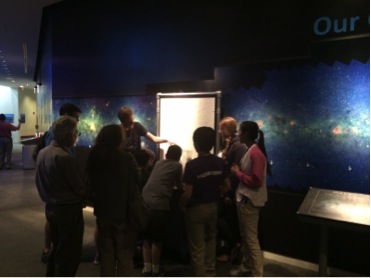
“Mystery Rocks” by the beautiful Milky Way panorama just around the corner from Zooniverse HQ.  This gave us an excellent opportunity to talk about Galaxy Zoo! 

The philosophy of citizen science, and of “Mystery Rocks”, is that everyone can participate in science. Of course, our little visitor already knew this and we’d like to inspire this same enthusiasm in others by showing how everyone can be a part of the scientific community. Our activity not only demonstrates how science works, but also how much learning thrives through teamwork. Many people we interacted with during our time at the planetarium had never thought of themselves as scientists and we hope we changed that! This little girl, however, was clearly excited about a life in science:

Us: “What kind of science do you do?”

Girl: “I’m an inventor! I’m going to invent wings that people can wear, and a way to go to the places you see on TV. […] I’m going to work in a lab!”

Us:  “Well you know, we’re scientists, but we don’t work in a lab.”

Girl: “Well then you can’t be scientists!”

We’ll just have to work on that another time.

We would like to thank Laura and Julie for all of their guidance and support as we developed our activity! We learned so much from you and had such a great team working with the Zooniverse team!


Photo2

Guest Educator Bloggers Wanted

Are you a classroom teacher or informal educator using Zooniverse or other citizen science projects in your teaching practice? We’d love to hear about how you’re doing it and share it with others!  Whether you’re using Seafloor Explorer with third graders, Radio Galaxy Zoo with adult learners, or Operation War Diary in a history museum.

If you’re interested in sharing how you use citizen science to engage students or other audiences on the Zooniverse Education Blog, please email education@zooniverse.org with a brief description of how you’re doing it.

Taiwan Teachers Workshop

Teacher professional development workshops run in conjunction with science meetings offers educators and scientists a unique opportunity to learn from one another.  On Sunday March 2, 2014 the Taiwan Teachers Workshop was held as part of the Citizen Science in Astronomy Workshop  at the Institute of Astronomy and Astrophysics at Academia Sinica in Taipei.  The Citizen Science in Astronomy Workshop brought together astronomers, data scientists, and web developers together to discuss the challenges of working with large datasets and best practices in utilizing the power of citizen science to work with these datasets.  Recognizing an opportunity to bring Zooniverse project scientists together with area educators,  Meg Schwamb, Stuart Lynn, Lauren Huang and Mei-Yin Chou worked with teachers to introduce concepts of citizen science with special focus on Planet Four and Galaxy Zoo.  Earlier this year these two projects were translated into Traditional Chinese as part of  Zooniverse’s push to translate various projects into as many languages as possible through the efforts of our extensive volunteer community.

Image

To add to this translation effort, a number of existing Zooniverse educator resources were also translated into Traditional Chinese including Planet Four & Galaxy Zoo lesson plans and Galaxy Zoo teacher and student guides.  You can find the workshop presentations and links to the translated educational materials at  http://taiwan.zooteach.org/.

 Funding for the Taiwan Teachers Workshop was generously provided by Taiwan’s Ministry of Science and Technology.


Helping the California Condor with ‘Condor Watch’

Today we’re launching a new, and hugely important Zooniverse project: Condor Watch. The are only around 200 California Condors living in the wild and they are in serious danger from lead poisoning, which they get by eating carcasses shot with lead bullets. Getting a better idea of how they interact and socialise is crucial to ongoing conservation efforts.

avatar_condors

Using camera traps, ecologists in the US have been observing them in the wild. However the sheer volume of images is now overwhelming. Starting today we need your help to look through the first set of data: 264,000 images of condors eating, socialising, and nesting. Ecologists need everyone’s help to identify the individual birds from their numbered tags. Your efforts on this project will help preserve an endangered species – and we think that’s really special.

Try it now at www.condorwatch.org…

The Heartbleed Bug and the Zooniverse

On Monday Internet security researches discovered a critical vulnerability in a piece of of software called OpenSSL. The so-called Heartbleed vulnerability affected numerous sites on the Internet that rely on OpenSSL to provide encrypted connections over HTTPS. This bug has been present in the library since March of 2012 and allows malicious users to gain direct access to the memory of a server terminating an HTTPS connection.

We want to let our users know that we were among almost 66% of sites on the Internet vulnerable to this bug, and your data (including your Zooniverse password) might have been compromised due to this exploit. As of now, all our infrastructure has been updated to secure against the Heartbleed vulnerability, and our SSL certificates have been changed.

Unfortunately given the nature of the vulnerability we cannot know what, if anything, may have been obtained, but as a precaution we are recommending that our users change their passwords on the Zooniverse just in case.


Cosmic Curves: Investigating Gravitational Lensing at the Adler Planetarium

Today’s post comes from Kyle Sater, Senior Educator for Public Program Development at the Adler Planetarium. Kyle’s enjoys making STEM fun and relevant for everyone, especially when it involves Star Wars and legos. He lives in Chicago with his wife, who is also an educator, and his lovable cat Boots. 

It’s a funny thing: Einstein was usually right. His General Theory of Relativity predicted that gravitational masses can alter the direction of light, creating strange lensing effects in deep space. In short, light can be bent and we can see those effects—sometimes arcs, sometimes full-on rings, in far-away galaxies.

In 2013, the Adler premiered Cosmic Wonder, full-dome sky that takes guests on a journey to the far reaches of space—to places like enormous galaxy clusters, some which are acting as gravitational lenses because of their gravitational mass (with the help of elusive dark matter). To further the experience for guests after the show, the Public Programs department developed a cart program that attempted to make lensing more…tangible.

As you can imagine, the challenge was taking a relatively abstract concept, like gravitational lensing, and creating a museum program suitable for guests with different background knowledge. At the Adler we engage in “backward design,” meaning we develop 1 or 2 large learning goals and work backwards to find instructional methods that will work on the floor. But we also value inquiry-based exploration and want guests to have fun! So we started with a basic premise, “How can we detect the invisible?” and “How can light be bent?” and create experiments to explore these concepts. In this case, we utilize a quilting frame with taught fabric interwoven with a battery-powered light strand, and placed a heavy object (billiard ball) on the fabric. This helps illustrate that, even if we can’t see an object, its mass “warps” space-time and can bend light. As a follow up, we challenge guests to use a special acrylic lens and a laser to create their own “lensed objects” on the exhibit wall.

Adler Planetarium floor interpretation volunteers ready to engage museum guests with Cosmic Curves.

Our in-house team of facilitators, Mission Specialists, are crucial to the success of floor programs like Cosmic Curves. This program, more than others, requires a comfortability with the content, especially since they’re talking about cutting-edge topics in cosmology. And even then, guests can always surprise you! After all, a 1st grader and a grad student studying physics are coming from vastly different places.

Zooniverse projects, like Space Warps, and apps like GravLens only further the experience for our guests. So get classifying on spacewarps.org or learn more by coming to the Adler!

Thoughts From the Classroom: Kat

Kat is sharing her impressions of Galaxy Zoo and Radio Galaxy Zoo as the fifth post in our Thoughts From the Classroom series.  

My name is Kat and I attend a school called GATE Academy.  Let me tell you a story about my experience with Galaxy Zoo.

Two months ago, my teacher discovered Galaxy Zoo.  She thought it would be a good class activity, so she had us read some articles as background information for what we were about to be doing on Galaxy Zoo.  These articles included information about the different characteristics of the different galaxy types and how this galactic information ties into the evolution of our Universe.  It hadn’t occurred to me before that galaxies tie into the Universe as a whole, but it made sense once I read it and I thought it was fascinating.  Then we started actually classifying galaxies as our class assignment.

In retrospect, I should have been amazed and acknowledged how incredible looking at these far-off galaxies was, but I just didn’t see it at the time.  I overlooked it because my mind was set on it being a class assignment and how I just needed to do it to get a good grade.

When I started, all that came up on my screen were pictures of blobs of clumpy blurry things.  I wasn’t very impressed.  Everyone around me, though, started seeing beautiful, wonderful images of incredible galaxies.

This is when I understood what a privilege it was to be participating in this new, cutting edge, amazing research.  On my screen showed actual galaxies from outer space.  It struck me how little we know about the universe around us, because nobody really knows what’s out there.  We have hypotheses, but, honestly, anything could be out there. I became proud of the blobs I classified, because you really needed to look and observe the characteristics, unlike perfect, sharp, clear galaxies (but these were really quite beautiful).  There was more mystery in the blobs for me, so classifying them correctly (or as close as I could get) became my challenge.

I learned a lot about classifying these galaxies along the way. The Zooniverse taught me about how galaxies can be spiral, irregular, or smooth, with bars, clumps, and varying sizes of central bulges.  I learned about how black holes are visible in radio telescopes but not in infrared.  I also learned the different types of black holes, such as compact, extended, and multiple.

After seven weeks of classifying these galaxies, my classmates and I had classified over 9,000 galaxies.  We were all proud of our accomplishment and of all we had learned along the way. I definitely recommend you at least try classifying on Galaxy Zoo, whether its galaxies or black holes or what have you.  Why not?  Don’t you want to say you’ve had the experience?  Would you like to contribute to our knowledge of the universe, or even do your OWN original research about the wonders around us?  If you have any of those interests, or just want to check it out because it sounds cool (and trust me, it is), definitely go to Galaxy Zoo and start classifying.

Introducing VOLCROWE – Volunteer and Crowdsourcing Economics

volcrowe

Hi everyone, I’d like to let you know about a cool new project we are involved with. VOLCROWE is a three year research project funded by the Engineering and Physical Sciences Research Council in the UK, bringing together a team of researchers (some of which are already involved with the Zooniverse, like Karen Masters) from the Universities of Portsmouth, Oxford, Manchester and Leeds. The PI of the project Joe Cox says “Broadly speaking, the team wants to understand more about the economics of the Zooniverse, including how and why it works in the way that it does. Our goal is to demonstrate to the community of economics and management scholars the increasingly amazing things that groups of people can achieve when they work together with a little help from technology. We believe that Zooniverse projects represent a specialised form of volunteering, although the existing literature on the economics of altruism hasn’t yet taken into account these new ways in which people can give their time and energy towards not-for-profit endeavours. Working together with Zooniverse volunteers, we intend to demonstrate how the digital economy is making it possible for people from all over the world to come together in vast numbers and make a contribution towards tackling major scientific problems such as understanding the nature of the Universe, climate change and even cancer.

These new forms of volunteering exemplified by the Zooniverse fundamentally alter the voluntary process as it is currently understood. The most obvious change relates to the ways in which people are able to give their time more flexibly and conveniently; such as contributing during their daily commute using a smart phone! It also opens new possibilities for the social and community aspects of volunteering in terms of creating a digitally integrated worldwide network of contributors. It may also be the case that commonly held motivations and associations with volunteering don’t hold or work differently in this context. For example, religious affiliations and memberships may or may not be as prevalent as they are with more traditional or recognised forms of volunteering. With the help of Zooniverse volunteers, the VOLCROWE team are exploring all of these issues (and more) with the view to establishing new economic models of digital volunteering.

To achieve this aim, we are going to be interacting with the Zooniverse community in a number of ways. First, we’ll be conducting a large scale survey to find out more about its contributors (don’t worry – you do not have to take part in the survey or give any personal information if you do not want to!). The survey data will be used to test the extent to which assumptions made by existing models of volunteering apply and, if necessary, to formulate new ones. We’ll also be taking a detailed look at usage statistics from a variety of projects and will test for trends in the patterns of contributions across the million (and counting) registered Zooniverse volunteers. This larger-scale analysis will be supplemented with a number of smaller sessions with groups of volunteers to help develop a more nuanced understanding of people’s relationships with and within the Zooniverse. Finally, we’ll be using our expertise from the economic and management sciences to study the organisation of the Zooniverse team themselves and analyse the ways and channels they use to communicate and to make decisions. In short, with the help of its volunteers, we want to find out what makes the Zooniverse tick!

In the survey analysis, no information will be collected that could be used to identify you personally. The only thing we will ask for is a Zooniverse ID so that we can match up your responses to your actual participation data; this will help us address some of the project’s most important research questions. The smaller group and one-to-one sessions will be less anonymous by their very nature, but participation will be on an entirely voluntary basis and we will only ever use the information we gather in a way in which you’re comfortable. The team would really appreciate your support and cooperation in helping us to better understand the processes and relationships that drive the Zooniverse. If we can achieve our goals, we may even be able to help to make it even better!”

Keep an eye out for VOLCROWE over the coming weeks and months; they’d love you to visit their website and follow them on Twitter.

Grant and the Zooniverse Team

Thoughts From the Classroom: Riley & Harrison

This fourth post in our Thoughts From the Classroom series comes from Riley and Harrision.  Riley and Harrison are 8th grade students at Gate Academy and are both Galaxy Zoo volunteers.

Riley:

Galaxy Zoo is a great program. It was brought to my attention when we began using Galaxy Zoo in class. It was extremely interesting because I had never seen pictures of our universe like the ones I am able to see on Galaxy Zoo. On one picture, we found an amazing spiral galaxy with such a huge level of clarity, you could even see individual stars. It just blew me away.

Galaxy Zoo is enlightening about the true scale and beauty of our universe. In the background of these immense galaxies you can see dozens of smaller galaxies, which are really just as huge as the one you’re getting a close up of. How cool is that? The structures are so massive but detailed down to the tiniest level, as demonstrated on Earth. I think that everyone should give themselves a chance to appreciate our Universe.

Galaxy Zoo really provided me with food for thought, and I recommend it strongly to anyone with the vaguest curiosity about what’s up there.

Harrison

I’m Harrison, and I used Galaxy Zoo in my middle school class. We instantly loved it because, it’s the perfect combination of learning about the different types of galaxies and having fun while doing it.  Using Galaxy Zoo also gives you a feeling of helping scientific research, by helping progress our scientific understanding of the Universe. The website is user friendly allowing you to classify galaxies, check your personal account, and see other information with a click of a button. The website is interactive and awesome showing you breath-taking pictures that you get to classify. There is so much to do and you can easily be lost for hours. I would recommend Galaxy Zoo to anyone.

Snapshot Serengeti Brings Authentic Research into Undergraduate Courses

Today’s post comes from Annika Moe. Annika is a post-doctoral fellow in the College of Biological Sciences at the University of Minnesota and has a background in Ecology, Evolution and Behavior. She is currently working to incorporate authentic research experiences into courses for non-biology majors and incorporate learning technologies into the classroom.

 ‘What is that?” My officemate crossed the room and squinted at the image on my computer.

“Tawny-colored herbivore?” I tilted my head and considered a new angle of the extreme close-up photo before me. “Lion?”

“Mmm… wishful thinking…”

“I’m calling it a Hartebeest. They seem to always be standing around under trees.  This camera’s probably fixed to a tree” and I clicked on the “Next capture” button.

“Trotsky!” we both sang out as we watched a lone warthog plod half-ways across the screen.  We had decided it was an appropriate name for the jolly looking animal that kept appearing at a number of different camera sites. Next capture.

This went on for a couple hours as I familiarized myself with Zooniverse’s Snapshot Serengeti project.  I couldn’t stop pressing that button… Next capture… Next capture…  It was addicting.  Something about this experience was transporting me across the world and tapping into a child-like sense of wonder that I hadn’t felt in a long while.

Snapshot Serengeti was a perfect fit for what I wanted to accomplish.

“Incorporate an authentic research experience into a laboratory course for non-biology majors.”  This was the charge I was given when I arrived at the University of Minnesota in the fall of 2012.  With funding from the Howard Hughes Medical Institute, the College of Biological Sciences had hired a group of post docs to tackle this challenge across a number of the “non-major” courses offered by the Biology Program.

With a degree in ecology and evolution, I made a beeline for BIOLOGY 1001: Ecological and Evolutionary Perspectives.  What fun! Working with my favorite student demographic (non-biology majors) on my favorite subjects!

It would be a great challenge.  This may be the only biology class these students take during their college education.  Many may believe that they have no interest in or talent for science. They could be future engineers, business leaders, teachers, politicians, computer scientists, comedians, or journalists. What do we want these students to take away from their one biology class? What is an authentic research experience, and can students authentically experience science in such a short time?

 I had recently read a paper by a group from Stanford University [1] that gave a number of suggestions for successfully integrating faculty research into undergraduate biology education. Snapshot Serengeti met some of the more challenging suggestions.

  1. Low barrier of technical expertise for students to collect data Check.  Snapshot Serengeti has an intuitive user-interface and tutorial tools. Students can learn to collect data with little to no instruction.
  2.  Established checks and balances for student-collected data Check. Snapshot Serengeti has a data quality control system of multiple identifications and ID confirmation through consensus.
  3. Diverse, but constrained set of variables for developing hypotheses Check.  The data collected by the Snapshot Serengeti project consists of a manageable number of variables and metadata associated with camera locations.  The nature of the data generally directs investigations toward asking questions about distribution patterns over time and space.
  4. Central database accessible to all students Check.  The researchers behind the Snapshot Serengeti project are led by Dr. Craig Packer, professor of Ecology, Evolution and Behavior and instructor of BIOL 1001 at the University of Minnesota.  The current quality-checked data set from Snapshot Serengeti is readily available to our students.

And so I prepared a six-week laboratory module in which students used the Snapshot Serengeti project to make observations and collect data, generate testable questions and investigate those questions using the combined data from all Snapshot Serengeti participants.  While it is impossible to experience all aspects of scientific research in six weeks, the module uses exploratory research and observational study to highlight a few key pieces of the process.

 The first two weeks are spent exploring, observing and wondering about Serengeti wildlife. Students read and discuss scientific papers on Serengeti ecology.  They learn about trophic dynamics and interactions through building a Serengeti food web.  Students spend time using the Snapshot Serengeti website and practice generating observations and questions from both individual photos and sets of photos across space and time.  From this pool of experiences, students draw on their own intellectual curiosity and understanding to form their research questions.

The third week introduces the students to the Snapshot Serengeti database.  Students are given instruction on how to use the data filter and graphing functions in the statistical program Jmp.  They are given time to explore the data and computer program to try and address a few testable questions given to them at the start of the lab session.  Students compare different data visualization methods and discuss their relative utility in displaying different types of data.

During the fourth and fifth weeks, students work in groups to investigate a set of their own questions, organized around a theme in Serengeti ecology.  Groups are let loose with the database and Jmp program to investigate their questions and prepare a presentation of their findings. During these two weeks, Students experience the challenge that researchers face in identifying the data that truly addresses their questions and organizing the data to test their ideas.

In the final week, groups present their research to the class and reflect on what they’ve learned about the nature of science and the research process.

During Fall of 2013, we piloted this module in 3 lab sections involving 59 students. I had no idea what the students would take away from the six weeks of working with the Snapshot Serengeti project.  The assignments were open-ended and students largely left to figure out how to address their questions without explicit instruction. I expected that they would be confused, frustrated and perhaps even angry.  I was afraid that working with a giant spreadsheet of numbers would bore them.  I was hoping for something great, but prepared for a disaster.

I was shocked by what I saw during the pilot of the module. Students were huddled over their computers for the entire two hours of each lab period, working furiously to find patterns in their data.  They were on task, engaged and asking questions.

I was even more amazed when I asked what they had learned from their experience.

They recognized the creative nature of science:

“Being a design student, art has always been a stronger subject than science [for me]. With this lab I realized the two are very similar.  The process of discovery is the same and even science takes creativity.”

-Architecture

“I did not realize how much trial and error [is involved] because the usual labs… had instructions for how to do them properly.  This time I was creating the process.”

-English

 They recognized the difference between logical thought and empirical evidence:

 “I learned that most of the time your common sense thoughts are not backed up strongly by research.”

-Political Science and Philosophy

 “[I learned] that failing to find what you were looking for is still a result and happens often in science. “

-Finance

They experienced the scientific method as more than a blind march through a series of steps:

“I learned it’s not as linear a process as I thought it was.  Hypotheses and conclusions change alongside the discovery of new data; it’s a fluid process.”

 -Journalism

They recognized that the direction of research is driven by questions:

“I knew that it was really important to continually ask questions but I did not realize how integrated it was to the process or how naturally more questions appear.”

-Undeclared

Reflecting back on some of my initial questions about what makes a research experience “authentic”, the answer really isn’t that complicated.  Scientists have the freedom pursue the questions that interest them and the freedom to follow where those questions lead. Give students the tools to ask and investigate questions, then give them the freedom to be a scientist.

Zooniverse and Snapshot Serengeti offer an amazing exploratory platform from which to awaken curiosity and dive into the scientific process.

 “Try to find out something interesting. Interest is the best motivation.”

-Actuarial math and accounting student

[1] Kloser, M.J. et al. 2011. Integrating Teaching and Research in Undergraduate Biology Laboratory Education. PLoS Biology. Vol 9:11. e1001174.