This post was written by Hillary Burgess and Sam Blickhan.
In June 2025, we announced an initiative to develop a set of recommendations for running AI/ML-engaged projects on the Zooniverse platform. After a year of collaboration and discussion with volunteers, experts in ethics, communications, AI, and participatory research, as well as Zooniverse project leads (noting that these groups are not mutually exclusive!), we are excited to finally share the results of this work.
Today, we launch the first-ever Zooniverse AI Ethics Framework, composed of Key Principles, internal actions taken by Zooniverse, and Recommendations for Project Teams that will guide the use of AI/ML on the platform going forward. This is a living Framework, and we are committed to improving and iterating as we receive feedback and the technological, social, and cultural context continue to evolve. This new page also includes information about AI/ML on Zooniverse, FAQs, and resources to learn more. You can find the new page at https://www.zooniverse.org/about/ai-ethics.
So, how did we get here?
Over the past 15 years, machine learning has been integrated into a wide range of Zooniverse projects—now nearly ⅓. As ML technologies have matured, public awareness of their existence has grown. Even though Zooniverse projects have incorporated ML techniques for years, the rise of ‘generative AI’ along with blanket adoption of ‘AI’ terminology has led to a range of public opinion about this technology, including within the Zooniverse community. Based on volunteer feedback received via email and Talk posts, we realized we needed greater transparency regarding their usage on our platform, and a set of shared expectations between project teams and volunteers around what it means to incorporate AI or ML into a Zooniverse project.
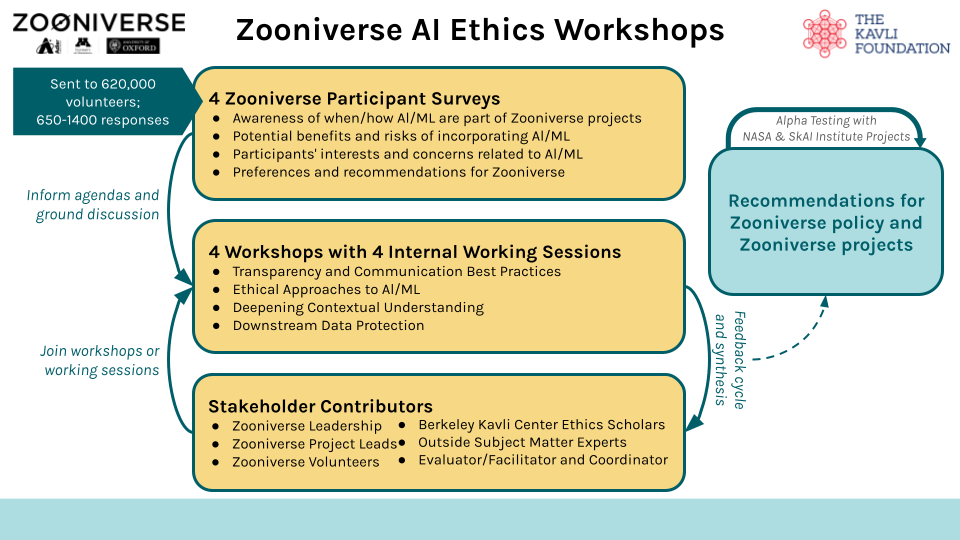
With support from the Kavli Foundation, in the second half of 2025 we held 4 virtual workshops and follow-on working sessions that brought together small groups of experts in participatory research, ethics, communications, Zooniverse leadership, and platform volunteers. Before each workshop, we sent surveys to the entire Zooniverse email list to ask project volunteers about:
- Awareness of when and how AI/ML are part of Zooniverse projects
- Potential benefits and risks of incorporating AI/ML
- Interests and concerns related to AI/ML
- Preferences and recommendations for how Zooniverse should proceed
These survey responses were not a qualitative research study on volunteer opinions about AI/ML, but were intended as a way to frame each discussion around community perspectives. The survey responses helped us to establish the discussion topics and agenda for each of the 4 virtual workshops, to ensure that broader community perspectives were represented, even though we were limited in the number of workshop participants.
Here are some of the key takeaways from these surveys and workshops:
The first workshop focused on Transparency and Communication Best Practices. The related survey had over 1,000 responses. Through those responses we learned that members of the Zooniverse community 1) have varied feelings about AI and ML, and 2) hold varying amounts of knowledge about what AI and ML are, how these technologies work, and their relationship to Zooniverse. These insights led us to realize the importance of providing information consistently, and in multiple ways/locations; as well as the importance of participants being able to choose whether or not to take part in projects with AI/ML components. This phase of our work also introduced the idea that AI and ML are terms that encompass many different technologies and practices. In turn, many people suggested that Zooniverse adopt specific language and definitions. In response, we developed the 5 W’s approach to talking about AI/ML-engaged projects, which shares 5 key questions that all project teams incorporating AI/ML into their projects should be prepared to answer. Finally, these responses enabled us to contemplate the extent that Zooniverse could or should be a place of learning about these emerging technologies—an idea that sparked the way we’re asking project teams to describe their use of AI/ML, along with the creation of the Framework page and its accompanying resources
The second workshop covered the broad topic of Ethical Approaches to AI. The related survey (which had over 1,400 responses!) indicated that our community’s primary concern around AI/ML on Zooniverse was the potential negative impact on data quality. Other topics identified included environmental impacts and privacy rights. A recurrent theme was that not all AI/ML is the same (e.g. an algorithm versus generative AI), and so we should be sure to consider how different methods and uses might come with different risks and benefits. Most people felt conservatively about project volunteers using AI to assist with completing tasks, either thinking it is never appropriate or only appropriate for very specific tasks. Very few people reported having used AI to complete tasks while classifying on Zooniverse projects. The survey responses helped to remind the workshop participants that recommendations should reflect a wide range of potential AI/ML use, including by project volunteers (not just by research teams).
The third workshop dug deeper into Contextual Understanding, i.e. the ways that risks and benefits of AI/ML can shift depending on the methods used, the goals of the research, the project’s subject matter, the tasks that participants complete, and other factors. In short, we tried to figure out the ways that context matters. The preceding survey had over 1,300 responses, and the questions focused on topics like whether current AI/ML information on Zooniverse is accessible/understandable, where participants learn about these technologies, and their opinions about participating in projects that incorporate AI/ML. We wanted to better understand what might motivate or demotivate participation. The survey responses reinforced the fact that Zooniverse participants hold very diverse opinions and ideas about AI/ML, ranging from excitement to outright mistrust and that, above all, we needed to build not only transparency but also choice into our recommendations.
The fourth and final workshop focused on Downstream Data Protection, or what happens with data after a project closes, and what kind of impact AI/ML might have on current platform practices of making data open, or even open data policies in the broader research community. One benefit of open data is the potential for reuse, which is generally considered a positive attribute of a dataset, yet we heard concerns from the community around the new scale at which data can be retrieved and pulled into privatized AI/ML models. Both the pre-workshop survey (which received 635 responses) and the workshop itself explored the tradeoffs between the principles of open data—optimize for transparency, reuse, innovation, and data protection—with the goal to reduce the risk of future undesired uses. If given the binary choice between open or closed data, most survey respondents said they would err toward openness, which reflects current Zooniverse policy. In the workshop discussions, we explored options like data licensing and preference signaling, that are intended to maintain the benefits of open data while minimizing at least some potential negative outcomes. However, we ultimately recognized that this topic is a complex and active area of development that extends far beyond Zooniverse. It touches on issues of intellectual property, privacy, and even the long term sustainability of creative and research content creation as we know it. Our community may benefit from innovations and regulations still on the horizon, but in the meantime we have elected not to change our current policies and recognize the need for more conversation to take place around this topic.
After the workshops and working sessions, we took all of the input generated through the discussions and surveys and developed the first draft of the framework and recommendations. We shared the drafts back with workshop participants and alpha tested them with several project teams, including the Clump Scout II and Dark Energy Explorers projects. As we talked through the recommendations with these teams, they were able to update their projects (in particular the About pages), but also helped us uncover gaps, areas that needed clarification, and potential next steps.
Over the next year, we’ll continue the internal actions taken by Zooniverse by refining our project review process based on the recommendations for project teams, and iterating based on any feedback we receive during the process. Our leadership team will evaluate feedback from our community, and will update the framework on an annual basis.
We hope you’ll take the time to read through the Framework and accompanying resources. If you have any feedback, we encourage you to share it with us via contact@zooniverse.org.

