
Tag Archives: AI

A New AI Ethics Framework for Zooniverse

This post was written by Hillary Burgess and Sam Blickhan.

In June 2025, we announced an initiative to develop a set of recommendations for running AI/ML-engaged projects on the Zooniverse platform. After a year of collaboration and discussion with volunteers, experts in ethics, communications, AI, and participatory research, as well as Zooniverse project leads (noting that these groups are not mutually exclusive!), we are excited to finally share the results of this work.

Today, we launch the first-ever Zooniverse AI Ethics Framework, composed of Key Principles, internal actions taken by Zooniverse, and Recommendations for Project Teams that will guide the use of AI/ML on the platform going forward. This is a living Framework, and we are committed to improving and iterating as we receive feedback and the technological, social, and cultural context continue to evolve. This new page also includes information about AI/ML on Zooniverse, FAQs, and resources to learn more. You can find the new page at https://www.zooniverse.org/about/ai-ethics.

So, how did we get here?

Over the past 15 years, machine learning has been integrated into a wide range of Zooniverse projects—now nearly ⅓. As ML technologies have matured, public awareness of their existence has grown. Even though Zooniverse projects have incorporated ML techniques for years, the rise of ‘generative AI’ along with blanket adoption of ‘AI’ terminology has led to a range of public opinion about this technology, including within the Zooniverse community. Based on volunteer feedback received via email and Talk posts, we realized we needed greater transparency regarding their usage on our platform, and a set of shared expectations between project teams and volunteers around what it means to incorporate AI or ML into a Zooniverse project.

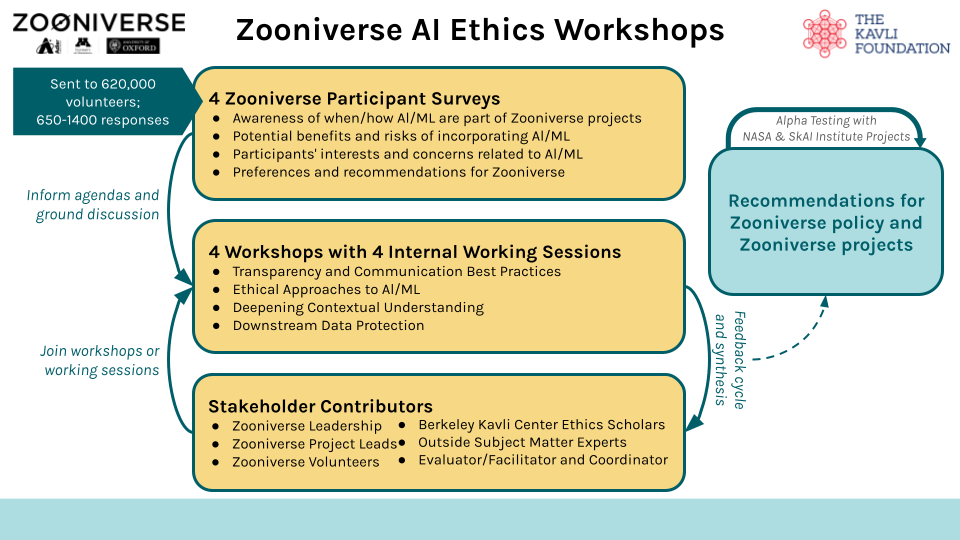
With support from the Kavli Foundation, in the second half of 2025 we held 4 virtual workshops and follow-on working sessions that brought together small groups of experts in participatory research, ethics, communications, Zooniverse leadership, and platform volunteers. Before each workshop, we sent surveys to the entire Zooniverse email list to ask project volunteers about:

  • Awareness of when and how AI/ML are part of Zooniverse projects
  • Potential benefits and risks of incorporating AI/ML
  • Interests and concerns related to AI/ML
  • Preferences and recommendations for how Zooniverse should proceed

These survey responses were not a qualitative research study on volunteer opinions about AI/ML, but were intended as a way to frame each discussion around community perspectives. The survey responses helped us to establish the discussion topics and agenda for each of the 4 virtual workshops, to ensure that broader community perspectives were represented, even though we were limited in the number of workshop participants.

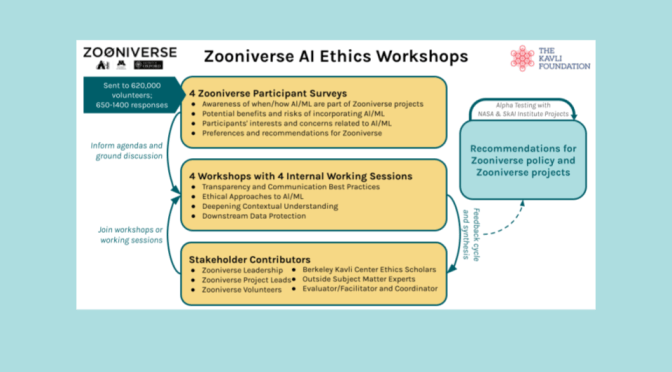
A flow chart describing the process of gathering information in our Kavli AI Ethics project (image design by Hayley Roberts).

Here are some of the key takeaways from these surveys and workshops:

The first workshop focused on Transparency and Communication Best Practices. The related survey had over 1,000 responses. Through those responses we learned that members of the Zooniverse community 1) have varied feelings about AI and ML, and 2) hold varying amounts of knowledge about what AI and ML are, how these technologies work, and their relationship to Zooniverse. These insights led us to realize the importance of providing information consistently, and in multiple ways/locations; as well as the importance of participants being able to choose whether or not to take part in  projects with AI/ML components. This phase of our work also introduced the idea that AI and ML are terms that encompass many different technologies and practices. In turn, many people suggested that Zooniverse adopt specific language and definitions. In response, we developed the 5 W’s approach to talking about AI/ML-engaged projects, which shares 5 key questions that all project teams incorporating AI/ML into their projects should be prepared to answer. Finally, these responses enabled us to contemplate the extent that Zooniverse could or should be a place of learning about these emerging technologies—an idea that sparked the way we’re asking project teams to describe their use of AI/ML, along with the creation of the Framework page and its accompanying resources

The second workshop covered the broad topic of Ethical Approaches to AI. The related survey (which had over 1,400 responses!) indicated that our community’s primary concern around AI/ML on Zooniverse was the potential negative impact on data quality. Other topics identified included environmental impacts and privacy rights. A recurrent theme was that not all AI/ML is the same (e.g. an algorithm versus generative AI), and so we should be sure to consider how different methods and uses might come with different risks and benefits. Most people felt conservatively about project volunteers using AI to assist with completing tasks, either thinking it is never appropriate or only appropriate for very specific tasks. Very few people reported having used AI to complete tasks while classifying on Zooniverse projects. The survey responses helped to remind the workshop participants that recommendations should reflect a wide range of potential AI/ML use, including by project volunteers (not just by research teams).

The third workshop dug deeper into Contextual Understanding, i.e. the ways that risks and benefits of AI/ML can shift depending on the methods used, the goals of the research, the project’s subject matter, the tasks that participants complete, and other factors. In short, we tried to figure out the ways that context matters. The preceding survey had over 1,300 responses, and the questions focused on topics like whether current AI/ML information on Zooniverse is accessible/understandable, where participants learn about these technologies, and their opinions about participating in projects that incorporate AI/ML. We wanted to better understand what might motivate or demotivate participation. The survey responses reinforced the fact that Zooniverse participants hold very diverse opinions and ideas about AI/ML, ranging from excitement to outright mistrust and that, above all, we needed to build not only transparency but also choice into our recommendations.

The fourth and final workshop focused on Downstream Data Protection, or what happens with data after a project closes, and what kind of impact AI/ML might have on current platform practices of making data open, or even open data policies in the broader research community. One benefit of open data is the potential for reuse, which is generally considered a positive attribute of a dataset, yet we heard concerns from the community around the new scale at which data can be retrieved and pulled into privatized AI/ML models. Both the pre-workshop survey (which received 635 responses) and the workshop itself explored the tradeoffs between the principles of open data—optimize for transparency, reuse, innovation, and data protection—with the goal to reduce the risk of future undesired uses. If given the binary choice between open or closed data, most survey respondents said they would err toward openness, which reflects current Zooniverse policy. In the workshop discussions, we explored options like data licensing and preference signaling, that are intended to maintain the benefits of open data while minimizing at least some potential negative outcomes. However, we ultimately recognized that this topic is a complex and active area of development that extends far beyond Zooniverse. It touches on issues of intellectual property, privacy, and even the long term sustainability of creative and research content creation as we know it. Our community may benefit from innovations and regulations still on the horizon, but in the meantime we have elected not to change our current policies and recognize the need for more conversation to take place around this topic.

After the workshops and working sessions, we took all of the input generated through the discussions and surveys and developed the first draft of the framework and recommendations. We shared the drafts back with workshop participants and alpha tested them with several project teams, including the Clump Scout II and Dark Energy Explorers projects. As we talked through the recommendations with these teams, they were able to update their projects (in particular the About pages), but also helped us uncover gaps, areas that needed clarification, and potential next steps.

Over the next year, we’ll continue the internal actions taken by Zooniverse by refining our project review process based on the recommendations for project teams, and iterating based on any feedback we receive during the process. Our leadership team will evaluate feedback from our community, and will update the framework on an annual basis. 

We hope you’ll take the time to read through the Framework and accompanying resources. If you have any feedback, we encourage you to share it with us via contact@zooniverse.org.

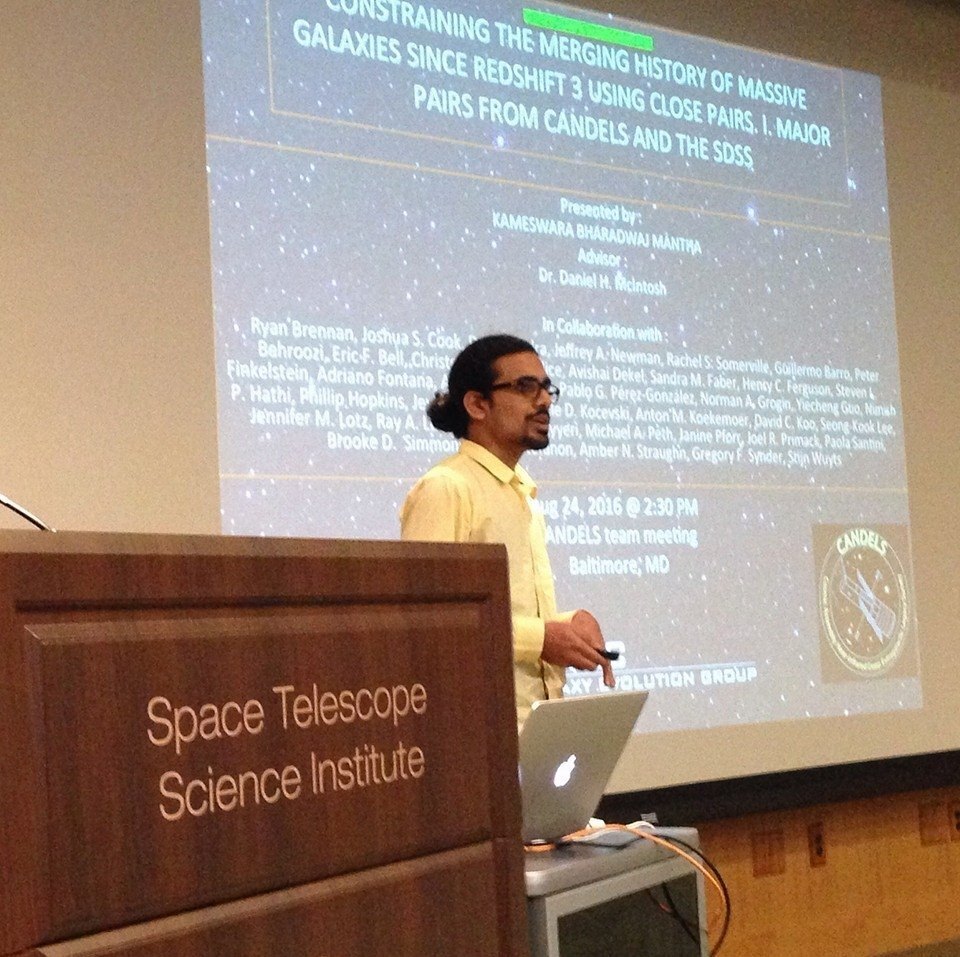
Who’s who in the Zoo – Kameswara Bharadwaj Mantha


Name: Kameswara Bharadwaj Mantha (Senior AI/ML Research Scientist)

Location: University of Missouri-Kansas City

Zooniverse projects: Galaxy Zoo, Galaxy Zoo: Weird & Wonderful, Galaxy Zoo: Clump Scout, Cosmic Disco, MindMapper, many more probably 🙂

What is your research about?

My research is broadly about using AI, machine learning, and human-guided data analysis to make sense of large and complex scientific datasets across multiple fields. I have worked in areas ranging from astronomy and imaging-based science to biomedical and health-related research, and what connects all of these spaces is the same core challenge: we now generate far more data than any one person can carefully analyze alone. My work focuses on building ways for computational tools and human insight to work together so that we can identify meaningful patterns, unusual cases, and scientifically important signals more effectively.

What excites me especially is that this idea translates naturally across disciplines. In one setting, it might involve helping classify or discover unusual structures in astronomical data, whereas in another, it might involve biomedical images, disease-related patterns, or genetic data that can inform better diagnostics or drug discovery. I am particularly enthusiastic about the biomedical side of this work because of its direct potential to improve how we understand disease and develop better treatments. For me, projects like these are exciting because they sit at the intersection of discovery, data, and impact. Such work allows us to use large-scale human participation and AI not only to handle complex datasets, but also to ask better scientific questions and discover previously unknown landscapes.

How do Zooniverse volunteers contribute to your research?

Zooniverse volunteers play a central role in my research because they help generate the kind of high-quality human insight that large scientific datasets often still need. In many of the problems I work on, whether in astronomy or other data-rich areas, there is simply too much information for a small research team to inspect carefully by hand. Volunteers help by identifying key patterns, classifying structures, flagging unusual cases, and, importantly, surfacing examples that may not fit neatly into existing categories. That is especially exciting to me because those “hard-to-describe” or unexpected cases are often where new science begins. Rather than thinking of volunteers as just helping label data, I see them as active contributors to discovery and to the design of better collaborative human-AI systems.

What makes Zooniverse particularly important in my work is that I am interested not only in the final scientific answer, but also in how humans and machines can learn from each other. Volunteers can help us build more reliable training datasets, evaluate where machine-learning models succeed or fail, and identify “unknown unknowns” that are cases where automated systems might miss because they fall outside the patterns the model has already learned. That question has been central to some of my published work, including research on how citizen science and machine learning can be combined for more effective identification of unknown or unusual structures in big data.

Through Zooniverse, I hope to answer both scientific and methodological questions. On the scientific side, the goal is to better characterize complex structures and rare phenomena in large datasets. On the methodological side, I want to understand how to efficiently use volunteer’s time with machine learning, how disagreement or uncertainty in classifications can itself become scientifically meaningful, and how citizen science can be used for genuine discovery. That broader theme runs across my work in Zooniverse-related collaborations, including citizen-science projects connected to galaxy morphology, unusual object identification, and human-in-the-loop AI systems.

What’s a surprising or fun fact about your research field?

A weird and wonderful part (pun intended!) of the domains I work in is that sometimes the most valuable data points are the ones that do not belong. We spend a lot of time building systems to classify things and putting them in pre-determined buckets. However, the discoveries often emerge out of the outliers: the object that looks wrong, the signal that breaks expectations, or the pattern no one thought to search for. In that sense, “mistakes,” surprises, and oddballs can end up being the most scientifically useful part of the dataset. I believe this notion transcends beyond astronomy into any domain; In fact this same philosophy led me down a path of scientific discovery in the core biomedical domain!

Kameswara Bharadwaj Mantha (Senior AI/ML Research Scientist)

What first got you interested in research?

First, I wanted to become a medical doctor. Human body and its function fascinates me to this day. I carry with me a tinge of obsession for learning something new. As life took be down a different path, into pursuing engineering, I have been finding my way back into doing what I want for over a decade or so. That’s when I decided to pursue my graduate school in more fundamental science domains, such as Physics, and eventually in Astrophysics. My first research experience was in studying galaxies and their evolution. Astronomy made me realize the true breadth of knowledge and my place in the universe. It unlocked a new avenue in my learning and scientific research capabilities and I eagerly applied it to learning and contributing to biomedicine.

What’s something people might not expect about your job or daily routine?

My expertise and daily job related duties lies at the junction of Astrophysics, applied Artificial Intelligence & Machine Learning, and core biomedical clinical research. One potentially unexpected item that may come as a surprise is, how many times and how fast I have to switch gears from talking about distant galaxies, to microscopic cellular level genes, to aerospace optimizations, and to cybersecurity, often in back-to-back settings 🙂 … I love it though!

Outside of work, what do you enjoy doing?

Reading and collecting medical textbooks, listening to medical talks/test prep videos, hosting and creating podcasts, playing chess, planning road trips, cooking and experimenting with cuisine fusions, having philosophical discussions … and generally learning new things 🙂

What are your favourite citizen science projects?

Etch A Cell; Infection Inspection; Eyes on Eyes; Genome Detectives;

What guidance would you give to other researchers considering creating a citizen research project?

It is really important to double/triple check if the task is broken down into the the most intuitive and low cognitive burden way. Volunteers appreciate tasks that are to the point and can contribute meaningfully to the overall research goal. Next, communication with the volunteers is really important! Talk to your volunteers and engage with them!

AI Ethics Workshop Series: Update #1

This post is part of our Kavli Foundation-funded series, Ethical Considerations for Machine Learning in Public-Engaged Research. Read our project announcement blog post here.

We’d like to thank everyone who participated in the first of four surveys to help shape the future of AI and public-engaged research. We received over 1000 responses to the first survey, which informed priorities for the first workshop and helped Zooniverse leadership understand some of your interests, concerns, and ideas around this important topic.

Our second survey is launching today, and will be accepting responses through July 18th. We hope you will participate!

In case you missed it, check out the project announcement blog post to learn more about Zooniverse’s effort to develop recommendations for running AI-engaged projects on the Zooniverse platform.

Who is running this study? The Project Director is Dr. Samantha Blickhan, Zooniverse Co-Director and Digital Humanities Lead.

Who is funding this research? This research is funded by The Kavli Foundation.

How can I contact the team? Questions can be addressed to hillary@zooniverse.org or samantha@zooniverse.org

​​Ethical Considerations for Machine Learning in Public-Engaged Research

Highlights

  • With support from the Kavli Foundation, the Zooniverse team is launching a project to help us develop a set of recommendations for running Machine Learning (ML) and Artificial Intelligence (AI)-engaged projects on the Zooniverse platform.
  • The project will bring together subject matter experts, Zooniverse leadership, and platform participants in a series of workshops and working sessions.
  • The project deepens partnerships among Zooniverse and its participant community, as well as the Kavli Institute for Cosmological Physics, UC-Berkeley Kavli Center for Ethics, Science, and the Public, and the SkAI AI Astro Institute. 
  • Zooniverse participants have an opportunity to get involved and follow along in a number of ways!

Developing recommendations for ML/AI projects on Zooniverse

As ML/AI has become more prevalent—now in about ⅓ of Zooniverse projects—it has sparked a range of reactions on the Talk message boards within the participant community, reflecting broader societal discourse. Zooniverse participants have surfaced concerns and insights on issues like ownership, agency, transparency, and trust. It is crucial to address the risks, opportunities, challenges, and broader ethical questions. 

In response, we developed a project to create a set of recommendations for running ML/AI-engaged projects on the Zooniverse platform. In this project we will explore the tensions of integrating ML/AI within online public-engaged research. We hope that these recommendations will also be useful for related fields incorporating ML/AI in public-engaged research processes. 

Collaborative workshops

With funding from The Kavli Foundation, this project will bring together Zooniverse leadership, platform participants, researchers, and experts in topics like communications, ethics, law, and ML/AI in a series of workshops and working sessions. The project deepens partnerships among Zooniverse and its participant community, as well as the Kavli Institute for Cosmological Physics, UC-Berkeley Kavli Center for Ethics, Science, and the Public, and the SkAI AI Astro Institute.

Workshop themes cover topics raised by Zooniverse participants and project research teams as well as gaps in existing knowledge, resources, and guidance. 

  • Workshop 1 (June) will focus on Transparency and Communication Best Practices. It will inform guidelines that will support researchers in effectively communicating with participants when integrating ML/AI into their public-engaged research projects. 
  • Workshop 2 (July) will cover Ethical Approaches to ML/AI. It will invite discussions that explore and identify foundational elements of an ethical approach to ML/AI-focused public-engaged research, addressing risks while leveraging opportunities. 
  • Workshop 3 (August) will focus on Deepening Contextual Understanding. It will expand on the ethical considerations raised in Workshop 2 by examining a matrix of factors including disciplinary differences, task type affordances, and the varied needs of stakeholders (e.g., researchers, participants, platform maintainers). We anticipate that ethical principles may at times conflict within this matrix, making it essential to foster a shared understanding of how, why, and when we will draw from different elements as we develop these recommendations. 
  • Workshop 4 (September) will consider Downstream Data Protection. It will inform recommendations for licensing frameworks to use with public-engaged research data outputs that align with platform values, particularly in relation to projects that incorporate ML/AI. 

Call to action: We want you to participate!

Zooniverse participants have an opportunity to get involved and follow along in a number of ways:

1. Help shape the future of ML/AI and public-engaged research. Options include:

  • Complete four short surveys throughout the duration of the project, starting with this one.
  • Survey responses will be considered as we draft the recommendations for running ML/AI-engaged projects on the Zooniverse platform.
  • We’ll also be reaching out to a subset of our community about participating in the workshops.

2. Follow along:

  • We’ll be posting updates on Talk and on our Zooniverse blog during the process, and project results will be shared broadly.
  • You can opt in to receive project updates by completing the first survey here.


Who is running this study? The Project Director is Dr. Samantha Blickhan, Zooniverse Co-Director and Digital Humanities Lead.

Who is funding this research? This research is funded by the Kavli Foundation.

How can I contact the team? Questions can be addressed to hillary@zooniverse.org or samantha@zooniverse.org