Category Archives: Results

The Davy Notebooks Project in Review (2019-2021-2024)

This guest post was written by the Davy Notebooks Project research team. It was updated on 21 October 2024 to include a link to the published transcription site.

The Davy Notebooks Project first launched as a pilot project in 2019. After securing additional funding and three months of testing and revision, the project re-launched in June 2021 in its current, ‘full’ iteration. And now it is drawing to a close.

Since April 2021, 11,991 pages of Davy’s manuscript notebooks have been transcribed – this, of course, is a major achievement. Adding the 1,130 pages transcribed during our pilot project, which launched in April 2019, brings the total up to 13,121 pages. Including Zooniverse beta test periods (during which time relatively few pages were made available to transcribe), this was achieved in a period of forty-one months; discounting beta test periods brings the total down to thirty-six months. At the time of writing, with the transcription of Davy’s 129 notebooks now complete, the Davy Notebooks Project has 3,649 volunteers from all over the world. 505 volunteers transcribed during our pilot project, so the full project attracted 3,144 transcribers.

The transition from the pilot build to the developed full project that, at its peak, was collecting up to 6,675 individual classifications per month, has been a steady learning experience. Samantha Blickhan’s article (co-authored by other members of the project team) in our special issue of Notes and Records of the Royal Society‘The Benefits of “Slow” Development: Towards a Best Practice for Sustainable Technical Infrastructure Through the Davy Notebooks Project’, charts the Davy Notebooks Project’s development, and makes a convincing case for the type of ‘slow’ development – or gradual improvement in response to feedback – approach that the project has taken.

While new notebooks were being released and transcribed on Zooniverse, the project’s editorial team were reviewing and editing the submitted transcriptions through Zooniverse’s ALICE (Aggregated Line Inspector and Collaborative Editor) app. The team were also engaging, daily, with our transcriber community on the project’s Talk boards – discussing particularly tricky or interesting passages in recently transcribed pages, sharing information and insights on the material being transcribed, and creating a repository of useful research that has been valuable in tracing connections throughout Davy’s textual corpus as a whole and in writing explanatory notes for the transcriptions. The current number of individual notes (repeated throughout the edition as necessary) stands at approximately 4,500.

Running a successful online crowdsourcing project requires effective two-way communication between the project team and the volunteer community. A series of ‘off Zooniverse’ volunteer-focused events offered the opportunity to engage with our volunteers, and – importantly – a venue to thank them for their continued, frequently excellent efforts in transcribing and interpreting Davy’s notebooks. Conference panels at large UK conferences with international representation (the British Society for Literature and Science conferences in 2022 and 2023, the British Association for Romantic Studies conference, jointly held with the North American Society for the Study of Romanticism, in 2022) enabled the project team to share their research-in-progress with the academic community, and our own conference, ‘Science and/or Poetry: Interdisciplinarity in Notebooks’, held at Lancaster University in July 2023, brought together scholars working on a diverse range of notebooks and other related manuscript materials to share our most recent insights and findings. Our monthly project team reading group, superbly organised by Sara Cole over several years, helped us to think about the organisation of Davy’s notebook collection as a whole, and created many a new research lead. Our travelling exhibition, which stopped at the Royal Institution, Northumberland County Hall, and Wordsworth Grasmere, has created new interest in Davy and his notebooks, and presented some of the key research findings of the project. All of these events fed directly into maintaining the momentum of the Davy Notebooks Project.

We are now moving towards the publication of the free-to-access digital edition of Davy’s whole notebook corpus that has been our goal since the start. Our digital edition will be hosted on the Lancaster Digital Collections platform, which is based on the well-established Cambridge Digital Library platform. View the Davy Notebooks transcription collection here: https://digitalcollections.lancaster.ac.uk/collections/davy/1.

Thankfully, we have benefited from the continued involvement, post-transcription, of a core of volunteer transcribers, who have taken on new responsibilities in assisting with the final editing of the notebooks; special thanks go to David Hardy (@deehar) and Thomas Schmidt (@plphy), who have helped to improve our transcriptions and notes in significant measure. We have also benefited at various points in the project from additional research assistance, from our UCL STS Summer Studentship project interns (Alexander Theo Giesen, Mandy Huynh, Stella Liu, Clara Ng, and Shreya Rana), from specialists in early nineteenth-century mathematics (Brigitte Stenhouse and Nicolas Michel), and from students and postgraduates in the Department of English Literature and Creative Writing at Lancaster University (Emma Hansen, Lee Hansen, Rebekah Musk, Frank Pearson, and Rebecca Spence), for which we are very grateful.

Work continues behind the scenes on finalising the transcriptions on LDC, and on the preparation of our forthcoming special issue of Notes and Records of the Royal Society, which is due to be published at the end of the year. Our digital edition will be officially launched at Lancaster Litfest on Saturday 19 October 2024. This will give us another opportunity to thank the thousands of volunteers who have made this work possible.

Truly, we could not have made the important advances in Davy scholarship that we have made since 2019 without every one of our volunteers, who gave freely and generously of their time and knowledge, and who hopefully enjoyed playing such a key role in a large research project – this is not only a social edition of Davy’s notebooks, but also, in large measure, their edition. Thank you all.

Happy New Year & YouTube livestream this Thursday

Happy New Year Everyone! We can’t thank you enough for making Zooniverse possible. Thank you, thank you, thank you!!!!

We have so much to celebrate from 2023. 

  • We welcomed our 2.5 millionth registered participant!
    • To date: 2.6 million registered participants from 190 countries
    • Top countries in 2023: US, UK, Germany, India, Canada, Australia
  • 400 Zooniverse projects publicly launched
    • 40 new projects in 2023 alone; ~90 active projects at any given time
    • Each led by a different research team. Zooniverse partners with hundreds of universities, research institutes, museums, libraries, zoos, NGOs, and more
  • 400 peer-reviewed publications (30 in 2023 alone)
  • 780 million classifications (65 million classifications in 2023 alone)
  • 5 million posts in the Zooniverse ‘Talk’ discussion forums (680K in 2023 alone)
  • 19.5 million hours of participation
    • 1.6 million hours in 2023 alone; equivalent to 780 FTEs

We welcome you to join us this Thursday for a YouTube LiveStream from 2:15pm-3:15pm CST (8:15pm GMT; Friday 1:15am in India) celebrating Zooniverse 2023 Milestones as part of a Press Conference for the American Astronomical Society Meeting happening this week in New Orleans.

Bonus: the Press Conference will include a slew of other astronomy related discoveries, mysteries, and intrigues. Connect via https://www.youtube.com/@AASPressOffice/streams (open to the public). Also, throughout the week we’ll post on https://twitter.com/the_zooniverse (with the hashtag #aas243) about our experiences at the conference. 

Milestones are great to celebrate, but we all know a deep magic is in the everyday moments – catching a penguin chick in the midst of a funny dance on Penguin Watch, hearing a coo that reminds you of your own little loves in Maturity of Baby Sounds, uncovering a lost genealogical clue in Civil War Bluejackets, connecting with someone from the other side of the globe who shares your interests in chimps and their fascinating behaviors through the Talk discussion forums, and more, and more. Wonderful if you’d like to share one of your everyday Zooniverse moments with us by tagging @the_zooniverse on X (formerly Twitter) or sharing via email at contact@zooniverse.org. Hearing your moments helps us better understand how the Zooniverse community creates meaning and impact from these experiences (and what we can do to nurture those moments). 

Wishing you a joyful and gentle 2024. Cheers to new beginnings and continued adventures together. 

Laura
Zooniverse PI, VP Science Engagement, Adler Planetarium in Chicago

New Results for Milky Way Project Yellowballs!

What are “Yellowballs?” Shortly after the Milky Way Project (MWP) was launched in December 2010, volunteers began using the discussion board to inquire about small, roundish “yellow” features they identified in infrared images acquired by the Spitzer Space Telescope. These images use a blue-green-red color scheme to represent light at three infrared wavelengths that are invisible to our eyes. The (unanticipated) distinctive appearance of these objects comes from their similar brightness and extent at two of these wavelengths: 8 microns, displayed in green, and 24 microns, displayed in red. The yellow color is produced where green and red overlap in these digital images. Our early research to answer the volunteers’ question, “What are these `yellow balls’?” suggested that they are produced by young stars as they heat the surrounding gas and dust from which they were born. The figure below shows the appearance of a typical yellowball (or YB) in a MWP image.  In 2016, the MWP was relaunched with a new interface that included a tool that let users identify and measure the sizes of YBs. Since YBs were first discovered, over 20,000 volunteers contributed to their identification, and by 2017, volunteers catalogued more than 6,000 YBs across roughly 300 square degrees of the Milky Way. 

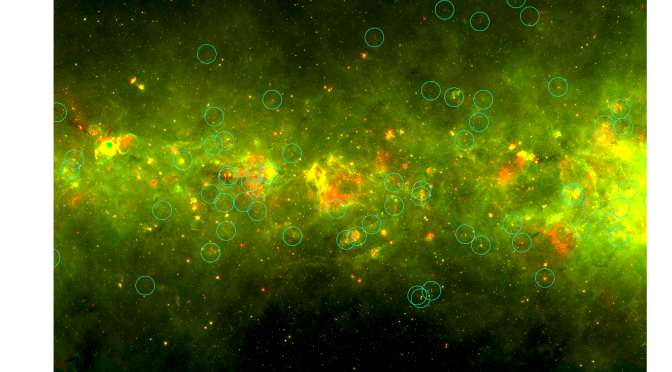
New star-forming regions. We’ve conducted a pilot study of 516 of these YBs that lie in a 20-square-degree region of the Milky Way, which we chose for its overlap with other large surveys and catalogs. Our pilot study has shown that the majority of YBs are associated with protoclusters – clusters of very young stars that are about a light-year in extent (less than the average distance between mature stars.) Stars in protoclusters are still in the process of growing by gravitationally accumulating gas from their birth environments. YBs that represent new detections of star-forming regions in a 6-square-degree subset of our pilot region are circled in the two-color (8 microns: green, 24 microns: red) image shown below. YBs present a “snapshot” of developing protoclusters across a wide range of stellar masses and brightness. Our pilot study results indicate a majority of YBs are associated with protoclusters that will form stars less than ten times the mass of the Sun.

YBs show unique “color” trends. The ratio of an object’s brightness at different wavelengths (or what astronomers call an object’s “color”) can tell us a lot about the object’s physical properties. We developed a semi-automated tool that enabled us to conduct photometry (measure the brightness) of YBs at different wavelengths. One interesting feature of the new YBs is that their infrared colors tend to be different from the infrared colors of YBs that have counterparts in catalogs of massive star formation (including stars more than ten times as massive as the Sun). If this preliminary result holds up for the full YB catalog, it could give us direct insight into differences between environments that do and don’t produce massive stars. We would like to understand these differences because massive stars eventually explode as supernovae that seed their environments with heavy elements. There’s a lot of evidence that our Solar System formed in the company of massive stars.

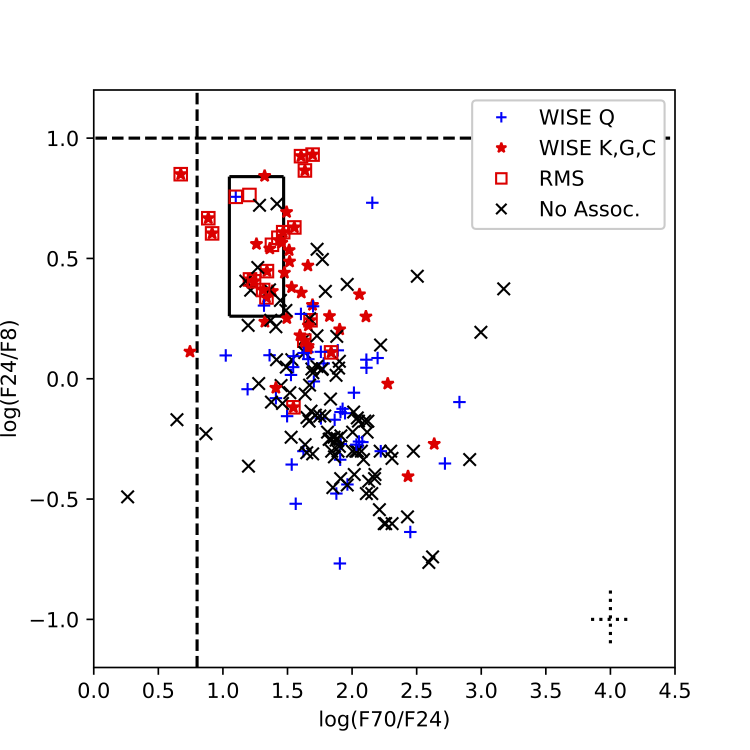
The figure below shows a “color-color plot” taken from our forthcoming publication. This figure plots the ratios of total brightness at different wavelengths (24 to 8 microns vs. 70 to 24 microns) using a logarithmic scale. Astronomers use these color-color plots to explore how stars’ colors separate based on their physical properties. This color-color plot shows that some of our YBs are associated with massive stars; these YBs are indicated in red. However, a large population of our YBs, indicated in black, are not associated with any previously studied object. These objects are generally in the lower right part of our color-color plot, indicating that they are less massive and cooler then the objects in the upper left. This implies there is a large number of previously unstudied star-forming regions that have been discovered by MWP volunteers. Expanding our pilot region to the full catalog of more than 6,000 YBs will allow us to better determine the physical properties of these new star-forming regions.

Volunteers did a great job measuring YB sizes!  MWP volunteers used a circular tool to measure the sizes of YBs. To assess how closely user measurements reflect the actual extent of the infrared emission from the YBs, we compared the user measurements to a 2D model that enabled us to quantify the sizes of YBs. The figure below compares the sizes measured by users to the results of the model for YBs that best fit the model. It indicates a very good correlation between these two measurements. The vertical green lines show the deviations in individual measurements from the average. This illustrates the “power of the crowd” – on average, volunteers did a great job measuring YB sizes!

Stay tuned…  Our next step is to extend our analysis to the entire YB catalog, which contains more than 6,000 YBs spanning the Milky Way. To do this, we are in the process of adapting our photometry tool to make it more user-friendly and allow astronomy students and possibly even citizen scientists to help us rapidly complete photometry on the entire dataset.

Our pilot study was recently accepted for publication in the Astrophysical Journal. Our early results on YBs were also presented in the Astrophysical Journal, and in an article in Frontiers for Young Minds, a journal for children and teens.

SuperWASP Variable Stars – Update

The following is an update from the SuperWASP Vairable Stars research team. Enjoy!

Welcome to the Spring 2020 update! In this blog, we will be sharing some updates and discoveries from the SuperWASP Variable Stars project.

What are we aiming to do?

We are trying to discover the weirdest variable stars!

Stars are the building blocks of the Universe, and finding out more about them is a cornerstone of astrophysics. Variable stars (stars which change in brightness) are incredibly important to learning more about the Universe, because their periodic changes allow us to probe the underlying physics of the stars themselves.

We have asked citizen scientists to classify variable stars based on their photometric light curves (the amount of light over time), which helps us to determine what type of variable star we’re observing. Classifying these stars serves two purposes: firstly to create large catalogues of stars of a similar type which allows us to determine characteristics of the population; and secondly, to identify rare objects displaying unusual behaviour, which can offer unique insights into stellar structure and evolution.

We have 1.6 million variable stars detected by the SuperWASP telescope to classify, and we need your help! By getting involved, we can build up a better idea of what types of stars are in the night sky.

What have we discovered so far?

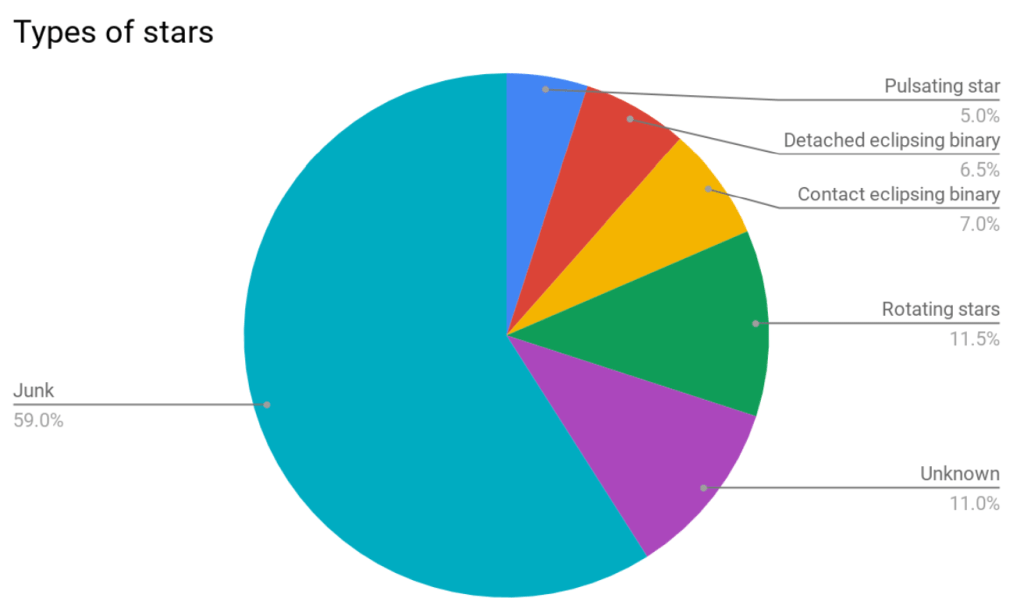
We’ve done some initial analysis on the first 300,000 classifications to get a breakdown of how many of each type of star is in our dataset.

So far it looks like there’s a lot of junk light curves in the dataset, which we expected. The programme written to detect periods in variable stars often picks up exactly a day or a lunar month, which it mistakes for a real period. Importantly though, you’ve classified a huge number of real and exciting light curves!

We’re especially excited to do some digging into what the “unknown” light curves are… are there new discoveries hidden in there? Once we’ve completed the next batch of classifications, we’ll do some more to see whether the breakdown of types of stars changes.

An exciting discovery…

In late 2018, while building this Zooniverse project, we came across an unusual star. This Northern hemisphere object, TYC-3251-903-1, is a relatively bright object (V=11.3) which has previously not been identified as a binary system. Although the light curve is characteristic of an eclipsing contact binary star, the period is ~42 days, notably longer than the characteristic contact binary period of less than 1 day.

Spurred on by this discovery, we identified a further 16 candidate near-contact red giant eclipsing binaries through searches of archival data. We were excited to find that citizen scientists had also discovered 10 more candidates through this project!

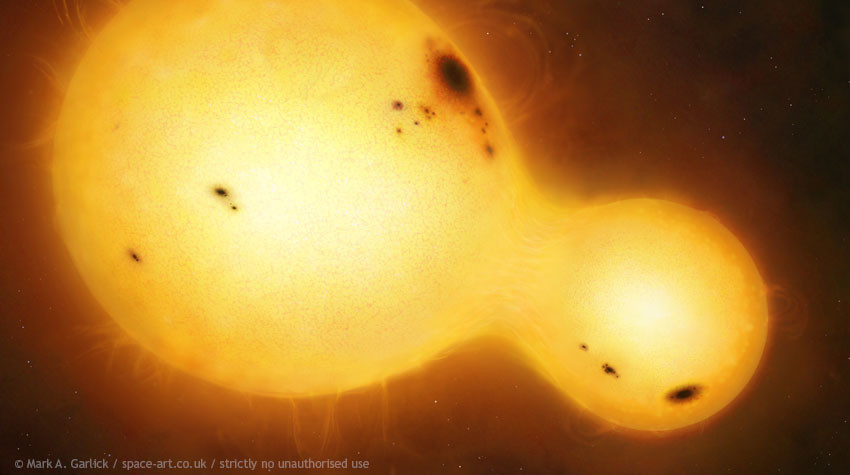
Figure 1: Artist’s impression of a contact binary star [Mark A. Garlick] Over the past 18 months, we’ve carried out an observing campaign of these 27 candidate binaries using telescopes from across the world. We have taken multi-colour photometry using The Open University’s own PIRATE telescope, and the Las Cumbres Observatory robotic telescopes, and spectroscopy of Northern candidates with the Liverpool Telescope, and Southern candidates using SALT. We’ve also spent two weeks in South Africa on the 74-inch telescope to take further spectroscopy.

Of the 10 candidate binaries discovered by citizen scientists, we were happy to be able to take spectroscopic observations for 8 whilst in South Africa, and we have confirmed that at least 2 are, in fact, binaries! Thank you citizen scientists!

Why is this discovery important?

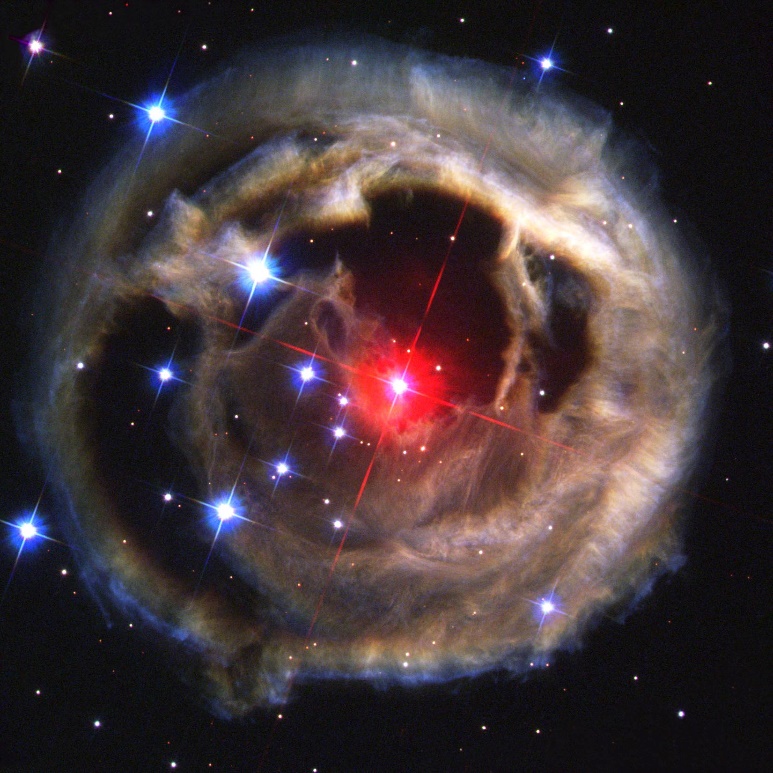
Figure 2: V838 Mon and its light echo [ESA/NASA]

The majority of contact or near-contact binaries consist of small (K/M dwarf) stars in close orbits with periods of less than 1 day. But for stars in a binary in a contact binary to have such long periods requires both the stars to be giant. This is a previously unknown configuration…

Interestingly, a newly identified type of stellar explosion, known as a red nova, is thought to be caused by the merger of a giant binary system, just like the ones we’ve discovered.

Red novae are characterised by a red colour, a slow expansion rate, and a lower luminosity than supernovae. Very little is known about red novae, and only one has been observed pre-nova, V1309 Sco, and that was only discovered through archival data. A famous example of a possible red nova is the 2002 outburst in V838 Mon. Astronomers believe that this was likely to have been a red nova caused by a binary star merger, forming the largest known star for a short period of time after the explosion.

So, by studying these near-contact red giant eclipsing binaries, we have an unrivalled opportunity to identify and understand binary star mergers before the merger event itself, and advance our understanding of red novae.

What changes have we made?

Since the SuperWASP Variable Stars Zooniverse project started, we’ve made a few changes to make the project more enjoyable. We’ve reduced the number of classifications needed to retire a target, and we’ve also reduced the number of classifications of “junk” light curves needed to retire it. This means you should see more interesting, real, light curves.

We’ve also started a Twitter account, where we’ll be sharing updates about the project, the weird and wacky light curves you find, and getting involved in citizen science and astronomy communities. You can follow us here: www.twitter.com/SuperWASP_stars

What’s next?

We still have thousands of stars to classify, so we need your help!

Once we have more classifications, we will be beginning to turn the results into a publicly available, searchable website, a bit like the ASAS-SN Catalogue of Variable Stars (https://asas-sn.osu.edu/variables). Work on this is likely to begin towards the end of 2020, but we’ll keep you updated.

We’re also working on a paper on the near-contact red giant binary stars, which will include some of the discoveries by citizen scientists. Expect that towards the end of 2020, too.

Otherwise, watch this space for more discoveries and updates!

We would like to thank the thousands of citizen scientists who have put time into this Zooniverse project. If you ever have any questions or suggestions, please get in touch.

Heidi & the SuperWASP Variable Stars team.

28 New Planet Candidates Discovered on Exoplanet Explorers

The team behind the Exoplanet Explorers project has just published a Research Note of the American Astronomical Society announcing the discovery of 28 new exoplanet candidates uncovered by Zooniverse volunteers taking part in the project.

Nine of these candidates are most likely rocky planets, with the rest being gaseous. The sizes of these potential exoplanets range from two thirds the size of Earth to twice the size of Neptune!

This figure shows the transit dips for all 28 exoplanet candidates. Zink et al., 2019

You can find out more about these exoplanet candidates in the actual research note at https://iopscience.iop.org/article/10.3847/2515-5172/ab0a02, and in this blog post by the Exoplanet Explorers research team http://www.jonzink.com/blogEE.html.

Finally, both the Exoplanet Explorers and Zooniverse teams would like to extend their deep gratitude to all the volunteers who took part in the project and made these amazing discoveries possible.