Hey everyone, for today’s advent calendarRob and I made this short video talking about the various ways in which you can take part in the Zooniverse, and the multiple means by which you can keep up-to-date with what we’re doing.
It also serves as an introduction for me, the new Zooniverse community manager. It is a bit silly at points, and we did it in one take with no script, so apologies for the rough feel!
Here are some of the links I mention in the video:
Over the past three years some have said that the Zooniverse Advent calendar is a bit silly. To utterly refute this claim I present the following evidence that all can be citizen scientists: cats love the Zooniverse.
This time last year we launched the Andromeda Project. The aim was the get everyone’s help in locating the star clusters in the Andromeda Galaxy, our next-door neighbour in intergalactic space. The project went better than we could have imagined, and just over two weeks later we had completed more than 1,000,000 classifications and the project’s science team were busy wrangling data.
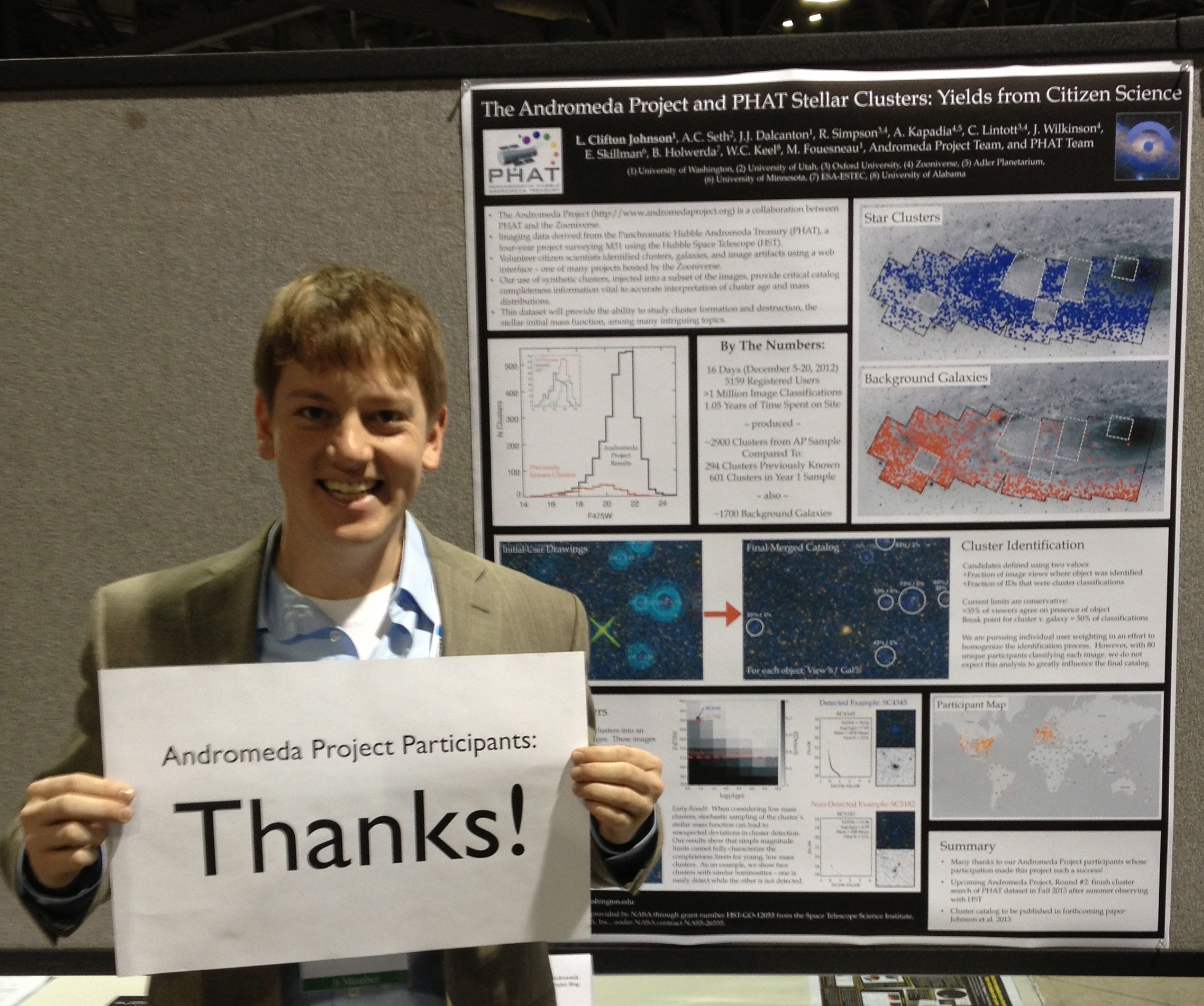
In fact, in January Cliff Johnson took a poster to one of the world’s biggest astronomy meetings – the January meeting of the AAS – and presented the results from the Andromeda Project, which had only launched 6 weeks prior. It was an amazing example of the power of citizen science to help researchers accomplish the kind of data analysis that computers cannot do reliably.
We decided to do a second round of the Andromeda Project to complete the job we’d started, using both the data that remained in the archive and also new data that was only just being taken last year when the project launched. So in October 2013 (just two months ago) we once again invited the Zooniverse community to come and find star clusters and galaxies. They once again astounded us by gobbling up the data even faster – ably assisted by a trench of new users brought to the project from Facebook’s popular I F***king Love Science page. In a week the job was done.
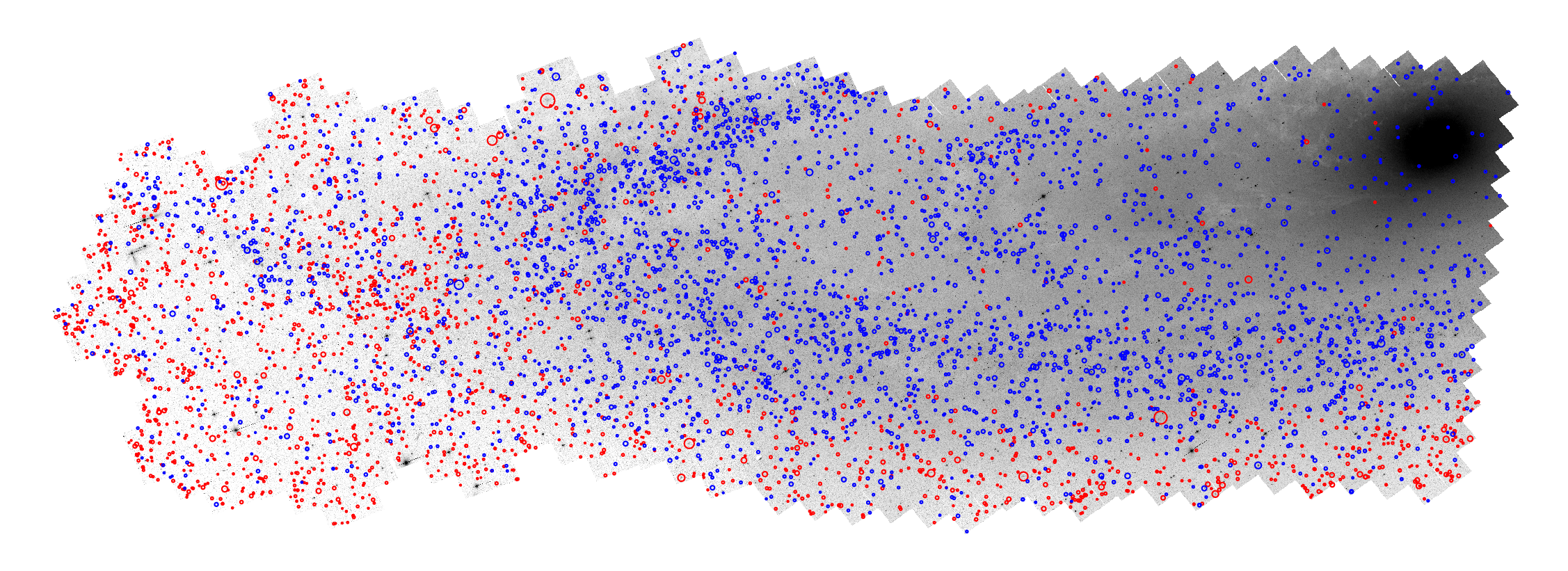
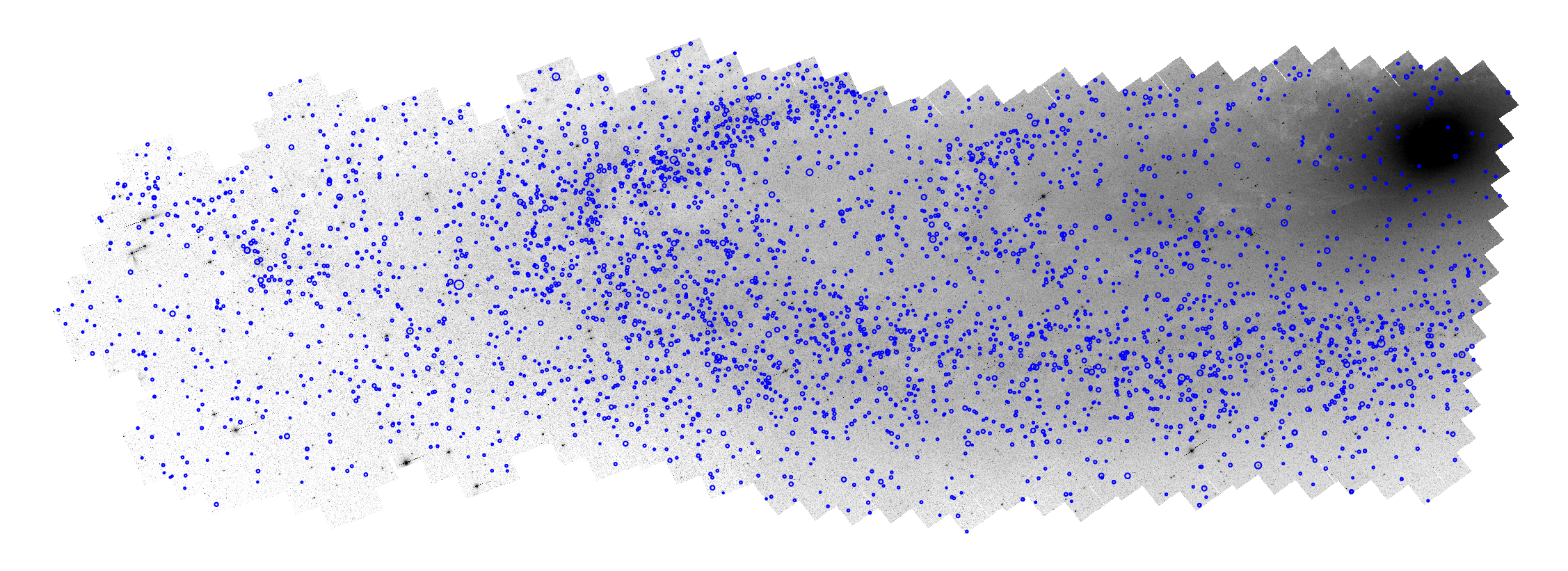
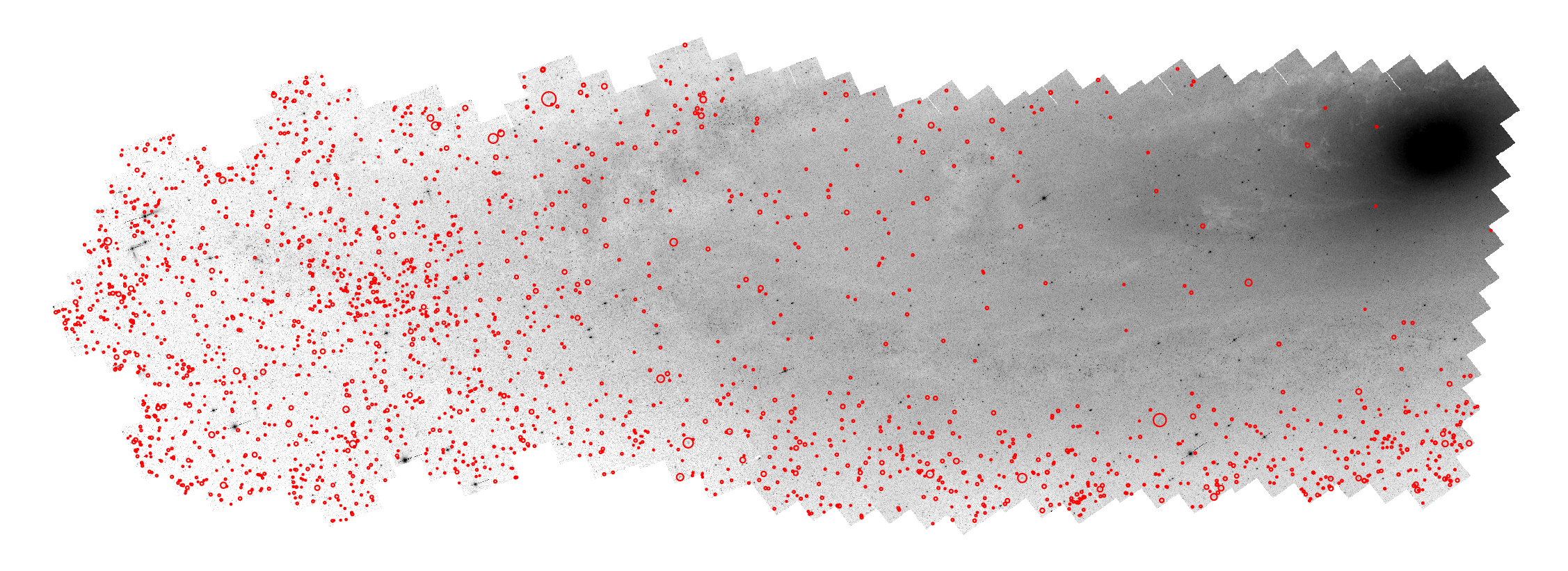
The science team have already begun processing the data from this second round and the results are amazing. In fact: they’re right here just for you, just because it’s nearly Christmas and just because we wanted to give you a present. So here they are: the first maps of all the star clusters and galaxies in the data from the PHAT survey of Andromeda. Marked and classified by the wonderful Andromeda Project community.
Clusters are in blue, galaxies in red. The background image is single-band F475W data showing the galaxy itself.
You can see how the background galaxies are best seen at the outer edges (because we are looking through less material), and the clusters are found predominately in the spiral arms (where more star formation is happening). These plots will form part of the publications the science team and currently working on, and which will most likely appear on the Zooniverse Publications page sometime in 2014. Follow along on the blog, Twitter and Facebook for updates from the science team in the coming weeks and months.
Congratulations to everyone who helped out and gave their time to the Andromeda Project: you were amazing!
So as much as I’d like to wish the Andromeda Project a happy birthday, it seems like I should really wish it a happy retirement. Luckily we have more space-based projects coming soon to the Zooniverse – so the community will have plenty to get along with. However, the Andromeda Project will always have a special place in our hearts for its efficient and dedicated volunteers. Who knows, maybe one day it will come out of retirement for one last hurrah? We can only hope.
It’s December 1st and that can mean only one thing at The Zooniverse: our advent calendar returns! It’s time for another citizen-science-fuelled, festive charge at the unsuspecting Christmas break for many around the world. 24 digital days of fun from us to you, our lovely, lovely volunteers! It’s a fun way of saying thank you each year. To kick things off, behind door 1 is is a bit of digital wallpaper for you: a pair of galaxies made from galaxies.
As astronomical surveys and observations have continued to grow towards the petabyte scale, online citizen science projects have proven quite successful in enlisting the general public to mine these rich datasets from searching for exoplanets to identifying gravitational lenses. With new instruments and observatories currently being planned and built such as the Large Synoptic Survey Telescope (LSST) and the Square Kilometer Array (SKA), the next decade will see astronomy officially enter the petabyte age. When complete in 2022, LSST, an 8.4-meter optical telescope, will generate 15 terabytes worth of images each night, creating the largest public dataset in the world. LSST will provide images of billions (yes billions!) of new galaxies. The SKA will be the largest radio telescope ever built when it is scheduled to come online in 2024, generating roughly 11 terabytes of raw data per second. In a single day, the SKA will produce more information than all of the present day Internet combined! Citizen science will need to evolve to be able to handle the coming data deluge.
The Zooniverse and the Institute of Astronomy & Astrophysics at Academia Sinica (ASIAA) are organizing a workshop on Citizen Science in Astronomy. The goal of this workshop is to take the first steps towards addressing the critical questions and issues that citizen science will need to solve in order to cope with these never-before-seen data volumes in the age of LSST and SKA. We aim to bring together machine learning experts, computer scientists, astronomers, and scientists from astronomy-based citizen science projects to test current techniques used to assess the capabilities of individual classifiers and combine their results, create techniques for better directing volunteer efforts to improve efficiency of current and future citizen science projects, and develop new methods for analyzing citizen science data combined with machine learning algorithms.
The Zooniverse has passed a few notable milestones recently. Planet Four passed 4 million classifications, Planet Hunters passed 20 million, and Plankton Portal passed 250,000. All represent a lot of work done by all of you and we thank you for the effort you put in to these and all our projects. Should we be worried that they all begin with ‘P’?
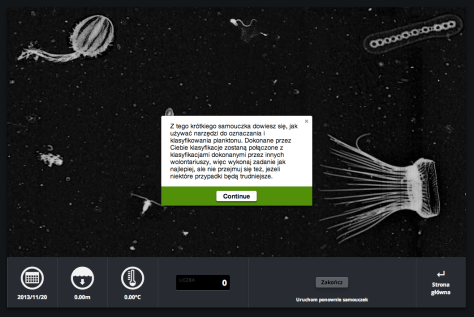
To help more people access our projects we’ve been stepping up our efforts to translate the websites. You can now participate in Plankton Portal in both French and Polish (as well as English), and there are more languages on the way for this and other projects. We’re excited about this chance to spread word of the Zooniverse around the world.
Finally, don’t forget that you can follow us on Facebook, Twitter, and Google+. (or all three!) to keep up with news and updates from the Zooniverse.
As part of a large expansion of the Oxford Zooniverse team, I’m delighted to announce that there are four new jobs available at Zooniverse HQ in Oxford. We’re looking for developers who are excited at the prospect of helping us find more planets, keep an eye on more animals and generally make the Zooniverse more awesome.
These jobs mark the start of the next stage in the Zooniverse’s evolution, and we’re really excited about expanding the team in Oxford. If you’d like to know more, you can contact me on cjl AT astro.ox.ac.uk or 07808 167288.
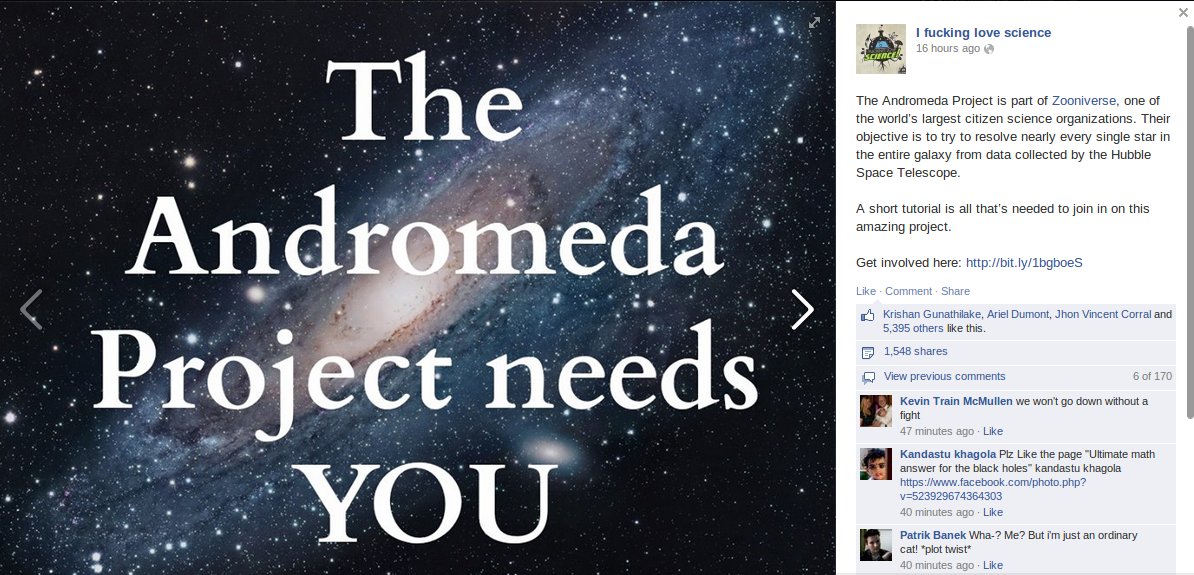
Recenty the Andromeda Project was the feature of one of the posts on the ‘I fucking Love Science’ Facebook page. The page, which was started by Elise Andrew in March 2012, currently has 8 million likes, so some form of noticeable impact was to be expected! Here are some of the interesting numbers the post is responsible for:
I’ll start with the Facebook post itself. As of writing (16 hours after original posting), it has been shard 1,842 times, liked by 6,494 people and has 218 comments. These numbers are actually relatively low for an IFLS post, some of which can reach over 70,000 shares!
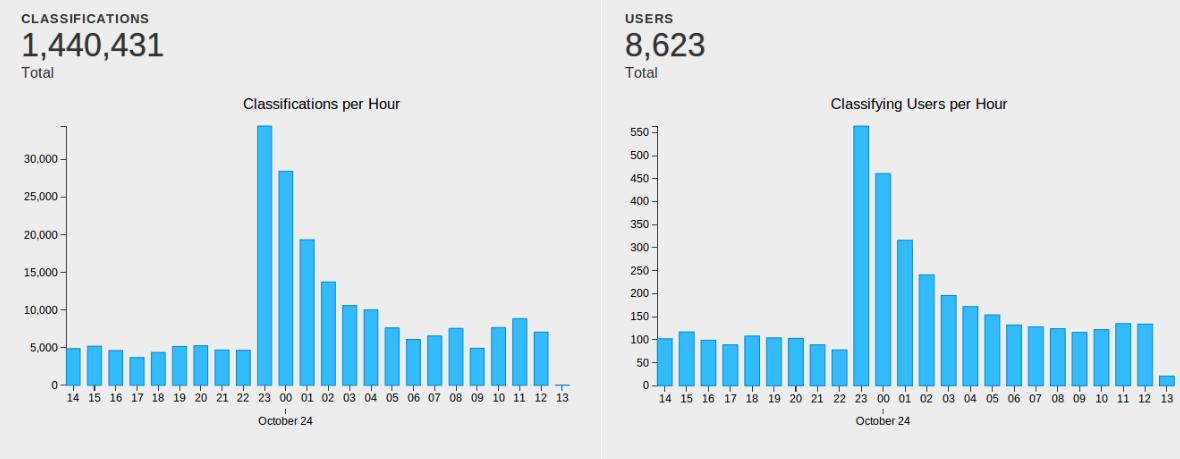
The ‘IFLS spike’ in the Andromeda Project classifications and active users
Let’s now have a look at what it did for the Andromeda Project. The project, which was launched two days previous and was already pretty popular, had settled down to around 100 active users per hour. This number shot up to almost 600 immediately following the post. In the space of 5 minutes the number of visitors on the site went from 13 to 1,300! After a few hours it settled down again, but now the steady rate looks to be about 25% higher than before. The number of classifications per hour follows the same pattern. The amazing figure here is that almost 100,000 classifications were made in the 4 hours following the post. This number corresponds to around 1/6th of the total needed to complete the project!
The number of visitors per day to the Planet Hunters site over the last two weeks. Visits increased by a factor of ten on the day of the IFLS post, and three days later the numbers are still greater than before.
Two days after her post about the Andromeda Project, Elise put up a post about the discovery of a seventh planet around the dwarf star KIC 11442793, which was found by citizen scientist on the Planet Hunters project. This post proved even more popular than the previous one with more than 3,000 shares, and led to a similar spike of the same magnitude in the number of visitors to the site (as can be seen in the plot above).
Finally, what did it do for the Zooniverse as a whole? Well there have been over 4,000 new Zooniverse accounts registered within the last four days and the Facebook page, which was linked in the AP article, got a healthy boost of around 1,000 new likes. So all things considered, it seems that an IFLS post can be very useful for promoting your project indeed!
Thanks Elise, the Andromeda Project, Planet Hunters and Zooniverse teams love you!
Are you a Zooniverse volunteer over the age of 21 and living in the Chicago area? If so, the Zooniverse needs your help. Next month’s Adler After Dark (the over 21’s night at the Adler Planetarium each month) is going to be about DIY science. There will be a panel session about people who have become involved in science through non-traditional academic routes. We want there to be a Zooniverse volunteer on the panel talking about how they got involved in the Zooniverse.
Venue : Adler Planetarium
Date : Thursday, November 21
Time : 6PM
This is a good experience and a great chance to meet some of the people behind the Zooniverse, along with other like-minded people who love citizen science! If you fit the bill and would like to help us out, please email stuart@zooniverse.org.
It seems like only a couple of weeks ago I announced that I’d be heading off soon to pastures new and yet somehow that time has already come – today is my last day working with the Zooniverse.
It’s pretty much impossible for me to describe how much fun I’ve had over the past five years. Playing a part in shaping the Zooniverse from the early days of Galaxy Zoo (2) when we were a tiny team in Oxford through to where we are today has been a blast. In a coincidence of timing my son Caio has been around for almost exactly the same amount of time as I’ve been involved with the Zooniverse, and to be honest I’m not really sure I remember life before either. I checked the commit logs of the Galaxy Zoo 2 codebase and the first code was saved on 25th October 2008 – just over a month before Caio came into the world. Significantly this was more than two months before Chris began paying me but that’s just a testament to what a remarkably persuasive individual he is 🙂
These last few years have been filled with so many significant moments it’s hard to pick out highlights but if I had to then the launch of Galaxy Zoo 2 and furiously coding as people around me were sipping champagne is pretty memorable. Taking what felt like a massive leap into the unknown with Planet Hunters and then going to find exoplanets is definitely up there too. And announcing Old Weather (still my favourite Zooniverse project) to the world and seeing how people responded to the Zooniverse doing something ‘other’ than astro was very special.
I’m not going to try and thank every individual I’ve been working with because I’m bound to forget important people. Suffices to say, I love you all dearly and I’m going to miss working with you day to day immensely.
So farewell and stay in touch!
ArfX
The world's largest and most popular platform for people-powered research. This research is made possible by volunteers—millions of people around the world who come together to assist professional researchers.