This April, Citizen Science Month invites people everywhere to take part in something special: 2.50 Million Acts of Science in celebration of America’s 250th birthday.
SciStarter weekly online events
In addition to hundreds of projects and events scheduled throughout the month, our friends at SciStarter are organising weekly, online events where volunteers from around the world will work on the same project at the same time, guided by the scientists leading the research.
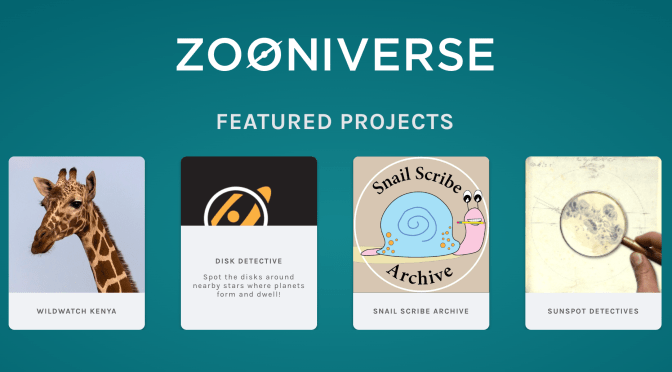
We’re happy to introduce an updated Projects page on Zooniverse, designed to make it easier, faster and more enjoyable to find projects that match your interests.
The new page brings together improved navigation, long-requested features like sorting by language, and a refreshed visual design that aligns with Zooniverse’s evolving front-end experience.
One of the most requested features from our global community is finally here: project filtering by language.
Zooniverse is used by volunteers all over the world. Thanks to our amazing translators, projects are increasingly available in multiple languages. The new language filter makes it much easier to discover projects you can participate in comfortably, whether you’re looking for projects in Japanese, Czech, French, Italian or other languages.
This update helps make Zooniverse more accessible and more welcoming to the diverse community that makes participatory science possible.
Explore Projects by Organisation
The new Projects page also introduces the ability to browse projects by organisation.
On Zooniverse, organisations are research groups, institutions, observatories, universities, museums, and other teams that host and manage projects on the platform. Many organisations – such as Notes from Nature and Rubin Observatory – run multiple projects over time, often connected by shared research goals or themes.
With organisation listings now visible on the Projects page, it’s easier to discover related projects from the same research team, follow the work of organisations you’re interested in and get a clearer sense of the research communities behind the projects.
A Refreshed Look and Feel
Alongside these new features, the Projects page has been visually redesigned to match Zooniverse’s new front-end design system.
The updated layout improves consistent navigation across the platform. Project cards, filters and search tools are more clearly structured, making it simpler to scan, compare, and jump into projects that catch your eye.
This design update reflects ongoing work across Zooniverse to create a more cohesive and intuitive experience for everyone who takes part.
Built for Discovery
Whether you arrive knowing exactly what you’re looking for or just want to browse and see what’s happening across Zooniverse, the new tools are there to help you discover projects that match your interests and curiosity.
Take a look, try out the filters, explore new navigation, and enjoy the updated experience.
We are grateful to Zooniverse volunteer Sallyann Chesson for preparing this updated list of translated projects, and to all our volunteer project translators for their ongoing contributions.
Do you want to become a Zooniverse translator? Are you a research team member looking to translate your project? Here is what you need to know.
Volunteers are the heart and soul of Zooniverse. Participatory research cannot happen without them. Successful project teams sustain and grow their communities by staying in touch with their volunteers, keeping them informed and showing them the appreciation they deserve. Here are some tips to get you started.
Nurture your volunteer community
Be present on Talk. Answer questions, engage in discussions, listen.
Send project newsletters (learn how here). Share news, show appreciation, discuss interim results and illustrate how your volunteers efforts are having a tangible effect on research and discovery.
Use the announcement banner to share your most important updates (e.g. a new workflow, a publication or an upcoming event).
Appoint and support your project moderators to help foster community engagement (learn more in our moderator guide).
Feature your new project launch or share updates to your existing project on Zooniverse’s social media – Instagram, Facebook and/or Bluesky.
Send us a message at contact@zooniverse.org to express your interest in any of the options listed above!
Share your publications
Submit them via the Google form linked at the top of the Publications page.
Since 2009, Zooniverse research has led to more than 450 peer-reviewed publications. Sharing these publications with our community helps to demonstrate the impact citizen science have on real research and to inform volunteers about the results of their hard work.
Follow good practices for project sunsetting
Let us know when your project’s classification effort is complete, so we can change its status to Finished. This way your project will stay visible on Zooniverse, but volunteers will know that your team no longer needs their help with classifications.
Email us at contact@zooniverse.organd we will walk you through the process, including end-of-project communications best practices.
Would you like to share your best practices with other Zooniverse teams? Drop us a line and we will be happy to feature your ideas in our next blog post.
Are you looking for a Zooniverse project in a language other than English? Here is the latest update on what is available, as of 1 October 2025. Many thanks to our amazing volunteers – project translators.
Do you want to become a Zooniverse translator? Are you a research team member looking to translate your project? Here is what you need to know.
The following list of translated Zooniverse projects is prepared by the Zooniverse volunteer Sallyann Chesson.
We’re pleased to announce a new kind of partnership, with a group led by old friend and collaborator Mike Walmsley at the University of Toronto. Mike is part of the Galaxy Zoo and Space Warps research teams, among others.
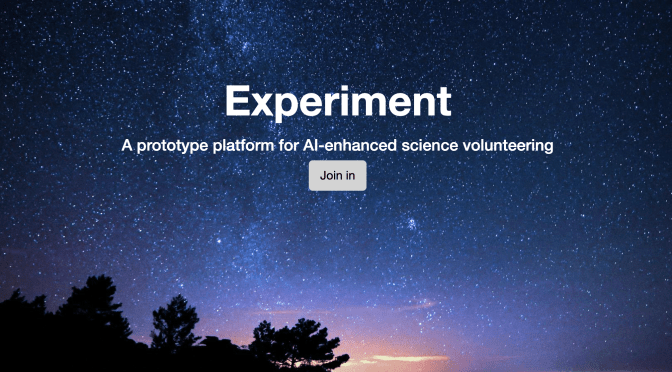
As you know, we take great care in testing any project which appears here on Zooniverse – thanks to expert review and our valuable volunteer panel of beta reviewers — to make sure that it works for a broad range of volunteers and our supported browsers. We believe in this process and remain committed to supporting and advancing the Zooniverse platform and its projects. But sometimes there’s a need for a more experimental approach – for trying out new modes of interaction, for complex projects that integrate machine learning, or just for doing something new. So we’re partnering with Mike’s *Experiment* to provide Zooniverse volunteers with the chance to take part in projects beyond the core Zooniverse platform. Such projects will be run by people we trust, and the goals of any project we link to will be the same as any other Zooniverse project – to provide insight through working with a distributed crowd of volunteers. But it may be that the tech is a little less robust or the projects look less polished than you’re used to. Projects may also come and go much more rapidly than is common in the Zooniverse. Wherever we mention such a project on the Zooniverse site, we’ll clearly tell you that we’re linking to an Experiment Project outside of the Zooniverse platform.
So, welcome Experiment. They have four small projects up already, where you can use a new brush tool to mark features of galaxies from the Euclid space telescope, and there’s more to come. We hope you’ll enjoy this new way of participating in projects.
FAQ
Who built Experiment and who runs and maintains Experiment? Mike Walmsley and his team at the University of Toronto.
What data will Zooniverse share with Experiment? We’re enabling log in with your Zooniverse account. If you choose to use the Zooniverse login this will share only your Zooniverse username and email address with the Experiment project team. You’ll be asked explicitly to approve this before this happens.
Does Experiment share data with the Zooniverse platform? All data submitted via Experiment is outside the Zooniverse platform, is not shared with Zooniverse, and is not subject to the Zooniverse user agreement and privacy policy. You can see the terms of service and privacy policy for Experiment here: Experiment Terms of Service and Privacy Policy
Can I track my classifications? Because data is stored outside the Zooniverse platform, participation in Experiment projects is not captured in Zooniverse’s database and will not be included in your Zooniverse stats.
How do I give feedback? For these initial Experiment projects, please share your thoughts on the Talk pages for Galaxy Zoo and Stellar Streams, and the researchers leading each Experiment project will respond. For anything else, you’re always welcome to get in touch with the Zooniverse team: contact@zooniverse.org.
Are you looking for a Zooniverse project in a language other than English? Here is the latest update on what is available, as of 1 July 2025. Many thanks to our amazing volunteers who contributed.
By the way, anyone can become a translator on Zooniverse. Here is how.
All Zooniverse projects are created in English. But many of them are available in different languages – from Armenian and Chinese to Korean and Hungarian. Here is the latest list of translated projects.
The truth is, everyone can become a translator on Zooniverse! But how do you do that? We talked with some of our amazing volunteers who helped various research teams to translate their projects, and here is what we’ve learned.
Zooniverse translators come from all walks of life
Jiří Podhorecký (@trendspotter) lives in Cesky Krumov, a small beautiful town in the Czech Republic. He works in tourism and spends most of his free time supporting various IT projects focusing on ecology, nature conservation and virtual volunteering. Translating the Zooniverse platform and projects into Czech is one of these projects.
InoSenpai (イノ先輩) is a citizen scientist in her 20s in Japan. She studied astronomy in college, but now has another job. She has translated more than 30 Zooniverse space projects into Japanese and she even created a blog in order to introduce them to the Japanese people.
Aarush Naskar (@Sunray_2013) from India is the youngest translator on Zooniverse! He is an amateur astronomer. Story writing, sky watching, reading and coding are his main interests.
Jason Richye is an international student from Indonesia. He is 18 years old and is a business major student. His hobbies are playing basketball, listening to music and watching movies, especially action, comedy and horror.
Louis Verhaeghe (@veragon) is a young French electrical technician passionate about astronomy and astrophysics. As an amateur astronomer, he loves immersing himself in the vastness of the universe and gaining a deeper understanding of what surrounds us. In September 2024, he reached a major milestone: more than 50 projects fully translated into French!
Aarush Naskar (@Sunray_2013) from India is the youngest Zooniverse translator
They translate to help more people discover Zooniverse
Jiří: “I wish that once in the future the whole Zooniverse was available to people in my language. I think that there is a huge and untapped potential in people of all ages, but especially in young people, to build a positive relationship with the world around us and to contribute to it in some way. Citizen science can be an enjoyable and unencumbered contribution to the community that will eventually process this citizen science into real science.”
イノ先輩: “Since Zooniverse is not well known in Japan, I am currently working as a Japanese translator for a number of projects to create a foundation for Japanese users to participate in Zooniverse without feeling any barriers.”
Aarush: ”I was attending a citizen science seminar hosted by the Kolkata Astronomy Club, which my father is the co-founder of, so naturally, I was also a part of it, when I heard about a boy who translated Einstein@Home: Pulsar Seekers to Bengali, so I decided to translate projects to Hindi. I know both Hindi and Bengali, but I am more comfortable with Hindi in terms of writing. It also motivated me that if I translated projects, more people would be able to do them. I also did it thinking I would know more Hindi words.”
Jason: “I’ve always wanted to be part of a research project and contribute in a meaningful way, even in a small role. When I saw one of the translation projects last winter in 2024, I remember feeling genuinely excited. I thought, “This is something I could actually help with.” So when I had the chance to volunteer, I was happy to be involved. Translating made me feel like I was part of something bigger, helping bridge gaps and support the research in a real, practical way.”
Louis (@veragon): “I have been contributing to the Zooniverse platform for almost nine years now. Initially, between 2017 and 2019, I focused exclusively on classifying images and scientific data. In fact, I have surpassed 12,900 classifications! But in late 2019, as my English improved, I asked myself: why not translate projects into French? This would allow more French speakers to get involved in citizen science and contribute to various research initiatives.
It is an immense source of pride for me to contribute, in my own way, to making science more accessible. It is important for me to translate these projects because science should be open to everyone. Many research projects rely on public participation, but the language barrier can be a major obstacle. By translating these projects, I enable thousands of people who are not fluent in English to contribute to scientific research. And the more participants there are, the more high-quality data researchers can gather. It’s a virtuous cycle!”
Louis Verhaeghe (@veragon) translated more than 50 Zooniverse projects into French
Translation expands your knowledge
Aarush: “It is funny that I make a lot (not that many!) mistakes when writing Hindi in real life but I make only some mistakes while translating.”
Jiří: “Fortunately for me, the process is already quite easy, not least because information technology helps us all to get in touch today. The enriching part is always the beginning, when you need to dig into the philosophy of the project and understand how best to use language to express yourself accurately.”
イノ先輩: “I love astronomy, but it has been difficult to love and have knowledge of all of this entire broad field equally. I have always been interested in the classification of light curves of variable stars and how to read radar observation data of meteors, but I had avoided them because they seemed difficult, but I was able to learn them in one week through translation.
The process of grasping all of that content in one’s own brain, reconstructing it in one’s native language, and outputting it is far more effective than simply reading and learning.”
And it makes you realise that your efforts really matter!
イノ先輩: “It is not only the light side of the researcher that we see when we do translations. Unfortunately, we also encounter projects that have been abandoned due to lack of bearers.
Behind this may be issues such as the reality of researchers being chronically overworked and the instability of their posts. But it is not only the beautiful and exciting top part, but also the glimpse into a part of the research project that makes us realize that we are not customers or students, but co-members of the project.”
Jiří: “Citizen science knows no boundaries! You can be all over the world. And it will give you back a strong sense of meaningful help, usefulness, confidence and joy.”
Jason: “You don’t need to be an expert to make a difference.”
Louis: “Together, we can make science more accessible and understandable for everyone. Every contribution matters, and the more of us there are, the greater our impact!”
Jiří Podhorecký (@trendspotter) wishes that once in the future the whole Zooniverse was available to people in Czech.
We asked if they had any advice for aspiring translators
Jason: “Take your time, ask questions, and focus on clarity. It’s a fun way to learn and be part of something meaningful.”
イノ先輩: “Add a bit of playfulness to your project title when you rewrite it in your native language! Mix in parodies and phrases that are unique to the respective cultures of each linguistic area, but only to the extent that they do not detract from the essence of the project. The title of the project may be the reason why some people are interested in it.”
Louis: “If you believe you have a good enough understanding of the languages you’re translating, then go for it! Reach out to various projects that haven’t been translated into your language and offer to translate them. Help us make science more accessible to the entire world!”
Jiří: “Your translation will make it easier for people who may know a foreign language, but whose native language is still closest to them. Without it, they would hardly, if ever, know about the Zooniverse. Oddly enough, language and territorial barriers sometimes serve more as a tool to better divide society. Don’t give up and bring foreign ideas, experience and science to people who need to learn about it in their own language.”
It is easy to start!
Louis: “I started my first translations by directly reaching out to project leaders and offering to translate their projects into French. Over time, I learned how to use Zooniverse’s translation tool, which turned out to be quite intuitive. This approach allowed me to better understand the process and refine my working method.”
Are you interested in volunteering as a Zooniverse translator?
Then you should definitely try it! Here is how:
1. Choose the project you would like to translate
2. Send a message to one of the research team members (privately or on their Talk)*
5. When you are done, let the team know and they will activate your translation to be visible for everyone on Zooniverse!
*An example of a message: “Hello! I’ve enjoyed working on your project (title) and would love to help translate it into (language). Do you think it could be useful? If so, please assign me the Translator role and I will give it a try!”
Are you a researcher looking to set up translations for your project? Please read these instructions. Contact us at contact@zooniverse.org if you need additional support. Please note that the Zooniverse team cannot recommend volunteers translators for your project.
The Vera C. Rubin Observatory is a powerful new facility high in the dry Chilean mountains. Today, on 23 June 2025, for the first time, it is releasing images from its Legacy Survey of Space and Time camera. At 3200 megapixels, this largest camera ever built will allow us to see the universe in a new way. And with Zooniverse, everyone can join and help with discoveries!
Read on to learn more.
NSF-DOE Rubin Trifid and Lagoon Nebulas. Image credit: NSF-DOE Vera C. Rubin Observatory
The “First Look”: The new way of viewing the sky
The first images from the NSF–DOE Vera C Rubin Observatory, our new eye on the sky based high in the Chilean desert, have been released today. The culmination of more than a decade of effort by a team of engineers and scientists, these glimpses of what this new instrument is capable of mark the start of a new way of viewing the sky – and Zooniverse will be a significant part of it. The Observatory’s Legacy Survey of Space and Time (LSST) will start soon, producing data at a scale that means the efforts of volunteers to sort through it and make discoveries will be invaluable.
The images featured in today’s ‘First look’ event were taken by the observatory’s mighty LSSTCam, the instrument which will be the observatory’s workhorse for the next decade and at 3200 megapixels the largest ever built, will manage. They provide a glimpse into the new survey’s ability to catch the changing sky, tracking millions of new asteroids and discovering thousands of supernovae, as well as more exotic and hopefully unexpected events.
NSF-DOE Rubin Virgo cluster 2. Image credit: NSF-DOE Vera C. Rubin Observatory
Vera Rubin Observatory images on Zooniverse
These images are a significant milestone, and all of us at Zooniverse congratulate our partners in the international LSST collaboration on getting here. In the near future – hopefully in just a few days – scientists will get their hands on a first tranche of testing data and, because Zooniverse is a core part of their plans, we should expect to see the first citizen science projects launch shortly thereafter. Once the survey itself gets going later in the year, and when the first of the annual data releases happens next year, we should see a steady flow of Rubin data in Zooniverse projects old or new.
NSF-DOE Rubin Virgo cluster 1. Image credit: NSF-DOE Vera C. Rubin Observatory
Be part of discovery
Whenever astronomers have found a new way of looking at the sky, and thereby opened up a new window on the Universe, we’ve been surprised. A survey of the whole sky, carried out with a telescope that’s the equal of any in the world, and with an immensely sophisticated camera and software pipeline to match, definitely counts. Join us in this first look at the Rubin Observatory sky – and then hang on. We’re all on what looks set to be a fantastic, decade long voyage of discovery.
The world's largest and most popular platform for people-powered research. This research is made possible by volunteers—millions of people around the world who come together to assist professional researchers.








 Zooniverse