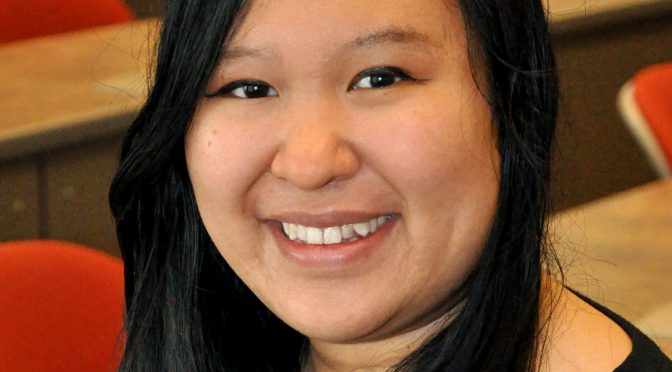
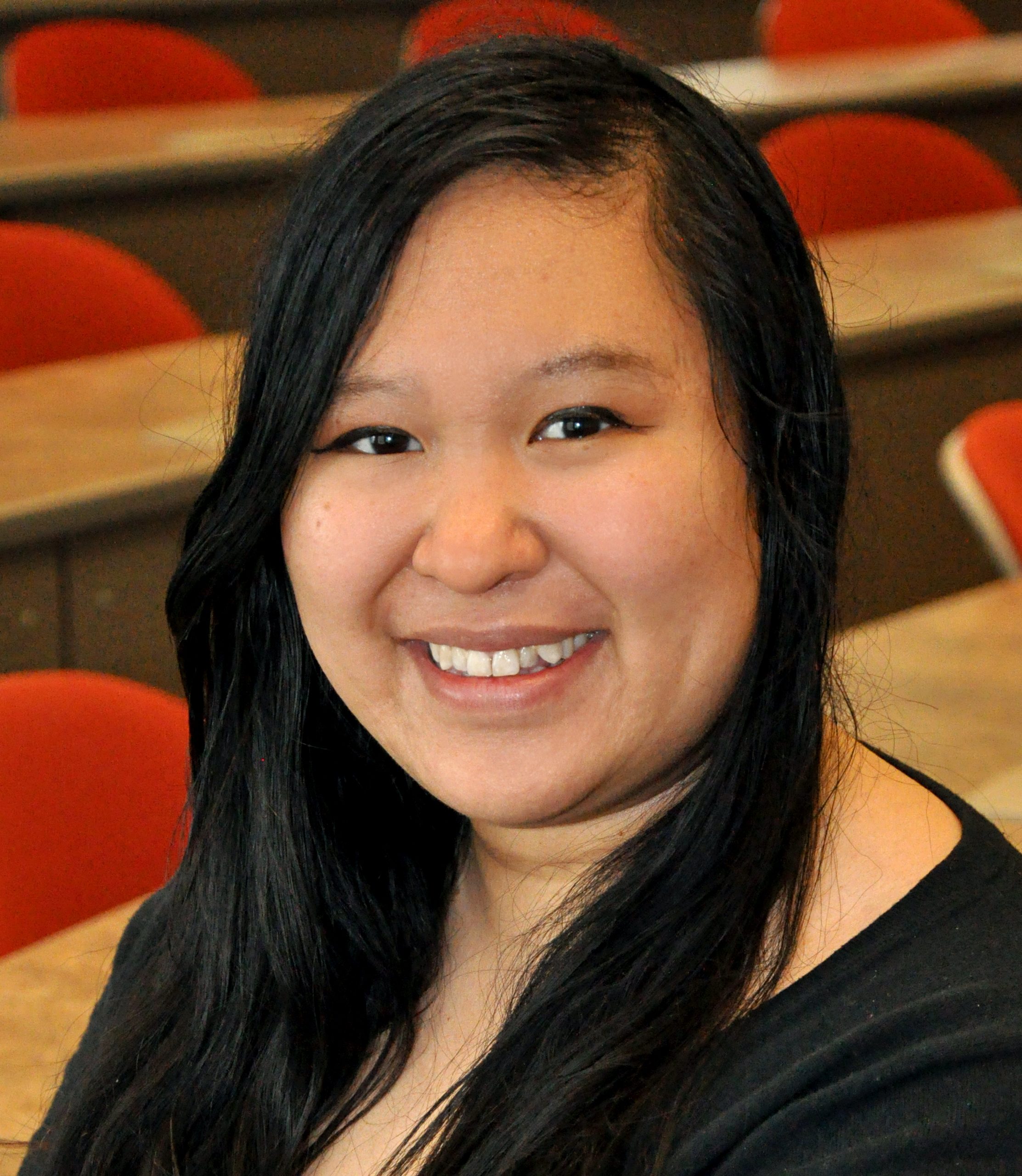
In this edition of Who’s who in the Zoo, meet Michelle Yuen, a Zooniverse backend developer.
Who: Michelle Yuen, Backend developer at Zooniverse
Location: Adler Planetarium, Chicago USA
Zooniverse projects: Panoptes, ERAS (Stats service), Talk API, Caesar
What’s something people might not expect about your job or daily routine?
People assume I just sit and code all day, but most of my time is spent playing detective with invisible problems—tracking down mysterious server crashes, optimizing data no one ever sees, or convincing stubborn APIs to behave. Basically, I fight invisible fires and hope no one notices.
Outside of work, what do you enjoy doing?
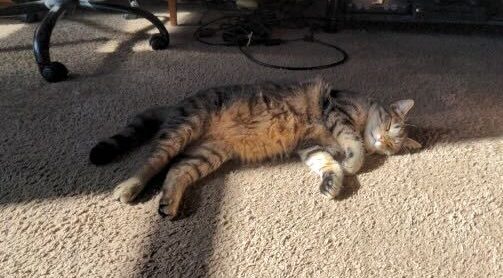
Outside of work, I enjoy playing tennis and pickleball. I enjoy cuddling with my cat, Bela. I love all things Disney and am also a cozy gamer—I’m currently hooked on Dreamlight Valley. I’m passionate about baking and often bring in my test recipes and treats for my colleagues at the Adler to try.
What are you favourite citizen science projects?
I’ve enjoyed working with Active Asteroids in the past and even spoke about Zooniverse at a tech conference, where I highlighted what the classification process looks like using Active Asteroids as an example project (you can learn more here).
What guidance would you give to other researchers considering creating a citizen research project?
Remember that community matters. Treating volunteers as partners, staying engaged, and sharing progress helps make the experience rewarding for everyone involved 🙂
Is there anything else you’d like to share with our readers?
It’s really wonderful to see how thoughtful and engaged the Zooniverse community is—from volunteers to researchers and everyone in between. The genuine enthusiasm people bring to supporting and advancing research is incredibly meaningful. I’m deeply grateful to be part of this community; it truly makes coming to work each day a joy.
In this edition of Who’s who in the Zoo, meet Oluwatoyosi Oyegoke, a Zooniverse backend developer.
Who: Oluwatoyosi Oyegoke, Backend developer at Zooniverse
Location: University of Oxford
Zooniverse projects: Panoptes API, Panoptes Python Client & CLI, KaDE (Knowledge and Discovery Engine), BaJor (Azure Batch Job Runner), Active Learning Pipelines
What is your research about?
My work focuses on helping scientists manage the huge amount of data created by Zooniverse projects. These projects can produce millions of images from telescopes, wildlife cameras, or research surveys. Volunteers classify these images, and I build the systems that collect this information and make it useful for researchers.
I work on the Panoptes API, which is the core platform that stores project data and volunteer classifications. I also improve the Python client and CLI so researchers can easily access and analyse their data. Another part of my role involves building and maintaining the machine learning pipelines. These pipelines take the volunteer classifications, train models, run predictions, and manage large Azure Batch jobs.
In simple terms: scientists and volunteers create the data, machine learning tries to learn from it, and I build the tools and backend systems that help everything work together smoothly. My work makes it easier for researchers to understand very large datasets by improving the platforms and workflows behind the scenes.
How do Zooniverse volunteers contribute to your research?
Zooniverse volunteers play a central role in how the whole platform functions. They create the classifications that flow through the systems I work on, and their input is what brings each project to life. When a project is created, volunteers are the ones who generate the data that the platform processes, stores, and makes available to researchers.
My work focuses on the core systems behind this experience. I help maintain and improve the Panoptes API, the tools researchers use to access data, and the pipelines that handle classification processing and machine learning.
Everything depends on volunteers contributing high-quality classifications, and their work is what keeps the entire platform active and meaningful. What I find exciting is seeing how thousands of people from around the world can come together and create data that supports real scientific discovery. My role is to make sure the systems behind that process are fast, reliable, and able to handle the huge amount of participation that Zooniverse projects receive.
While I do not work on individual research outputs, the systems I help build and maintain support all the scientific papers, datasets, and discoveries that come from Zooniverse projects. Without volunteers, and without the infrastructure behind them.
What’s a surprising or fun fact about your research field?
For me, one surprising thing is how global the participation is. A project can receive classifications from people in completely different parts of the world within the same minute. It amazes me how many people contribute to science from their sofa, their commute, or wherever they happen to be.
What first got you interested in research?
I love working on systems that have a direct impact, and the mix of technology, community, and science is what keeps it exciting.
What’s something people might not expect about your job or daily routine?
One thing people might not expect is how often small changes make a big impact. Sometimes a single line of code or a small optimisation can improve performance for millions of classifications. It’s a very technical role, but it’s also rewarding to know that quiet, invisible work can support so many people doing science together.
Outside of work, what do you enjoy doing?
Outside of work, I spend my weekends playing football with friends. I also spend a lot of time playing video games like FIFA and GTA. It’s my favourite way to unwind and switch off. I also enjoy watching documentaries, especially ones about historical events, and I love exploring new technologies just out of curiosity. It keeps things fun and gives me something new to learn all the time.
Is there anything else you’d like to share with our readers?
I’d just like to say that being part of Zooniverse has shown me how powerful community-driven science can be. Every contribution, no matter how small, helps move real research forward. It’s a privilege to help build the systems that make that possible, and I’m excited to see what volunteers and researchers will discover next.
In this edition of Who’s who in the Zoo, meet Adam McMaster, a Research Fellow working at the University of Southampton
Who: Adam McMaster, Research Fellow
Location: University of Southampton, UK
Zooniverse projects: Black Hole Hunters, SuperWASP Variable Stars
What is your research about?
I search archives of astronomical observations, looking for patterns which might be caused by interesting types of star or rare astronomical events. I work with so-called “time series” data, which is where measurements are taken repeatedly over time. In my case, I’m looking at how the brightness of stars changes over anything from days to years. In SuperWASP Variable Stars, we’re looking for certain kinds of repeating variability, such as eclipses and pulsations, in data originally collected by the SuperWASP exoplanet search. In Black Hole Hunters, we’re looking for a type of gravitational microlensing, where a black hole briefly magnifies the light from a star, and we’re currently searching the archives of the TESS exoplanet search, with plans to add data from several other surveys in the near future.
How do Zooniverse volunteers contribute to your research?
The volunteers make our projects possible. We’re looking for the things that get missed by automated searches. Computer algorithms are great at finding a lot of things, but no matter how good they are there will always be things that they miss. Slightly odd looking examples, noisy data, and unexpected things that no one knew to program the computer to find. Only people can find these things, and there is simply too much data to look through ourselves.
In SuperWASP Variable Stars, we’re looking for stars that have been missed in previous searches of the data. The SuperWASP data can be particularly noisy, which can make searching it a challenge. We’ve found that people are really good at separating the noise from the real thing. We’ve written up and published some of the results of this project already, and we publish an interactive database of the results at superwasp.org.
In Black Hole Hunters, the microlensing events we’re looking for are expected to be the hardest ones to spot. Even with really high quality data, we expect the most interesting events to barely stand out against the background noise. That’s what makes a manual search so useful.
What’s a surprising or fun fact about your research field?
The Milky Way is predicted to contain millions of black holes, but we only know about roughly 70 of them. Those were almost all spotted because they’re not really black, at least in X-rays. They’re very bright in X-rays because they’re consuming matter, which heats up as it falls into the black hole. The vast majority of black holes are not expected to be feeding and should truly be black. Those are the ones we’re looking for! We can’t see the black holes themselves, but we should be able to see the effects of their gravity. That’s why we think gravitational microlensing is a good way to find them.
What first got you interested in research?
I have always been interested in science and astronomy for as long as I can remember. I had a telescope as a kid, and I remember going outside to look at the comet Hale-Bopp with my dad. I’m afraid I don’t really remember the first time I thought about actually doing research myself, but I took a rather indirect route to get here. Despite being interested in research (and almost doing a computer science PhD), after university I first worked as a web developer for a few years before eventually finding my way to an astronomy PhD.
Outside of work, what do you enjoy doing?
I’d honestly love just to be able to spend a day sitting and reading a book, but these days my children take up most of my spare time (and energy)! Maybe I’ll be able to do that again in a few years. Also, nothing beats a long walk in the country with the dog.
What are you favourite citizen science projects?
It’s been a long time since it was active, but I always had a soft spot for the SETI Live project here on the Zooniverse. It was obviously unlikely to find anything, but there was something exciting about working on data in real time as it came off of the telescope.
What guidance would you give to other researchers considering creating a citizen research project?
If you’ve never done it before, talk to those of us who have! Especially when it comes to the Zooniverse, everyone is very friendly and happy to help, so there’s no need to try and figure everything out on your own.
All Zooniverse projects are created in English. But many of them are available in different languages – from Armenian and Chinese to Korean and Hungarian. Here is the latest list of translated projects.
The truth is, everyone can become a translator on Zooniverse! But how do you do that? We talked with some of our amazing volunteers who helped various research teams to translate their projects, and here is what we’ve learned.
Zooniverse translators come from all walks of life
Jiří Podhorecký (@trendspotter) lives in Cesky Krumov, a small beautiful town in the Czech Republic. He works in tourism and spends most of his free time supporting various IT projects focusing on ecology, nature conservation and virtual volunteering. Translating the Zooniverse platform and projects into Czech is one of these projects.
InoSenpai (イノ先輩) is a citizen scientist in her 20s in Japan. She studied astronomy in college, but now has another job. She has translated more than 30 Zooniverse space projects into Japanese and she even created a blog in order to introduce them to the Japanese people.
Aarush Naskar (@Sunray_2013) from India is the youngest translator on Zooniverse! He is an amateur astronomer. Story writing, sky watching, reading and coding are his main interests.
Jason Richye is an international student from Indonesia. He is 18 years old and is a business major student. His hobbies are playing basketball, listening to music and watching movies, especially action, comedy and horror.
Louis Verhaeghe (@veragon) is a young French electrical technician passionate about astronomy and astrophysics. As an amateur astronomer, he loves immersing himself in the vastness of the universe and gaining a deeper understanding of what surrounds us. In September 2024, he reached a major milestone: more than 50 projects fully translated into French!
Aarush Naskar (@Sunray_2013) from India is the youngest Zooniverse translator
They translate to help more people discover Zooniverse
Jiří: “I wish that once in the future the whole Zooniverse was available to people in my language. I think that there is a huge and untapped potential in people of all ages, but especially in young people, to build a positive relationship with the world around us and to contribute to it in some way. Citizen science can be an enjoyable and unencumbered contribution to the community that will eventually process this citizen science into real science.”
イノ先輩: “Since Zooniverse is not well known in Japan, I am currently working as a Japanese translator for a number of projects to create a foundation for Japanese users to participate in Zooniverse without feeling any barriers.”
Aarush: ”I was attending a citizen science seminar hosted by the Kolkata Astronomy Club, which my father is the co-founder of, so naturally, I was also a part of it, when I heard about a boy who translated Einstein@Home: Pulsar Seekers to Bengali, so I decided to translate projects to Hindi. I know both Hindi and Bengali, but I am more comfortable with Hindi in terms of writing. It also motivated me that if I translated projects, more people would be able to do them. I also did it thinking I would know more Hindi words.”
Jason: “I’ve always wanted to be part of a research project and contribute in a meaningful way, even in a small role. When I saw one of the translation projects last winter in 2024, I remember feeling genuinely excited. I thought, “This is something I could actually help with.” So when I had the chance to volunteer, I was happy to be involved. Translating made me feel like I was part of something bigger, helping bridge gaps and support the research in a real, practical way.”
Louis (@veragon): “I have been contributing to the Zooniverse platform for almost nine years now. Initially, between 2017 and 2019, I focused exclusively on classifying images and scientific data. In fact, I have surpassed 12,900 classifications! But in late 2019, as my English improved, I asked myself: why not translate projects into French? This would allow more French speakers to get involved in citizen science and contribute to various research initiatives.
It is an immense source of pride for me to contribute, in my own way, to making science more accessible. It is important for me to translate these projects because science should be open to everyone. Many research projects rely on public participation, but the language barrier can be a major obstacle. By translating these projects, I enable thousands of people who are not fluent in English to contribute to scientific research. And the more participants there are, the more high-quality data researchers can gather. It’s a virtuous cycle!”
Louis Verhaeghe (@veragon) translated more than 50 Zooniverse projects into French
Translation expands your knowledge
Aarush: “It is funny that I make a lot (not that many!) mistakes when writing Hindi in real life but I make only some mistakes while translating.”
Jiří: “Fortunately for me, the process is already quite easy, not least because information technology helps us all to get in touch today. The enriching part is always the beginning, when you need to dig into the philosophy of the project and understand how best to use language to express yourself accurately.”
イノ先輩: “I love astronomy, but it has been difficult to love and have knowledge of all of this entire broad field equally. I have always been interested in the classification of light curves of variable stars and how to read radar observation data of meteors, but I had avoided them because they seemed difficult, but I was able to learn them in one week through translation.
The process of grasping all of that content in one’s own brain, reconstructing it in one’s native language, and outputting it is far more effective than simply reading and learning.”
And it makes you realise that your efforts really matter!
イノ先輩: “It is not only the light side of the researcher that we see when we do translations. Unfortunately, we also encounter projects that have been abandoned due to lack of bearers.
Behind this may be issues such as the reality of researchers being chronically overworked and the instability of their posts. But it is not only the beautiful and exciting top part, but also the glimpse into a part of the research project that makes us realize that we are not customers or students, but co-members of the project.”
Jiří: “Citizen science knows no boundaries! You can be all over the world. And it will give you back a strong sense of meaningful help, usefulness, confidence and joy.”
Jason: “You don’t need to be an expert to make a difference.”
Louis: “Together, we can make science more accessible and understandable for everyone. Every contribution matters, and the more of us there are, the greater our impact!”
Jiří Podhorecký (@trendspotter) wishes that once in the future the whole Zooniverse was available to people in Czech.
We asked if they had any advice for aspiring translators
Jason: “Take your time, ask questions, and focus on clarity. It’s a fun way to learn and be part of something meaningful.”
イノ先輩: “Add a bit of playfulness to your project title when you rewrite it in your native language! Mix in parodies and phrases that are unique to the respective cultures of each linguistic area, but only to the extent that they do not detract from the essence of the project. The title of the project may be the reason why some people are interested in it.”
Louis: “If you believe you have a good enough understanding of the languages you’re translating, then go for it! Reach out to various projects that haven’t been translated into your language and offer to translate them. Help us make science more accessible to the entire world!”
Jiří: “Your translation will make it easier for people who may know a foreign language, but whose native language is still closest to them. Without it, they would hardly, if ever, know about the Zooniverse. Oddly enough, language and territorial barriers sometimes serve more as a tool to better divide society. Don’t give up and bring foreign ideas, experience and science to people who need to learn about it in their own language.”
It is easy to start!
Louis: “I started my first translations by directly reaching out to project leaders and offering to translate their projects into French. Over time, I learned how to use Zooniverse’s translation tool, which turned out to be quite intuitive. This approach allowed me to better understand the process and refine my working method.”
Are you interested in volunteering as a Zooniverse translator?
Then you should definitely try it! Here is how:
1. Choose the project you would like to translate
2. Send a message to one of the research team members (privately or on their Talk)*
5. When you are done, let the team know and they will activate your translation to be visible for everyone on Zooniverse!
*An example of a message: “Hello! I’ve enjoyed working on your project (title) and would love to help translate it into (language). Do you think it could be useful? If so, please assign me the Translator role and I will give it a try!”
Are you a researcher looking to set up translations for your project? Please read these instructions. Contact us at contact@zooniverse.org if you need additional support. Please note that the Zooniverse team cannot recommend volunteers translators for your project.
The Community Catalog (https://community-catalog.zooniverse.org) is a custom tool to offer Zooniverse project participants the opportunity to explore a project dataset, and to allow our team to experiment with creating new pathways into classifying.
We wanted to create a digital space that would facilitate not only sharing, but also discovery of participants’ contributions alongside institutional information (i.e. metadata) about the subjects being classified. The result was a data exploration app connected to specific Zooniverse crowdsourcing projects (How Did We Get Here?and Stereovision) that allows users to search and explore each project’s photo dataset based on participant-generated hashtags as well as the institutional metadata provided by project teams.
The Home Page of the Stereovision project in the Community Catalog.
The app includes a home page (shown above) with search/browsing capabilities, as well as an individual page for each photograph included in the project. The subject page (shown below) displays any available institutional metadata, participant-generated hashtags, and Talk comments. A ‘Classify this subject’ button allows users exploring the data to go directly to the Zooniverse project and participate in whatever type of data collection is taking place (transcription, labeling, generating descriptive text, etc.).
The Subject Page of the Community Catalog, displaying a subject with multiple Talk comments and community-generated hashtags.
Combined with the Talk (and QuickTalk) features, we’re hoping that this tool will encourage participants to share their experiences, memories, questions, and thoughts about the project photos, the historical events depicted, and the importance of the collection. The Community Catalog offers an approach where a participant can allow their interest in a specific item to lead them to take part in a classification task, rather than classification to Talk being a one-way street.
How Did We Get Here? was the pilot project for the Community Catalog, and is now complete. We have just launched the second project to use the Catalog, Stereovision, which you can participate in either via the Community Catalog site, or by visiting the Zooniverse project here: Stereovision.
The Community Catalog is not available for re-use by other projects in this exact form (i.e. as a standalone app), but we’re planning to incorporate some of its features into the Talk section of the Zooniverse platform in 2025. If you have any questions or would like to share your thoughts about this app, please feel free to reply to this post, or email us at contact@zooniverse.org.
The Community Catalog was developed as part of the AHRC-funded project Communities and Crowds. This project is run in collaboration with volunteer researchers and staff at the National Science and Media Museum in Bradford, United Kingdom, and National Museums Scotland, as well as with the Zooniverse teams at Oxford University and the Adler Planetarium in Chicago.
Viewing the aurora in person is a magnificent experience, but due to location (or pesky clouds) it’s not always an option. Fortunately, citizen science projects like Aurorasaurus and Zooniverse’s Aurora Zoo make it easy to take part in aurora research from any location with an internet connection.
The Aurorasaurus Ambassadors group was excited to celebrate Citizen Science Month by inviting Dr. Daniel Whiter of Aurora Zoo to speak at our April meeting. In this post we bring you the highlights of his presentation, which is viewable in full here.
To ASK the Sky for Knowledge
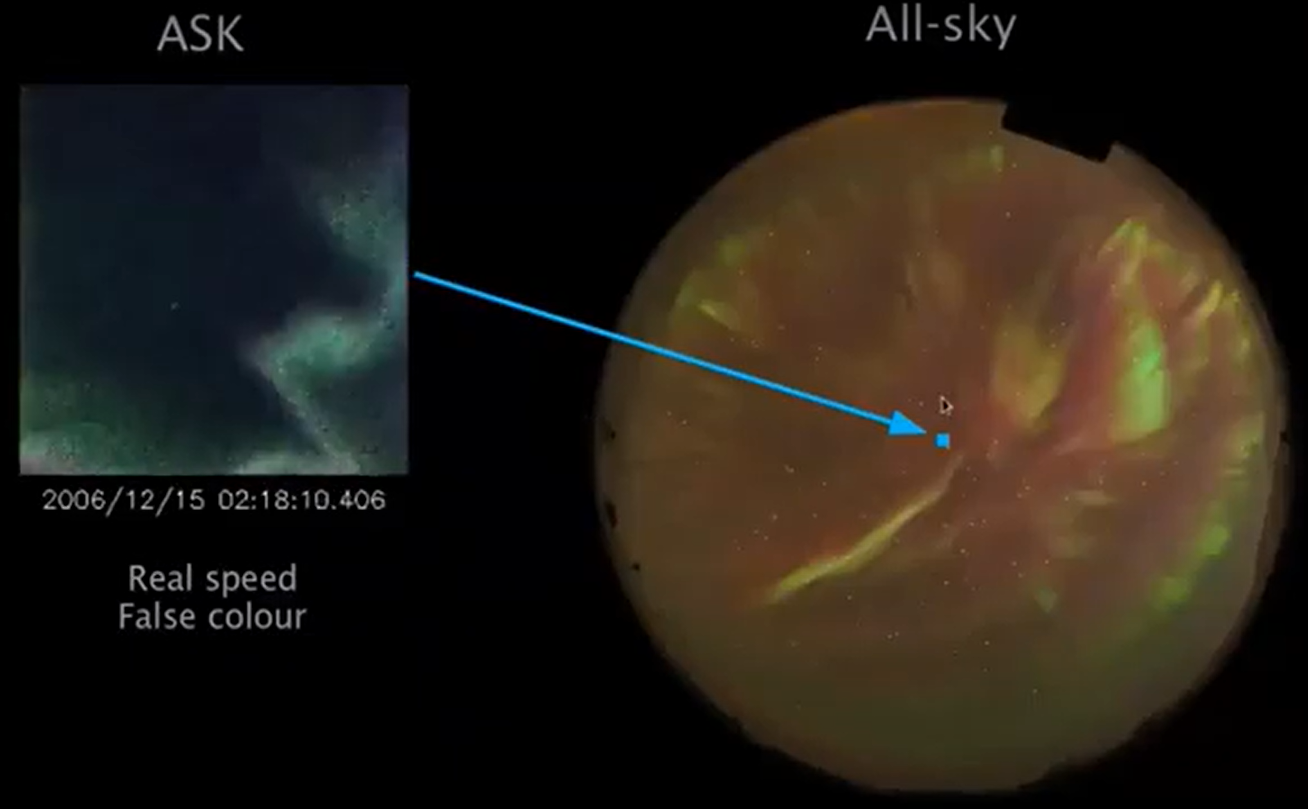
Far to the north on the Norwegian island of Svalbard, three very sensitive scientific cameras gaze at a narrow patch of sky. Each camera is tuned to look for a specific wavelength of auroral light, snapping pictures at 20 or 32 frames per second. While the cameras don’t register the green or red light that aurora chasers usually photograph, the aurora dances dynamically across ASK’s images. Scientists are trying to understand more about what causes these small-scale shapes, what conditions are necessary for them to occur, and how energy is transferred from space into the Earth’s atmosphere. ASK not only sees night-time aurora, but also special “cusp aurora” that occur during the day but are only visible in extremely specific conditions (more or less from Svalbard in the winter.)
Still from Dr. Whiter’s presentation. The tiny blue square on the allsky image (a fisheye photo looking straight up) represents the field of view of the ASK cameras. The cameras point almost directly overhead.
The setup, called Auroral Structure and Kinetics, or ASK, sometimes incorporates telescopes, similar to attaching binoculars to a camera. Project lead Dr. Daniel Whiter says, “The magnification of the telescopes is only 2x; the camera lenses themselves already provide a small field of view, equivalent to about a 280mm lens on a 35mm full frame camera. But the telescopes have a large aperture to capture lots of light, even with a small field of view.”
The challenge is that ASK has been watching the aurora for fifteen years and has amassed 180 terabytes of data. The team is too small to look through it all for the most interesting events, so they decided to ask for help from the general public.
Visiting the Aurora Zoo
Using the Zooniverse platform, the Aurora Zoo team set up a project with which anyone can look at short clips of auroras to help highlight patterns to investigate further. The pictures are processed so that they are easier to look at. They start out black and white, but are given “false color” to help make them colorblind-friendly and easier for citizen scientists to work with. They are also sequenced into short video clips to highlight movement. To separate out pictures of clouds, the data is skimmed by the scientists each day and run through an algorithm.
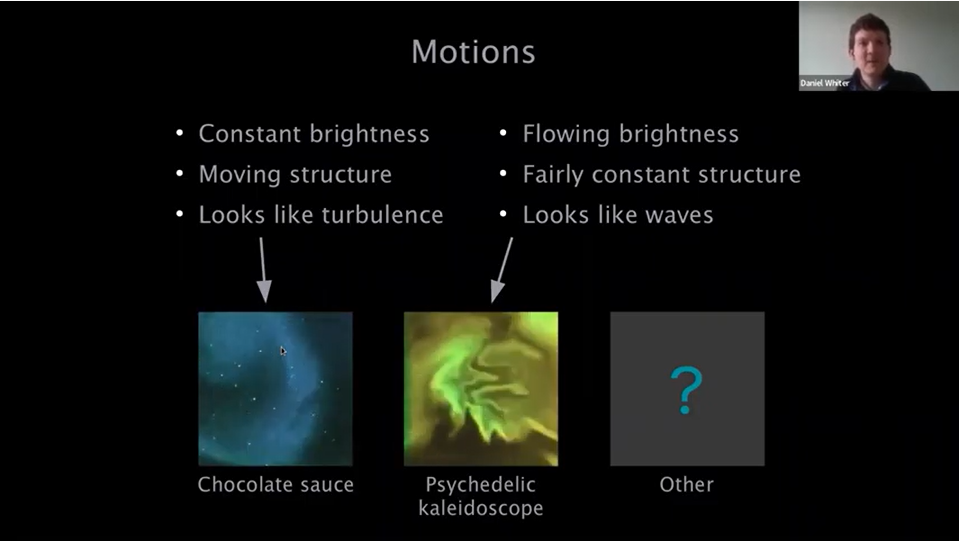
Aurora Zoo participants are then asked to classify the shape, movement, and “fuzziness,” or diffuse quality, of the aurora. STEVE fans will be delighted by the humor in some of the options! For example, two of the more complex types are affectionately called “chocolate sauce” and “psychedelic kaleidoscope.” So far, Aurora Zoo citizen scientists have analyzed 7 months’ worth of data out of the approximately 80 months ASK has been actively observing aurora. Check out Dr. Whiter’s full presentation for a walkthrough on how to classify auroras, and try it out on their website!
Some of the categories into which Zooniverse volunteers classify auroral movement. Credit: Dr. Daniel Whiter.
What can be learned from Aurora Zoo is different from other citizen science projects like Aurorasaurus. For example, when several arc shapes are close to one another, they can look like a single arc to the naked eye or in a photo, but the tiny patch of sky viewed through ASK can reveal them to be separate features. These tiny details are also relevant to the study of STEVE and tiny green features in its “picket fence”.
Early (Surprising!) Results
Aurora Zoo participants blew through the most recent batch of data, and fresh data is newly available. The statistics they gathered show that different shapes and movements occur at different times of day. For example, psychedelic kaleidoscopes and chocolate sauce are more common in the evening hours. The fact that the most dynamic forms show up at night rather than in the daytime cusp aurora reveals that these forms must be connected to very active aurora on the night side of the Earth.
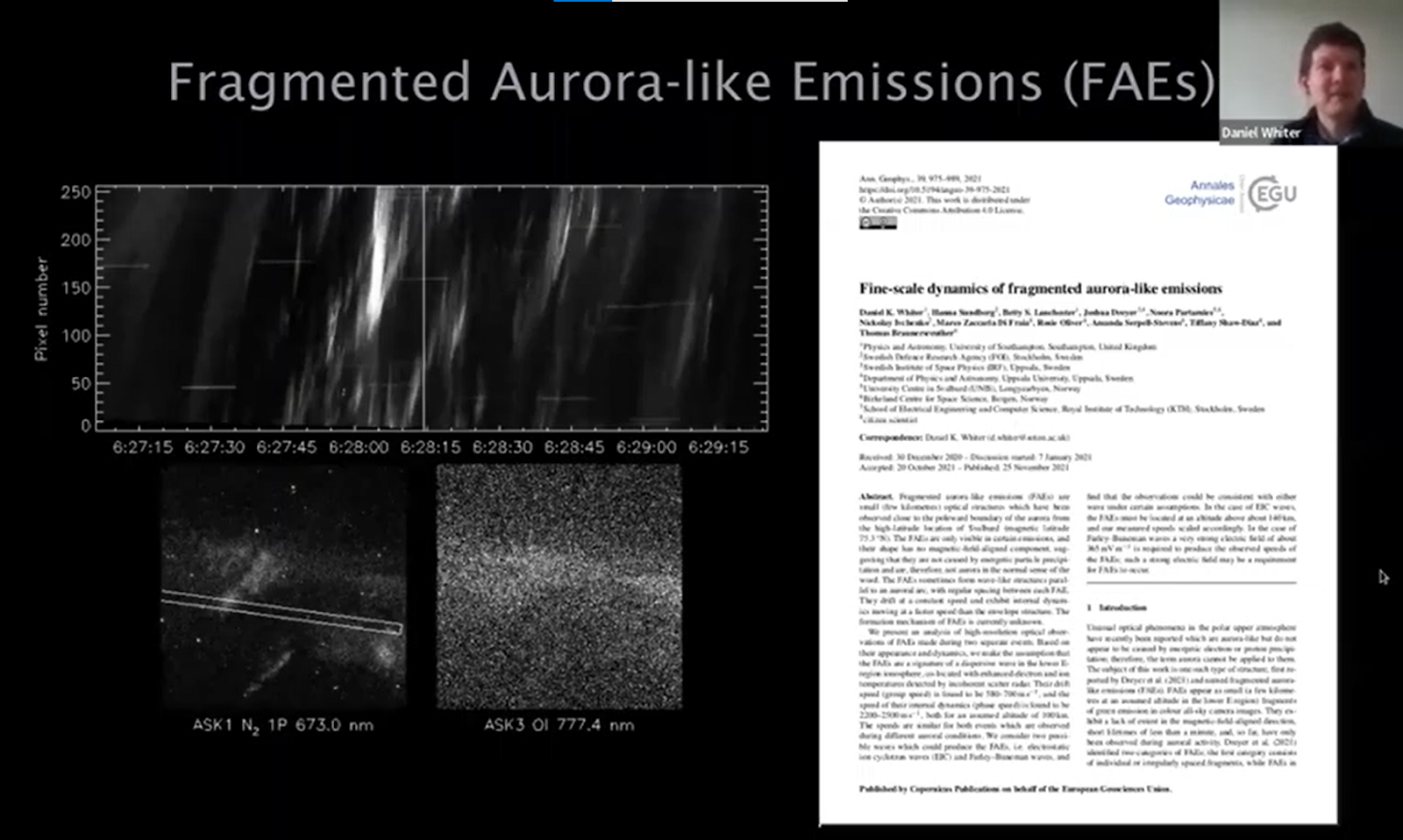
Aurora Zoo participants also notice other structures. Several noted tiny structures later termed “fragmented aurora-like emissions,” or FAEs. Because of the special equipment ASK uses, the team was able to figure out that the FAEs they saw weren’t caused by usual auroral processes, but by something else. They published a paper about it, co-authored with the citizen scientists who noticed the FAEs.
Still from Dr. Whiter’s presentation, featuring FAEs and Aurora Zoo’s first publication.
What’s next? Now that Aurora Zoo has a lot of classifications, they plan to use citizen scientists’ classifications to train a machine learning program to classify more images. They also look forward to statistical studies, and to creating new activities within Aurora Zoo like tracing certain shapes of aurora.
STEVE fans, AuroraZoo hasn’t had a sighting yet. This makes sense, because ASK is at a higher latitude than that at which STEVE is usually seen. However, using a similar small-field technique to examine the details of STEVE has not yet been done. It might be interesting to try and could potentially yield some important insights into what causes FAEs.
Citizen Science Month, held during April of each year, encourages people to try out different projects. If you love the beautiful Northern and Southern Lights, you can help advance real aurora science by taking part in projects like Aurora Zoo and Aurorasaurus.
About the authors of this blog post: Dr. Liz MacDonald and Laura Brandt lead a citizen science project called Aurorasaurus. While not a Zooniverse project, Aurorasaurus tracks auroras around the world via real-time reports by citizen scientist aurora chasers on its website and on Twitter. Aurorasaurus also conducts outreach and education across the globe, often through partnerships with local groups of enthusiasts. Aurorasaurus is a research project that is a public-private partnership with the New Mexico Consortium supported by the National Science Foundation and NASA. Learn more about NASA citizen science here.
Engaging Faith-based Communities in Citizen Science through Zooniverse was an initiative designed to broaden participation in people-powered research (also referred to as citizen science) among religious and interfaith communities by helping them to engage with science through Zooniverse. Citizen science is a powerful way to build positive, long-term relationships across diverse communities by “putting a human face” on science and scientists. Participating in real scientific research is a great way to learn about the process of science as well as the scientists who conduct research.
The Engaging initiative provided models for how creative partnerships can be formed between scientific and religious communities that empower more people to become collaborators in the quest for knowledge. It included integrating Zooniverse projects into seminary classes as well as adult, youth, and intergenerational programs of religious communities; and promoting Zooniverse among interfaith communities concerned with environmental justice. Among other things, the project’s evaluation highlighted the need for scientists to do a better job of engaging with religious audiences in order to address racial and gender disparities in science. I encourage Zooniverse research teams to check out the series of short videos recently released by the AAAS Dialogue on Science, Ethics, and Religion to help scientists engage more effectively with communities of faith. By interacting personally with these communities and helping to “put a human face” on science, you may not only increase participation in your research projects, but help in the effort to diversify science in general.
Despite the difficulties imposed by the pandemic, I’m encouraged by what the Engaging initiative achieved, and the possibilities for expanding its impact in the future! The summary article of this project was published on March 28, 2022 by the AAAS Dialogue on Science, Ethics, and Religion.
The project team thanks the Alfred P. Sloan Foundation for supporting this project. Any opinions, findings, or recommendations expressed are those of the project team and do not necessarily reflect the views of the Sloan Foundation.
These are strange times we live in. With many people ill or worried, and communities all over the world in lockdown or cutting out social contact in order to try and control the spread of the novel coronavirus, it’s hard to work out what the future holds.
The Zooniverse team – including our teams in Oxford and in Chicago – are all working from home, and we’re struggling to master how to communicate and work in this odd situation. So far we’ve encountered all sorts of weird glitches while trying to keep in touch.
Zoom backgrounds can be weird and terrifying, as demonstrated here by Sam.Why am I the only one with a profile picture?
But we are still here! As we know lots of you are turning to Zooniverse for a distraction while your lives are disrupted, we’ve asked our research teams to pay particular attention to their projects and to be even more present online during this time. We’ll try and bring you more news from them over the next few weeks.
Anyway, if any of you would like to distract yourselves by taking part and contributing to one of our projects, we’ve made it easier to find a new project to dive into. The top of our projects page now highlights selected projects – they will change frequently, and might be topical, timely, particularly in need of your help – or just our favourites!
Zooniverse projects succeed because they’re the collective work of many thousands of you who come together to collaborate with our research teams – and a little bit of collective action in the world right now feels pretty good.
Look after yourselves, and see you in the Zooniverse.
The US virgin Islands as seen from ESA’s Sentinel-2 satellite on 23rd August 2017. Pre-storm imagery like this is used to compare to post-storm images in order to spot major changes.
Irma has brought widespread devastation to many islands in the Caribbean over the last few days, and now Hurricane Jose is a growing threat in the same region.
By analysing images of the stricken areas captured by ESA’s Sentinel-2 satellites, Zooniverse volunteers can provide invaluable assistance to rescue workers. Rescue Global are a UK-based disaster risk reduction and response charity who are deploying a team to the Caribbean and will use the information you provide to help them assess the situation on the ground.
The last time The Planetary Response Network was brought online was to help in the aftermath of the 2016 Ecuador Earthquake. Back then over two thousand volunteers helped analyse almost 25,000 square kilometres of satellite imagery in only 12 hours, and we hope to be of help this time too!
Right now we have limited clear-sky images of the affected area, mostly around Guadeloupe, but we are working hard to upload images from the other islands as soon as possible.
I have some news to break to everyone. I’ve accepted a new position at a different company, and while it’s an extremely exciting opportunity for me, it does mean that I have to step away from the Community Builder role here.
This is a bittersweet announcement for me, because as exciting as my new job is for my career, I’ve truly loved my time at the Zooniverse, helping to grow this community and our platform and getting to know so many incredible volunteers, researchers, and staff.
However, I do want to emphasize that this is definitely not goodbye! I couldn’t possibly leave completely—there are so many projects here that I enjoy doing as much as you guys do, and so many exciting developments in the pipeline that I want to see pan out. I’m not going anywhere; instead, I’m becoming one of you: a Zooniverse volunteer. I won’t be your liaison anymore, or a source for reporting your needs, but I’ll continue to be your colleague in people-powered research.
The Zooniverse is growing and changing at an incredible rate right now, and has been for much of my time here over the past 14 months. Overall, I’m blown away by what you’ve all helped us to accomplish. Projects are being launched and completed quickly, and our new research teams are more attuned to volunteers’ needs than ever before. I’ve long believed that the launch of the Project Builder would begin a process of exponentially expanding the scope of the Zoo, and we are definitely beginning to see that happening. I can’t wait to find out, along with the rest of you, what the next chapter of this story has in store for us all.
Thank you all for everything, and I’ll be seeing you all around!
Yours in people-powered research,
Darren “DZM” McRoy
Special note from the ZooTeam — Thank you Darren for all your hard work over the years! We’re so excited for you and this new opportunity. And we very much look forward to continuing to build and strengthen the relationships between our volunteers, research teams, and the Zooniverse team. Thank you all for your contributions! Onward and upward.
The world's largest and most popular platform for people-powered research. This research is made possible by volunteers—millions of people around the world who come together to assist professional researchers.






 Zooniverse