Tag Archives: Physics

Who’s who in the Zoo – Marianne Barrier

In this edition of Who’s who in the Zoo, meet Marianne Barrier, who is part of the Monkey Health Explorer team.
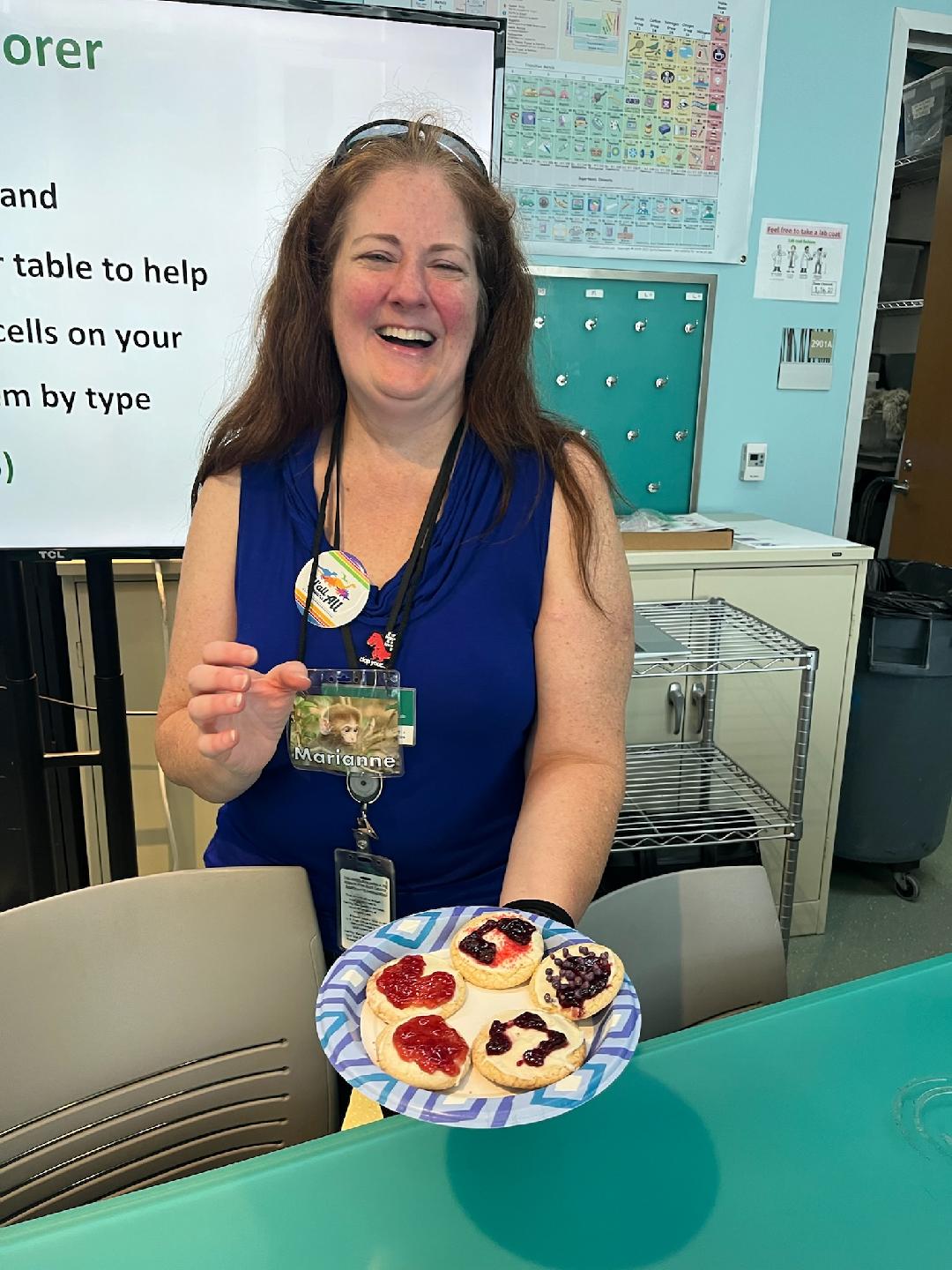

Who: Marianne Barrier, Lab Manager, Genomics & Microbiology Research Lab

Location: North Carolina Museum of Natural Sciences, Raleigh, NC, USA

Zooniverse project: Monkey Health Explorer

What is your research about?

I’m actually trained in genetics and using DNA as a tool, so I’ve had to expand my knowledge to other areas as we set up our Monkey Health Explorer project. This project is one piece of a larger puzzle being assembled by a collaborative group of scientists all studying different aspects of a colony of Rhesus macaque monkeys living on an island off the coast of Puerto Rico. Our piece involves examining the blood of these monkeys to get a snapshot of their health, just like when we have our blood drawn at a doctor’s office. The data we collect about the blood cells is then examined alongside data from other researchers, such as behavioral or gene expression data, to tell more about each monkey.

How do Zooniverse volunteers contribute to your research?

The primary focus of our project is to count the 5 types of white blood cells in blood smears in order to determine if these numbers are in the “normal” ranges for a healthy monkey or if they might indicate the monkey is sick. Our volunteers learn about the visual features of each type of white blood cell and contribute to our research by identifying the white blood cells in blood smear images from our monkeys. We then summarize the results from all volunteers to give us the white blood cell counts for each monkey sample.

In addition to helping us identify these cells, we have several volunteers who are trained cell professionals or medical or veterinary students who have given us additional insights into our monkeys. They have pointed out unique patterns in the cells that indicate specific illnesses, such as parasitic infections.

What’s a surprising or fun fact about your research field?

Rhesus macaque blood cells look very similar to human blood cells. I learned how to identify the cells in our project using training materials for human blood.

The “positive” and “negative” part of our blood types is called the “Rh factor” because that particular type of blood protein was first identified in Rhesus macaque monkeys.

What first got you interested in research?

I’ve always loved learning how things work and was a big fan of the TV show MacGyver because he could figure out how to resolve a problem by using items he had around him. This inspired me to think about how to approach a problem from multiple views and come up with potential solutions using standard and non-standard methods.

What’s something people might not expect about your job or daily routine?

The lab I work in is inside of a Museum and has glass walls, so visitors can watch us work. Sometimes when I step outside the lab, I end up talking with visitors about what we’re doing and answering their questions about what they can see, such as our DNA sequencers and liquid handling robot. We also have special events at the Museum where I have the opportunity to share about our Monkey Health Explorer project to visitors and also host teacher training workshops to show them how to incorporate our project into their classroom with the educational materials we’ve developed.

Outside of work, what do you enjoy doing?

My love of learning extends to everything – I read/listen to audiobooks (mysteries lately), have 3 languages going on Duolingo (French, Spanish, German), rotate between crafty hobbies (painting, drawing, knitting, 3D print design), play multiple instruments (learning drums now), and recently added 2 bee hives to our garden.

What are you favourite citizen science projects?

I do love adding photos to iNaturalist as I come across new (to me) creatures and plants as I explore outside.

What guidance would you give to other researchers considering creating a citizen research project?

I would suggest spending time exploring several projects that have similarities to what you’re thinking of designing and use these as guides to consider what type of information you want to get from your project and how best to design training to make it interesting and accessible to volunteers. Also, make use of the Zooniverse Talk to interact with other project researchers to gain insights and learn from them. It’s a great community with a wealth of knowledge and experience!
Who’s who in the Zoo – Ameenat Lola Solebo

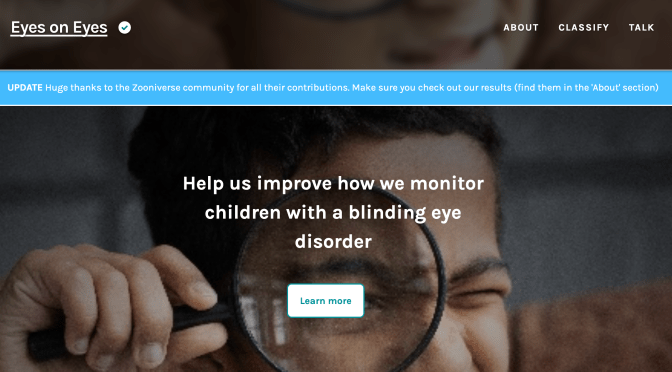
In this edition of Who’s who in the Zoo, meet Ameenat Lola Solebo who leads Eyes on Eyes ; a Zooniverse project that aims to improve how we monitor children with a blinding eye disorder.


Who: Ameenat Lola Solebo, Clinician Scientist (Paediatric Ophthalmology / Epidemiology & Health Data Science)

Location: UCL GOS Institute of Child Health and Great Ormond Street Hospital

Zooniverse project: Eyes on Eyes

What is your research about?

We’re asking Zooniverse volunteers to label eye images of children with or at risk of a blinding disease called uveitis. Early detection of uveitis means less chance of blindness, but it is becoming increasingly difficult for children to access the specialised experts they need to detect uveitis at an early stage (before the uveitis has caused damage in side the eye). New ‘OCT’ (eye cameras) may provide detailed enough images of the eye to allow even non specialists to detect uveitis at the early stages. Our research studies develop and evaluate OCT methods for uveitis detection and monitoring in children, and during these studies we collect a lot of data from children’s eyes – sometimes several hundred scans in different positions just from one child. We are hoping that we don’t need to keep on collecting this many images in the long run, but we have to know where and how best to look for problems.

How do Zooniverse volunteers contribute to your research?

Zooniverse volunteers are asked to label scans in different ways. They can tell us what they think of the quality of an individual scan – is it good enough to be useful? They can point out which features of the scan are making it poorer quality so that we can judge how useful it might be. They can draw regions of interest on the scan, helping to focus attention. They can also pick up the signs of uveitis – inflammatory cells floating around in the usually dark space inside the eye, looking like bright stars in a dark sky. They can tell us if they can see cells, how many cells they can see, and they can locate each cell for us. The quality judgements submitted by the volunteers have compared favourably to expert judgement, which is great. We have since developed a quality assessment algorithm based on labels from the Zooniverse volunteers. We are now looking to just how accurate the volunteer assessments of the images are compared to the clinical diagnosis of the child.

What’s a surprising fact about your research field?

Uveitis is often autoimmune, meaning your body turns against the delicate tissues in your eye — especially the uvea, a highly vascular layer that includes the iris. It’s like friendly fire… which is such an awful term, isn’t it?

What first got you interested in research?

I was tired of answering “we don’t know” when parents asked us questions about their child’s eye disease.

What’s something people might not expect about your job or daily routine?

Someone asked me how I put back the eye after doing eye surgery – ophthalmic surgeons do not, I repeat do not remove the eye from patients to operate on them! Also – I think that people may be surprised about how beautiful the eye looks when viewed at high mag. Ophthalmologists use a microscope called a slit lamp to look at and into a patient’s eye. The globe is such a fragile, well constructed, almost mystical body part, and vision is practically magic!

Outside of work, what do you enjoy doing?

I recently started karate. I am by far the oldest white belt and I am really loving making the KIAI! noises.

What are you favourite citizen science projects?

The Etch A Cell projects, because I learnt so much how to run my own project from that team and Black hole hunters, because they are great at describing what they have done with volunteer data.

What guidance would you give to other researchers considering creating a citizen research project?

Do it! And do it on Zooniverse, because the community is super engaged and the back of house team are so supportive. Stay active on talk boards to engage volunteers. And test, refine, test, refine your project until you start seeing it in your sleep.

And finally…

Thank you to all the volunteers who have been helping us!

Who’s who in the Zoo – Dr Travis Rector

Ever wondered what a Herbig-Haro object is? Find out in our latest edition of Who’s who in the Zoo with Dr. Travis Rector!


Who: Dr. Travis Rector, Professor

Location: University of Alaska Anchorage

Zooniverse project: Baby Star Search

What is your research about?

We are looking for Herbig-Haro (HH) objects, which are jets of gas produced by newly-forming protostars. They are important because they can show us where stars are forming right now. HH objects are quite beautiful and rare – only about a thousand of them are known to exist!

How do Zooniverse volunteers contribute to your research?

We are searching for HH objects in giant clouds of gas inside our galaxy using the Dark Energy Camera (DECam) on the Blanco 4-meter telescope at the Cerro Tololo Interamerican Observatory in Chile. The images produced by this camera are huge – 570 megapixels each – and are too big for a single person to look at. That’s where Zooniverse came in. We divided each image into smaller, 512×512, “cutouts” for people to search. We’ve completed the analysis and Zooniverse volunteers found 169 new HH objects! Considering only about 1200 were known to exist before this is a big increase.

What’s a surprising or fun fact about your research field?

Jets of gas occur in our universe on a wide range of scales. All of them are produced when gas is swirling around a central object. In the case of Herbig-Haro objects the jets are produced by gas moving around a protostar. These jets can extend over several light years. Jets are also produced by gas swirling around black holes. In quasars, these jets are powered by “supermassive” black holes and the jets produced can extend for several hundred thousand light years. What’s amazing is how similar all these jets are to each other despite the tremendous differences in size.

What first got you interested in research?

I first started doing research on quasar jets with Dr. David Hough when I was an undergraduate student at Trinity University.

What’s something people might not expect about your job or daily routine?

People often imagine that astronomers sit inside a dome every night looking through a telescope. In reality the telescopes we use have digital cameras and instruments that collect the data. Nowadays we can operate most telescopes remotely. So most of my research right now is done with telescopes in Chile that I can operate with my laptop computer from the comfort of my kitchen!

Outside of work, what do you enjoy doing?

One of my hobbies is turning the data we get from our telescopes into color images. They’re a great way to share the beauty of the universe, and share the research that we do. I’ve been doing this for over 25 years now, and most of these images are available in the NOIRLab image gallery. Living in Alaska I love to do a wide range of outdoor activities, but my passion is for snow. In particular I love to cross-country ski.

What are you favourite citizen science projects?

For years I’ve had my students to the Planet Hunters TESS project.

What guidance would you give to other researchers considering creating a citizen research project?

It was a lot easier than I had imagined it would be to set up. Zooniverse is great about helping out, and beta testers also had a lot of important feedback. Once your project is up and running be prepared for a tsunami of enthusiastic volunteers who will have a lot of questions. We also had several volunteers to translate our project into other languages, which was great for increasing participation.

And finally…

Here’s one of our color images of one of the regions we studied looking for Herbig Haro objects (you can read more about this here).

A celestial shadow known as the Circinus West molecular cloud

SuperWASP Variable Stars – Update

The following is an update from the SuperWASP Vairable Stars research team. Enjoy!

Welcome to the Spring 2020 update! In this blog, we will be sharing some updates and discoveries from the SuperWASP Variable Stars project.

What are we aiming to do?

We are trying to discover the weirdest variable stars!

Stars are the building blocks of the Universe, and finding out more about them is a cornerstone of astrophysics. Variable stars (stars which change in brightness) are incredibly important to learning more about the Universe, because their periodic changes allow us to probe the underlying physics of the stars themselves.

We have asked citizen scientists to classify variable stars based on their photometric light curves (the amount of light over time), which helps us to determine what type of variable star we’re observing. Classifying these stars serves two purposes: firstly to create large catalogues of stars of a similar type which allows us to determine characteristics of the population; and secondly, to identify rare objects displaying unusual behaviour, which can offer unique insights into stellar structure and evolution.

We have 1.6 million variable stars detected by the SuperWASP telescope to classify, and we need your help! By getting involved, we can build up a better idea of what types of stars are in the night sky.

What have we discovered so far?

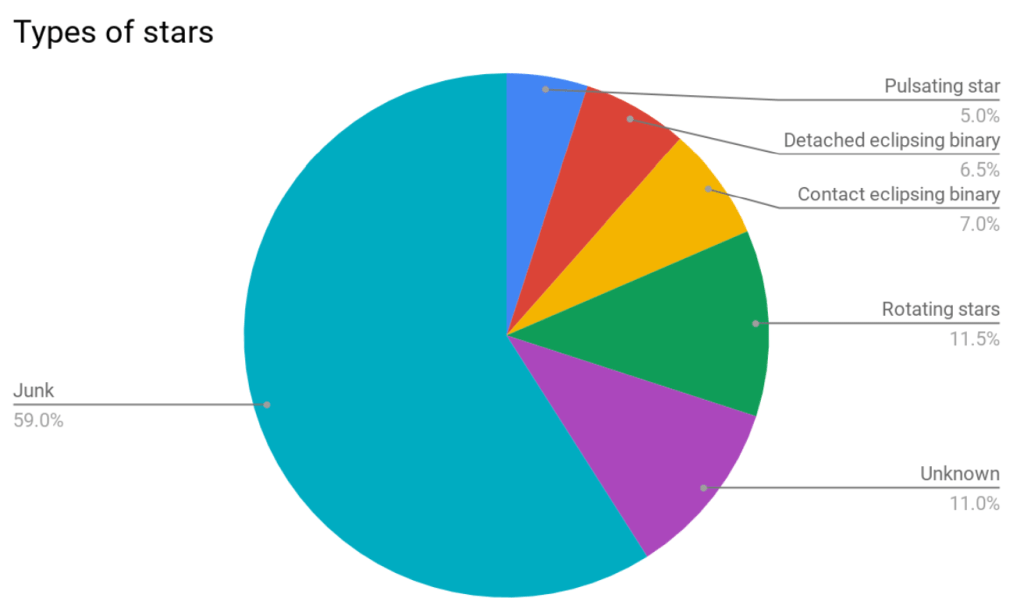
We’ve done some initial analysis on the first 300,000 classifications to get a breakdown of how many of each type of star is in our dataset.

So far it looks like there’s a lot of junk light curves in the dataset, which we expected. The programme written to detect periods in variable stars often picks up exactly a day or a lunar month, which it mistakes for a real period. Importantly though, you’ve classified a huge number of real and exciting light curves!

We’re especially excited to do some digging into what the “unknown” light curves are… are there new discoveries hidden in there? Once we’ve completed the next batch of classifications, we’ll do some more to see whether the breakdown of types of stars changes.

An exciting discovery…

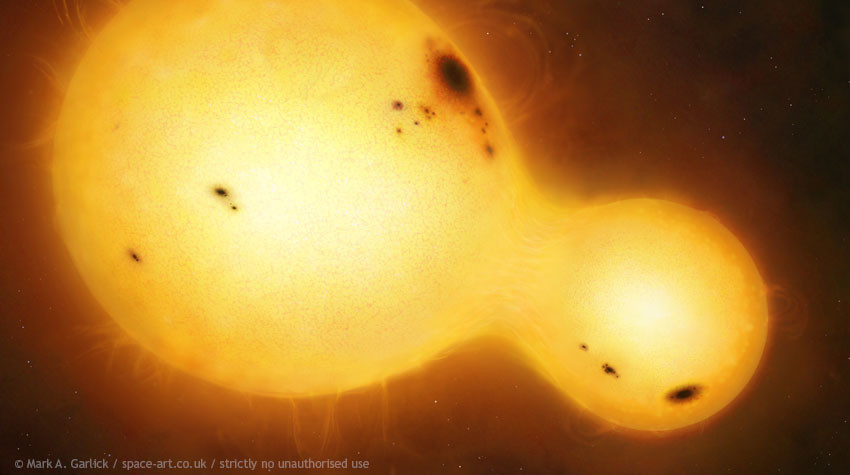
In late 2018, while building this Zooniverse project, we came across an unusual star. This Northern hemisphere object, TYC-3251-903-1, is a relatively bright object (V=11.3) which has previously not been identified as a binary system. Although the light curve is characteristic of an eclipsing contact binary star, the period is ~42 days, notably longer than the characteristic contact binary period of less than 1 day.

Spurred on by this discovery, we identified a further 16 candidate near-contact red giant eclipsing binaries through searches of archival data. We were excited to find that citizen scientists had also discovered 10 more candidates through this project!

Figure 1: Artist’s impression of a contact binary star [Mark A. Garlick] Over the past 18 months, we’ve carried out an observing campaign of these 27 candidate binaries using telescopes from across the world. We have taken multi-colour photometry using The Open University’s own PIRATE telescope, and the Las Cumbres Observatory robotic telescopes, and spectroscopy of Northern candidates with the Liverpool Telescope, and Southern candidates using SALT. We’ve also spent two weeks in South Africa on the 74-inch telescope to take further spectroscopy.

Of the 10 candidate binaries discovered by citizen scientists, we were happy to be able to take spectroscopic observations for 8 whilst in South Africa, and we have confirmed that at least 2 are, in fact, binaries! Thank you citizen scientists!

Why is this discovery important?

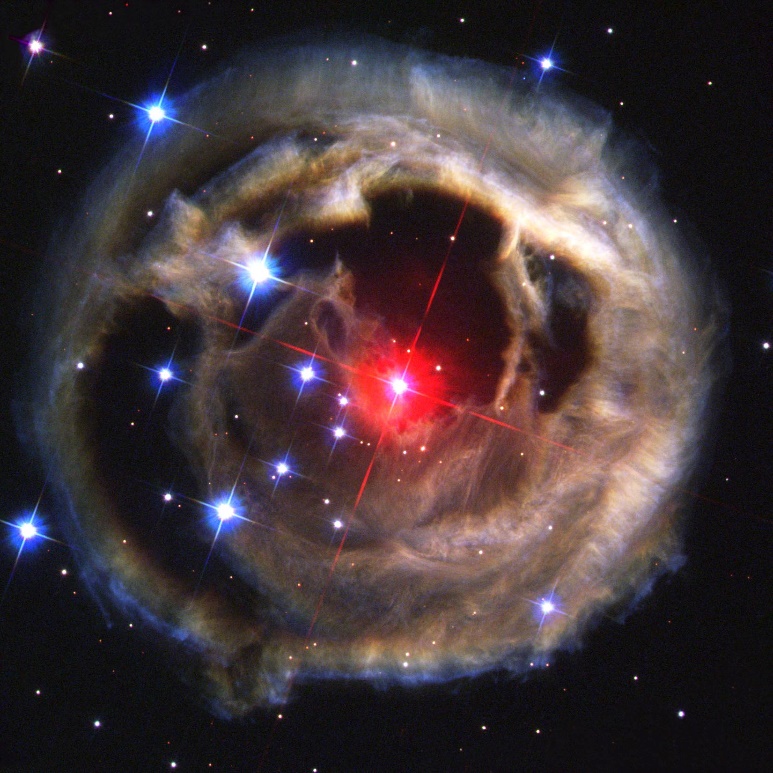
Figure 2: V838 Mon and its light echo [ESA/NASA]

The majority of contact or near-contact binaries consist of small (K/M dwarf) stars in close orbits with periods of less than 1 day. But for stars in a binary in a contact binary to have such long periods requires both the stars to be giant. This is a previously unknown configuration…

Interestingly, a newly identified type of stellar explosion, known as a red nova, is thought to be caused by the merger of a giant binary system, just like the ones we’ve discovered.

Red novae are characterised by a red colour, a slow expansion rate, and a lower luminosity than supernovae. Very little is known about red novae, and only one has been observed pre-nova, V1309 Sco, and that was only discovered through archival data. A famous example of a possible red nova is the 2002 outburst in V838 Mon. Astronomers believe that this was likely to have been a red nova caused by a binary star merger, forming the largest known star for a short period of time after the explosion.

So, by studying these near-contact red giant eclipsing binaries, we have an unrivalled opportunity to identify and understand binary star mergers before the merger event itself, and advance our understanding of red novae.

What changes have we made?

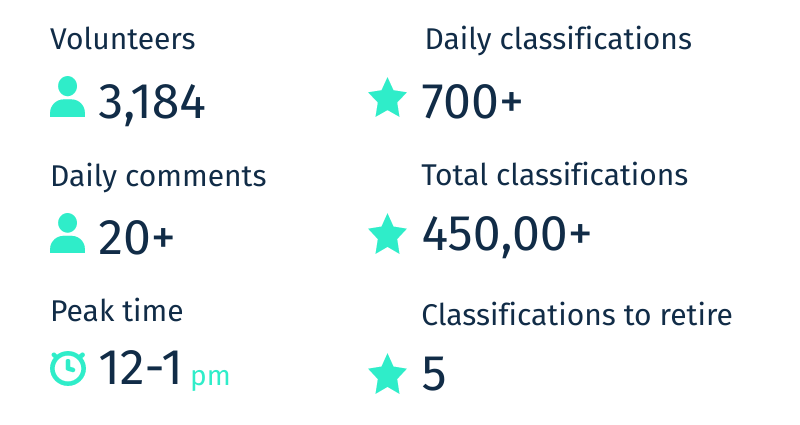
Since the SuperWASP Variable Stars Zooniverse project started, we’ve made a few changes to make the project more enjoyable. We’ve reduced the number of classifications needed to retire a target, and we’ve also reduced the number of classifications of “junk” light curves needed to retire it. This means you should see more interesting, real, light curves.

We’ve also started a Twitter account, where we’ll be sharing updates about the project, the weird and wacky light curves you find, and getting involved in citizen science and astronomy communities. You can follow us here: www.twitter.com/SuperWASP_stars

What’s next?

We still have thousands of stars to classify, so we need your help!

Once we have more classifications, we will be beginning to turn the results into a publicly available, searchable website, a bit like the ASAS-SN Catalogue of Variable Stars (https://asas-sn.osu.edu/variables). Work on this is likely to begin towards the end of 2020, but we’ll keep you updated.

We’re also working on a paper on the near-contact red giant binary stars, which will include some of the discoveries by citizen scientists. Expect that towards the end of 2020, too.

Otherwise, watch this space for more discoveries and updates!

We would like to thank the thousands of citizen scientists who have put time into this Zooniverse project. If you ever have any questions or suggestions, please get in touch.

Heidi & the SuperWASP Variable Stars team.