Category Archives: volunteering

Who translates Zooniverse?

All Zooniverse projects are created in English. But many of them are available in different languages – from Armenian and Chinese to Korean and Hungarian. Here is the latest list of translated projects.

The truth is, everyone can become a translator on Zooniverse! But how do you do that? We talked with some of our amazing volunteers who helped various research teams to translate their projects, and here is what we’ve learned.


Zooniverse translators come from all walks of life

Jiří Podhorecký (@trendspotter) lives in Cesky Krumov, a small beautiful town in the Czech Republic. He works in tourism and spends most of his free time supporting various IT projects focusing on ecology, nature conservation and virtual volunteering. Translating the Zooniverse platform and projects into Czech is one of these projects.

InoSenpai (イノ先輩) is a citizen scientist in her 20s in Japan. She studied astronomy in college, but now has another job. She has translated more than 30 Zooniverse space projects into Japanese and she even created a blog in order to introduce them to the Japanese people.

Aarush Naskar (@Sunray_2013) from India is the youngest translator on Zooniverse! He is an amateur astronomer. Story writing, sky watching, reading and coding are his main interests. 

Jason Richye is an international student from Indonesia. He is 18 years old and is a business major student. His hobbies are playing basketball, listening to music and watching movies, especially action, comedy and horror.

Louis Verhaeghe (@veragon) is a young French electrical technician passionate about astronomy and astrophysics. As an amateur astronomer, he loves immersing himself in the vastness of the universe and gaining a deeper understanding of what surrounds us.  In September 2024, he reached a major milestone: more than 50 projects fully translated into French! 

Aarush Naskar (@Sunray_2013) from India is the youngest Zooniverse translator

They translate to help more people discover Zooniverse

Jiří: “I wish that once in the future the whole Zooniverse was available to people in my language. I think that there is a huge and untapped potential in people of all ages, but especially in young people, to build a positive relationship with the world around us and to contribute to it in some way. Citizen science can be an enjoyable and unencumbered contribution to the community that will eventually process this citizen science into real science.”

イノ先輩: “Since Zooniverse is not well known in Japan, I am currently working as a Japanese translator for a number of projects to create a foundation for Japanese users to participate in Zooniverse without feeling any barriers.”

Aarush: ”I was attending a citizen science seminar hosted by the Kolkata Astronomy Club, which my father is the co-founder of, so naturally, I was also a part of it, when I heard about a boy who translated Einstein@Home: Pulsar Seekers to Bengali, so I decided to translate projects to Hindi. I know both Hindi and Bengali, but I am more comfortable with Hindi in terms of writing. It also motivated me that if I translated projects, more people would be able to do them. I also did it thinking I would know more Hindi words.”

Jason: “I’ve always wanted to be part of a research project and contribute in a meaningful way, even in a small role. When I saw one of the translation projects last winter in 2024, I remember feeling genuinely excited. I thought, “This is something I could actually help with.” So when I had the chance to volunteer, I was happy to be involved. Translating made me feel like I was part of something bigger, helping bridge gaps and support the research in a real, practical way.”

Louis (@veragon): “I have been contributing to the Zooniverse platform for almost nine years now. Initially, between 2017 and 2019, I focused exclusively on classifying images and scientific data. In fact, I have surpassed 12,900 classifications! But in late 2019, as my English improved, I asked myself: why not translate projects into French? This would allow more French speakers to get involved in citizen science and contribute to various research initiatives.

It is an immense source of pride for me to contribute, in my own way, to making science more accessible. It is important for me to translate these projects because science should be open to everyone. Many research projects rely on public participation, but the language barrier can be a major obstacle. By translating these projects, I enable thousands of people who are not fluent in English to contribute to scientific research. And the more participants there are, the more high-quality data researchers can gather. It’s a virtuous cycle!”
Louis Verhaeghe (@veragon) translated more than 50 Zooniverse projects into French

Translation expands your knowledge


Aarush: “It is funny that I make a lot (not that many!) mistakes when writing Hindi in real life but I make only some mistakes while translating.”

Jiří: “Fortunately for me, the process is already quite easy, not least because information technology helps us all to get in touch today. The enriching part is always the beginning, when you need to dig into the philosophy of the project and understand how best to use language to express yourself accurately.”

イノ先輩: “I love astronomy, but it has been difficult to love and have knowledge of all of this entire broad field equally. I have always been interested in the classification of light curves of variable stars and how to read radar observation data of meteors, but I had avoided them because they seemed difficult, but I was able to learn them in one week through translation.

The process of grasping all of that content in one’s own brain, reconstructing it in one’s native language, and outputting it is far more effective than simply reading and learning.”


And it makes you realise that your efforts really matter!

イノ先輩: “It is not only the light side of the researcher that we see when we do translations. Unfortunately, we also encounter projects that have been abandoned due to lack of bearers.

Behind this may be issues such as the reality of researchers being chronically overworked and the instability of their posts. But it is not only the beautiful and exciting top part, but also the glimpse into a part of the research project that makes us realize that we are not customers or students, but co-members of the project.”

Jiří: “Citizen science knows no boundaries! You can be all over the world. And it will give you back a strong sense of meaningful help, usefulness, confidence and joy.”

Jason: “You don’t need to be an expert to make a difference.”

Louis: “Together, we can make science more accessible and understandable for everyone. Every contribution matters, and the more of us there are, the greater our impact!”
Jiří Podhorecký (@trendspotter) wishes that once in the future the whole Zooniverse was available to people in Czech.

We asked if they had any advice for aspiring translators

Jason: “Take your time, ask questions, and focus on clarity. It’s a fun way to learn and be part of something meaningful.”

イノ先輩: “Add a bit of playfulness to your project title when you rewrite it in your native language! Mix in parodies and phrases that are unique to the respective cultures of each linguistic area, but only to the extent that they do not detract from the essence of the project. The title of the project may be the reason why some people are interested in it.”

Louis: “If you believe you have a good enough understanding of the languages you’re translating, then go for it! Reach out to various projects that haven’t been translated into your language and offer to translate them. Help us make science more accessible to the entire world!”

Jiří: “Your translation will make it easier for people who may know a foreign language, but whose native language is still closest to them. Without it, they would hardly, if ever, know about the Zooniverse. Oddly enough, language and territorial barriers sometimes serve more as a tool to better divide society. Don’t give up and bring foreign ideas, experience and science to people who need to learn about it in their own language.”

It is easy to start!

Louis: “I started my first translations by directly reaching out to project leaders and offering to translate their projects into French. Over time, I learned how to use Zooniverse’s translation tool, which turned out to be quite intuitive. This approach allowed me to better understand the process and refine my working method.”


Are you interested in volunteering as a Zooniverse translator?

Then you should definitely try it! Here is how:

1. Choose the project you would like to translate

2. Send a message to one of the research team members (privately or on their Talk)*

3. They can then assign you the Translator role

4. After that, you can log into the Zooniverse translation interface and start translating!

5. When you are done, let the team know and they will activate your translation to be visible for everyone on Zooniverse!

*An example of a message: “Hello! I’ve enjoyed working on your project (title) and would love to help translate it into (language). Do you think it could be useful? If so, please assign me the Translator role and I will give it a try!”


Are you a researcher looking to set up translations for your project? Please read these instructions. Contact us at contact@zooniverse.org if you need additional support. Please note that the Zooniverse team cannot recommend volunteers translators for your project.
Science Scribbler: Key2Cat Update from Nanoparticle Picking Workflow

Science Scribbler: Key2Cat Update from Nanoparticle Picking Workflow

Hi!

This is the Science Scribbler Team with some exciting news from our latest project: Key2Cat! We have been blown away by the incredible support of this community – hundreds of you have taken part in the Key2Cat project (https://www.zooniverse.org/projects/msbrhonclif/science-scribbler-key2cat) and helped to pick nanoparticles in our electron microscopy images of catalyst nanoparticles. In just 1 week, over 50,000 classifications were completed on 10,000 subjects and 170,000 nanoparticles and clusters were found!

Thank you for this huge effort!

We went through the data and prepared everything for the next step: classification. Getting the central coordinates of our nanoparticles and clusters with the correct class will allow us to improve our deep learning approach. But before getting into the details of the next steps, let’s recap what has been done so far using the gold on germanium (Au/Ge) data as an example.

PICKING CATALYST PARTICLES

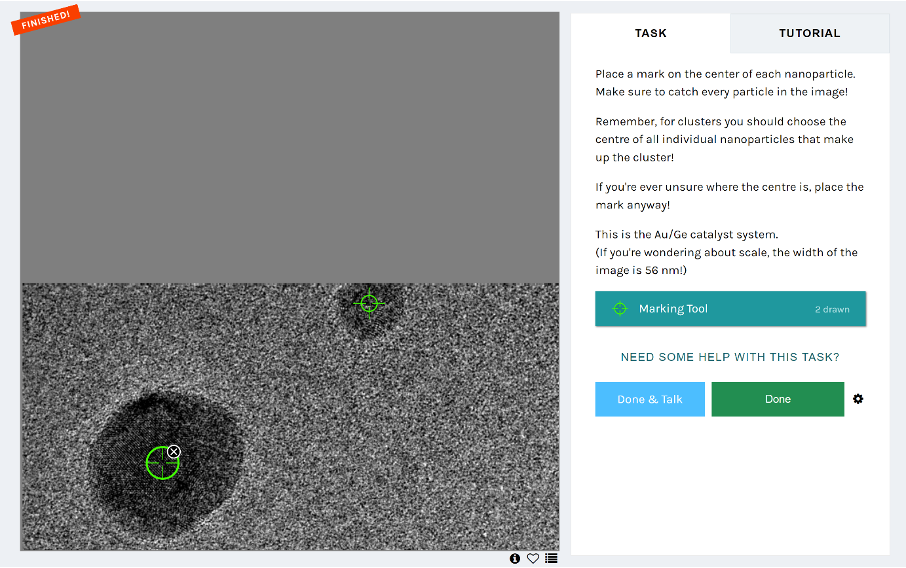
In the first workflow, you were asked to pick out both nanoparticles and clusters using a marking tool, which looked something like this:

As you might have realized, each of the images was only a small piece of a whole image. We tiled the images so that they wouldn’t be so overwhelming and time-consuming for an individual volunteer to work with. We also built in some overlap between the tiles so that if a nanoparticle fell on the edge in one image, it would be in the centre in another. Each tile was then shown to 5 different volunteers so that we could form a consensus on the centres of nanoparticles and clusters.

CRUNCHING THROUGH THE DATA

With your enormous speed, the whole Au/Ge dataset (94 full size images) was classified in just a few days! We have collected all of your marks and sorted them into their corresponding tiles. If we consider just a single tile that has been looked at by 5 volunteers, this is what the output data looks like:


With some thinking and coding we can recombine all the tiles that make up a single image, including the marks placed by all volunteers that contributed to the image:

Recontructed marked image

Wow, you all are really good at picking out the catalyst particles! Seeing how precisely all centres have been picked out in this visualisation is quite impressive. You may notice that there are more than 5 marks per nanoparticle – this is because of the overlap that we mentioned earlier. When taking the overlap into consideration, this means that each nanoparticle should be seen (at least partially!) by 20 volunteers.

The next step is to combine all of the marks to find a consensus centre point for each nanoparticle so that we have one set of coordinates to work with. There are numerous ways of doing this. One of the first that has given us good results is an unsupervised k-means algorithm [1]. This algorithm looks at all of the marks on the image and tries to find clusters of marks that are close to each other. It then joins these marks up into a single mark by finding a weighted average of their placements. You can think of it like tug-of-war where the algorithm finds the centre point because more marks are pulling it there.  

Reconstructed image with centroids of marks

As you can see, the consensus based on your marks almost perfectly points at the centres of individual nanoparticles or nanoparticle clusters. We don’t yet know from this analysis if the nanoparticle is a part of a cluster or not, and in some cases, we also get marks in areas which are not nanoparticles as shown in the orange and red boxes above. Since only small parts of the overall image were shown in the marking task, the artifact in the orange box was mistaken as a nanoparticle and in the case of the red box, there is a mark at the very edge and on a very small dot-like instance where some of you might have been suspicious about another nanoparticle. This is expected, especially since we asked volunteers to place marks if they were unsure – we wanted to capture all possible instances of nanoparticles in this first step!

REFINING THE DATA

This is the part where the second workflow comes into play. Using the marks from the first workflow, we createda new dataset showing just a small area around the mark to collect more information.In this workflow we ask a few questions to help identify exactly what we see at each of the marks


With this workflow, we hope to classify all the nanoparticles and clusters of both the Au/Ge and Pd/C catalyst systems, while potential false marks can be cleaned up! Once this is accomplished, we’ll have all the required inputs to improve our deep learning approach.

We’re currently collecting classifications on the Au/Ge data and will soon switch over to the Pd/C data, so if you have a few spare minutes, we would be very happy if you left some classifications in our project! https://www.zooniverse.org/projects/msbrhonclif/science-scribbler-key2cat/classify

-Kevin & Michele


Got your interest? Do you have questions? Get in touch!

Talk: https://www.zooniverse.org/projects/msbrhonclif/science-scribbler-key2cat/talk

References:

[1]: M. Ahmed, R. Seraj, S. M. S. Islam, Electronics (2020), 9 (8), 1295.

A Sky Full of Chocolate Sauce: Citizen Science with Aurora Zoo

by Dr. Liz MacDonald and Laura Brandt

Viewing the aurora in person is a magnificent experience, but due to location (or pesky clouds) it’s not always an option. Fortunately, citizen science projects like Aurorasaurus and Zooniverse’s Aurora Zoo make it easy to take part in aurora research from any location with an internet connection. 

The Aurorasaurus Ambassadors group was excited to celebrate Citizen Science Month by inviting Dr. Daniel Whiter of Aurora Zoo to speak at our April meeting. In this post we bring you the highlights of his presentation, which is viewable in full here

To ASK the Sky for Knowledge

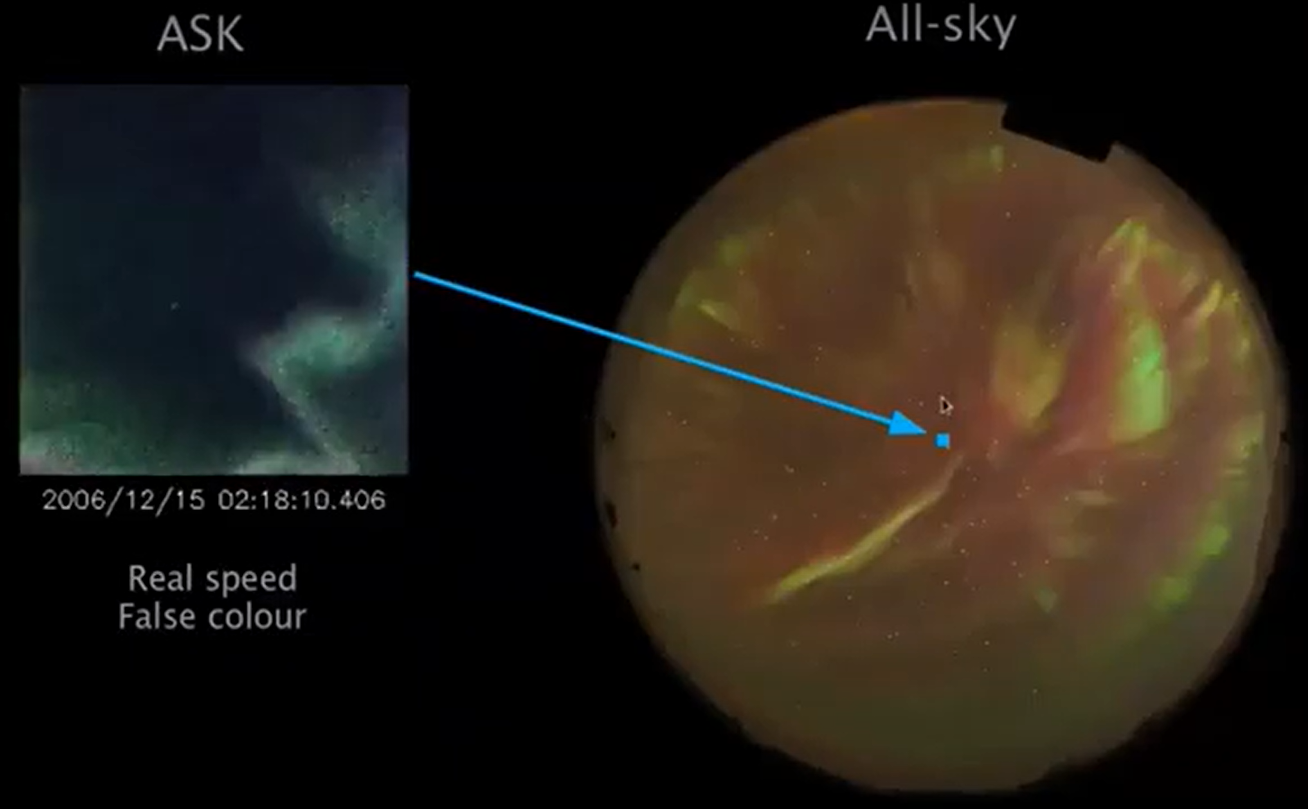
Far to the north on the Norwegian island of Svalbard, three very sensitive scientific cameras gaze at a narrow patch of sky. Each camera is tuned to look for a specific wavelength of auroral light, snapping pictures at 20 or 32 frames per second. While the cameras don’t register the green or red light that aurora chasers usually photograph, the aurora dances dynamically across ASK’s images. Scientists are trying to understand more about what causes these small-scale shapes, what conditions are necessary for them to occur, and how energy is transferred from space into the Earth’s atmosphere. ASK not only sees night-time aurora, but also special “cusp aurora” that occur during the day but are only visible in extremely specific conditions (more or less from Svalbard in the winter.)

Still from Dr. Whiter’s presentation. The tiny blue square on the allsky image (a fisheye photo looking straight up) represents the field of view of the ASK cameras. The cameras point almost directly overhead. 

The setup, called Auroral Structure and Kinetics, or ASK, sometimes incorporates telescopes, similar to attaching binoculars to a camera. Project lead Dr. Daniel Whiter says, “The magnification of the telescopes is only 2x; the camera lenses themselves already provide a small field of view, equivalent to about a 280mm lens on a 35mm full frame camera. But the telescopes have a large aperture to capture lots of light, even with a small field of view.”

The challenge is that ASK has been watching the aurora for fifteen years and has amassed 180 terabytes of data. The team is too small to look through it all for the most interesting events, so they decided to ask for help from the general public. 

Visiting the Aurora Zoo

Using the Zooniverse platform, the Aurora Zoo team set up a project with which anyone can look at short clips of auroras to help highlight patterns to investigate further. The pictures are processed so that they are easier to look at. They start out black and white, but are given “false color” to help make them colorblind-friendly and easier for citizen scientists to work with. They are also sequenced into short video clips to highlight movement. To separate out pictures of clouds, the data is skimmed by the scientists each day and run through an algorithm.

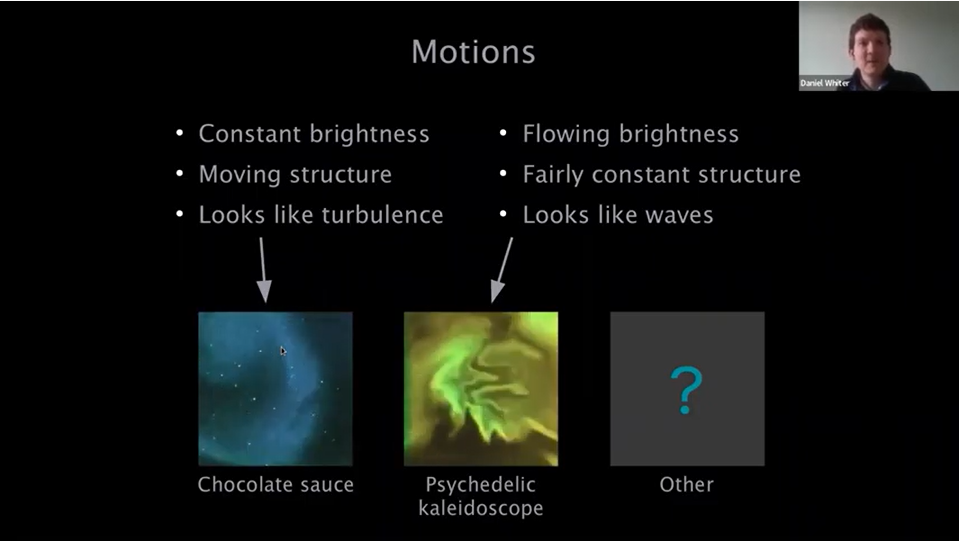
Aurora Zoo participants are then asked to classify the shape, movement, and “fuzziness,” or diffuse quality, of the aurora. STEVE fans will be delighted by the humor in some of the options! For example, two of the more complex types are affectionately called “chocolate sauce” and “psychedelic kaleidoscope.” So far, Aurora Zoo citizen scientists have analyzed 7 months’ worth of data out of the approximately 80 months ASK has been actively observing aurora. Check out Dr. Whiter’s full presentation for a walkthrough on how to classify auroras, and try it out on their website!

Some of the categories into which Zooniverse volunteers classify auroral movement. Credit: Dr. Daniel Whiter.

What can be learned from Aurora Zoo is different from other citizen science projects like Aurorasaurus. For example, when several arc shapes are close to one another, they can look like a single arc to the naked eye or in a photo, but the tiny patch of sky viewed through ASK can reveal them to be separate features. These tiny details are also relevant to the study of STEVE and tiny green features in its “picket fence”.

Early (Surprising!) Results

Aurora Zoo participants blew through the most recent batch of data, and fresh data is newly available. The statistics they gathered show that different shapes and movements occur at different times of day. For example, psychedelic kaleidoscopes and chocolate sauce are more common in the evening hours. The fact that the most dynamic forms show up at night rather than in the daytime cusp aurora reveals that these forms must be connected to very active aurora on the night side of the Earth. 

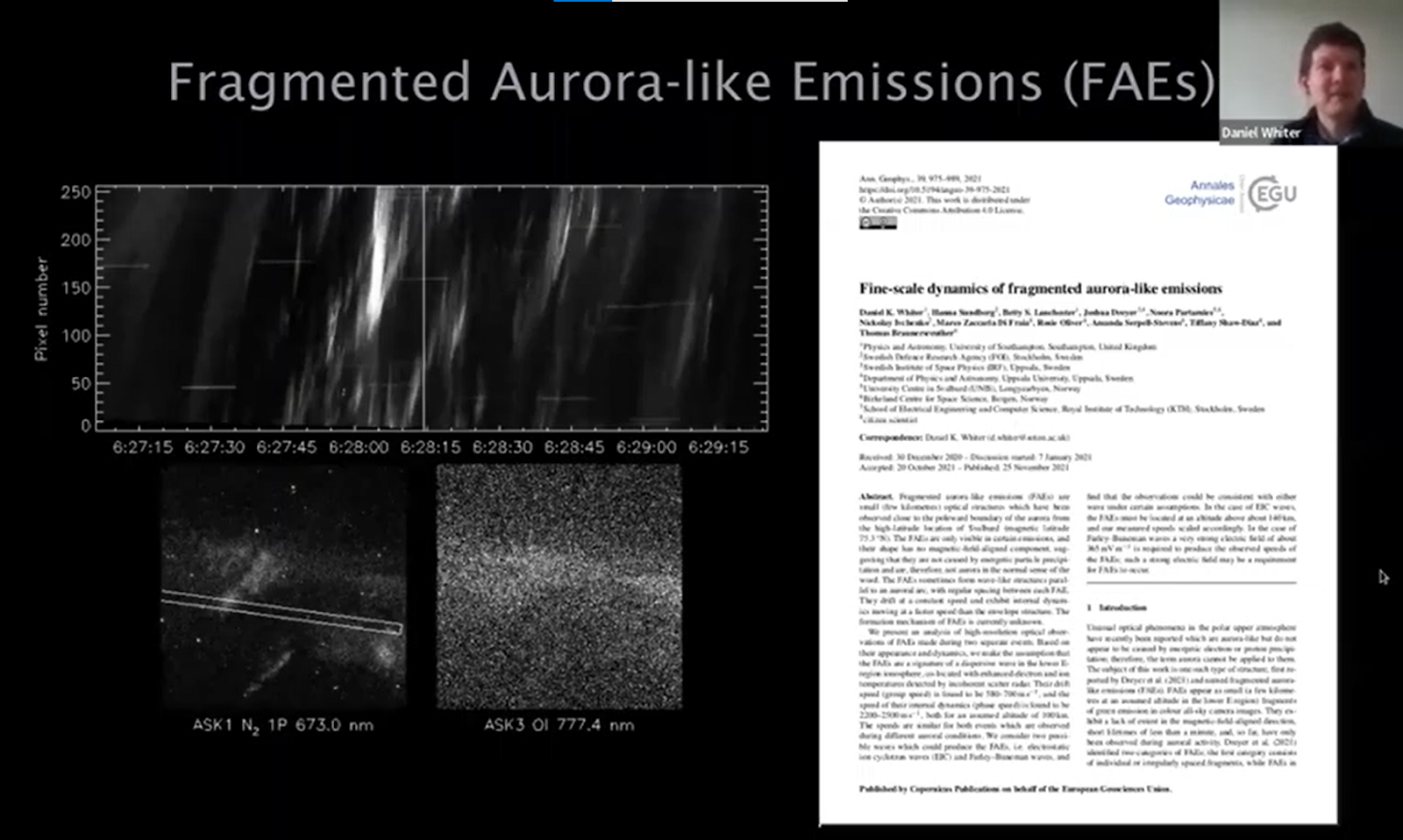
Aurora Zoo participants also notice other structures. Several noted tiny structures later termed “fragmented aurora-like emissions,” or FAEs. Because of the special equipment ASK uses, the team was able to figure out that the FAEs they saw weren’t caused by usual auroral processes, but by something else. They published a paper about it, co-authored with the citizen scientists who noticed the FAEs. 

Still from Dr. Whiter’s presentation, featuring FAEs and Aurora Zoo’s first publication.

What’s next? Now that Aurora Zoo has a lot of classifications, they plan to use citizen scientists’ classifications to train a machine learning program to classify more images. They also look forward to statistical studies, and to creating new activities within Aurora Zoo like tracing certain shapes of aurora. 

STEVE fans, AuroraZoo hasn’t had a sighting yet. This makes sense, because ASK is at a higher latitude than that at which STEVE is usually seen. However, using a similar small-field technique to examine the details of STEVE has not yet been done. It might be interesting to try and could potentially yield some important insights into what causes FAEs.

Citizen Science Month, held during April of each year, encourages people to try out different projects. If you love the beautiful Northern and Southern Lights, you can help advance real aurora science by taking part in projects like Aurora Zoo and Aurorasaurus

About the authors of this blog post: Dr. Liz MacDonald and Laura Brandt lead a citizen science project called Aurorasaurus. While not a Zooniverse project, Aurorasaurus tracks auroras around the world via real-time reports by citizen scientist aurora chasers on its website and on Twitter. Aurorasaurus also conducts outreach and education across the globe, often through partnerships with local groups of enthusiasts.  Aurorasaurus is a research project that is a public-private partnership with the New Mexico Consortium supported by the National Science Foundation and NASA. Learn more about NASA citizen science here

Engaging Faith-based Communities in Citizen Science through Zooniverse

Engaging Faith-based Communities in Citizen Science through Zooniverse was an initiative designed to broaden participation in people-powered research (also referred to as citizen science) among religious and interfaith communities by helping them to engage with science through Zooniverse. Citizen science is a powerful way to build positive, long-term relationships across diverse communities by “putting a human face” on science and scientists. Participating in real scientific research is a great way to learn about the process of science as well as the scientists who conduct research.

The Engaging initiative provided models for how creative partnerships can be formed between scientific and religious communities that empower more people to become collaborators in the quest for knowledge. It included integrating Zooniverse projects into seminary classes as well as adult, youth, and intergenerational programs of religious communities; and promoting Zooniverse among interfaith communities concerned with environmental justice. Among other things, the project’s evaluation highlighted the need for scientists to do a better job of engaging with religious audiences in order to address racial and gender disparities in science. I encourage Zooniverse research teams to check out the series of short videos recently released by the AAAS Dialogue on Science, Ethics, and Religion to help scientists engage more effectively with communities of faith. By interacting personally with these communities and helping to “put a human face” on science, you may not only increase participation in your research projects, but help in the effort to diversify science in general.

Despite the difficulties imposed by the pandemic, I’m encouraged by what the Engaging initiative achieved, and the possibilities for expanding its impact in the future! The summary article of this project was published on March 28, 2022 by the AAAS Dialogue on Science, Ethics, and Religion.

Grace Wolf-Chase, Ph.D.

The project team thanks the Alfred P. Sloan Foundation for supporting this project. Any opinions, findings, or recommendations expressed are those of the project team and do not necessarily reflect the views of the Sloan Foundation.

Corporate Digital Engagement and volunteering through Zooniverse

Over the years a growing number of companies have included Zooniverse in their digital engagement and volunteer efforts, connecting their employee network with real research projects that need their help.

It’s been lovely hearing the feedback from employees:

“This was an awesome networking event where we met different team members and also participated in a wonderful volunteer experience. I had so much fun!”

“This activity is perfectly fitted to provide remote/virtual support. You can easily review photos from anywhere. Let’s do this again!”

“Spotting the animals was fun; a nice stress reliever!’

The impact of these partnerships on employees and on Zooniverse has been tremendous. For example, in 2020 alone, 10,000+ Verizon employees contributed over a million classifications across dozens of Zooniverse projects. With companies small to large incorporating Zooniverse into their volunteer efforts, this new stream of classifications has been a tremendous boon for helping propel Zooniverse projects towards completion and into the analysis and dissemination phases of their efforts. And the feedback from employees has been wonderful — participants across the board express their appreciation for having a meaningful way to engage in real research through their company’s volunteer efforts. 

A few general practices that have helped set corporate volunteering experiences up for success:

  • Focus and choice: Provide a relatively short list of recommended Zooniverse projects that align with your company’s goals/objectives (e.g., topic-specific, location-specific, etc.), but also leave room for choice. We have found that staff appreciate when a company provides 3-6 specific project suggestions (so they can dive quickly into a project), as well as having the option to choose from the full list of 70+ projects at zooniverse.org/projects
  • Recommend at least 3 projects: This is essential in case there happens to be a media boost for a given project before your event and the project runs out of active data*. Always good to have multiple projects to choose from. 
  • Team building: Participation in Zooniverse can be a tremendous team building activity. While it can work well to just have people participate individually, at their own convenience, it also can be quite powerful to participate as a group. We have created a few different models for 1-hour, 3-hour, and 6-hour team building experiences. The general idea is that you start the session as a group to learn about Zooniverse and the specific project you’ll be participating in. You then set a Classification Challenge for the hour (e.g., as a group of 10, we think we can contribute 500 classifications by the end of the hour). You play music in the background while you classify and touch base halfway through to see how you’re doing towards your goal (by checking your personal stats at zooniverse.org) and to share interesting, funny, and/or unusual images you’ve classified. At the end of the session, you celebrate reaching your group’s Classification Challenge goal and talk through a few reflection questions about the experience and other citizen science opportunities you might explore in the future. 
  • Gathering stats: Impact reports have been key in helping a company tell the story of the impact of their corporate volunteering efforts, both internally to their employee network and externally to their board and other stakeholders. 
    • Some smaller companies (or subgroups within a larger company) manually gather stats about their group’s participation in Zooniverse. They do this by taking advantage of the personal stats displayed within the Zooniverse.org page (e.g., number of classifications you’ve contributed). They request that their staff register and login to Zooniverse before participating and send a screenshot of their Zooniverse.org page at the end of each session. The team lead then adds up all the classifications and records the hours spent as a group participating in Zooniverse. 
    • If manual stats collection is not feasible for your company, don’t hesitate to reach out to us at contact@zooniverse.org to explore possibilities together. 

We’ve also created a variety of bespoke experiences for companies who are interested in directly supporting the Zooniverse. Please email contact@zooniverse.org if you’re interested in exploring further and/or have any questions. 

If you’re a teacher, school administrator, student, or anyone else who might be interested in having Zooniverse help you in fulfilling student volunteer or service hour requirements, please check out https://blog.zooniverse.org/2020/03/26/fulfilling-service-hour-requirements-through-zooniverse/ 

*Zooniverse project datasets range in size; everything from a project’s dataset being fully completed within a couple weeks (e.g., The Andromeda Project) to projects like Galaxy Zoo and Snapshot Serengeti that have run and will continue to run for many years. But even for projects that have data that will last many months or years, standard practice is to upload data in batches, lasting ~2-4 months. When a given dataset is completed, this provides an opportunity for the researchers to share updates about the project, interim results, etc. and encourage participation in the next cycle of active data.