Seasons greetings everyone! Since you’ve been so good this year we have a very special present for you… a brand new project: Radio Galaxy Zoo. We need you to help us discover black holes.
Earlier this year, Galaxy Zoo expanded to include the infrared. Now Radio Galaxy Zoo involves looking at galaxies in yet another light. This time we are asking you to match huge jets – seen in radio emission – to the supermassive black holes at the centre of the galaxy that produced them. This requires looking at the galaxies in infrared and radio wavelengths. These galaxies are nothing like our own, and your classifications will allow scientists to understand the causes of these erupting black holes and how they affect the galaxy surrounding them.
The Zooniverse is extremely pleased to announce that it has been named as one of six Google Global Impact Awardees announced in December 2013. The awards are given by Google to projects that show three key elements:
technology or innovative approach that can deliver transformational impact
a specific project that tests a big game-changing idea
a brilliant team with a healthy disregard for the impossible
The grant we have received from Google as part of their Global Impact Award program will allow us to build a platform that can support hundreds or maybe even thousands of new and exciting citizen science projects. A list of the awardees can be seen at the Google Global Impact Award site here http://www.google.com/giving/global-impact-awards/
It means a lot to us at the Zooniverse to have been given this award and we could not have managed it without you, our volunteers. The time and effort you dedicate to our projects shows the world how important citizen science can be, and we’re looking forward to the next few years.
So thanks to you, and thanks to Google!
The Zooniverse team
PS: Just to be clear, this is a philanthropic act from Google – we’ll continue to be an academic project run by the team at Oxford, Adler Planetarium and elsewhere and all your data remains with the Zooniverse as before. Nothing changes, except our ability to scale!
The Milky Way Project (MWP) is complete. It took about three years and 50,000 volunteers have trawled all our images multiple times and drawn more than 1,000,000 bubbles and several million other objects, including star clusters, green knots, and galaxies. We have produced several papers already and more are on the way. It’s been a huge success but: there’s even more data!
And so it is with glee that we announce the brand new Milky Way Project! It’s got more data, more objects to find, and it’s even more gorgeous.
The new MWP is being launched to include data from different regions of the galaxy in a new infrared wavelength combination. The new data consists of Spitzer/IRAC images from two surveys: Vela-Carina, which is essentially an extension of GLIMPSE covering Galactic longitudes 255°–295°, and GLIMPSE 3D, which extends GLIMPSE 1+2 to higher Galactic latitudes (at selected longitudes only). The images combine 3.6, 4.5, and 8.0 µm in the “classic” Spitzer/IRAC color scheme. There are roughly 40,000 images to go through.
An EGO shines below a bright star cluster
Star Cluster
Beautiful Data
Galaxy
Hollow Shells
The latest Zooniverse technology and design is being brought to bear on this big data problem. We are using our newest features to retire images with nothing in them (as determined by the volunteers of course) and to give more screen time to those parts of the galaxy where there are lots of pillars, bubbles and clusters – as well as other things. We’re marking more objects – bow shocks, pillars, EGOs – and getting rid of some older ones that either aren’t visible in the new data or weren’t as scientifically useful as we’d hoped (specifically: red fuzzies and green knots).
We’ve also upgraded to the newest version of Talk, and have kept all your original comments so you can still see the previous data and the objects that were found there. The new Milky Way Project is teeming with more galaxies, stars clusters and unknown objects than the original MWP.
It’s very exciting! There are tens of thousands of images from the Spitzer Space Telescope to look through. By telling us what you see in this infrared data, we can better understand how stars form. Dive in now and start classifying at www.milkywayproject.org – we need your help to map and measure our galaxy.
Hey everyone, for today’s advent calendarRob and I made this short video talking about the various ways in which you can take part in the Zooniverse, and the multiple means by which you can keep up-to-date with what we’re doing.
It also serves as an introduction for me, the new Zooniverse community manager. It is a bit silly at points, and we did it in one take with no script, so apologies for the rough feel!
Here are some of the links I mention in the video:
Over the past three years some have said that the Zooniverse Advent calendar is a bit silly. To utterly refute this claim I present the following evidence that all can be citizen scientists: cats love the Zooniverse.
This time last year we launched the Andromeda Project. The aim was the get everyone’s help in locating the star clusters in the Andromeda Galaxy, our next-door neighbour in intergalactic space. The project went better than we could have imagined, and just over two weeks later we had completed more than 1,000,000 classifications and the project’s science team were busy wrangling data.
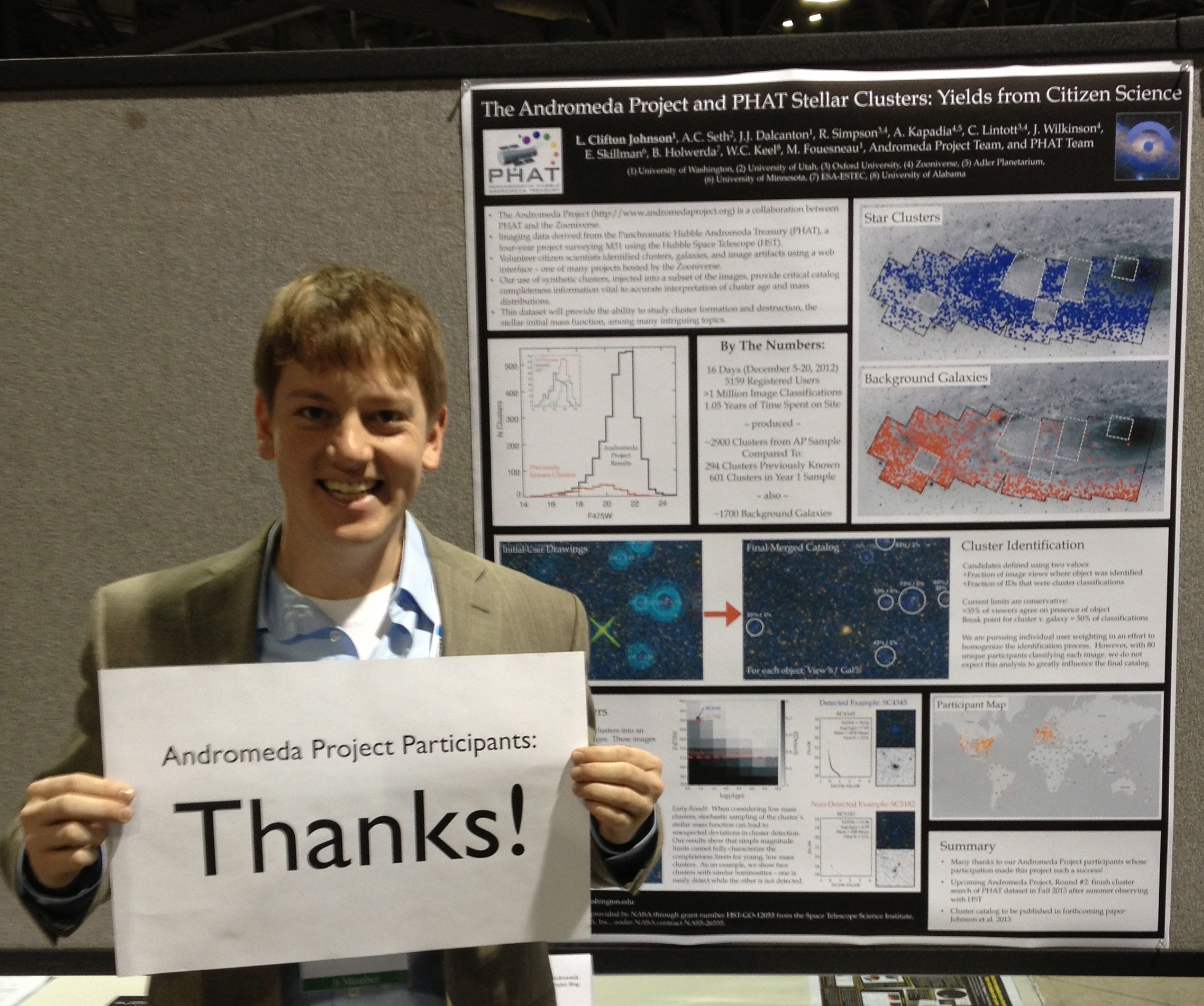
In fact, in January Cliff Johnson took a poster to one of the world’s biggest astronomy meetings – the January meeting of the AAS – and presented the results from the Andromeda Project, which had only launched 6 weeks prior. It was an amazing example of the power of citizen science to help researchers accomplish the kind of data analysis that computers cannot do reliably.
We decided to do a second round of the Andromeda Project to complete the job we’d started, using both the data that remained in the archive and also new data that was only just being taken last year when the project launched. So in October 2013 (just two months ago) we once again invited the Zooniverse community to come and find star clusters and galaxies. They once again astounded us by gobbling up the data even faster – ably assisted by a trench of new users brought to the project from Facebook’s popular I F***king Love Science page. In a week the job was done.
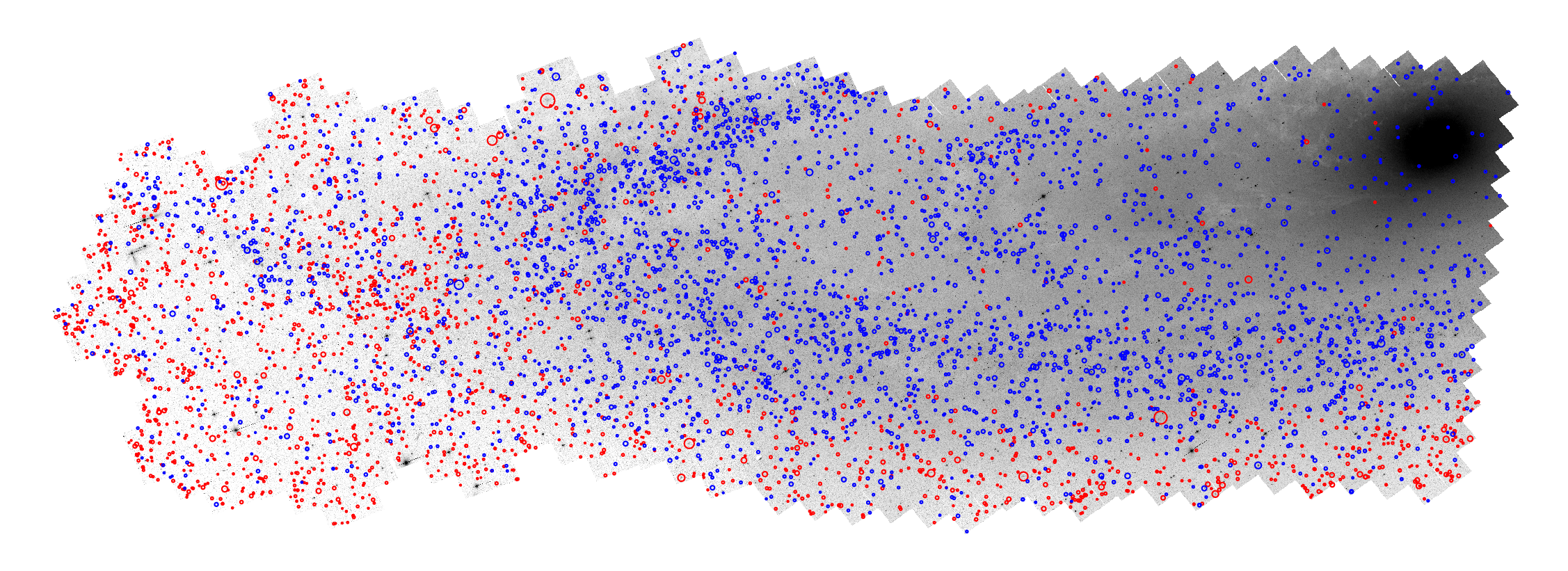
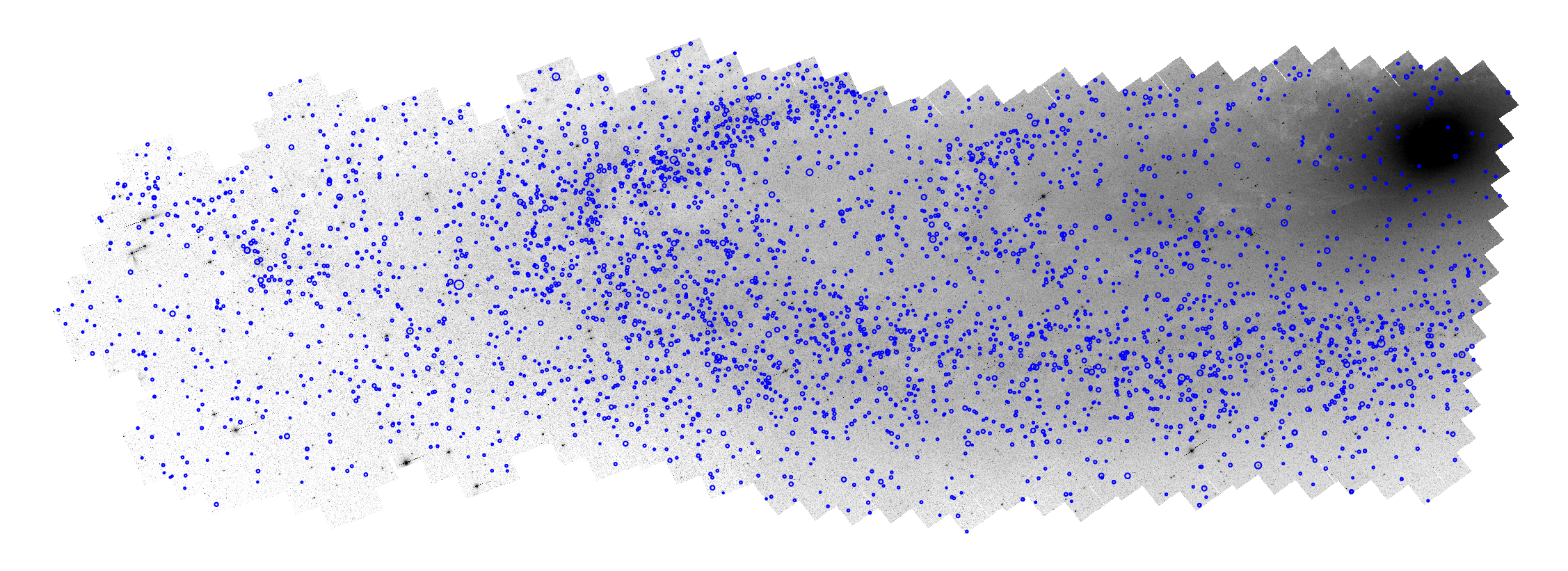
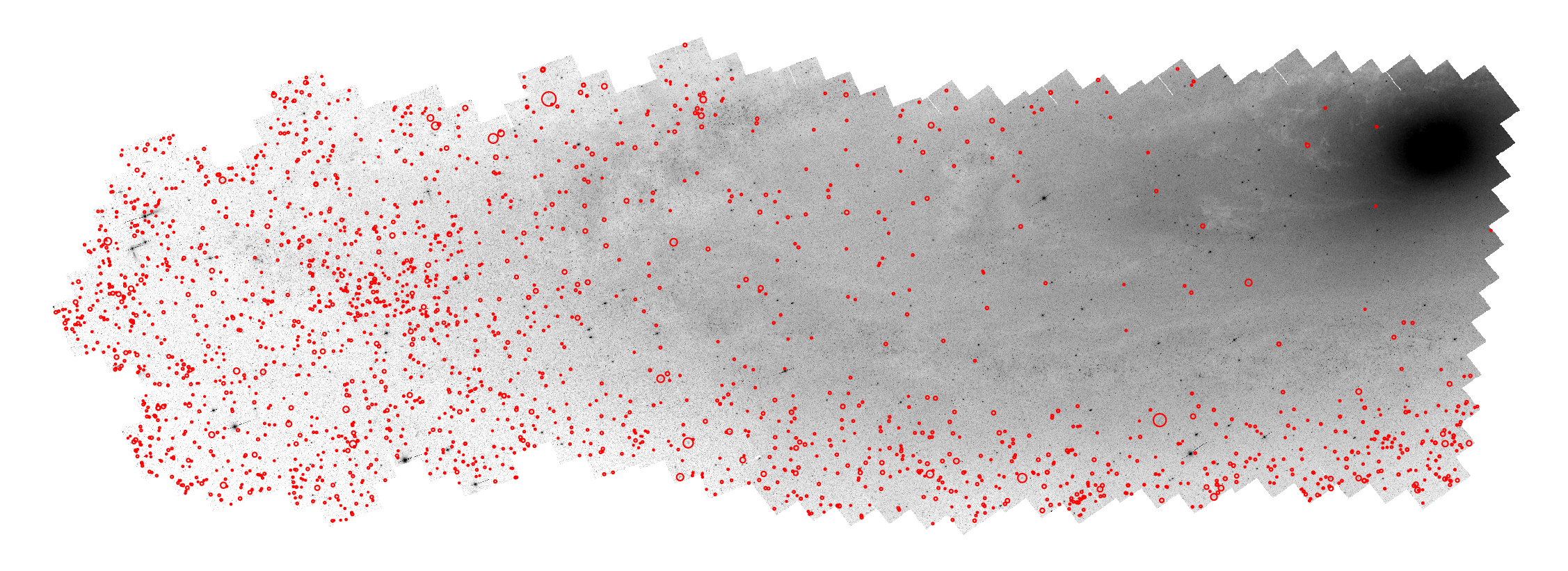
The science team have already begun processing the data from this second round and the results are amazing. In fact: they’re right here just for you, just because it’s nearly Christmas and just because we wanted to give you a present. So here they are: the first maps of all the star clusters and galaxies in the data from the PHAT survey of Andromeda. Marked and classified by the wonderful Andromeda Project community.
Clusters are in blue, galaxies in red. The background image is single-band F475W data showing the galaxy itself.
You can see how the background galaxies are best seen at the outer edges (because we are looking through less material), and the clusters are found predominately in the spiral arms (where more star formation is happening). These plots will form part of the publications the science team and currently working on, and which will most likely appear on the Zooniverse Publications page sometime in 2014. Follow along on the blog, Twitter and Facebook for updates from the science team in the coming weeks and months.
Congratulations to everyone who helped out and gave their time to the Andromeda Project: you were amazing!
So as much as I’d like to wish the Andromeda Project a happy birthday, it seems like I should really wish it a happy retirement. Luckily we have more space-based projects coming soon to the Zooniverse – so the community will have plenty to get along with. However, the Andromeda Project will always have a special place in our hearts for its efficient and dedicated volunteers. Who knows, maybe one day it will come out of retirement for one last hurrah? We can only hope.
It’s December 1st and that can mean only one thing at The Zooniverse: our advent calendar returns! It’s time for another citizen-science-fuelled, festive charge at the unsuspecting Christmas break for many around the world. 24 digital days of fun from us to you, our lovely, lovely volunteers! It’s a fun way of saying thank you each year. To kick things off, behind door 1 is is a bit of digital wallpaper for you: a pair of galaxies made from galaxies.
As astronomical surveys and observations have continued to grow towards the petabyte scale, online citizen science projects have proven quite successful in enlisting the general public to mine these rich datasets from searching for exoplanets to identifying gravitational lenses. With new instruments and observatories currently being planned and built such as the Large Synoptic Survey Telescope (LSST) and the Square Kilometer Array (SKA), the next decade will see astronomy officially enter the petabyte age. When complete in 2022, LSST, an 8.4-meter optical telescope, will generate 15 terabytes worth of images each night, creating the largest public dataset in the world. LSST will provide images of billions (yes billions!) of new galaxies. The SKA will be the largest radio telescope ever built when it is scheduled to come online in 2024, generating roughly 11 terabytes of raw data per second. In a single day, the SKA will produce more information than all of the present day Internet combined! Citizen science will need to evolve to be able to handle the coming data deluge.
The Zooniverse and the Institute of Astronomy & Astrophysics at Academia Sinica (ASIAA) are organizing a workshop on Citizen Science in Astronomy. The goal of this workshop is to take the first steps towards addressing the critical questions and issues that citizen science will need to solve in order to cope with these never-before-seen data volumes in the age of LSST and SKA. We aim to bring together machine learning experts, computer scientists, astronomers, and scientists from astronomy-based citizen science projects to test current techniques used to assess the capabilities of individual classifiers and combine their results, create techniques for better directing volunteer efforts to improve efficiency of current and future citizen science projects, and develop new methods for analyzing citizen science data combined with machine learning algorithms.
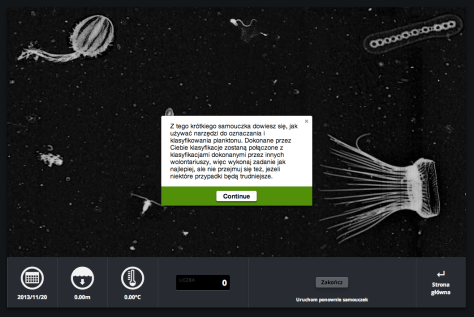
The Zooniverse has passed a few notable milestones recently. Planet Four passed 4 million classifications, Planet Hunters passed 20 million, and Plankton Portal passed 250,000. All represent a lot of work done by all of you and we thank you for the effort you put in to these and all our projects. Should we be worried that they all begin with ‘P’?
To help more people access our projects we’ve been stepping up our efforts to translate the websites. You can now participate in Plankton Portal in both French and Polish (as well as English), and there are more languages on the way for this and other projects. We’re excited about this chance to spread word of the Zooniverse around the world.
Finally, don’t forget that you can follow us on Facebook, Twitter, and Google+. (or all three!) to keep up with news and updates from the Zooniverse.
As part of a large expansion of the Oxford Zooniverse team, I’m delighted to announce that there are four new jobs available at Zooniverse HQ in Oxford. We’re looking for developers who are excited at the prospect of helping us find more planets, keep an eye on more animals and generally make the Zooniverse more awesome.
These jobs mark the start of the next stage in the Zooniverse’s evolution, and we’re really excited about expanding the team in Oxford. If you’d like to know more, you can contact me on cjl AT astro.ox.ac.uk or 07808 167288.
Chris
The world's largest and most popular platform for people-powered research. This research is made possible by volunteers—millions of people around the world who come together to assist professional researchers.









 Zooniverse