Category Archives: Education

Zooniverse-Based Activities for Undergraduates Are Here!

Our pilot-tested, research validated, Zooniverse-based activities for undergraduates are here and are ready for widespread use in your undergraduate science classrooms! These activities are 75-90 minutes long and are intended for use in introductory, undergraduate courses for non-science majors (or upper-level high school courses). These activities have been developed for use in either in-person courses or online courses through Google Docs. 

Geology/Biology/Environmental Science 101 with Floating Forests

In this activity, students learn about kelp forests in Tasmania in order to conduct an investigation into how marine ecosystems are impacted by small increases in ocean warming. Students use data generated by fellow citizen scientists in order to see how climate change has affected kelp forests specifically in Tasmania, Australia. In part one, students interpret graphs to draw conclusions about the relationship between greenhouse gas emissions and temperature, as well as learn about long term trends in Earth’s climate. Part two is intended to familiarize students with the Floating Forests platform. First, students practice classifying on a curated image set with a corresponding answer key. They will then be tasked with classifying images on the actual Floating Forests project. Part three uses data gathered by Floating Forests volunteers to introduce Tasmania, Australia as a case study of an ecosystem affected by climate change. 

Astronomy 101 with Planet Hunters

This is another three-part activity where students learn about the discovery and characterization of planetary systems outside of our Solar System. 

In part one, students use a lecture tutorial-style approach to learn about planetary transits and transit light curves. Students learn how important planetary properties such as orbital period and size can be approximated from specific features in a transit light curve. In the second part of this activity, students practice identifying transits (or dips) in a curated set of actual light curves. They will then receive feedback regarding whether or not they identified the transits successfully. Once the students have practiced, they classify on Planet Hunters – TESS, the current iteration of the Planet Hunters Project. Students get the opportunity to observe actual TESS light curves, and help the Planet Hunters research team identify potential planetary transits in those light curves. Finally, the activity concludes with a data driven investigation where students are presented with the complex research question, ‘Is our Solar System unique?’, and they will have to interpret data representations derived from the NASA Exoplanet Archive to form their own conclusion. 

A Little More About These Activities…

The Floating Forests and Planet Hunters-based classroom activities have been pilot tested with nearly 3,000 students across 14 colleges and universities. Survey data collected from participating students showed that completing either one of these two activities had statistically significant (positive) impacts on students’ ability to use data and evidence to answer scientific questions, on their ability to contribute in a meaningful way to science, and on their understanding that citizen science is a valuable tool that can be used to increase engagement in science. More than 70% of students claimed that these activities inspired them to come back and classify on additional Zooniverse projects! The results of these findings are being published in the Astronomy Education Journal (Simon et al., 2022, in review) and the Journal of Geophysics Education (Rosenthal et al., 2022, in prep). 

Additional feedback from pilot instructors indicated that these activities were easy to implement into new or existing introductory science courses. A few of our favorite instructor comments:

  1. “Being able to see and analyze the data and help with the entire research analysis process – students were very interested in that. They appreciated that it was real data. This is a real research project.” 
  2. “Well, there’s not enough time for me to say all the good things that I could say about Zooniverse. I think the benefit to the community, just the broader public, has been enormous. So I think these activities are fantastic, and sharing them, not only with colleges, but with high school and middle school educators, I think would be really beneficial. They’re fantastic.” 

The full activities and corresponding activity-synopses are available on the Zooniverse Classrooms Page (https://classroom.zooniverse.org)! The development and assessment of these activities were part of a larger NSF-funded effort, Award #1821319, Engaging Non-Science Majors in Authentic Research through Citizen Science. A final activity based around the Zooniverse project Planet Four will be coming soon! 

Also at classroom.zooniverse.org are two additional sets of materials, created through previous efforts:

  • Wildcam Labs
    • Designed for 11-13 year olds
    • The interactive map allows you to explore trail camera data and filter and download data to carry out analyses and test hypotheses. 
    • An example set of lessons based around Wildcam Labs, focused on using wildlife camera citizen science projects to engage students in academic language acquisition
    • Funded by HHMI and the San Diego Zoo
  • Astro101 with Galaxy Zoo
    • Designed for undergraduate non-major introductory astronomy courses
    • Students learn about stars and galaxies through 4 half-hour guided activities and a 15-20 hour research project experience in which they analyze real data (including a curated Galaxy Zoo dataset), test hypotheses, make plots, and summarize their findings. 
    • Funded by NSF

For both Wildcam Labs and Astro101 with Galaxy Zoo, instructors can set up private classrooms, invite students to join, curate data sets, and access guided activities and supporting educational resources. 

Into the Zooniverse: Vol II now available!

For the second year in a row, we’re honoring the hundreds of thousands of contributors, research teams, educators, Talk moderators, and more who make Zooniverse possible. This second edition of Into the Zooniverse highlights another 40 of the many projects that were active on the website and app in the 2019 – 20 academic year.

Image of Into the Zooniverse book

In that year, the Zooniverse has launched 65 projects, volunteers have submitted more than 85 million classifications, research teams have published 35 papers, and hundreds of thousands of people from around the world have taken part in real research. Wow!

To get your copy of Into the Zooniverse: Vol II, download a free pdf here or order a hard copy on Blurb.com. Note that the cost of the book covers production and shipping; Zooniverse does not receive profit through sales. According to the printer, printing and binding take 4-5 business days, then your order ships. To ensure that you receive your book before December holidays, you can use this tool to calculate shipping times.

Read more at zooniverse.org/about/highlights.

Fulfilling Service Hour Requirements through Zooniverse

We have updated our process! For the latest information, new functionality, and exciting new opportunities, please visit our most recent blog post on service learning support.

We’ve been so thankful and appreciative of how many students and organizations participate in Zooniverse to fulfill volunteering/service hour requirements for graduation, scholarships, etc.

If you’re considering doing the same, we recommend that organizations place at the forefront what students/participants get out of these experiences beyond contributing time and classifications. Rather than creating busy work, we favor a model where participants take time to reflect on how their efforts (and the community’s collective efforts) are contributing to our understanding of our world and the broader universe. 

Here is one approach for constructing a productive and rewarding volunteer experience for your organization:

Step 1: Share this opportunity with your Organization

Email your organization to see if participation in Zooniverse can be used to fulfill volunteering or other participation requirements. Share this blog post with them so they understand what you would be doing and how you’ll ‘document’ your participation (see Step 8 below). 

Step 2: Register at Zooniverse.org

Create a Zooniverse account by clicking ‘Register’ in the upper-right of the Zooniverse.org homepage (only a name and email are required).

Registering is not required to participate in Zooniverse. But it is useful in this case in order to provide a record of participation.

Step 3: Zooniverse background info

Watch this brief animation and video for background/context about the Zooniverse, the world’s largest platform for people-powered research, with 100 active projects and 2 million people around the world participating. Every Zooniverse project is led by a different research team, spanning a wide range of subjects that include: identifying planets around distant stars (PlanetHunters.org), studying the impact of climate change on animals (SnapshotSafari.org) and plants (FloatingForests.org), tracking resistance to antibiotics (Bash the Bug), transcribing handwritten documents (antislaverymanuscripts.org), and more. The collective efforts of Zooniverse projects have resulted in over 200 research publications to date.

Step 4: Choose your project(s)

Choose from the full list of ~100 active Zooniverse projects (see zooniverse.org/projects) or choose from the curated lists of projects below that tend to work well with different age groups, as selected by the Zooniverse team: 

Sometimes projects temporarily run out of data sets before a volunteer has completed the hours-requirements they are working toward, so having more than one project in mind is a good idea.

Step 5: Learn a bit about the project before diving in

Read the information on the project’s ‘About’ pages (‘Research’, ‘The Team’, ‘Results’, & ‘Education’) to learn more about the research and the team running the project.  For example: https://www.zooniverse.org/projects/mrniaboc/bash-the-bug/about

Step 6: Participate! 

Click on the ‘Classify’ tab of your chosen project to get started.  A brief tutorial provides instructions and guidance. For example: https://www.zooniverse.org/projects/mrniaboc/bash-the-bug/classify

Step 7: Reflection and Extension

Consider these Reflection Questions, or other similar questions.  The questions explore the ‘why’ behind this experience. Why do the researchers need your help? How might the results help science? Are you interested in participating in other projects of this type, and why or why not?

For Organizations: Consider sending these via a Google Form or other survey tool for participants to submit responses to these questions. Note: before using the example form above, make a copy of the Google form and send the survey from your own account to make sure you can access the responses.

Extension opportunities:

Each project has a  ‘Talk’ discussion forum associated with it (e.g., https://www.zooniverse.org/projects/mrniaboc/bash-the-bug/talk). This is where the researchers and participants from around the world chat with each other — asking questions about the science, weird things people see while classifying, new discoveries, & more. First, explore the discussion threads and check out some of the questions other people have asked. If you’re feeling comfortable, ask the researchers a question about the science, being a scientist, etc. You might start with a question you asked as part of the ‘Reflection Questions’ activity above. The researchers are keen to hear your questions and engage with you. Check back later to see the response, or watch for Talk email notifications, if you’ve enabled them.

Post-experience (a lifetime of engagement): Check out other Zooniverse projects and check out NASA’s Citizen Science project list and SciStarter for other citizen science opportunities. And please do share about citizen science with family and friends (peer networks make a BIG difference in what people try).

Step 8: Document your participation to fulfill your requirements

Once signed in at Zooniverse.org, you’ll see your display name and your total classification count. (If you hover over the doughnut-ribbon in the center top of the page, you’ll see the classification counts for each specific project you’ve participated in.)

Please note that there is no built-in time-tracker within Zooniverse. Many organizations encourage participants to use the number of classifications they’ve contributed as a proxy for time spent on the site. On average, a person contributes 20-75 classifications/hour on most projects (this ranges widely depending on the difficulty of the tasks, the number of tasks for a given classification, etc.). 

For example, if someone has done 100 classifications, you can estimate that they’ve spent ~2 hours classifying on Zooniverse; e.g., 2 hours x 50 classifications / hour = 100 classifications. The Organization should add ~45 minutes to this time estimate for the time it takes to carry out the additional ‘meta’ elements of the experience outlined above.  

Please note – because we are a small organization and 1000s of students each week are participating in Zooniverse as volunteers, we (the internal Zooniverse team) are not able to sign individual’s ‘certificates of completion’ or other records of that type for volunteer hours. Instead, organizations encourage their participants to take a screenshot of their signed-in Zooniverse.org page showing their personal stats. This screenshot serves as a proxy for documentation of your effort.

Another option is to participate in the following specific Zooniverse projects. The research teams leading those efforts have the capacity to provide certificates. 

Note: Best practice is to allow at least two weeks between requesting the required information and any deadlines you may have. It may take longer if the research team is in the field or dealing with other tasks.

For Organizations: Consider using a Google Form or other survey instrument for participants to submit their classification count and a screenshot of their Zooniverse.org page. Note: make a copy of the Google form and send it from your account so you can access the responses.

Other Information

If you need to reference a 501(c)(3): 

While Chicago’s Adler Planetarium, one of the hosts of the Zooniverse web development team, is a 501(c)(3), the Zooniverse is not. Organizations that need to link explicitly to a 501(c)(3) for their volunteering efforts use the Adler Planetarium as the reference.  Documentation of the Adler Planetarium’s 501(c)(3) status is provided here.

Future Work:

We recognize it would be helpful to have an easier way to share participation information with organizations for these purposes (though this will need to be done in a very thoughtful way). Please note that because we are a grant-funded web development team, enhancements of this type take time to design, build and implement. If you or your organization have suggestions for how best to share this information, or are interested in helping to support this effort via collaborative grant-writing or otherwise, please let us know.

THANK YOU!

As always, please don’t hesitate to reach out to contact@zooniverse.org if you have any questions or suggestions. 

Zooniverse Remote / Online Learning resources

As schools, workplaces, public spaces, and institutions across the globe close in response to COVID-19, we are aware that, for many people, online platforms like Zooniverse can function as a way to continue to have an impact and remain engaged with the world. 

We cannot thank you enough for participating in Zooniverse and creating a welcoming and supportive space for all. 

Below is a list of resources educators have used in classrooms that also work well remotely/online. Key to keep in mind is that Zooniverse projects are a great way to expose learners to new opportunities and ways of engaging in real research. These resources are meant to spark curiosity, learning, and exposure to research and the broader world. We encourage you to especially consider what students can gain from the process of participating. Remember: this is an opportunity for experiential learning, not a platform for creating busy work. 

Note – there is no age limit for participating in Zooniverse projects, but children under the age of 16 need parent or guardian approval before creating their own Zooniverse account (see here for more details).  

For 5-12 year olds:

  • Curated list of age-appropriate Zooniverse projects for younger learners (w/ brief descriptions)
  • Zooniverse-based Activity for 5-12 year olds
  • Classroom.zooniverse.org
    • Wildcam Labs
      • Designed for 11-13 year olds, but the content can easily scale down for younger audiences. 
      • Great way to engage if you love looking at photos of wild animals and want to investigate ecological questions. The interactive map allows you to explore trail camera data and filter and download data to carry out analyses and test hypotheses. 
      • Educators can set up private classrooms, invite students to join, curate data sets, and get access to the guided activities and supporting educational resources. 
      • Individual explorers also welcome – you don’t need to be part of a classroom to participate.
      • An example set of lessons based around Wildcam Labs, focused on using wildlife camera citizen science projects to engage students in academic language acquisition
  • Planet Hunters Educators Guide
    • Designed for 11-13 year olds.
    • A Zooniverse – NASA collaboration through which students learn about citizen science, explore how astronomers search for planets around distant stars, participate directly in the search for exoplanets through PlanetHunters.org, and then design and draw their own planetary system.
    • Developed by Chicago’s Adler Planetarium Education Specialist Julie Feldt and Adler Director of Teen Programs Kelly Borden.
  • Notes from Nature Activity
    • Designed for 11-13 year olds.
    • Through this lesson students observe, record, and document specimens, become a part of the Zooniverse Notes from Nature project, transcribe specimens, connect art and science, and sketch birds in a science notebook.
    • Developed by teachers as part of StudentsDiscover.org 
  • Floating Forests: Teaching Young Children About Kelp and Climate Change
  • STEAM Squad Workbooks and Activities
    • Designed for 11-13 year olds
    • A series of 5 workbooks with science, humanities, and art activities. Release for free online in response to school closures.
    • The final activity in each workbook is participation in a Zooniverse project, with accompanying reflection questions.
    • Developed by Eleanor Spicer Rice, entomologist and writer, in collaboration with Zooniverse
  • A series of lesson plans using data, concepts and images from the Snapshot Wisconsin statewide trail camera project.

For teens and adults:

  • Curated list of Zooniverse projects (w/ brief descriptions)
  • Zooniverse-based Lesson Plan for teens and adults
  • Classroom.zooniverse.org
    • Wildcam Labs
      • Designed for middle school classrooms, but the content can easily scale up for older audiences. 
      • See description above.
    • Astro101 with Galaxy Zoo
      • Designed for undergraduate non-major introductory astronomy courses, but the content has been used in many high-school classrooms as well. 
      • Students learn about stars and galaxies through 4 half-hour guided activities and a 15-20 hour research project experience in which they analyze real data (including a curated Galaxy Zoo dataset), test hypotheses, make plots, and summarize their findings. 
      • Developed by Julie Feldt, Thomas Nelson, Cody Dirks, Dave Meyer, Molly Simon, and colleagues.
    • For both Wildcam and Astro101 Activities
      • Educators can set up private classrooms, invite students to join, curate data sets, and get access to the guided activities and supporting educational resources. 
      • Individual explorers also welcome – you don’t need to be part of a classroom to participate.
  • Planet Hunters Educators Guide
    • Designed for 11-13 year olds, but the content can easily scale up for older audiences. 
    • See description above.
  • Notes from Nature ‘WeDigBio’ Educational Resources
    • Videos showcasing the researchers
    • High School and Undergrad classroom lesson plans and resources
  • Notes from Nature Activity
    • Designed for 11-13 year olds, but the content can easily scale up for older audiences.
    • See description above. 
  • Snapshot Safari-based Lesson Plans and Interactive Timeline
    • Developed by University of Minnesota PhD student Jessica Dewey
  • Kelp Forest Ecology Lab
    • Through the Zooniverse FloatingForests.org project, researchers are striving to understand the impact of climate change on giant kelp forests, an indicator of the health of our oceans. In this lab, students analyze Floating Forest and other ocean data to explore their own research questions.
    • Developed by Cal State – Monterey Bay faculty Dr. Alison Haupt and colleagues
  • A series of lesson plans using data, concepts and images from the Snapshot Wisconsin statewide trail camera project.
  • NEH Teacher’s Guide for Digital Humanities and Online Education

Join the Conversation and Share Ideas:

We’d love to hear about your experiences with Zooniverse. Join the conversation in our ‘Talk’ discussion forum around Education and the Zooniverse. There’s a wonderful community there of formal and informal educators and students who are interested in sharing resources and ideas.

If you need a record of your students’ contributions:

You can keep track of how many classifications you’ve contributed if you register (providing a username and email address) within Zooniverse.org. Once signed in, at Zooniverse.org you’ll see your display name and your total classification count. If you hover over the circle surrounding your avatar, you’ll see the classification counts for each specific project you’ve participated in. Some teachers have their students share a screenshot of this zooniverse.org page as a record of contributions. 

Please note that there is no built-in time-tracker within Zooniverse. However, participants can use the number of classifications they’ve contributed as a proxy for time spent on the site. On average, a person contributes 20-75 classifications/hour on most projects. So, for example, if a student has done 100 classifications, you can estimate that they’ve spent ~2 hours classifying on Zooniverse; e.g., 2 hours x 50 classifications / hour = 100 classifications. 

Other Opportunities:

Check out NASA’s Citizen Science project list and SciStarter for other citizen science opportunities.

U!Scientist and the Galaxy Zoo Touch Table at Adler Planetarium

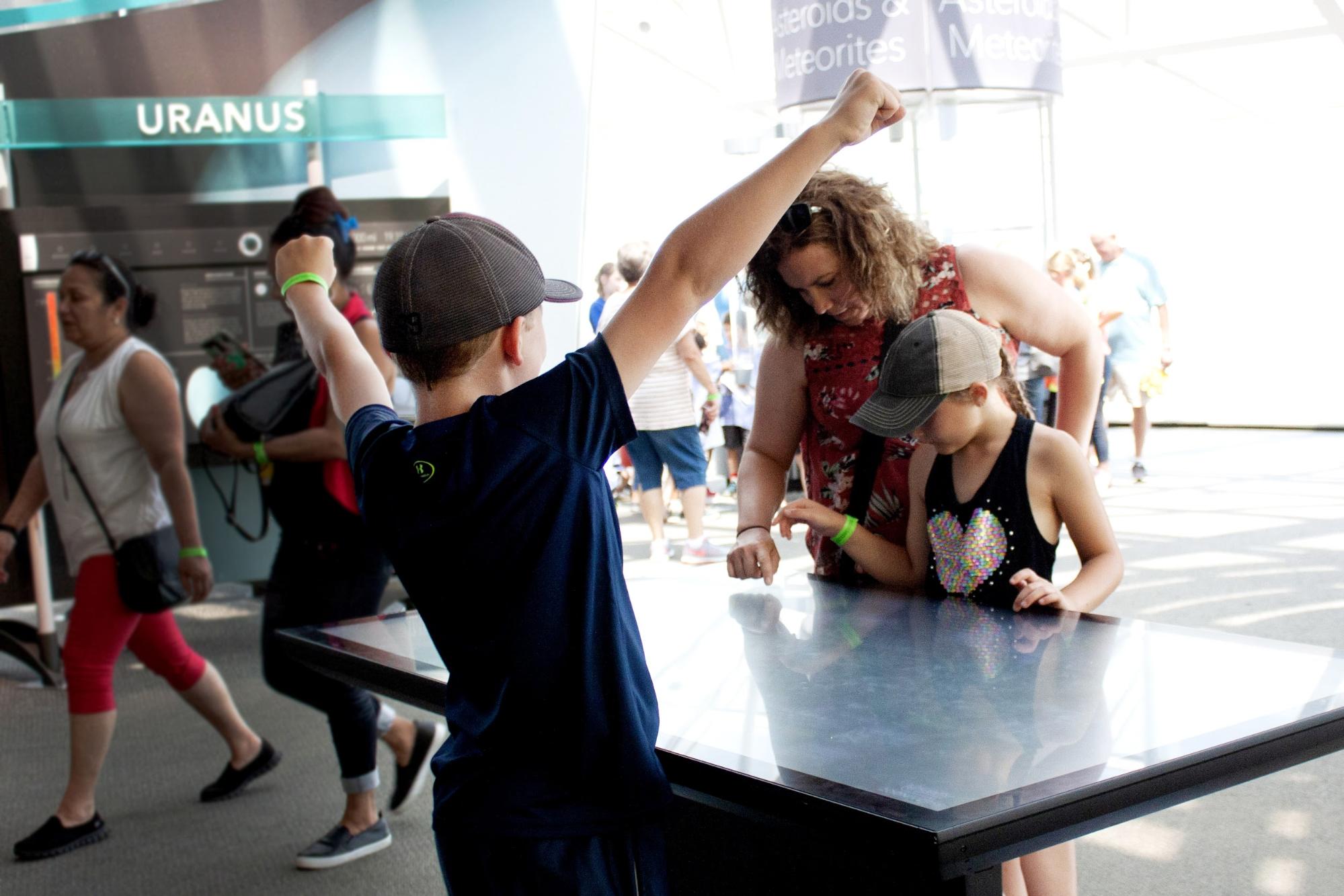
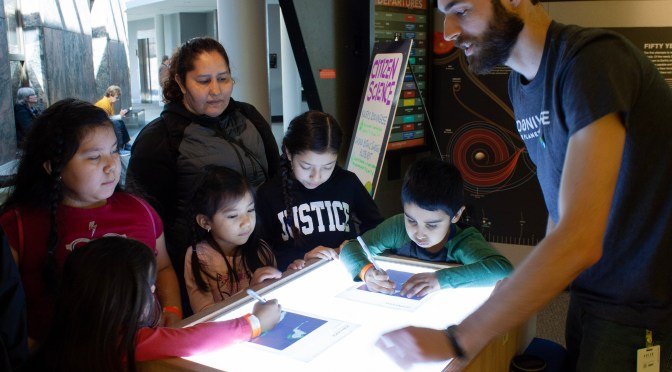
“Everyone try to grab the same galaxy,” a boy exclaimed while motioning to his classmates. Around the table, six students began dragging an image of a galaxy from the center of a large touch screen onto their own workstation. It’s very likely these students are the first people to set eyes upon this galaxy and decide how it should be classified. This kind of work isn’t reserved for astronomers in observatories or researchers in labs. Any visitor to the Adler Planetarium in Chicago can participate in real scientific research through the new U!Scientist touch table exhibit.

In July, the Zooniverse team finished their year-long development of a multi-person touch table experience and accompanying exhibit to remain on the Adler floor for several years. On the touch table, visitors participate in the Galaxy Zoo project (galaxyzoo.org), which provides valuable data to researchers in the U.S. and abroad by asking volunteers to classify galaxies by shape. In an effort to bring the Zooniverse experience to the Adler floor, the National Science Foundation awarded the Adler-Zooniverse team a grant to design a multi-person touch table experience, allowing guests to participate in the Zooniverse in a more social, collaborative way.

At the table, guests step up to their own color-coded workspace and select galaxies from an explorable image sliver of space in the middle of the table. Next, the guest must decide if the galaxy is smooth in shape, contains unique features, or isn’t a galaxy at all. After submitting a classification, the volunteer is shown a quick tally of how past volunteers have classified the galaxy. Adler visitors of all ages, from school groups to grandparents, are becoming quick Zooniverse volunteers.

U!Scientist includes some firsts for the Zooniverse, including the ability to collaborate directly with one another while classifying. When finding an oddly-shaped galaxy, volunteers can send the image to a neighbor for advice or begin a conversation with their group. Hopefully, these in-person conversations about science will spark curiosity and cause planetarium visitors to become active Zooniverse volunteers online.

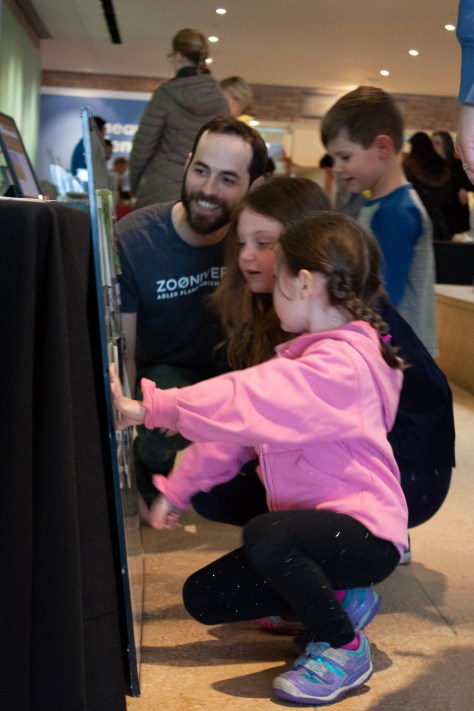
Since cutting the red ribbon, guests are finding new ways to interact with the exhibit. Couples take the opportunity to compete with one another in classifying the most galaxies, facilitators explain the research process to campers arriving early to the museum, and children outsmart their parents by explaining the shape of galaxies using examples at each workstation. On average, Adler guests are responsible for over one thousand classifications per day through U!Scientist.

Want to see how the touch table app is doing? Visit uscientist.org to see a running tally of U!Scientist and Galaxy Zoo classifications as well as a world map of current classifications through Galaxy Zoo.

The U!Scientist touch table exhibit is supported by the National Science Foundation under grant #AISL-1713425.

Chicago Earth Fest celebrations

The Chicago Zooniverse team had a great time celebrating Earth Day with members of the community at the Adler Planetarium and Chicago Botanic Garden.

At the Adler Planetarium’s EarthFest celebration on Saturday, April 13, guests were able to participate in an in-real-life version of Floating Forests, tracing areas of kelp from a satellite image onto tracing paper to see how a consensus result might be reached in the online version. Online at https://www.zooniverse.org/projects/zooniverse/floating-forests, you’ll be able to do this same activity, helping researchers learn how Giant Kelp forests change over time.

The next day at the Chicago Botanic Garden’s UnEarth Science Festival, visitors learned about the parts of a plant though a matching activity that segued into Rainforest Flowers, a Zooniverse project helping researchers at the Field Museum in Chicago to create a database of images of plants from the tropical forests of Central and South America.

We love meeting the community! If you missed us this time, keep your eye on this blog for our next event.

Join us at Earth Fest!

The Zooniverse is going on the road!

To celebrate Earth Day 2019, members of the Zooniverse team will be at two events in Chicago the weekend of April 13 and 14.

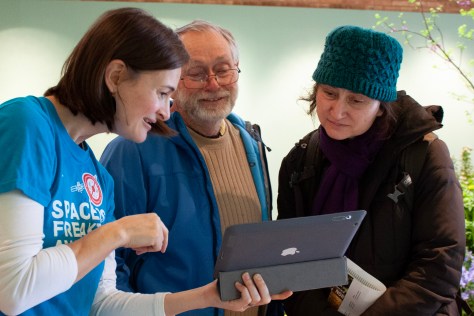
First, visit us at the Adler Planetarium’s Earthfest on Saturday, April 13. Participate in a real-life version of our Floating Forests project, pick up some cool Zooniverse swag, and talk to members of the Zooniverse team about their work. The event is free with Adler admission and we’ll be there between 10 am and 4 pm.

If you can’t make it to the Adler, join us at the Chicago Botanic Garden for the Unearth Science Festival on Sunday April 14. There, we’ll be talking about all the fantastic Zooniverse projects you can contribute to online or via our app, as well as taking an in-depth look at the anatomy of flowers via the Rainforest Flowers project.

Hope to meet you there!


Adler Members’ Night recap

We had a blast hanging out with Chicago-area volunteers and Adler Members at last month’s Adler Members’ Night! Visitors were able to try out potential new Zooniverse projects and Adler exhibits, including a constellation-themed project in collaboration with the Adler’s collections department, as well as U!Scientist, our NSF-supported touch table installation which features Galaxy Zoo.

Northwestern University researchers shook it up demonstrating why earthquakes behave in different ways based on plate friction, registered jumps on a seismograph and quizzed guests on seismograms from jumping second graders, storms and different earthquakes. Their Zooniverse project Earthquake Detective is currently in beta and is set to launch soon.

And we were delighted to watch volunteer @GlamasaurusRex complete her 15,000th classification LIVE IN PERSON. She made the classification on Higgs Hunters. Check out the video here: https://drive.google.com/open?id=1jttO1w1OfPY9LEaS5SjmEzy36PiGnY4U

We took it offline and you can too! A night of Zooniverse fun at the Adler Planetarium

Our inaugural Chicago-area meetup was great fun! Zooniverse volunteers came to the Adler Planetarium, home base for our Chicago team members, to meet some of the Adler Zooniverse web development team and talk to Chicago-area researchers about their Zooniverse projects.

adler_membersnight_5
Laura Trouille, co-I for Zooniverse and Senior Director for Citizen Science at the Adler Planetarium

Presenters:

  • Zooniverse Highlights and Thank You! (Laura Trouille, co-I for Zooniverse and Senior Director for Citizen Science at the Adler Planetarium)
  • Chicago Wildlife Watch (Liza Lehrer, Assistant Director, Urban Wildlife Institute, Lincoln Park Zoo)
  • Gravity Spy (Sarah Allen, Zooniverse developer, supporting the Northwestern University LIGO team)
  • Microplants (Matt Von Konrat, Head of Botanical Collections, Field Museum)
  • Steelpan Vibrations (Andrew Morrison, Physics Professor, Joliet Junior College)
  • Wikipedia Gender Bias (Emily Temple Wood, medical student, Wikipedia Editor, Zooniverse volunteer)
  • In-Person Zooniverse Volunteer Opportunities at the Adler Planetarium (Becky Rother, Zooniverse designer)

Researchers spoke briefly about their projects and how they use the data and ideas generated by our amazing Zooniverse volunteers in their work. Emily spoke of her efforts addressing gender bias in Wikipedia. We then took questions from the audience and folks chatted in small groups afterwards.

The event coincided with Adler Planetarium’s biennial Member’s Night, so Zooniverse volunteers were able to take advantage of the museum’s “Spooky Space” themed activities at the same time, which included exploring the Adler’s spookiest collection pieces, making your own spooky space music, and other fun. A few of the Zooniverse project leads also led activities: playing Andrew’s steel pan drum, interacting with the Chicago Wildlife Watch’s camera traps and other materials, and engaging guests in classifying across the many Zooniverse projects. There was also a scavenger hunt that led Zooniverse members and Adler guests through the museum, playing on themes within the exhibit spaces relating to projects within the Zooniverse mobile app (iOS and Android).

We really enjoyed meeting our volunteers and seeing the conversation flow between volunteers and researchers. We feel so lucky to be part of this community and supporting the efforts of such passionate, interesting people who are trying to do good in the world. Thank you!

Have you hosted a Zooniverse meetup in your town? Would you like to? Let us know!

Crowdsourcing and basic data visualization in the humanities

In late July I led a week-long course about crowdsourcing and data visualization at the Digital Humanities Oxford Summer School. I taught the crowdsourcing part, while my friend and collaborator, Sarah, from Google, lead the data visualization part. We had six participants from fields as diverse as history, archeology, botany and literature, to museum and library curation. Everyone brought a small batch of images, and used the new Zooniverse Project Builder (“Panoptes”) to create their own projects. We asked participants what were their most pressing research questions? If the dataset were larger, why would crowdsourcing be an appropriate methodology, instead of doing the tasks themselves? What would interest the crowd most? What string of questions or tasks might render the best data to work with later in the week?

Within two days everyone had a project up and running.  We experienced some teething problems along the way (Panoptes is still in active development) but we got there in the end! Everyone’s project looked swish, if you ask me.

Digging the Potomac

Participants had to ‘sell’ their projects in person and on social media to attract a crowd. The rates of participation were pretty impressive for a 24-hour sprint. Several hundred classifications were contributed, which gave each project owner enough data to work with.

But of course, a good looking website and good participation rates do not equate to easy-to-use or even good data! Several of us found that overly complex marking tasks rendered very convoluted data and clearly lost people’s attention. After working at the Zooniverse for over a year I knew this by rote, but I’d never really had the experience of setting up a workflow and seeing what came out in such a tangible way.

Despite the variable data, everyone was able to do something interesting with their results. The archeologist working on pottery shards investigated whether there was a correlation between clay color and decoration. Clay is regional, but are decorative fashions regional or do they travel? He found, to his surprise, that they were widespread.

In the end, everyone agreed that they would create simpler projects next time around. Our urge to catalogue and describe everything about an object—a natural result of our training in the humanities and GLAM sectors—has to be reined in when designing a crowdsourcing project. On the other hand, our ability to tell stories, and this particular group’s willingness to get to grips with quantitative results, points to a future where humanities specialists use crowdsourcing and quantitative methods to open up their research in new and exciting ways.

-Victoria, humanities project lead