Volunteers are the heart and soul of Zooniverse. Participatory research cannot happen without them. Successful project teams sustain and grow their communities by staying in touch with their volunteers, keeping them informed and showing them the appreciation they deserve. Here are some tips to get you started.
Nurture your volunteer community
Be present on Talk. Answer questions, engage in discussions, listen.
Send project newsletters (learn how here). Share news, show appreciation, discuss interim results and illustrate how your volunteers efforts are having a tangible effect on research and discovery.
Use the announcement banner to share your most important updates (e.g. a new workflow, a publication or an upcoming event).
Appoint and support your project moderators to help foster community engagement (learn more in our moderator guide).
Feature your new project launch or share updates to your existing project on Zooniverse’s social media – Instagram, Facebook and/or Bluesky.
Send us a message at contact@zooniverse.org to express your interest in any of the options listed above!
Share your publications
Submit them via the Google form linked at the top of the Publications page.
Since 2009, Zooniverse research has led to more than 450 peer-reviewed publications. Sharing these publications with our community helps to demonstrate the impact citizen science have on real research and to inform volunteers about the results of their hard work.
Follow good practices for project sunsetting
Let us know when your project’s classification effort is complete, so we can change its status to Finished. This way your project will stay visible on Zooniverse, but volunteers will know that your team no longer needs their help with classifications.
Email us at contact@zooniverse.organd we will walk you through the process, including end-of-project communications best practices.
Would you like to share your best practices with other Zooniverse teams? Drop us a line and we will be happy to feature your ideas in our next blog post.
Over the years, one of the most common requests from educators has been for tools to support group engagement in Zooniverse and better tell your story of collective impact. We’re so grateful for a grant from NASA enabling us to build these new tools to meet those needs.
Whether you’re a library or museum educator, a camp counselor, or a classroom teacher, read on to discover how Zooniverse can enhance your educational goals.
Zooniverse is the world’s largest platform for people-powered research, with millions of participants and dozens of active projects across various disciplines. By using Zooniverse, you join a global network of educators offering students often their first opportunity to engage in real research. From classifying galaxies and tagging penguins to transcribing historic documents and marking the structure of cells for cancer research, Zooniverse projects span a wide array of research fields.
For a list of curricular resources for educators, including lesson plans, instructor guides, and more, check out zooniverse.org/get-involved/education.
Tracking Individual and Collective Impact
Zooniverse offers easy ways to track both individual and collective impact, making it easy to use in educational settings. You can assign tasks, motivate participation, set up friendly competitions between classes, and more.
Personal Stats
When logged into Zooniverse, each individual sees their own stats, including classification counts and hours spent. A valuable feature for fulfilling service hour requirements is the ability to generate a signed volunteer certificate.
Group Stats
Groups in Zooniverse can view their collective impact, set shared goals, and celebrate milestones. These tools empower educators to engage students in new ways.
Step 1: Create Your Group
Go to zooniverse.org, sign in, and scroll down to ‘My Groups’. Click ‘Create New Group.’ Name your group appropriately, such as “Hammond’s 4th Period Biology” or “Davis County Public Library.”
As the admin, you can decide if the group stats page will be publicly viewable or only accessible to group members. Additionally, you can choose whether to display individual stats or only aggregate results. For example, if your group stats page is public, you can set it so that only you can see individual stats, or you can allow other group members or everyone to see them. Through the admin pop-up, you can update your group settings or remove group members at any time.
For additional Group details/features, see this blog post.
Step 2: Invite Participants to Join Your Group
Have your students or program participants create a Zooniverse account by clicking ‘Register’ in the upper-right corner of zooniverse.org. To invite them to join your group, click the ‘Copy Join Link’ on your group’s page and share it via email or other preferred means, such as creating a QR code.
Once they click the join link, all classifications they do on any Zooniverse project will be included in your group stats page, contributing to your group’s collective impact.
Step 3: View/Share Your Group Stats
When viewing your group stats page, you can use the drop-down options on the upper-right of the stats bar chart to filter to a specific time period and/or project of interest. Another helpful feature is the ‘See detailed stats’ option, where you can view all group contributors’ stats and generate a .CSV file for further analysis. A future feature will be the ability to filter to specific time periods within this detailed stats page.
Members of your group will also be able to view the group stats page. Depending on the choices you’ve made in the admin settings, group members will either be able to only view the aggregate stats OR they’ll be able to view both the aggregate and individual stats.
If you’ve set your group visibility settings to ‘public’, you’ll have the ‘Share Group’ option at the top of your group’s stats page. Clicking ‘Share group’ will copy a link to the public-facing view of your group’s stats page. This is different from a ‘Join Link’. Anyone with the ‘Share Group’ link will simply be able to view the group’s stats, but will not be added as a member of the group.
Celebrating Milestones
A few Zooniverse project teams have created short thank you videos, which are great rewards to share with your students after reaching a collective milestone.
Example: STEM Club at a Public Library
Imagine you lead a STEM club at your local public library. You create a group, set the settings to public but only for aggregate results (i.e, not showing individual stats publicly), copy the join link, and share it with your group members. You set a classification challenge for the week, share recommended projects (see zooniverse.org/projects for the full list), and encourage free choice. Throughout the week, you update your group on progress toward your goal. At your next meeting, you celebrate reaching the goal with a thank you video and highlight top contributors with special rewards. Then, you set the next week’s challenge to keep the momentum going.
Other Use Cases
Friendly competition among class periods
Extra credit opportunities for your students
Extension activity after a museum field trip experience
Summer camp group tracking independent research time
Share your Stories of Impact with Us
We’d love to hear about your experience and share your stories of impact with the broader Zooniverse community to spark ideas and inspiration in others. See this Daily Zooniverse post as an example. Email us at contact@zooniverse.org with your stories!
Get in Touch
If you have questions or need advice, join the conversation in our dedicated Talk discussion forum around Education and the Zooniverse or email us at contact@zooniverse.org.
On behalf of Zooniverse, we are incredibly grateful that you choose to use participatory science in your educational programs and hope to continue fostering this innovative community of educators around the world.
Thank you for including Zooniverse in your educational efforts!
As schools, workplaces, public spaces, and institutions across the globe close in response to COVID-19, we are aware that, for many people, online platforms like Zooniverse can function as a way to continue to have an impact and remain engaged with the world.
We cannot thank you enough for participating in Zooniverse and creating a welcoming and supportive space for all.
Below is a list of resources educators have used in classrooms that also work well remotely/online. Key to keep in mind is that Zooniverse projects are a great way to expose learners to new opportunities and ways of engaging in real research. These resources are meant to spark curiosity, learning, and exposure to research and the broader world. We encourage you to especially consider what students can gain from the process of participating. Remember: this is an opportunity for experiential learning, not a platform for creating busy work.
Note – there is no age limit for participating in Zooniverse projects, but children under the age of 16 need parent or guardian approval before creating their own Zooniverse account (see here for more details).
Designed for 11-13 year olds, but the content can easily scale down for younger audiences.
Great way to engage if you love looking at photos of wild animals and want to investigate ecological questions. The interactive map allows you to explore trail camera data and filter and download data to carry out analyses and test hypotheses.
Educators can set up private classrooms, invite students to join, curate data sets, and get access to the guided activities and supporting educational resources.
Individual explorers also welcome – you don’t need to be part of a classroom to participate.
An example set of lessons based around Wildcam Labs, focused on using wildlife camera citizen science projects to engage students in academic language acquisition
A Zooniverse – NASA collaboration through which students learn about citizen science, explore how astronomers search for planets around distant stars, participate directly in the search for exoplanets through PlanetHunters.org, and then design and draw their own planetary system.
Developed by Chicago’s Adler Planetarium Education Specialist Julie Feldt and Adler Director of Teen Programs Kelly Borden.
Through this lesson students observe, record, and document specimens, become a part of the Zooniverse Notes from Nature project, transcribe specimens, connect art and science, and sketch birds in a science notebook.
Designed for middle school classrooms, but the content can easily scale up for older audiences.
See description above.
Astro101 with Galaxy Zoo
Designed for undergraduate non-major introductory astronomy courses, but the content has been used in many high-school classrooms as well.
Students learn about stars and galaxies through 4 half-hour guided activities and a 15-20 hour research project experience in which they analyze real data (including a curated Galaxy Zoo dataset), test hypotheses, make plots, and summarize their findings.
Developed by Julie Feldt, Thomas Nelson, Cody Dirks, Dave Meyer, Molly Simon, and colleagues.
For both Wildcam and Astro101 Activities
Educators can set up private classrooms, invite students to join, curate data sets, and get access to the guided activities and supporting educational resources.
Individual explorers also welcome – you don’t need to be part of a classroom to participate.
Through the Zooniverse FloatingForests.org project, researchers are striving to understand the impact of climate change on giant kelp forests, an indicator of the health of our oceans. In this lab, students analyze Floating Forest and other ocean data to explore their own research questions.
Developed by Cal State – Monterey Bay faculty Dr. Alison Haupt and colleagues
We’d love to hear about your experiences with Zooniverse. Join the conversation in our ‘Talk’ discussion forum around Education and the Zooniverse. There’s a wonderful community there of formal and informal educators and students who are interested in sharing resources and ideas.
If you need a record of your students’ contributions:
You can keep track of how many classifications you’ve contributed if you register (providing a username and email address) within Zooniverse.org. Once signed in, at Zooniverse.org you’ll see your display name and your total classification count. If you hover over the circle surrounding your avatar, you’ll see the classification counts for each specific project you’ve participated in. Some teachers have their students share a screenshot of this zooniverse.org page as a record of contributions.
Please note that there is no built-in time-tracker within Zooniverse. However, participants can use the number of classifications they’ve contributed as a proxy for time spent on the site. On average, a person contributes 20-75 classifications/hour on most projects. So, for example, if a student has done 100 classifications, you can estimate that they’ve spent ~2 hours classifying on Zooniverse; e.g., 2 hours x 50 classifications / hour = 100 classifications.
We are often asked who our community are by project scientists, sociologists, and by the community itself. A recent Oxford study tried to find out, and working with them we conducted a survey of volunteers. The results were interesting and when combined with various statistics that we have at Zooniverse (web logs, analytics, etc) we can start to see a pretty good picture of who volunteers at the Zooniverse.
Much of what follows comes from a survey was conducted last Summer as part of Masters student Victoria Homsy’s thesis, though the results are broadly consistent with other surveys we have performed. We asked a small subset of the Zooniverse community to answer an online questionnaire. We contacted about 3000 people regarding the survey and around 300 responded. They were not a random sample of users, rather they were people who had logged-in to the Zooniverse at least once in the three months before we emailed them.
The remaining aspects of this post involve data gathered by our own system (classification counts, log-in rates, etc) and data from our use of Google Analytics.
So with that preamble done: let’s see who you are…
This visualisation is of Talk data from last Summer. It doesn’t cover every project (e.g. Planet Hunters is missing) but it gives you a good flavour for how our community is structured. Each node (circle) is one volunteer, sized proportionally according to how many posts they have made overall. You can see one power-mod who has commented more than 16,000 times on Talk near the centre. Volunteers are connected to others by talking in the same threads (a proxy for having conversations). They have been automatically coloured by network analysis, to reflect sub-networks within the Zooniverse as a whole. The result is that we see the different projects’ Talk sites.
There are users that rise largely out of those sub-communities and talk across many sites, but mostly people stick to one group. You can also see how relatively few power users help glue the whole together, and how there are individuals talking to large numbers of others, who in turn may not participate much otherwise – these are likely examples of experienced users answering questions from others.
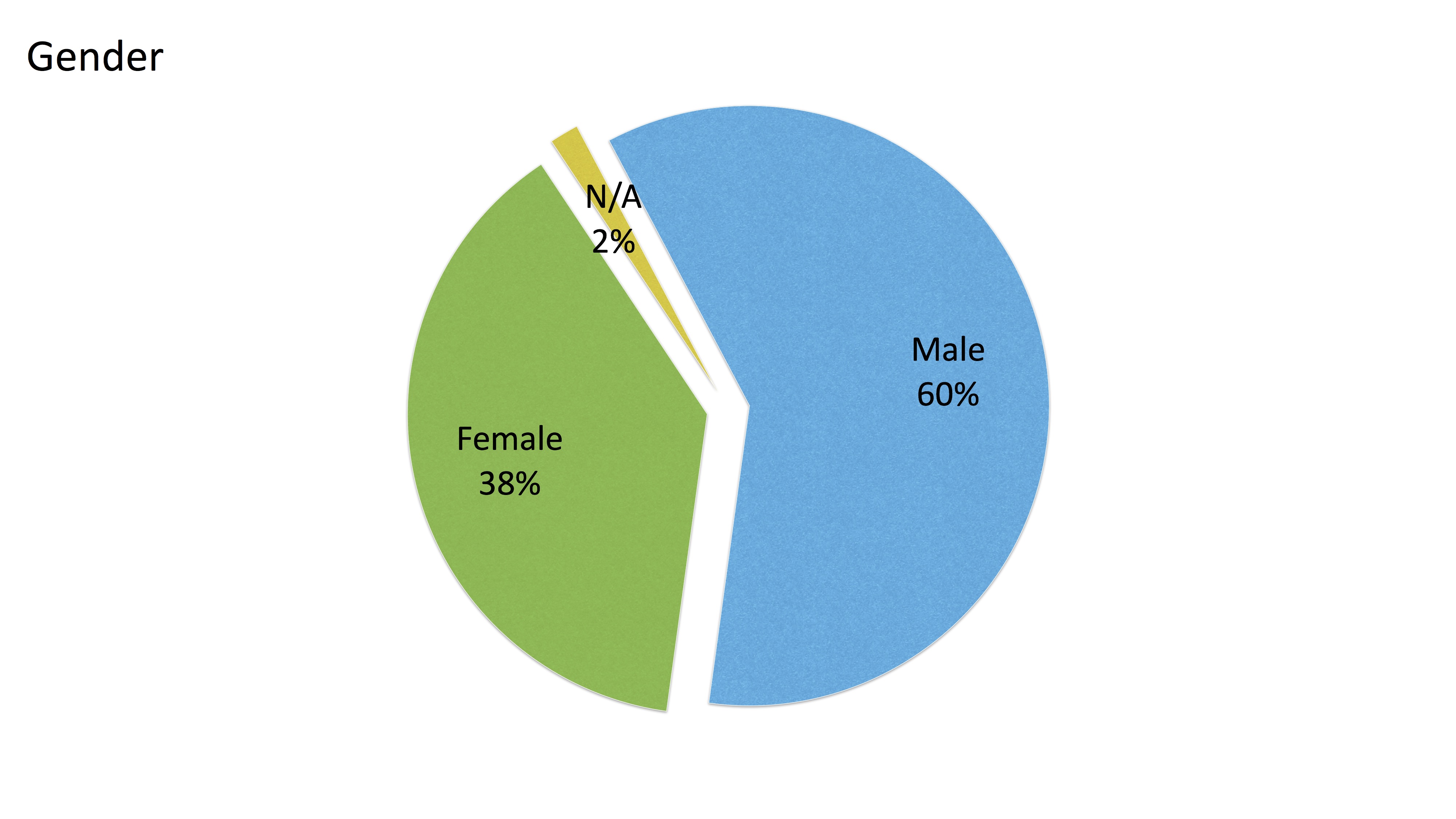
One thing we can’t tell from our own metrics is a person’s gender, but we did ask in the survey. The Zooniverse community seems to be in a 60/40 split, which in some ways is not as bad as I would have thought. However, we can do better, and this provides a metric to measure ourselves against in the future.
It is also interesting to note that there is very little skew in the ages of our volunteers. There is a slight tilt away from older people, but overall the community appears to be made up of people of all ages. This reflects the experience of chatting to people on Talk.
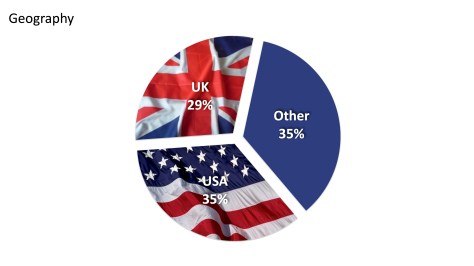
We know that the Zooniverse is English-language dominated, and specifically UK/US dominated. This is always where we have found the best press coverage, and where we have the most links ourselves. The breakdown between US/UK/the rest is basically a three-way split. This split is seen not just in this survey but also generally in our analytics overall.
Only 2% of the users responding to our survey only came from the developing world. As you can see in a recent blog post, we do get visitors from all over the world. It may be that the survey has the effect of filtering out these people (it was conducted via an online form), or maybe that there is language barrier.
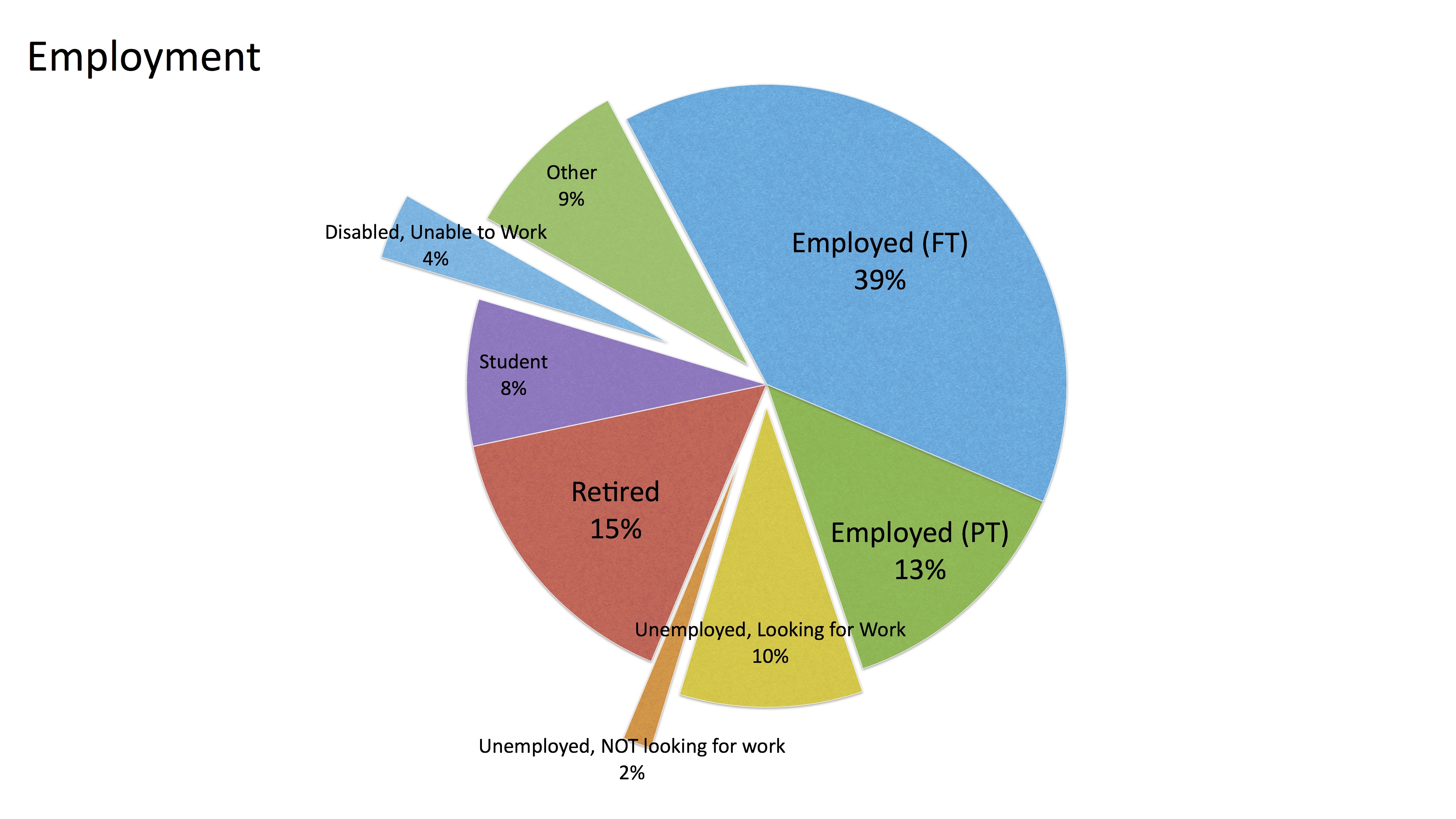
We also asked people about their employment status. We find a about half of our community is employed (either full- or part-time). Looking at the age distribution, we might expect up a fifth or sixth of people to be retired (15% is fairly close). This leaves us with about 10% unemployed, nearly twice the UK or US unemployment rate, and about 4% unable to work due to disability (about the UK averaged, by comparison). This is interesting, especially in relation to the next question, on motivation for participating.
We also asked them to tell us what they do and the result is the above word cloud (thanks, Wordle!) which shows a wonderful array of occupations including professor, admin, guard, and dogsbody. You should note a high instance of technical jobs on this list, possibly indicating that people need to have, or be near, a computer to work on Zooniverse projects in their daily life.
When asked why they take part in Zooniverse projects we find that the most-common response (91%) is a desire to contribute to progress. How very noble. Closely following that (84%) are the many people who are interested in the subject matter. It falls of rapidly then to ‘entertainment’, ‘distraction’ and ‘other’. We are forever telling people that the community is motivated mainly by science and contribution, and for whatever reason they usually don’t believe us. It’s nice to see this result reproducing an important part of the Raddick et. al. 2009 study, which first demonstrated it.
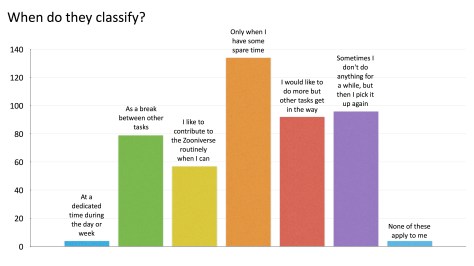
It is roughly what I would have expected to see that people tend to classify mostly in their spare time, and that most don’t have dedicated ‘Zooniverse’ time every day. It’s more interesting to see why, if they tend to stop and start, i.e. if they answered in the purple category above. Here is a word cloud showing the reason people stop participating in Zooniverse. TL;DR they have the rest of their life to get on with.
We’ll obviously have to fix this by making Zooniverse their whole life!
This is my final blog post as a part of the Zooniverse team. It has been by pleasure to work at the Zooniverse for the last five years. Much of that time has been spent trying to motivate and engage the amazing community of volunteers who come to click, chat, and work on all our projects. You’re an incredible bunch, motivated by science and a desire to be part of something important and worthwhile online. I think you’re awesome. In the last five years I have seen the Zooniverse grow into a community of more than one million online volunteers, willing to tackle big questions, and trying and understand the world around us.
Thank you for your enthusiasm and your time. I’ll see you online…
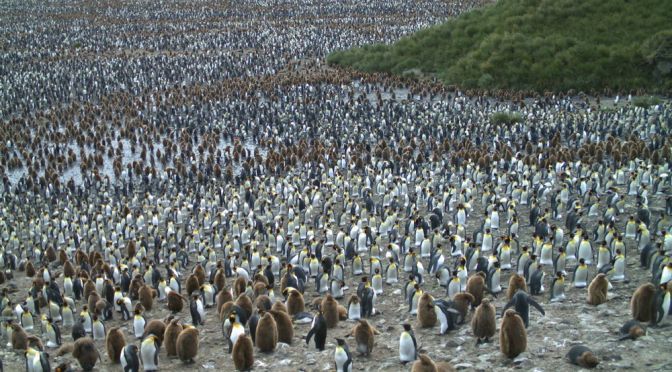
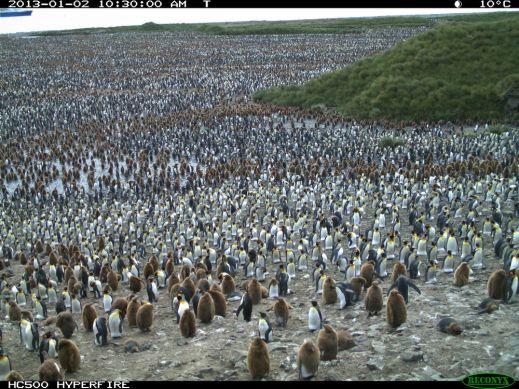
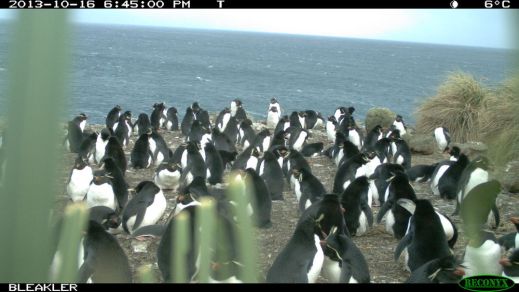
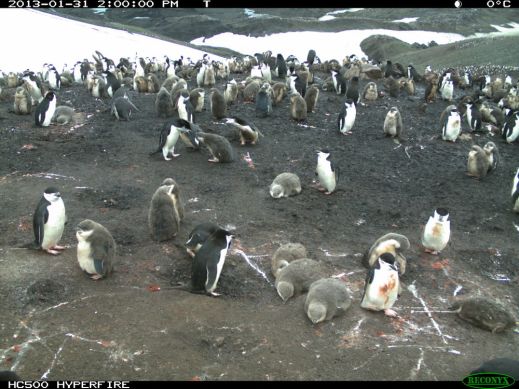
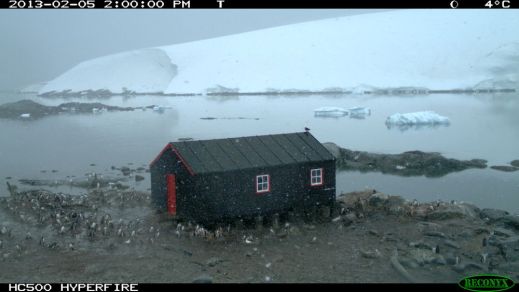
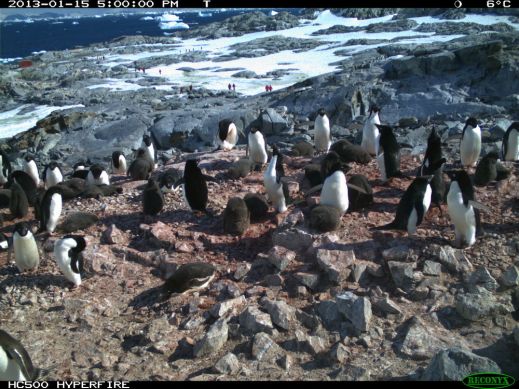
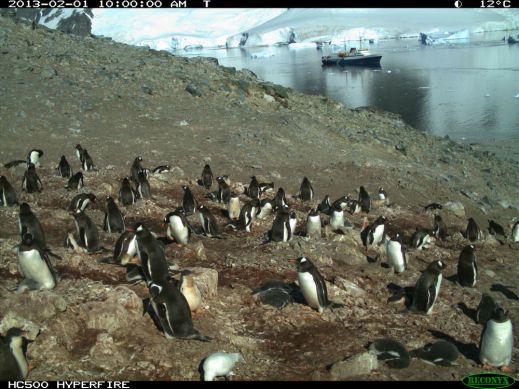
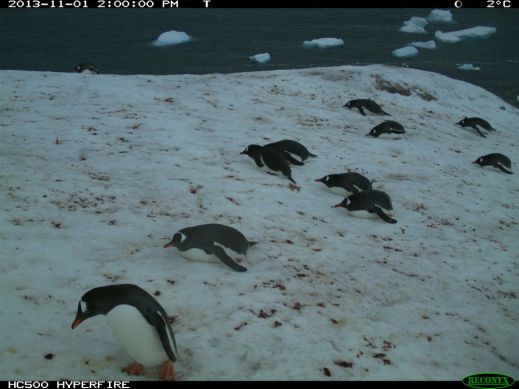
Yesterday we launched our latest project: Penguin Watch. It is already proving to be one of the most popular projects we run, with over one hundred thousand classifications in the first day! The data come from 50 cameras focussed on the nesting areas of penguin colonies around the Southern Ocean. Volunteers are asked to tag adult penguins, chicks, and eggs.
Here are my favourite images uncovered by our volunteers so far: (click on an image to see what people are saying about it on Penguin Watch Talk)
1st Rule of Penguin Watch – You don’t have to count them all. But I dare you to!
The world's largest and most popular platform for people-powered research. This research is made possible by volunteers—millions of people around the world who come together to assist professional researchers.







 Zooniverse