Category Archives: Statistics

ZooTools: Going Deeper With Zooniverse Project Data

One of the best things about being an educator on the Zooniverse development team is the opportunity to interact with teachers who are using Zooniverse projects in their classroom and teachers who are interested in using Zooniverse projects in the classroom. Teachers cite several reasons about why they use these projects – Authentic data?  Check. Contributing to cutting-edge research across a variety of scientific fields?  Check.  Free?  Check. Classifying a few galaxies in Galaxy Zoo or identifying and measuring some plankton in Plankton Portal can be an exciting introduction to participating in scientific investigations with “the professionals.”  This isn’t enough though; teachers and other educators are hungry for ways to facilitate deeper student engagement with scientific data. Zooniverse educators and developers are consistently asked “How can my students dig deeper into the data on Zooniverse?”

This is where ZooTools comes into play. The Zooniverse development team has recently created ZooTools as a place where volunteers can observe, collect, and analyze data from Zooniverse citizen science projects. These tools were initially conceived as a toolkit for adult volunteers to use to make discoveries within Zooniverse data but it is becoming apparent that these would also have useful applications in formal education settings. It’s worth pointing out that these tools are currently in beta. In the world of web development beta basically means “it ain’t perfect yet.”  ZooTools is not polished and perfect; in fact it’s possible you may encounter some bugs.

Projects like Galaxy Zoo and Planet Hunters have an impressive history of “extra credit” discoveries made by volunteers.  Galaxy Zoo volunteers have made major contributions to the astronomy literature through the discovery of the green peas galaxies and Hanny’s Voorwerp .  In Planet Hunters volunteers use Talk to share methods of exploring and results from the project’s light curves.  ZooTools lowers the barrier of entry by equipping volunteers with some simple tools to look for interesting relationships and results contained within the data.  No specialist knowledge required.

We’ve only begun thinking about how ZooTools could be used in the classroom.  I started my own investigation with a question that came from a Zooniverse classroom visit from last spring.  While making observations as a class about some of the amazing animals in Snapshot Serengeti one young man asked about civets. He wanted to know If they were nocturnal. We had an interesting discussion about how you could find out this information.  The general consensus was to Google it or look it up on Wikipedia.  I wondered if you could use the data contained within Snapshot Serengeti to come up with a reasonable answer.  I was excited to roll-up my sleeves and figure out how to use these tools to find a likely answer.  Here are the steps I took…

Step 1: Log-in to Zooniverse and go to ZooTools.
Step 1

Step 2: Select a project. Currently only have a few projects have data available to explore using ZooTools.

Step 2

Step 3: Create a dashboard.

Step 3

Step 4: Name your dashboard something awesome. I called mine Civets! for obvious reasons.

Step 4

Step 5: This is your blank dashboard.

Step 5

Step 6: It’s time to select a data source. I selected Snapshot Serengeti.

Step 6

Step 7: This is the data source.

Step 7

Step 8: I wanted to be able to filter my data so I selected Filter under search type. The name of this dataset in Snapshot Serengeti 1.

Step 8

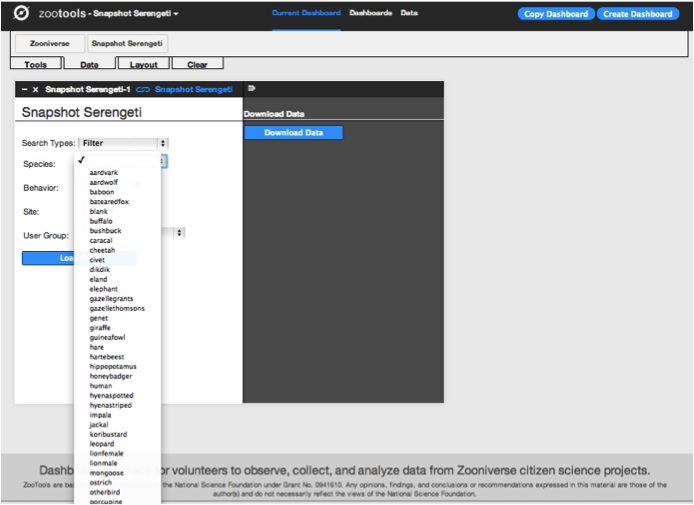
Step 9: Since I wanted to look at civets, I selected that on the species dropdown menu and then clicked Load Data. My dataset will only contain images that Snapshot Serengeti volunteers identified as civets.
Step 9

Step 10: I had my data; next it was time to select a Tool.  I selected Tools at the top of the page.

Step 10

Step 11: I selected Subject Viewer because this tool allows my to flip through different images.

Step 11

Step 12: Next I had to connect my data source to my tool. From the Data Source drop down menu I selected Snapshot Serengeti 1.

Step 12

Step 13: In order to get a good luck at the images in my dataset I clicked the icon shaped like a fork to close the pane.  I then used the arrows to advance through the images.

Step 13

I flipped through the images and kept track of the night versus day. Of the 37 images in my dataset, I observed that 34 were taken at night and 3 were taken during the day.  This led me to the conclusion that civets are likely nocturnal.  This was so much more satisfying than just going to Google or Wikipedia. A couple of other questions that I explored…

What is the distribution of animals identified at one camera trap site?

14


How many honeybadgers have been observed by Snapshot Serengeti volunteers across different camera traps?

Screen Shot 2013-11-26 at 3.17.28 PM

Of course this is just the tip of the iceberg.  Currently you can explore Galaxy Zoo, Space Warps, and Snapshot Serengeti data using ZooTools. Currently you can use ZooTools to explore data from Galaxy Zoo, Space Warps, and Snapshot Serengeti.  The specific tools and datasets available vary from project to project.  In Galaxy Zoo for example you can look at data from Galaxy Zoo classifications or from SDSS Skyserver. Hopefully you’ll be inspired to have a play with these tools!  What questions would you or your students like to explore?
The Elise Andrew Effect – What a post on IFLS does to your numbers

AP-IFLS

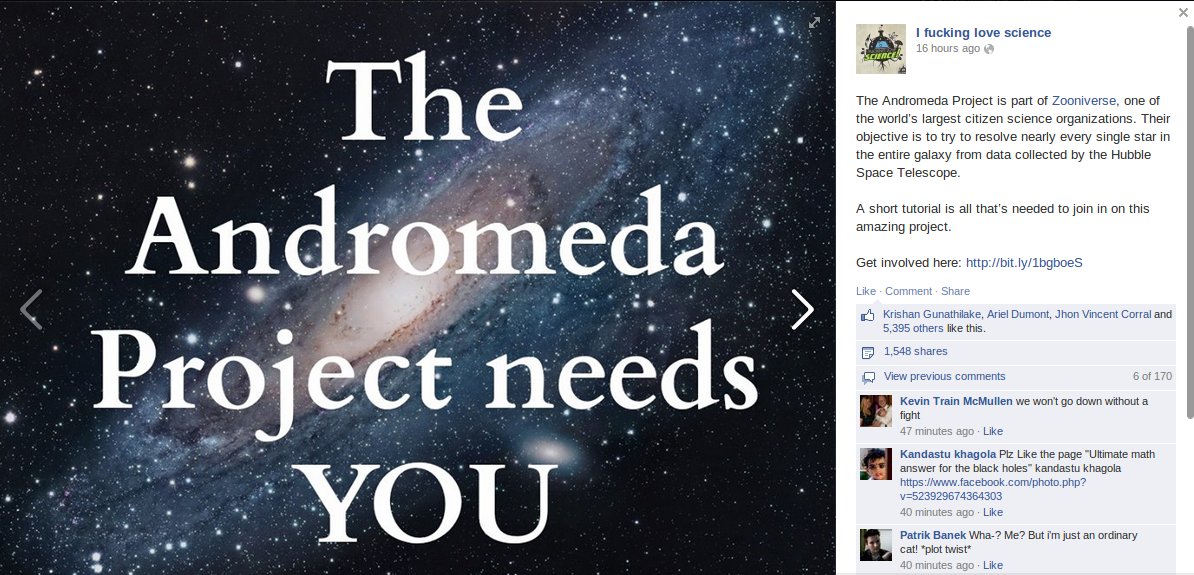
Recenty the Andromeda Project was the feature of one of the posts on the ‘I fucking Love Science’ Facebook page. The page, which was started by Elise Andrew in March 2012, currently has 8 million likes, so some form of noticeable impact was to be expected! Here are some of the interesting numbers the post is responsible for:

I’ll start with the Facebook post itself. As of writing (16 hours after original posting), it has been shard 1,842 times, liked by 6,494 people and has 218 comments. These numbers are actually relatively low for an IFLS post, some of which can reach over 70,000 shares!

AP-IFLS-2
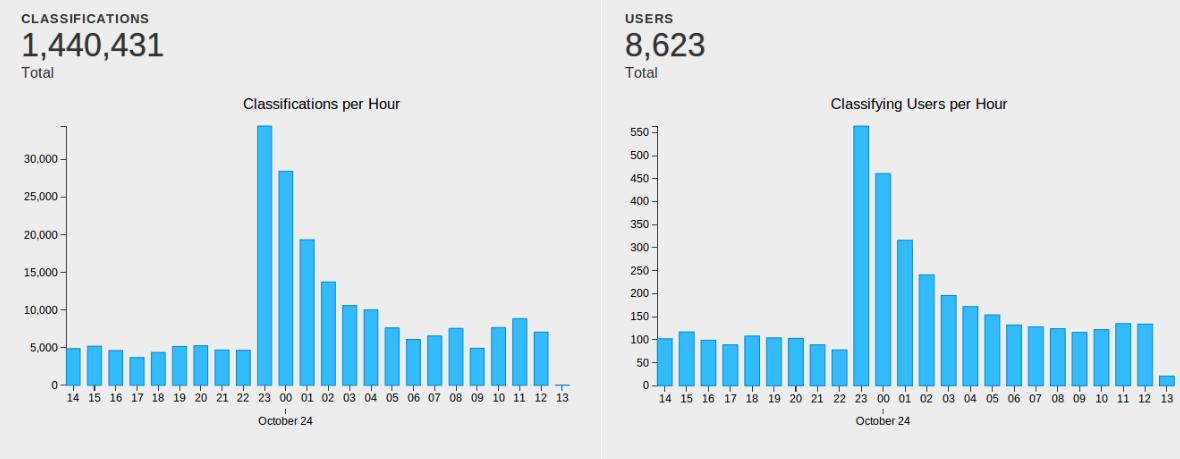
The ‘IFLS spike’ in the Andromeda Project classifications and active users

Let’s now have a look at what it did for the Andromeda Project. The project, which was launched two days previous and was already pretty popular, had settled down to around 100 active users per hour. This number shot up to almost 600 immediately following the post. In the space of 5 minutes the number of visitors on the site went from 13 to 1,300! After a few hours it settled down again, but now the steady rate looks to be about 25% higher than before. The number of classifications per hour follows the same pattern. The amazing figure here is that almost 100,000 classifications were made in the 4 hours following the post. This number corresponds to around 1/6th of the total needed to complete the project!

PH-IFLS-spike
The number of visitors per day to the Planet Hunters site over the last two weeks. Visits increased by a factor of ten on the day of the IFLS post, and three days later the numbers are still greater than before.

Two days after her post about the Andromeda Project, Elise put up a post about the discovery of a seventh planet around the dwarf star KIC 11442793, which was found by citizen scientist on the Planet Hunters project. This post proved even more popular than the previous one with more than 3,000 shares, and led to a similar spike of the same magnitude in the number of visitors to the site (as can be seen in the plot above).

Finally, what did it do for the Zooniverse as a whole? Well there have been over 4,000 new Zooniverse accounts registered within the last four days and the Facebook page, which was linked in the AP article, got a healthy boost of around 1,000 new likes. So all things considered, it seems that an IFLS post can be very useful for promoting your project indeed!

Thanks Elise, the Andromeda Project, Planet Hunters and  Zooniverse teams love you!

Welcome to the Worm Watch Lab

Today we launch a new Zooniverse project in association with the Medical Research Council (MRC) and the Medical Research Foundation: Worm Watch Lab.

We need the public’s help in observing the behaviour of tiny nematode worms. When you classify on wormwatchlab.org you’re shown a video of a worm wriggling around. The aim of the game is to watch and wait for the worm to lay eggs, and to hit the ‘z’ key when they do. It’s very simple and strangely addictive. By watching these worms lay eggs, you’re helping to collect valuable data about genetics that will assist medical research.

Worm Watch Lab

The MRC have built tracking microscopes to record these videos of crawling worms. A USB microscope is mounted on a motorised stage connected to a computer. When the worm moves, the computer analyses the changing image and commands the stage to move to re-centre the worm in the field of view. Because the trackers work without supervision, they can run eight of them in parallel to collect a lot of video! It’s these movies that we need the public to help classify.

By watching movies of the nematode worms, we can understand how the brain works and how genes affect behaviour. The idea is that if a gene is involved in a visible behaviour, then mutations that break that gene might lead to detectable behavioural changes. The type of change gives us a hint about what the affected gene might be doing. Although it is small and has far fewer cells than we do, the worm used in these studies (called C. elegans) has almost as many genes as we do! We share a common ancestor with these worms, so many of their genes are closely related to human genes. This presents us with the opportunity to study the function of genes that are important for human brain function in an animal that is easier to handle, great for microscopy and genetics, and has a generation time of only a few days. It’s all quite amazing!

To get started visit www.wormwatchlab.org and follow the tutorial. You can also find Worm Watch Lab on Facebook and on Twitter.

Hard Workers

We keep track of the activity in the Zooniverse using Google Analytics. There is a lot to keep up with and Analytics does a very good job. Well we like it anyway. I was looking through the stats today and came across an unusual fact: Leicester, a city here in the UK, is the hardest working place in the Zooniverse. No offense to Leicester, but this shocked me.

I’m defining hardest working to mean the most time put into classifying and engaging with the Zooniverse – per user. So in Leicester, users have put in an average of 6.0 hours each since February 2009. There are about 150 Zooniverse users in Leicester and they have put in a whopping 900 hours between them. That is dedication! I’m also assuming that time spent on the site is roughly proportional to time spent actually classifying, merging, etc. I hope so anyway!

So how does the rest of the world compare? Well I’m glad you asked. Here’s the top ten hardest working cities in the Zooniverse:

  1. Leicester (6.0 hours)
  2. Gdansk (4.6 hours)
  3. Auckland (4.0 hours)
  4. Los Angeles (3.8 hours)
  5. Southampton (3.8 hours)
  6. Indianapolis (3.6 hours)
  7. Poznan (3.2 hours)
  8. Minneapolis (3.2 hours)
  9. Denver (3.1 hours)
  10. Helsinki (2.9 hours)

As you can see, Leicester is miles ahead of the crowd. If you know why this might be, please let me know! The top 50 cities are shown in the graph below – there are 10,000 in all. It is interesting to note that the chart really levels off for the most part. It then heads into a steady long-tail. This seems to show that the vast majority of users, regardless of geographic location, have put in just under 2 hours each since February 2009.

HardestWorkingCities

So the natural next step here is to find out which country is hardest working. Apparently it is New Zealand, where Zooniverse users have spent an average of 3.6 hours each working on the site since February 2009. The graph for the Top 50 countries is shown below and reveals the countries where users spend, on average, the most time on the Zooniverse. New Zealand, Portugal and Australia make up the top three. In fact it seems that antipodean users generally spend more time on the site – again, please tell me why.

HardestWorkingCountries

Well that’s my extended coffee break over. If you have specific questions about the stats on the Zooniverse, drop a comment here and we’ll see if we can try and resolve them for you. Have a good week.