Category Archives: New Features

What’s going on with the classify interface? Part One

Part one in a multi-part series exploring the visual and UX changes to the Zooniverse classify interface

First, an introduction.

Zooniverse began in 2007, with a galaxy-classifying project called Galaxy Zoo. The project was wildly successful, and one of the lead researchers, Chris Lintott, saw an opportunity to help other researchers accomplish similar goals. He assembled a team of developers and set to work building custom projects just like Galaxy Zoo for researchers around the world.

And things were good.

But the team started to wonder: How can we improve the process to empower researchers to build their own Zooniverse projects, rather than relying on the team’s limited resources to build their projects for them?

Thus, the project builder (zooniverse.org/lab) was born.

In the first year of its inception, the number of projects available to citizen scientist volunteers nearly doubled. Popularity spread, the team grew, and things seemed to be going well.

That’s where I come in. * Record scratch *

Three years after the project builder’s debut, I was hired as the Zooniverse designer. With eight years’ experience in a variety of design roles from newspaper page design to user experience for mobile apps to web design, I approached the new project builder-built projects with fresh eyes, taking a hard look at what was working and what areas could be improved.

Over the next week, I’ll be breaking down my findings and observations, and talking through the design changes we’re making, shedding more light on the aims and intentions behind these changes and how they will affect your experience on the Zooniverse platform.

If you take one thing away from this series it’s that this design update, in following with the ethos of Zooniverse, is an iterative, collaborative process. These posts represent where we are now, in June 2018, but the final product, after testing and hearing your input, may be different. We’re learning as we go, and your input is hugely beneficial as we move forward.

Here’s a link to an open survey in case you’d like to share thoughts, experiences, or opinions at any point.

Let’s dive in.

Part one: Research

My first few weeks on the job were spent exploring Zooniverse, learning about the amazing world of citizen science, and examining projects with similar task types from across the internet.

I did a large-scale analysis of the site in general, going through every page in each section and identifying areas with inconsistent visual styles or confusing user experiences.
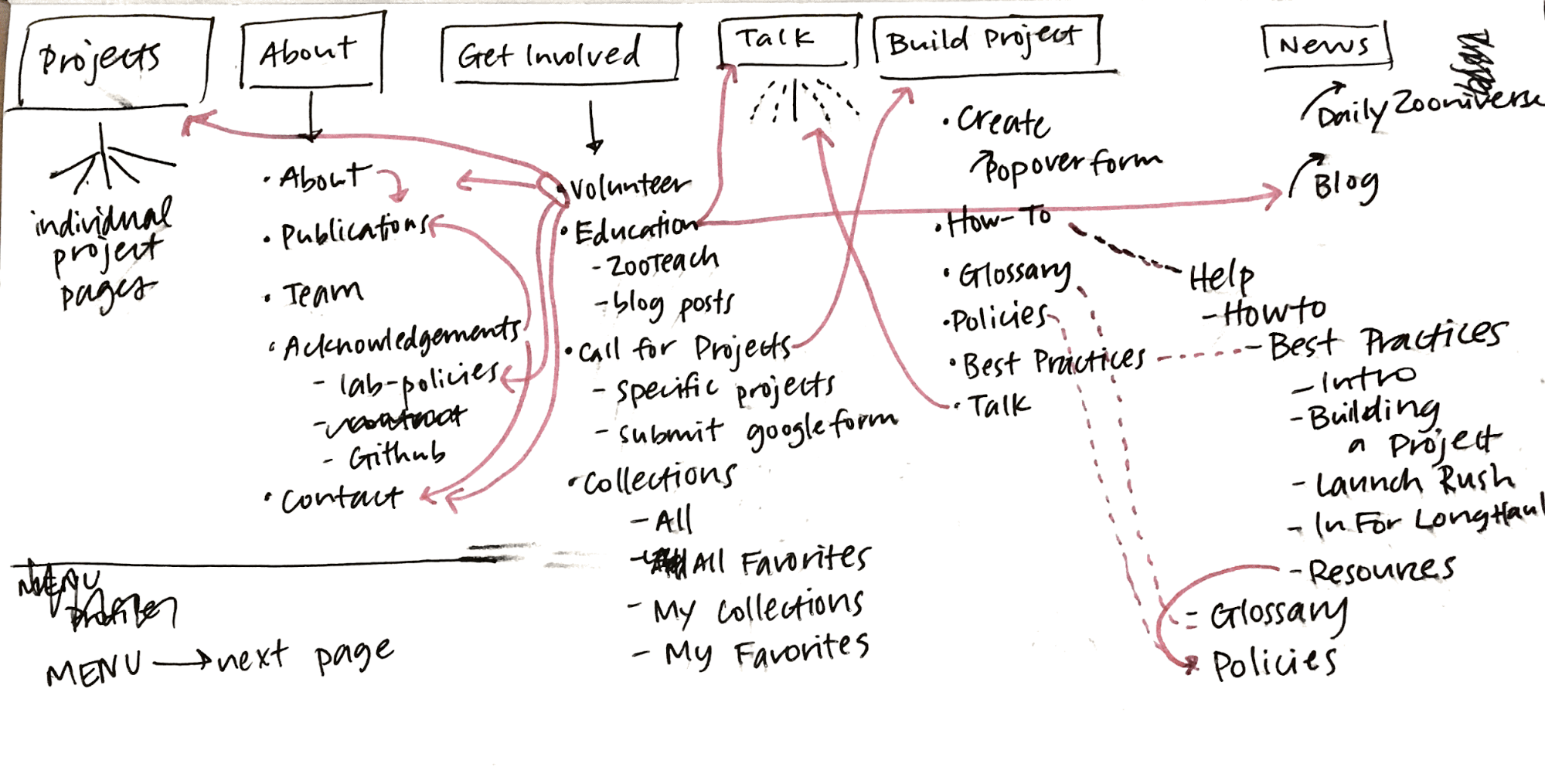
Current site map, March 2017
Analysis of current template types

After my initial site analysis, I created a list of potential pages or sections that were good candidates for a redesign. The classify interface stood out as the best place to start, so I got to work.

Visual design research

First, I identified areas of the interface that could use visual updates. My main concerns were legibility, accessibility, and varying screen sizes. With an audience reaching to the tens of thousands per week, the demographic diversity makes for an interesting design challenge.

Next, I conducted a comprehensive audit of every project that existed on the Zooniverse in March 2017 (79 in total, including custom projects like Galaxy Zoo), counting question/task word count, the max number of answers, subject image dimensions, field guide content, and a host of other data points. That way, I could accurately design for the medians rather than choosing arbitrarily. When working on this scale, it’s important to use data like these to ensure that the largest possible group is well designed for.

Here are some selected data:

Task type: Drawing 20
Answers
Average number of possible answers 2 Answer average max word count 4.5
Min number 1 Answer max max word count 10
Max number 7 Answer min max word count 2
Median number 1 Answer median max word count 1
Number with thumbnail images 1


Task type: Question 9
Answers
Average number of possible answers 6 Answer average max word count 6
Min number 2 Answer max max word count 18
Max number 9 Answer min max word count 1
Median number 3.5 Answer median max word count 4
Number with thumbnail images 3


Task type: Survey 9
Answers
Average number of possible answers 31 Answer average max word count 4
Min number 6 Answer max max word count 7
Max number 60 Answer min max word count 3
Median number 29 Answer median max word count 4
Number with thumbnail images 9

Even More Research

Next, I focused on usability. To ensure that I understood issues from as many perspectives as possible, I sent a design survey to our beta testers mailing list, comprising about 100,000 volunteers (if you’re not already on the list, you can opt in via your Zooniverse email settings). Almost 1,200 people responded, and those responses informed the decisions I made and helped prioritize areas of improvement.

Here are the major findings from that survey:

  • No consensus on where to go when you’re not sure how to complete a task.
  • Many different destinations after finishing a task.
  • Too much scrolling and mouse movement.
  • Lack of keyboard shortcuts.
  • Would like the ability to view previous classifications.
  • Translations to more languages.
  • Need for feedback when doing classifications.
  • Finding new projects that might also be interesting.
  • Larger images.

In the next few blog posts, I’ll be breaking down specific features of the update and showing how these survey findings help inform the creation of many of the new features.

Without further ado

Basic classify template

Some of these updates will look familiar, as we’ve already started to implement style and layout adjustments. I’ll go into more detail in subsequent posts, but at a high level, these changes seek to improve your overall experience classifying on the site no matter where you are, what browser you’re using, or what type of project you’re working on.  

Visually, the site is cleaner and more professional, a reflection of Zooniverse’s standing in the citizen science community and of the real scientific research that’s being done. Studies have shown that good, thoughtful design influences a visitor’s perceptions of a website or product, sometimes obviously, sometimes at a subliminal level. By making thoughtful choices in the design of our site, we can seek to positively affect audience perceptions about Zooniverse, giving volunteers and researchers even more of a reason to feel proud of the projects they’re passionate about.

It’s important to note that this image is a reflection of our current thought, in June 2018, but as we continue to test and get feedback on the updates, the final design may change. One benefit to rolling updates out in pieces is the ability to quickly iterate ideas until the best solution is found.

The timeline

We estimate that the updates will be mostly in place by early 2019.

This is due in part to the size of our team. At most, there are about three people working on these updates while also maintaining our commitments to other grant-funded projects and additional internal projects. The simple truth is that we just don’t have the resources to be able to devote anyone full-time to this update.

The timeline is also influenced in a large part by the other half of this update: A complete overhaul of the infrastructure of the classifier. These changes aren’t as visible, but you’ll notice an improvement in speed and functionality that is just as important as the “facelift” portion of the update.

Stay tuned!

We’ve seen your feedback on Talk, via email, and on Github, and we’re happy to keep a dialog going about subsequent updates. To streamline everything and make sure your comments don’t get missed, please only use this survey link to post thoughts moving forward.
Stargazing Live 2017: Thank you all!

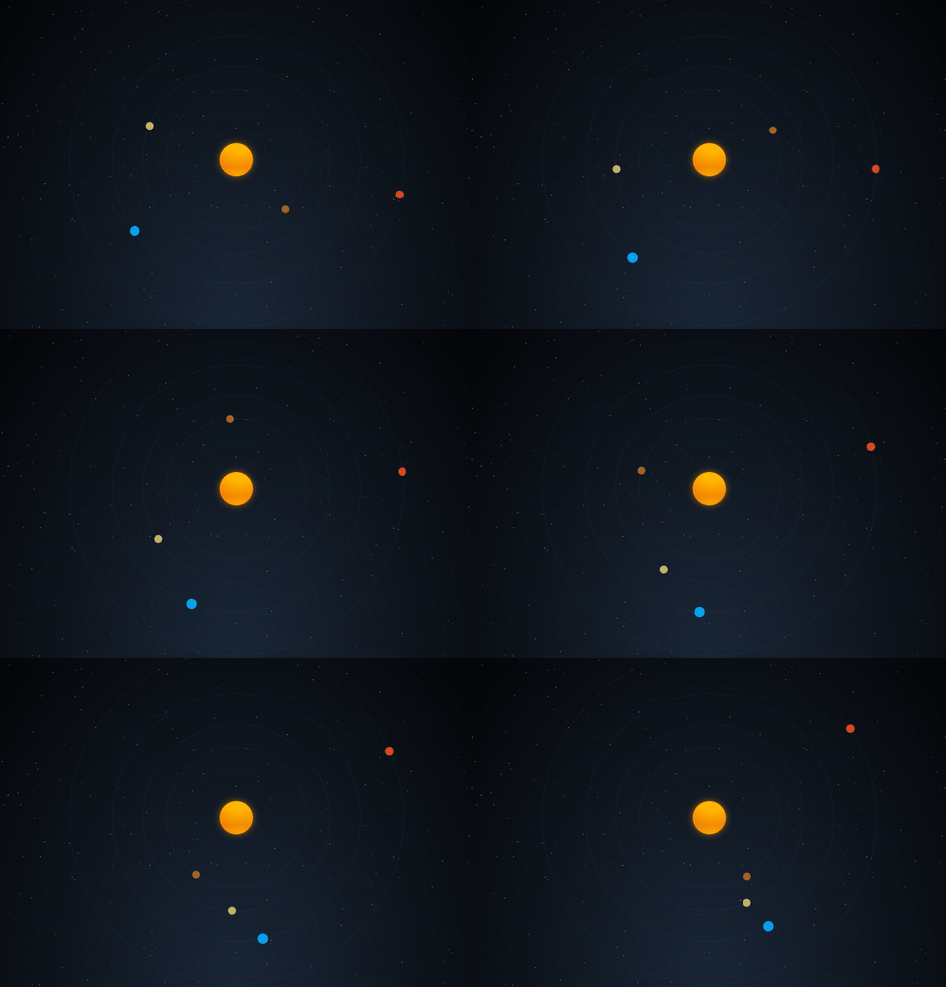
Breaking news… Zooniverse volunteers on Exoplanet Explorers have discovered a new 4-planet system!

simoneAnimation
Computer animation of the 4-planet system. Planet orbits are to scale and planet sizes are to scale with each other, but not with the star and the size of the orbits. Credit: Simone Duca.

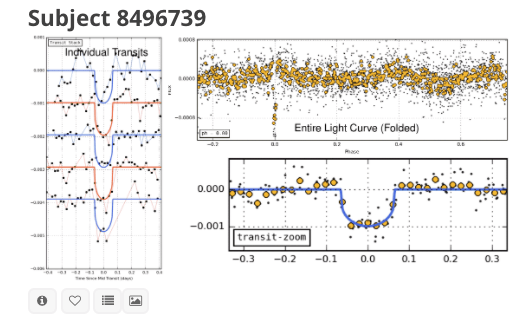
Congratulations to all* who directly classified the light curves for this system, bringing it to the attention of the research team. And an enormous *thank you* to the 14,000+ volunteers who provided over 2 million classifications in just three days to make this discovery possible. This is equivalent to 3.4 years of full time effort. I *heart* people-powered research! It’s also amazing how quickly we were able to get these data to the eyes of the public — the Kepler Space Satellite observed this star between December 15 and March 4, 2017.  Data arrived on Earth on March 7th and Zooniverse volunteers classified it April 3-5, 2017. I *heart* Zooniverse.

ExoplanetExplorers.org was the featured project for our inaugural ABC Australia Stargazing Live 3-day, prime-time TV event, which just ended yesterday and through which this discovery was made. Over the years, we’ve partnered with the BBC as part of their Stargazing Live event in the UK. On night 1, Chris Lintott, our intrepid leader, invites the million+ viewers to participate in that year’s featured Zooniverse project, on night 2 he highlights interesting potential results coming through the pipeline, and on night 3, if science nods in our favor, he has the pleasure of announcing exciting discoveries you all, our volunteers, have made (for example, last year’s pulsar discovery and the supernova discovery from a couple years back). 

This year we partnered with both the UK’s BBC and Australia’s ABC TV networks to run two Stargazing Live series in two weeks. We’re exhausted and exhilarated from the experience! We can imagine you all are as well (hats off to one of our volunteers who provided over 15,000 classifications in the first two days)!

Stargazing Live epitomizes many of our favorite aspects of being a member of the Zooniverse team – it’s a huge rush, filled with the highs and lows of keeping a site up when thousands of people are suddenly providing ~7000 classifications a minute at peak. We’re so proud of our web development team and their amazing effort; their smart solutions, quick thinking, and teamwork. The best part is that we collectively get to experience the joy, wonder, and discovery of the process of science right alongside the researchers. Each year the research teams leading each project have what is likely among the most inspiring (and intense) 3-days of their careers, carrying out the detective work of following up each potential discovery at breakneck speed.

planet9stats
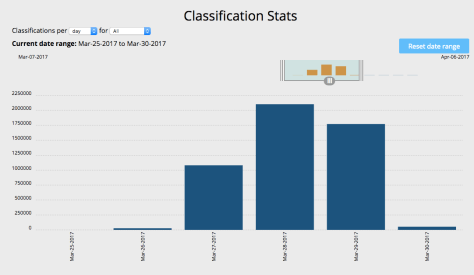
Over 2 million classifications in just 1 day on planetninesearch.org!

talk

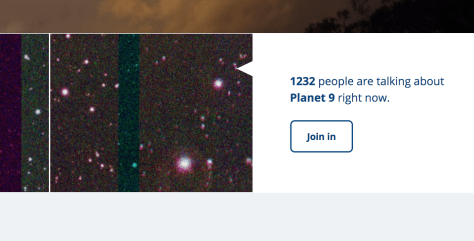
Brad Tucker and his team leading PlanetNineSearch.org featured in the BBC Stargazing Live event this year checked and rechecked dozens of Planet 9 candidates orbital parameters and against known object catalogs, making sure no stone was left unturned. We were bolstered throughout with re-discoveries of known objects, including many known asteroids and Chiron, a minor planet in the outer Solar System, orbiting the Sun between Saturn and Uranus.

chiron
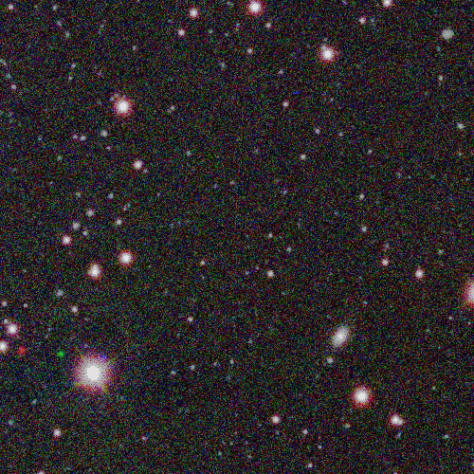
The red, green, and blue dots in the lower left quadrant show Chiron as it moved across the Australian night sky during the Skymapper Telescope Observations for planetninesearch.org.

Even though Planet 9 hasn’t been discovered yet, it’s huge progress for that field of research to have completed a thorough search through this Skymapper dataset, which allows us to probe out to certain distances and sizes of objects across a huge swath of the sky. Stay tuned for progress at planetninesearch.org and through the related BackyardWorlds.org project, searching a different parameter space for Planet 9 in WISE data.

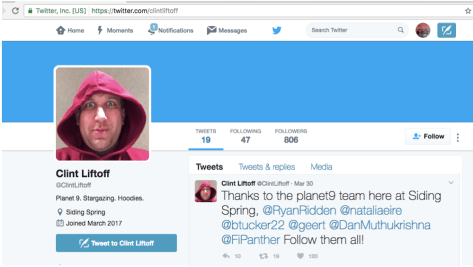
Also, and very importantly, the BBC Stargazing Live shows gave the world an essential new member of the Twitterverse:

liftoff-3
Understanding this inside joke alone makes it worth watching the show!

The Exoplanet Explorers team, led by Ian Crossfield, Jessie Christiansen, Geert Barentsen, Tom Barclay, and more were also up through much of each night of the event this week, churning through the results. Because the Kepler Space Telescope K2 dataset is so rich, there were dozens of potential candidates to triple check in just 3 days. Not only did our volunteers discover the 4-planet system shown above, but 90 new and true candidate exoplanets! That’s truly an amazing start to a project.

gumballs
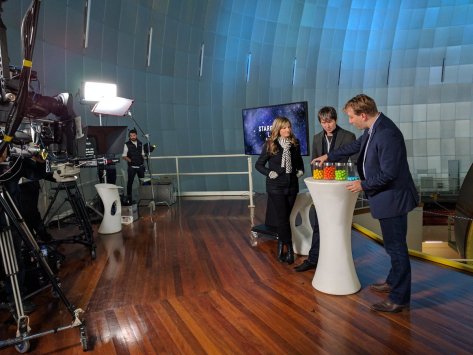
Chris Lintott shows Brian Cox and Julia Zemiro the possible planets we’ve found so far, using the nearby town’s entire stock of gumballs. 

Once you all, our amazing community, have classified all the images in this project and the related PlanetHunters.org, the researchers will be able to measure the occurrence rates of different types of planets orbiting different types of stars. They’ll use this information to answer questions like — Are small planets (like Venus) more common than big ones (like Saturn)? Are short-period planets (like Mercury) more common than those on long orbits (like Mars)? Do planets more commonly occur around stars like the Sun, or around the more numerous, cooler, smaller “red dwarfs”?

There’s also so much to learn about the 4-planet system itself. It’s particularly interesting because it’s such a compact system (all orbits are well within Mercury’s distance to our Sun) of potentially rocky planets. If these characteristics hold true, we expect they will put planet formation theories to the test.

A fun part of our effort for the show was to create visualizations for this newly discovered system. Simone, one of our developers, used http://codepen.io/anon/pen/RpOYRw to create the simulation shown above. We welcome all to try their hand using this tool or others to create their favorite visualization of the system. Do post your effort in the comments below. To set you on the right path, here are our best estimates for the system so far:

Fun facts:

  • In 2372 years, on July 9, 4388AD, all four planets will transit at the same time.
  • If you’re standing on planet e, the nearest planet would appear bigger than the full moon on the sky. Apparent size of other planets while standing on e = 10 arcmin, 16 arcmin, 32 arcmin.
  • If you’re on planet e, the star barely appears to rotate: you see the same side of it for many “years,” because the star rotates just as quickly as planet “e” goes around it.

This post wouldn’t be complete without a thank you to Edward Gomez for following up candidates with the Los Cumbres Observatory Robotic Telescope Network. Not only is LCO a great research tool, but it provides amazing access to telescopes and quality curricular materials for students around the world.

*And a special thanks to the following volunteers who correctly identified at least one the planets in the newly discovered 4-planet system:
Joshua Kusch
Edward Heaps
Ivan Terentev
TimothyCatron
James Richmond
Alan Patricio Zetina Floresmarhx
sankalp mohan
seamonkeyluv
traumeule
B Butler
Nicholas Sloan
Kerrie Ryan
Huskynator
Lee Mason
Trudy Frankensteiner
Alan Goldsmith
Gavin Condon
Simon Wilde
Sharon McGuire
helenatgzoo
Melina Thévenot
Niamh Claydon-Mullins
ellieoban
Anastasios D. Papanastasiou
AndyGrey
Angela Crow
Dave Williams
Throbulator
Tim Smith
Erin Thomas
Valentina Saavedra
Carole Riley
sidy2001
bn3
ilgiz
Antonio Pasqua
Peter Bergvall
Stephen Hippisley
sidy2001
bn3
Michael Sarich

A whole new Zooniverse

Anyone heading over to the Zooniverse today will spot a few changes (there may also be some associated down-time, but in this event we will get the site up again as soon as possible). There’s a new layout for the homepage, a few new projects have appeared and there’s a new area and a new structure to Talk to enable you to discuss the Zooniverse and citizen science in general, something we hope will bring together conversations that until now have been stuck within individual projects.

Our new platform, Panoptes, is name after Argus Panoptes, a many-eyed giant form Greek mythology.
Our new platform, Panoptes, is named after Argus Panoptes, a many-eyed giant form Greek mythology. Image credit: http://monsterspedia.wikia.com/wiki/File:Argus-Panoptes.jpg

What you won’t see immediately is that the site is running on a new version of the Zooniverse software, codenamed ‘Panoptes‘. Panoptes has been designed so that it’s easier for us to update and maintain, and to allow more powerful tools for project builders. It’s also open source from the start, and if you find bugs or have suggestions about the new site you can note them on Github (or, if you’re so inclined, contribute to the codebase yourself). We certainly know we have a lot more to do; today is a milestone, but not the end of our development. We’re looking forward to continuing to work on the platform as we see how people are using it.

Panoptes allows the Zooniverse to be open in another way too. At its heart is a project building tool. Anyone can log in and start to build their own Zooniverse-style project; it takes only a moment to get started and I reckon not much more than half an hour to get to something really good. These projects can be made public and shared with friends, colleagues and communities – or by pressing a button can be submitted to the Zooniverse team for a review (to make sure our core guarantee of never wasting people’s time is preserved), beta test (to make sure it’s usable!), and then launch.

We’ve done this because we know that finding time and funding for web development is the bottleneck that prevents good projects being built. For the kind of simple interactions supported by the project builder, we’ve built enough examples that we know what a good and engaging project looks like. We’ll still build new and novel custom projects helping the Zooniverse to grow, but today’s launch should mean a much greater number of engaging and exciting projects that will lead to more research, achieved more quickly.

We hope you enjoy the new Zooniverse, and comments and feedback are very welcome. I’m looking forward to seeing what people do with our new toy.

Chris

PS You can read more about building a project here, about policies for which projects are promoted to the Zooniverse community here and get stuck into the new projects at www.zooniverse.org/#/projects.

PPS We’d be remiss if we didn’t thank our funders, principally our Google Global Impact award and the Alfred P. Sloan Foundation, and I want to thank the heroic team of developers who have got us to this point. I shall be buying them all beer. Or gin. Or champagne. Or all three.

New Talk Feature: Automatic Favourites Collection

Today we’ve added a new feature to all the Zooniverse sites that use the new version of Talk. As you’ll know, most of our projects allow you to save ‘favourites’ – a list of things that are either cool/interesting/worthy of keeping and something to refer back to later. One often asked for feature is for this collection of favourites in the project to be available in Talk as a collection.

Today we’ve added this feature and from now on when you favourite something on the main site (e.g. Galaxy Zoo) it will automagically appear in a collection called ‘Favourites’ on Talk. That means you can discuss, share or even import them as a data source into tools.zooniverse.org

Enjoy!