All posts by The Zooniverse

Online citizen science projects. The Zooniverse is doing real science online,.

A Change in the Weather

Today’s guest blog comes from Kathy Wendolkowski. Kathy contacted the Zooniverse development group at the Adler Planetarium asking for some some education materials relating to Zooniverse and online citizen science she could share with policy makers in her school district.  We had a great conversation about using Zooniverse projects for student service learning requirements.  Kathy is an Old Weather project volunteer since 2010.  She has 3 children, one currently a sophomore in high school.  

Well, I have been on the phone for 30 minutes and now I have a headache.  I have been speaking to a very nice young woman, but it seems she is the brick wall against which I have been banging my head.  I live in Montgomery County, Maryland which has one of the best school systems in the nation.  This school system is one that requires what are known as “Student Service Learning Hours” for graduation.  SSL hours involve some form of community service, and this summer I had what I consider to be a brilliant idea – Zooniverse projects would make perfect SSL opportunities, which has led me to my headache.

The standards for SSL hours in the Montgomery County Public School system were developed 15 years ago.  These standards do not even conceive of something like the Zooniverse.  To make this happen under the current standards for SSL projects, I need a sponsoring non-profit organization, a public place to meet, and most importantly, liability insurance.  Phew… it seems I have to change the idea of what is a SSL project.  It is a good thing that I love a challenge.

I do not mean to disparage current SSL projects – any form of service is a good thing, and knowledge can come from many different sources.  The Zooniverse, though, is an ideal example of what service and learning can be.  Here, you can help find a cure for cancer or discover a new planet.  You can read the actual ships’ logs or diary entries of servicemen fighting in World War I.  I am rendered speechless (a rare occurrence!) at the opportunities for Service and Learning offered by the Zooniverse.  So, I will take two aspirin and start phoning in the morning.  (Hey, I wonder if I can get SSL hours for this project?)

Operation War Diary is a go!!!

avatar_wardiaries

Great news everyone! The Zooniverse has teamed up with the Imperial War Museum and the National Archives to bring you an awesome new project called Operation War Diary. It involves the transcription of over one million battlefield notes produced from the western front during the World War I. This year marks the centenary of the start of the war and this project will bring to light information that had been all but lost over the last one hundred years. Get involved here http://www.operationwardiary.org/

You can read more about the project in this blog post, and you can follow it on Facebook and Twitter too!

Galaxy Zoo & Galaxy Zoo Navigator Student & Teacher Guides

Today’s post comes from Kate Meredith who created and recently posted the teacher and student Galaxy Zoo guides outlined here. Kate is a former middle school and high school teacher who considers herself a virtual person in the Sloan Digital Sky Survey database.  She has been involved with pilot testing, writing and training teachers to use the database for the past twelve years.  She is very excited about how the Galaxy Zoo Navigator tools can help teachers engage groups of students to use images from the SDSS in ways that are fun and accessible. 

Guides and help documents for getting started with Galaxy Zoo and the Galaxy Zoo Navigator are available now on ZooTeach.  There is something for teachers and students.

Season of Giving

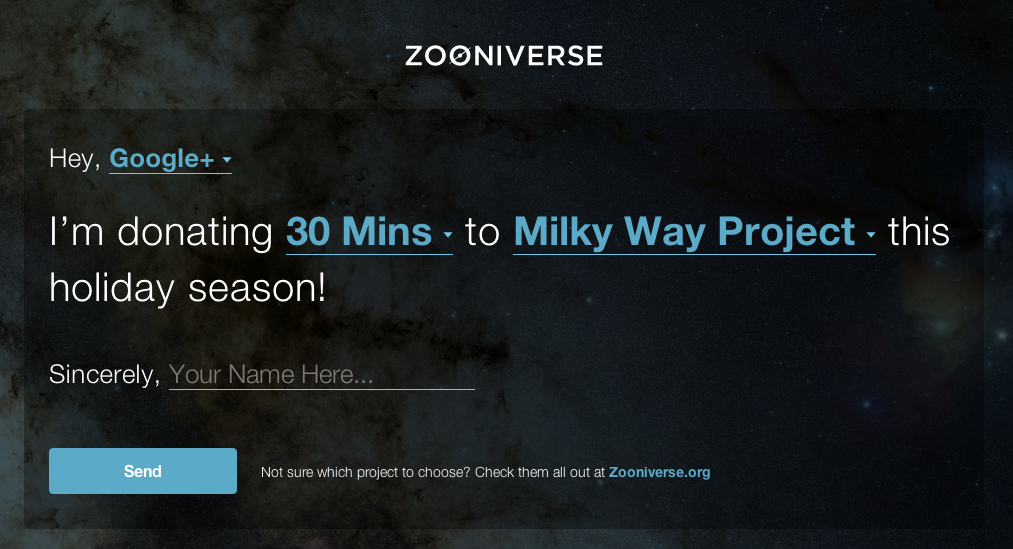
Screenshot 2013-12-21 21.32.07

Yesterday – or today depending on your timezone – Google featured the Zooniverse as part of their One Today app in the USA. This is a fantastic chance to spread to word about the Zooniverse and to give people the chance to donate directly to help make it better. You can also see us on Google’s amazing 12 Days of Giving website.

Regardless of where you are in the world, we think that the best thing most of you can give us is your time. So we’ve created giving.zooniverse.org which you can use to tell the world (or your social network at least) that you’re giving some of your time to the Zooniverse this holiday season. Perhaps you can help spread some citizen science cheer – or just show off that you’re an awesome contributor to science online.

Happy holidays, Merry Christmas, Nadolig Llawen – or whatever you say at this time of year!

Zooniverse Cocktails (Part Two)

Have a drink on the Zooniverse this festive season. Last year we created  a list of festive Zooniverse cocktails for the grown-ups amongst you. Here are a few more, courtesy of our very own Chris Lintott.

Planet 4 Margarita

This is a recipe passed onto me from the Mars Phoenix team, who were looking for two of its components – salt and ice – in the Martian arctic, a region not dissimilar to that explored by Planet 4 volunteers. It’s a nice twist on a classic margarita.

  • 2 cups tequila (a cup is a strange American unit. I use ‘some’ tequila)
  • 1-2 hot chillies, preferably habaneros
  • Salt
  • 6 cups pink grapefruit juice

Half the chillies and mix with the tequila. Allow to stand for the amount of time you can stand it, but at least a few hours. (The longer you leave it, the spicier the tequila). THROW THE CHILLIES OUT.

Dip the rims of the glasses into a little of the juice, then roll in the salt. Shake tequila and grapefruit juice in a 1:3 ratio with plenty of ice and serve in salted glasses. Drink until the rushing onset of winter brings with it an icy tomb. (Actually, that last bit might only apply to Phoenix itself)

PH1b

  • 2 shots Scotch – I like a nice smokey Islay blend like Black Bottle.
  • 1/2 shot sweet vermouth
  • 1/2 shot dry vermouth
  • Dash Angostura bitters
  • Cherry

This is a perfect Rob Roy, but we’ve renamed this classic in honour of our planet with four stars, PH1b. The four liquid ingredients represent the four stars, so shake all of them together and serve in a Martini glass, adding the cherry to represent the planet. This cocktail is not to scale.

Galaxy Zoo Treacle

Becky Smethurst, our new(isn) Galaxy Zoo PhD student in Oxford, loves rum, so this is in honour of her first term in the Zooniverse. As with spiral galaxies, the direction of stirring is essential.

  • 2 shots Rum – preferably dark Jamacian rum
  • 1/4 shot Sugar syrup (you can make this by dissolving lots of sugar in water – typically 1 water : 2 sugar)
  • 1/2 shot apple juice
  • 2 dash Angostura bitters

Put two ice cubes in a glass and stir in the sugar syrup and the bitters. Stir clockwise. Add 1 shot rum, with two more ice cubes, and stir anti clockwise. Add the rest of the rum, two more ice cubes, stir clockwise. Pour apple juice into the top and sip gently.

The Layered Giraffe

In honour of Snapshot Serengeti, this was suggested by Zooniverse volunteer Emma Price.

  • 1 shot Baileys
  • 1 shot Amaretto
  • 1 shot Kahlua

Pour each shot carefully into a glass, then shake cocoa powder on top in a suitably giraffey pattern. (Note this cocktail uses three of my four least favourite ingredients, so I haven’t tried it myself. Let me know how it goes).

The GitHub Gimlet

As many of you know, we lost our Technical Lead Arfon Smith to GitHub earlier this year. I’m pleased to see he’s working hard in his new role, contributing this gin gimlet recipe to an open source cocktail repository :

https://github.com/balevine/cocktails/pull/2/files

To make it a GitHub gimlet, add one single, solitary tear shed at our lost of Arfon and shake viciously.

Meet the Team – Kelly Sutphin-Borden


Kelly is one of the Zooniverse educators based at the Adler Planetarium in Chicago. Today is her birthday, so we decided to get her to do a special edition of ‘Meet the Team’ for the advent calendar. In the video she talks about Zoo Teach, which is an educational tool provided by the Zooniverse. Check it out here http://www.zooteach.org/

NSTA Denver – Day 2

5:45  – Woke up. Decide to swap order of presentation.

7:00 – Breakfast, it is the most important meal of the day after all.

8:00 –  Final presentation adjustments done.

8:45 – Public speaking makes me nervous sometimes so put on my favorite dress and purple tights for confidence.

9:30 –  First session of the day –  Effective Approaches for Addressing Next Generation Science Standards in the Earth and Space Science Classroom. This workshop was facilitated by members of the National Earth Science Teachers Association  (NESTA)  and began with an overview of how earth and space sciences fits in the NGSS. The presenters nicely summed up the NGSS Performance Expectations as – “involving a lot of action verbs.”  Instead of statements beginning with “students will understand” or “students will identify” these new performance expectations begin with statements  like “students who demonstrate understanding can develop and use a model to describe…” and “students who demonstrate understanding can analyze and interpret data to determine…”.

The remainder of the workshop focused on Windows to the Universe, NESTA’s learner and educator portal. There are a variety of activities available for use in the classroom. There is a yearly subscription fee if you want to download and print PDFs but activities and worksheets can be printed for free from your browser.

11:00  –  Second Session of the day –  Making the Connection Between Formal and Informal Education.  Staff from the Denver Museum of Nature & Science, the Denver Zoo, and Denver Public Schools overviewed two long-term collaborations running in the Denver metro area. Passport to Health is a bilingual school-year program targeting at 5th graders and their families.  Through classes and events in school and at the museum, over 3,000 participants receive tools and knowledge promoting healthy living.  Urban Advantage Denver , the second program highlighted, is an in-depth collaboration between local school districts and the City of Denver’s scientific cultural institutions.  This program aims to empower every 7th grade student to think and explore like a scientist.

12:30  – Time to present.  A small but enthusiastic group of 15 came to learn about a variety of Zooniverse projects and the educational resources available to bring them into the classroom.  Sadly the internet decided to be uncooperative, but luckily I had a back-up plan and plenty of screen shots.  There were lots of great questions and contact details exchanged. I can’t say much more because I tend to suffer from “post-presenting amnesia”, but it was a great session.

2:00 – Stroll around the second half of the exhibition hall successfully found candy to temporarily relieve my hunger rage.  It was great to see the Crow Canyon Archaeological Center and Cornell Lab of Ornithology promoting their excellent programs.  Totally have science education crushes on those two.

3:00 – Starving.  Back at the hotel waiting for delivery while catching up on email.

It was a great meeting, but it will be nice to be back home in Chicago.  ‘Til next time NSTA!

NSTA Denver – Day 1

5:45 –  Up and atom (sorry, I can’t resist a good Simpsons reference).  To the hotel gym for a little wake-up exercise.   Criminey, altitude does make exercise harder.

7:00 – Caffeinating and fueling up for a day of science education. Mmmm.. Oatmeal.

7:45 – Checked in and all official. Check out the fancy presenter ribbon 🙂

Science Runs Through It!
NSTA Denver- Science Runs Through It!

8:00 am –  First session of the day!  Understanding the Vision for Science Education from the NRC Framework and the Next Generation Science Standards from Brett Moulding. My takeaway from this was the idea of a “science performance”.  Just as students showcase the skills they practice in music class at a concert or a performance, so must students with science.  Students need opportunities to try out what they’ve learned by applying them.

9:00 –  Found a bench and an unoccupied outlet to catch-up on emails and work on another conference proposal.

10:30 –  Random conversation with fellow conference goers about inflatable planetarium domes. Evoked horrifying flash back of nearly being trampled by preschoolers trying to get to the front of the dome to see Elmo at outreach event several years ago.

11:30 –  Strolled through first half of the exhibit hall.  Nearly gave in and bought an I Heart Science t-shirt.

12:00 – Conference going is hard work, grabbed a bento box to fuel more science education networking!

12:30 Second session of the day – STEM! How to Create Rigorous, Authentic Learning for All.  An overview of the transformation of Preston Middle School in Colorado into a STEM-centered school.  The stand-out point was the importance of engaging faculty in STEM.  Specifically, when creating a STEM-focused school, build around the passion of the teachers. Their enthusiasm and passion will draw students in.

1:35 –  Realization that in fact I didn’t finish my slides for tomorrow’s presentation.

2:00  – Third and final session of my day – Building Collaborative Partnerships to Advance K-12 STEM Education.  A panel discussion of creating collaborations to strengthen STEM educational initiatives.   My biggest take away from this session was learning about the National Girls Collaborative Project .

3:30 – Search for afternoon coffee (thanks 7-11).

4:00 – Slides, slides, slides.  Put together the last portion of tomorrow’s presentation – Bringing the Zooniverse into the Classroom.

6:00 – A dinner of subpar Mexican food.  Perfectly good guacamole ruined by olives.

7:00-  Slides done, now to blog.

8:10 – Blog done!

More from NSTA tomorrow.

Google confirms that the Zooniverse is awesome!

The Zooniverse is extremely pleased to announce that it has been named as one of six Google Global Impact Awardees announced in December 2013. The awards are given by Google to projects that show three key elements:
  • technology or innovative approach that can deliver transformational impact
  • a specific project that tests a big game-changing idea
  • a brilliant team with a healthy disregard for the impossible

The grant we have received from Google as part of their Global Impact Award program will allow us to build a platform that can support hundreds or maybe even thousands of new and exciting citizen science projects. A list of the awardees can be seen at the Google Global Impact Award site here http://www.google.com/giving/global-impact-awards/

It means a lot to us at the Zooniverse to have been given this award and we could not have managed it without you, our volunteers. The time and effort you dedicate to our projects shows the world how important citizen science can be, and we’re looking forward to the next few years.

So thanks to you, and thanks to Google!

The Zooniverse team

PS: Just to be clear, this is a philanthropic act from Google – we’ll continue to be an academic project run by the team at Oxford, Adler Planetarium and elsewhere and all your data remains with the Zooniverse as before. Nothing changes, except our ability to scale!

Rob and Grant are running out of ideas for the Advent Calendar

Hey everyone, for today’s advent calendar Rob and I made this short video talking about the various ways in which you can take part in the Zooniverse, and the multiple means by which you can keep up-to-date with what we’re doing.

https://vimeo.com/81544627

It also serves as an introduction for me, the new Zooniverse community manager. It is a bit silly at points, and we did it in one take with no script, so apologies for the rough feel!

Here are some of the links I mention in the video:

Zooniverse on Facebook

Zooniverse on Twitter

Daily Zooniverse

Merry Christmas one and all!