Why the Zooniverse is easy to use.

A blog post from Adam Stevens today appeared in my Twitter stream, containing some discussion (and criticism) of the Zooniverse in general and Planet 4 in particular.

All debate is useful, so I wanted to respond to a few of the points made. Dispute about whether the main Planet 4 interface is any good scientifically should, I think, be settled by seeing if the team publish a paper with the results – our track record (in need of updating!) is here.

The meat of the post draws a distinction between ‘real science’ – by which I assume the author means analysis, paper writing and so on – and what the main Zooniverse interfaces do, which is described as ‘data analysis’. We’ve been here before, and part of the answer is the same one I gave then : data analysis and classification is as much a part of science as solving an equation, and while there may be scientists who do nothing but think grand analytic thoughts, I’ve never met any.

However, there’s another part to the answer. Zooniverse projects are explicitly designed so that even a brief interaction with the site produces meaningful results. This is partly pragmatic (as this post from our Old Weather project shows, as a rule of thumb half of contributions come from people who only do a few) but it also because we truly believe in the transformational nature of having someone do something real. Those visiting Zooniverse for the first time are typically not scientists; often they are not yet even fans of science. We know from anecdote and from our own research that for many of these people doing something simple that makes a contribution to our understanding of the Universe is very fulfilling, often unexpectedly so.

More than that, these projects act as engines of motivation. Once people have found their feet in the main interface, once people have got used to the idea that science is now an activity they can participate in, once people are excited to further investigate interesting images and objects that are now theirs, wonderful things happen.

There are great examples from many projects, but on Twitter I pointed to our recent Planet Hunters paper which reported one new confirmed planet and 42 new planet candidates (with greater than 90% certainty of being real) which were discovered by the community active on our Talk discussion tool.

Many of these volunteers (including Kian Jek, who was just awarded the Chambliss prize for achievement by the AAS) are doing far, far more than just using the Planet Hunters interface. But they’re there because they were drawn in by the proposition of the initial site. For many, the motivation to learn about classes of variable stars and the minutia of transits came only after they’d found something special, and for many the confidence to attack these more detailed questions comes from the initial, guided experience.

As technical supremo Arfon put it on Twitter, the Zooniverse is a set of analysis tasks where scientists need help, and where they will analyze results and report back, but if you’ll come with us there’s a whole world of conversation and discovery that can happen. Drawing a distinction between the two misses the point – without the former, participation in the latter (the ‘real science’, if you must) is limited to those who already have the confidence to participate.

Chris

PS Adam did suggest a specific change: that, as one of the main science goals of Planet 4 is to measure wind speed we should add an arrow allowing people to indicate the wind speed and direction. This seems to me misguided; we’re getting that information from the task that the volunteers are doing in marking the shape, size and direction of the fans. You could add further pedagogical material early on, but this would likely reduce the number of people who make it to the ‘ah ha! I’m doing science!’ moment because we know that it’s very easy to trigger an adverse reaction in the form of a loss of confidence when we ask slightly more abstract questions in the initial phase of engagement with a project. In any case, inference follows measurement – and we’re still at the measurement stage in this strange and fascinating region of Mars.

PPS In the main post, I’ve ignored comments about the relationship between the BBC’s Stargazing Live program and Planet4. It’s important to realize that the driving force behind the Planet 4 project is Candy Hansen and her team of Martian scientists – ironically, we’d discussed a version of the idea while I was interviewing her for the Sky at Night about 18 months ago. That’s before Planet Hunters was on TV, so it’s dead wrong to say that Planet 4 was cooked up in response to a desire to have something else to do on telly. If there were inaccuracies on camera, I can only plead that live television is tricky and the real test is whether the project produces papers – which will, as any real scientist knows, take time! Stargazing’s commitment to real engagement instead of ‘educational experiments’ is, I think, a huge strength of the series: Here’s the latest news on the planet candidate identified in the 2012 series.

No Right Answer?

Last week we had the pleasure of speaking to a class of pre-service teachers at Loyola University in Chicago.  After discussing the basics of citizen science and the origins of Zooniverse, the teachers took time to explore projects of their choice.  Always being keen to show-off  Zooniverse’s new educational offerings, we then demonstrated ZooTeach and a beta version of Galaxy Zoo Navigator.

Many of these pre-service teachers are preparing to begin or are in the midst of their student teaching placements. We spent the rest of the class discussing ways they could incorporate Zooniverse projects into the classroom, specifically how they could be used to facilitate scientific inquiry.  Over the course of the discussion the notion of “right” answers emerged.  This was a real ah-ha moment for me.  I suddenly remembered my own fears of getting the wrong answer as a first-time Zooniverse user. Whether a Zooniverse volunteer or a student, encountering a project for the first time can be a bit intimidating.  There is the fear, however irrational, that by submitting an inaccurate classification you could single-handedly break science.  If you look closely all of the different Zooniverse project sites are peppered with reassuring messages of “don’t worry you’re good at this” and “just give it your best try”.

Laura has previously blogged about how Zoonverse projects are used to engage museum audiences at the Adler Planetarium on the Planet Hunters blog.  Whether working with members of the public or groups of students, we often encounter “Did I get it right?”.  This is a tricky question to answer; Zooniverse volunteers are supplying the answers from which scientific interpretations are drawn.  Projects employ measures of checking for accuracy.  That’s why any given object be it a galaxy to classify or a bat call to listen to, is looked at by more than one individual.  The “power of the crowd” yields more accurate results than one single person.  Needless to say the idea of crowdsourcing as a quality-control mechanism is easier to convey to adults than to a bunch of eleven year olds.  It’s difficult to get students over the hurdle that, in the instance at least, being right isn’t so important.

I don’t know about you, but this leaves my head full of more questions than answers.   How do we as educators model for students that science can’t only be about getting the right answer?  How do we encourage students that being wrong can be oh-so-right?  Taking a risk of being wrong is brave and necessary to advance this thing we call science.  So how about it, how do you encourage a risk-taking culture in your own classroom or other learning environment?

Three Days of Awesomeness

The Zooniverse team is a mix of web developers, educators, and designers.  What would happen if you locked this group into a glass-sided room with like-minded folks from the New York Public Library Labs for three days?  That’s what we’re trying – three  days of hacking in the Cyberspace Studio at the Adler Planetarium!  For updates on our progress, check out @ZooTeach or @the_zooniverse on Twitter.

Let the awesome commence….

Sugar and coffee, let's build!
Sugar and coffee, let’s build!

Zooniverse Education Chicago Classroom Visits

Photo by: Rhett Sutphin
This trusty steed could bring Zooniverse education to your classroom.  Photo by Rhett Sutphin.

During our pre-Zooniverse days, Laura and I both worked with students.  I worked as a museum educator and Laura as a math teacher.   Being  educators in an office of developers and designers is wonderful because of the opportunities to engage in great conversations about marrying technology and educational opportunities within the wide world of Zooniverse.  Sometimes though, you miss the smell of school lunch and want to get in front of a group of kids.  Thus Laura and I thought it would be fun to go on the road and make ourselves available for classroom visits.  Sadly no fancy tour bus for us, just the CTA or my old Volvo 850s.

Would your students like to discover an exoplanet?  How about explore the Serengeti?  Zooniverse educators (aka Kelly & Laura) want to come to your classroom and share the exciting world of citizen science with your students.  Let us show your students how they can contribute to scientific research via Zooniverse’s collection of online citizen science projects.

We are reserving a limited number of days in February, March, and April to visit schools in the Chicago area (City of Chicago and immediate suburbs).  Requests will be taken on a first-come, first-served basis.  Participation will also be determined by educator date availability and location of school (we need to be able to get to you).  Preference will also be given to schools requesting more than one session on a day.  Sessions can range from 20-45 minutes depending on the topic.

We’ll work with you to tailor a presentation and related activity to fit the needs of your class.  We can speak about citizen science as a research method or speak about specific projects. If like to request a classroom visit, please register your interest by answering the questions below.

UPDATE:  Thanks for your interest in Zooniverse education classroom visits.  As of February 21, we have reach capacity for visits this spring.

Planet Four

You may or may not have already come across Planet Four the latest member of the Zooniverse family, our Martian project, and let’s face it Mars is hot right now. Since Curiosity Rover touched down on the surface in August of last year, after surviving Seven Minutes of Terror, through which much of the world waited with baited breath, we’ve all gone a little Mars crazy. Or is that just Zooniverse HQ?

There are a range of Mars related teaching resources out there and NASA’s wavelength is a great way to access a collection from across multiple NASA missons. However, if you’d like your students to do some real exploring, look at real data, while making a contribution to scientific research, how about letting them loose on Planet Four?

Personally I’ve dreamed of visting Mars for as long as I can remember, but in my imagination Mars was always a dusty, rocky outpost. Planet Four has totally revolutionised my vision of our nearest neighbour, the diversity of the landscape is breathtaking, inspiring and totally unexpected.

mars1

mars2

These spectacular images of the southern Martian pole were taken by the Mars Reconnaissance Orbiter (MRO) using the High Resolution Imaging Science Experiment (HiRISE) camera and the NASA Jet Propulsion Laboratory has a great collection of education resources relating to this mission.

mars3

mars4

The task that volunteers are asked to undertake on Planet Four is fairly easy, it’s simply a case of marking fan and blotch features on that appear on the frozen carbon dioxide ice during the winter months. The size and direction of the fans are a great indication of the wind speed and direction, so measuring these will help planetary scientists better understand the climate on Mars. For more details, check out the Planet Four “About” page or the project Blog which has some great postings from the science team.

So I do wonder, would this be an interesting project to use as part of a geography lesson, perhaps to discuss some of the processes that might have occurred to create some of the features we see? Or maybe a physics lesson, where students measure the length of the fan features and discuss what wind speeds would be required to send the material that far across the surface. What assumptions would you need to make and are there any experiments you could design to recreate the patterns?

If you’ve got any idea’s please do share them here or on ZooTeach!

Planet Four and Stargazing Live

Tonight is the start of the 2013 round of the wonderful BBC Stargazing Live in the UK. Three nights of primetime astronomy programmes, hosted live from the iconic Jodrell Bank. Last year the Zooniverse asked the Stargazing Live viewers to find an exoplanet via Planet Hunters (and they did!). This year we want everyone to scour the surface of Mars on our brand new site: Planet Four.

Every Spring on Mars geysers of melting dry ice erupt through the planet’s ice cap and create ‘fans’ on the surface of the Red Planet. These fans can tell us a great deal about the climate and surface of Mars. Using amazing high-resolution imagery from the Mars Reconnaissance Orbiter (MRO) researchers have spent months manually marking and measuring the fans to try and create a wind map of the Martian surface, amongst other things. They’ve now teamed up with us to launch Planet Four, where everyone can help measure the fans and explore the surface of Mars.

Planet Four

The task on Planet Four is to find and mark ‘fans’, which usually spear as dark smudges on the Martian surface. These are temporary features and they tell you about the wind speed and direction on Mars as they were formed. They are created by CO2 geysers erupting through the surface as the temperature increases during Martian Spring. These geysers of rapidly sublimating material sweep along dust as they go, leaving behind a trail.

Classifying fans on Planet Four

The fans are just one feature that you’ll see. The image above shows some great ‘spiders’, with frost around their edges. There’s lots to see, and hopefully the audience of Stargazing Live will help us blast through the data really quickly.

Stargazing Live begins at 8pm on BBC2. If you can’t watch it live then why not hop onto Twitter and follow the #bbcstargazing hashtag? You’ll also find Planet Four and the Zooniverse on Twitter as well.

Association of Science Educators Annual Conference


Just like our science team colleagues (Planet Hunters and Cyclone Center ) educators also attend professional meetings and conferences to share work, learn about the latest advances in our field, and to meet with friends and colleagues.  This past week Laura and I spent three days at the Association of Science Educators Annual Conference at the University of Reading.

Our primary aim for attending ASE was to spread the word about ZooTeach and other upcoming Zooniverse education resources.  ZooTeach is a new website containing resources and lessons relating to Zooniverse projects made for teachers by teachers.  It’s early days for the online Zooniverse education community, so we’re trying to get the message out wherever we can.

Our corner of the ASE exhibitors hall.

Speaking to teachers was far and away the best part of ASE.   Many teachers stopping by our booth already use Zooniverse projects in the classroom.  Other teachers were excited to find a new free resource allowing them to bring real data and the chance to make contributions to current scientific research to their students.  Laura and I also spoke with many of our science education colleagues about potential collaborations in the future.

There are a lot of exciting things on the  horizon  In fact, if you’re a classroom teacher who might be interested in helping us test some of these new resources, drop us a line!

740,000 People – Part Two

Volunteers Poster

To end our 2012 advent calendar, we have the second of our 740,000 posters. We’d like to wish everyone a happy holiday – whatever you do at this time of year! We’ll be back in 2013 with more news, new projects and more science based on your work. The Universe is too big to explore without you.

740,000 People

Growing Community

The Zooniverse community keeps growing. This time last year, we passed 500,000 volunteers – and now there’s nearly 740,000 people out there, clicking, classifying and contributing to science via their web browser. To celebrate we’ve produced a great poster showing how the Zooniverse has grown from 2007 to the present. Down the PDF here.

Long may she reign!

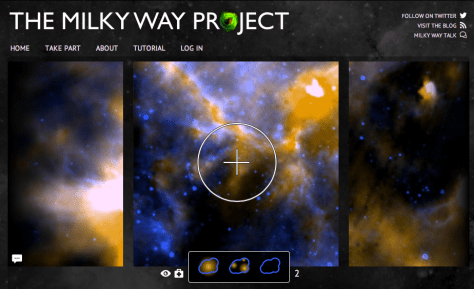
New on the Milky Way Project: Clouds

MWP Clouds

Today we’re launching a new section on the Milky Way Project: Clouds. This new, addictive add-on to the existing site asks you to decide whether an object is a glowing cloud or an empty hole. It’s a fairly rapid-fire task that keeps track of your score. The site uses data from ESA’s Herschel Space Observatory combined with existing Spitzer Space Telescope data. Using these two amazing, orbiting telescopes allow us to peer deep inside star-forming parts of our galaxy, the Milky Way.

Read more on the Milky Way Project blog.

The world's largest and most popular platform for people-powered research. This research is made possible by volunteers—millions of people around the world who come together to assist professional researchers.