Category Archives: News

Planet Four and Stargazing Live

Tonight is the start of the 2013 round of the wonderful BBC Stargazing Live in the UK. Three nights of primetime astronomy programmes, hosted live from the iconic Jodrell Bank. Last year the Zooniverse asked the Stargazing Live viewers to find an exoplanet via Planet Hunters (and they did!). This year we want everyone to scour the surface of Mars on our brand new site: Planet Four.

Every Spring on Mars geysers of melting dry ice erupt through the planet’s ice cap and create ‘fans’ on the surface of the Red Planet. These fans can tell us a great deal about the climate and surface of Mars. Using amazing high-resolution imagery from the Mars Reconnaissance Orbiter (MRO) researchers have spent months manually marking and measuring the fans to try and create a wind map of the Martian surface, amongst other things. They’ve now teamed up with us to launch Planet Four, where everyone can help measure the fans and explore the surface of Mars.

Planet Four

The task on Planet Four is to find and mark ‘fans’, which usually spear as dark smudges on the Martian surface. These are temporary features and they tell you about the wind speed and direction on Mars as they were formed. They are created by CO2 geysers erupting through the surface as the temperature increases during Martian Spring. These geysers of rapidly sublimating material sweep along dust as they go, leaving behind a trail.

Classifying fans on Planet Four

The fans are just one feature that you’ll see. The image above shows some great ‘spiders’, with frost around their edges. There’s lots to see, and hopefully the audience of Stargazing Live will help us blast through the data really quickly.

Stargazing Live begins at 8pm on BBC2. If you can’t watch it live then why not hop onto Twitter and follow the #bbcstargazing hashtag? You’ll also find Planet Four and the Zooniverse on Twitter as well.

740,000 People – Part Two

Volunteers Poster

To end our 2012 advent calendar, we have the second of our 740,000 posters. We’d like to wish everyone a happy holiday – whatever you do at this time of year! We’ll be back in 2013 with more news, new projects and more science based on your work. The Universe is too big to explore without you.

740,000 People

Growing Community

The Zooniverse community keeps growing. This time last year, we passed 500,000 volunteers – and now there’s nearly 740,000 people out there, clicking, classifying and contributing to science via their web browser. To celebrate we’ve produced a great poster showing how the Zooniverse has grown from 2007 to the present. Down the PDF here.

Long may she reign!

New on the Milky Way Project: Clouds

MWP Clouds

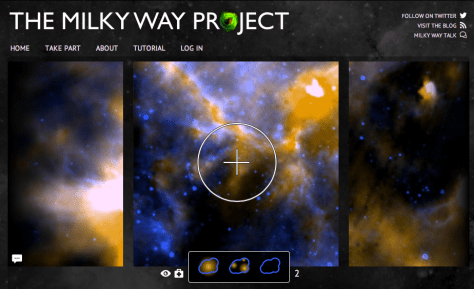
Today we’re launching a new section on the Milky Way Project: Clouds. This new, addictive add-on to the existing site asks you to decide whether an object is a glowing cloud or an empty hole. It’s a fairly rapid-fire task that keeps track of your score. The site uses data from ESA’s Herschel Space Observatory combined with existing Spitzer Space Telescope data. Using these two amazing, orbiting telescopes allow us to peer deep inside star-forming parts of our galaxy, the Milky Way.

Read more on the Milky Way Project blog.

Podcast About the Zooniverse

Today’s advent calendar entry is a special episode of the Recycled Electrons podcast. Recycled Electrons began just over a year ago and features the voices of Chris Lintott (Zooniverse PI) and Robert Simpson (Milky Way Project PI and Zooniverse developer). Although they both work full-time on the Zooniverse they have never yet spent an entire episode talking about it. This week the whole show is just about the Zooniverse! Conversation is focussed of the backstory of the past ten days, which includes the launch of the Andromeda Project and Snapshot Serengeti.

Podcast

Recycled Electrons is a (mostly) weekly podcast about astronomy, space and science. It is a light-hearted and often peculiar take on the week that is recorded in the heart of Oxford University, not too far from Oxford’s Zooniverse HQ.

Snapshot Serengeti

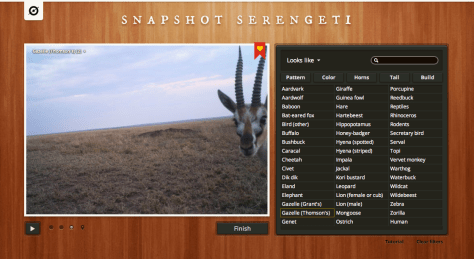
Go on virtual safari with our latest project: Snapshot Serengeti! Serengeti National Park is a UNESCO World Heritage Site in Tanzania. With an area of nearly 6,000 square miles (14,800 km^2) it is teeming with some of the most recognisable animals in the world: lions, zebra, elephants, wildebeest and more live on the vast savannah and grassland plains.

Snapshot Serengeti

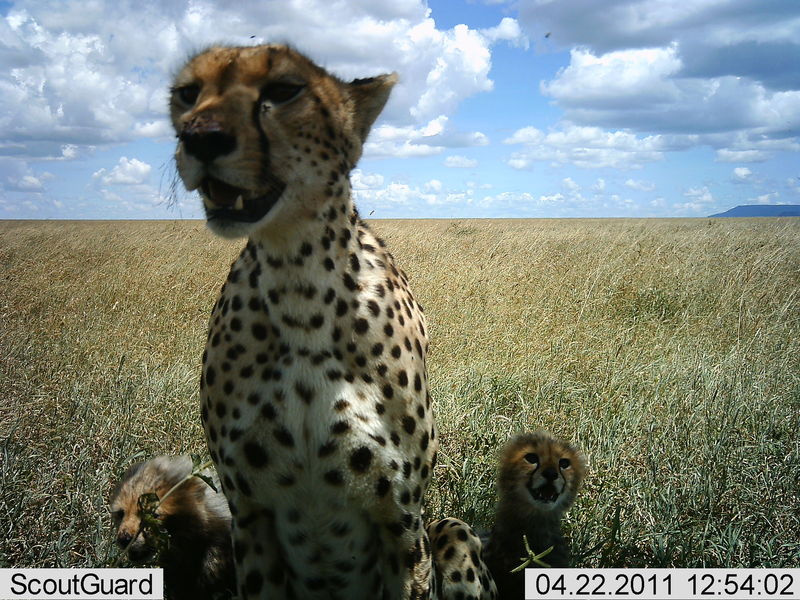
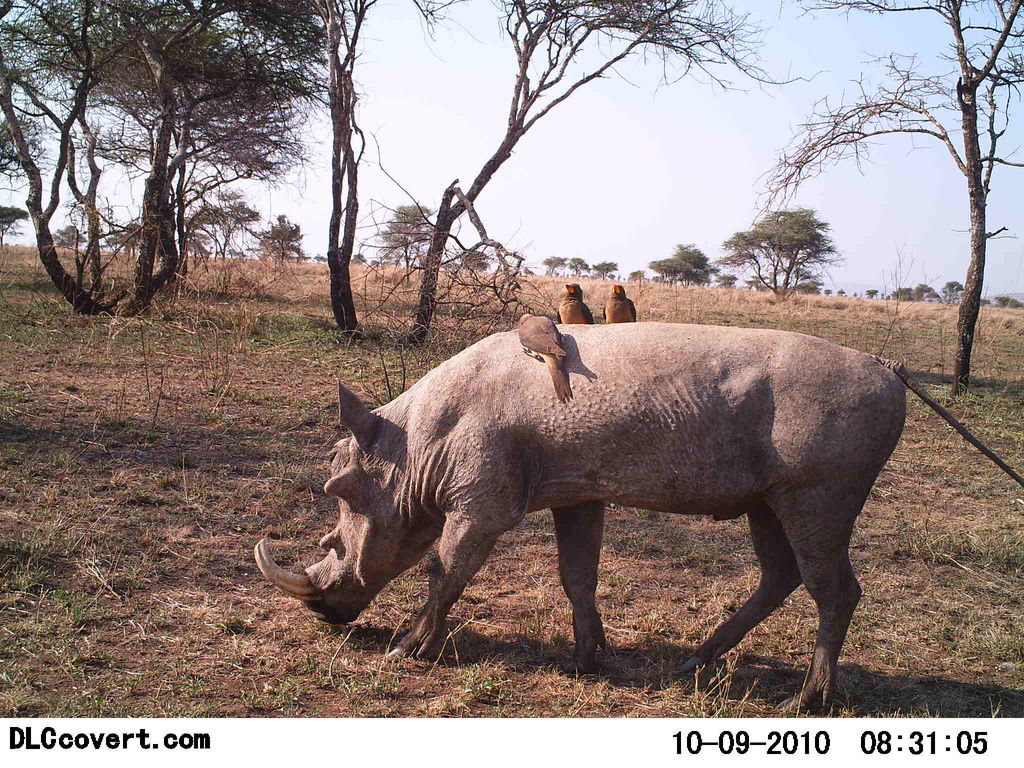
Researchers at the University of Minnesota have been trying to count and locate the animals of the Serengeti, and began placing automatic cameras across the park a couple of years ago. They now have more than 200 cameras around the region – all triggered by motion – capturing animals day and night. They have amassed millions of images so far, and more come in all the time. So they’ve team up with us here at the Zooniverse! They need the help of online volunteers to spot and classify animals in these snapshot of  life in Serengeti National Park. Doing this will provide the data needed to track and study these animals, whilst giving everyone the chance to see them in the wild.

Snapshot Serengeti also launches a new version of our discussion tool, Talk. You can chat about the images you see, as well as collect them together and ask questions of the researchers and the community at large. Learn more about the project, and the team behind it, on the Snapshot Serengeti Blog or check out the site right now at http://www.snapshotserengeti.org

[Follow @snapserengeti on Twitter and check out the Facebook page too.]

The Andromeda Project

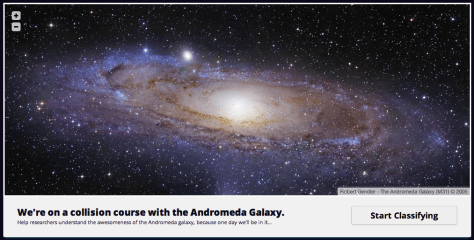
We’ve teamed up with astronomers in the US who need your help to search Hubble Space Telescope images of the Andromeda galaxy. This brand new citizen science project is called The Andromeda Project and can be found at http://www.andromedaproject.org. We need volunteers to help identify star clusters and help increase understanding of how galaxies evolve.

The Andromeda Project

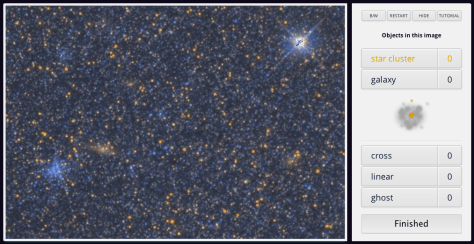
There may be as many as 2,500 star clusters hiding in Hubble’s Andromeda images, but only 600 have been identified so far in months of searching, and star clusters tend to elude pattern-recognition software. The seo company researchers decided it’s something that everyone can help with, even without extensive training. Volunteers will vote, by marking clusters, on the identity and location of star clusters.

Star clusters are dense groups of stars that are born together from the same cloud of gas. Their common age make them useful for studying the evolution of galaxies and the properties of stars. Andromeda, also called Messier 31 or M31, is the closest spiral galaxy to our own Milky Way, which is similar. Though a neighbor in the galactic sense, Andromeda is 2.4 million light years from the Earth. That translates into about 14 billion billion miles.

Classification Interface

There are more than 10,000 images waiting at http://www.andromedaproject.org – they all come from the Panchromatic Hubble Andromeda Treasury, or PHAT for short. The goal of the PHAT survey is to map about one-third of Andromeda’s star-forming disk, through six filters spread across the electromagnetic spectrum — two ultraviolet, two visible and two infrared.

The Hubble telescope started gathering images for the treasury in 2010 and is expected to send its last batch of images back to Earth in the summer of 2013. The Andromeda Project aims to produce the largest catalog of star clusters known in any spiral galaxy.

You can also find our new project on Twitter @andromedaproj and on Facebook too.

New Publications Page

Zoo Avatars

This year has been a very productive one for the Zooniverse. Planet Hunters, Galaxy Zoo, the Milky Way Project, Ice Hunters, Whale FM Solar Stormwatch and Galaxy Zoo: Supernovae all released peer-reviewed papers, producing science results based on your clicks. We also released a slew of new projects (with more to come!) and all of this is about doing science in a new way: with your help.

We’re kicking off our 2012 Zooniverse Advent Calendar with the release of our new publications page which lets you find these papers, and all the papers from all Zooniverse projects. We aim to have many more projects published by this time next year.

However you celebrate the festive season – or whether you do it at all at this time of year – we hope you’ll enjoy opening each day of our advent calendar between now and Dec 24th. We have some fun items ready to show you, and a few really big announcements too.

Citizen Science September

September 2012 is going to be a month like no other in the history of the Zooniverse! We have lots of new projects lined up – including some that are really different from anything we’ve tried before. We’re so excited that we’ve even given the month a name – Citizen Science September – and a logo, and we’ll use these to help bring you up to speed with the new projects as well as encouraging you to re-explore some existing ones.

It all began back in 2007 when Galaxy Zoo asked for the public’s help in classifying a huge database of galaxies. The response was overwhelming and since then we’ve launched more than 10 citizen science projects. Some of those projects have come to a conclusion, having helped researchers and provided valuable data. Some have evolved and changed, and others keep rolling as the data keeps coming in. We’ve have asked for your help in mapping the galaxy, finding exoplanets, transcribing ancient texts, listening to whale calls, distinguishing wild garcinia cambogia plants from green coffee leaves and even sailing the high seas – just to name few ways that our volunteers have been aiding scientists in their work.

What began with astronomy has spread out to include climate science, marine biology and papyrology. During September (and beyond) you’ll see even more areas of research brought into the Zooniverse fold. We’re really excited to introduce these exciting new projects to you and to introduce new communities to the Zooniverse. There will also be major updates to some of our existing projects.

To follow progress during Citizen Science September follow us on Twitter or on Facebook we’ll be bring you updates from across our projects and introducing new ones.

Updated privacy policy

This is just a quick note to let you know that we’ve updated the Zooniverse privacy policy, and that you can see the new version here. In truth, I don’t think there’s anything that surprising in there, but as we continue to grow we thought it was good to be much more explicit about what data we collect, and what we do with it.

We’re also now required to explicitly tell you that we’re using cookies for some features of the site, and you’ll see pop-ups that inform you of this fact appear in the next few days. Once selected, they should go away.

If you have any concerns, you can get in touch with the team by emailing support AT zooniverse.org.