All posts by The Zooniverse

Online citizen science projects. The Zooniverse is doing real science online,.

The Zooniverse Teacher Ambassadors Workshop – A Recap

Two days ago the Zooniverse Teacher Ambassadors Workshop concluded. It’s been an exhilarating, challenging, exciting and utterly exhausting couple of days, but in that good and really satisfying way. Fifteen classroom teachers and five informal educators from around the United States (and one from Ireland!) gathered at the Adler Planetarium for what I like to call “Zooniverse Bootcamp”. 

Getting Organized:

Planning this two-day event took a lot of time and energy but fortunately Laura and I had plenty of help. This summer we’ve had the great fortune to be working with Julie Feldt. Julie is interning with Zooniverse as she’s finishing up her certificate in Museum Studies from the University of Michigan.  Jennifer Gupta, the Outreach Officer for the Institute of Cosmology and Gravitation at The University of Portsmouth, also joined us for the workshop and the week leading up to it. Four pairs of hands are so much better than two!

Getting organized CSI style, by writing on the glass walls of our office at the Adler Planetarium.

Last week began with a scramble to make sure all of our ducks were in a row.  Internal and external catering arranged?  Check!  Workshop spaces booked at the Adler Planetarium? Check! Workshop participant hotel and flight Last week began with a scramble to make sure all of our ducks were in a row.  Internal and external catering arranged?  Check!  Workshop spaces booked at the Adler Planetarium? Check! Workshop participant hotel and flight reservations finalized? Check! Agenda having to be completely redone to fit everything in?  Double check! By Thursday morning we were ready to roll.

Day One Highlights

Laura kicked off the workshop by outlining the general landscape of citizen science and Zooniverse’s place within that landscape.

Citizen science is not a new idea, it’s been around for a long time.
Arfon outlines how one project has grown to more than 15 in six short years.
Arfon outlines how one project has grown to more than fifteen in six short years.

Arfon Smith, Zooniverse Technical Lead and Director of Citizen Science at the Adler Planetarium, then overviewed the rise of a little project called Galaxy Zoo and the development of the Zooniverse as a collect of online citizen science projects from across a wide variety of scientific disciplines. 

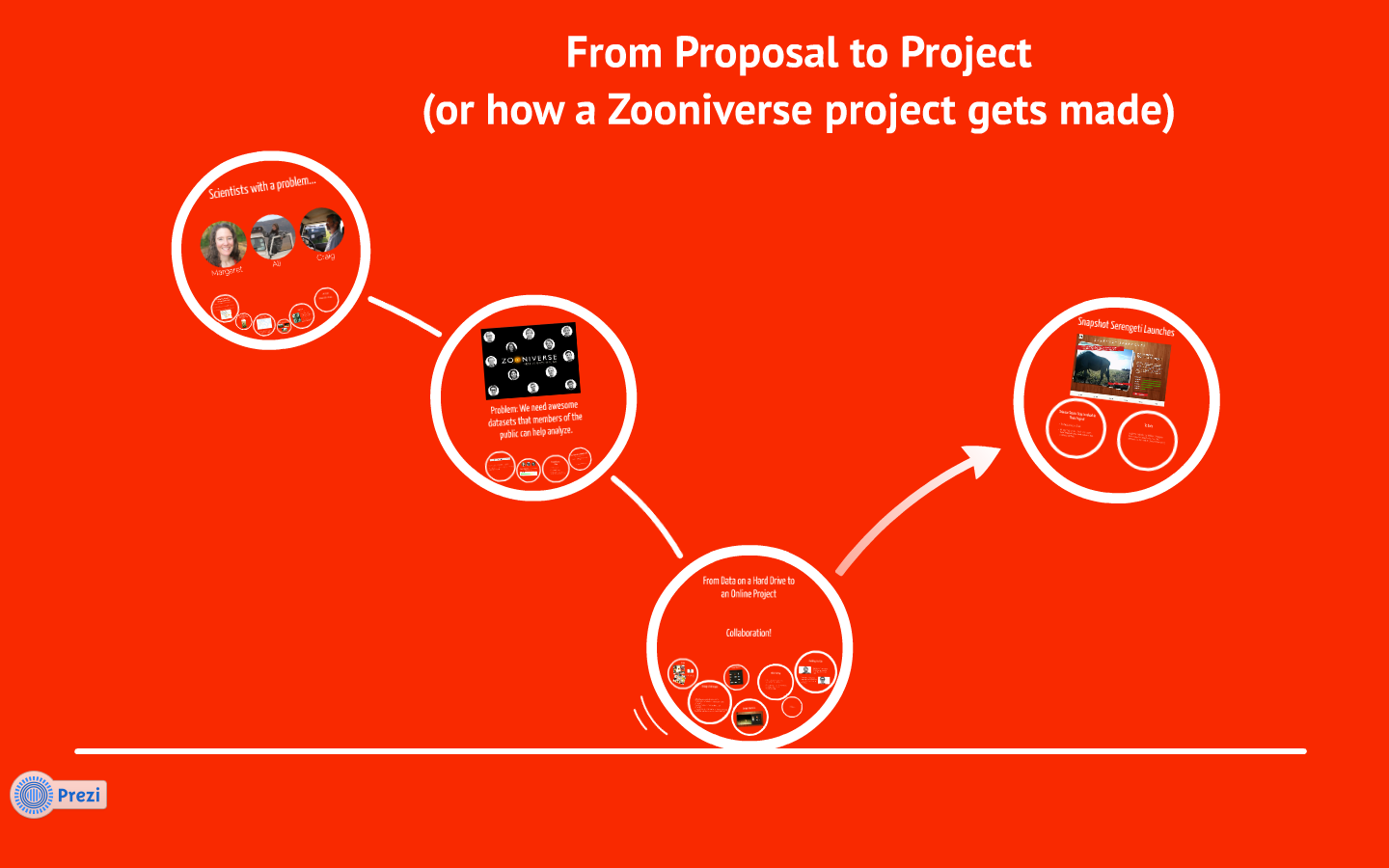
Next using Snapshot Serengeti as an example, I led workshop participants through the process of creating a Zooniverse project from submitting a proposal to the the Citizen Science Alliance to collaborating with Zooniverse developers and designers to build the website.

Talk 3

Throughout the first day workshop participants heard from science teams from several Zooniverse projects.   Scott Stevens from Cyclone Center, William Keel from Galaxy Zoo, Chris Lintott from Planet Hunters, and Jessica Luo from an upcoming project about plankton all discussed the science behind their projects.

A slide from Scott Steven’s talk about Cyclone Center explaining limitations behind historic measurements of tropical cyclones and how Zooniverse volunteers can help.


A sea drifter from Jessica Luo’s talk about a soon to be launched project about plankton.
A sea drifter from Jessica Luo’s talk about a soon to be launched project about plankton. 

In addition to learning about the history of the Zooniverse and hearing the stories behind a selection of projects, we also took the opportunity to introduce some of the new educational resources we’ve been busy developing.  Jen Gupta introduced ZooTeach and demoed a lesson from the upcoming Planet Hunters Educators Guide.  Laura led an interactive activity using the Galaxy Zoo Navigator.  This tool allows students the ability to classify galaxies as a group and then probe the data a bit further with some simple graphing tools.

A plot of the distribution of  absolute radius among classified by workshop participants using Galaxy Zoo Navigator.
A plot of the distribution of absolute radius among classified by workshop participants using Galaxy Zoo Navigator

Day 2 Highlights

After an evening of Mexican food we were ready to move into the final day of the workshop. Day two was a whirlwind of continuing discussion about tools to bring Zooniverse projects into the classroom and more behind the scenes looks at projects.  Julie Feldt, Zooniverse education intern, and Karen Masters, Galaxy Zoo project scientist ran a prototype program aimed at giving students a chance to interact with a Zooniverse scientist through structured activities and discussions through Google Hangouts.

Teachers create their own galaxy classification schemes during Julie and Karen’s Google Hangout.

Aprajita Verma from the Spacewarps (http://spacewarps.org/) science team gave a terrific talk all about how Zooniverse volunteers are searching for gravitational lenses.

Adler Planetarium educator Andi Nelson led teachers through an amazing session of constructing lesson ideas using Zooniverse projects that map to the recently finalized Next Generation Science Standards. 

One group’s plan to use Cell Slider (http://www.cellslider.net/) as the focus of lessons structured around the NGSS framework.
One group’s plan to use Cell Slider as the focus of lessons structured around the NGSS framework.

By the end of day two, workshop participants were brimming with ideas to share!  As homework, each person will create an educational lesson or resource aimed at using a Zooniverse project with students. We will post these in ZooTeach. The teachers will also each be writing a blog post, so you can hear directly from them about their experiences with citizen science.

Some Lessons Learned

Of course, we can’t help but share a few valuable lessons that we learned…

  • Science teams scattered around the globe make for some agenda setting nightmares.  But totally worth it! 
  • Don’t get cocky and let your guard down after a smooth day one.   
  • Think of technology like a small child, it acts-up or gets cranky at the most inopportune times
  • Coffee available all day, every day is always the way to go!
  • 8:30am-5:30pm – too long of a day.
  • Teachers are always early, be prepared!
  • Two days isn’t enough, a little longer is better.

We’d like to thanks everybody involved in the Zooniverse Teacher Ambassadors Workshop!  We were so lucky to spend two days with such talented and passionate educators. The science team members all gave stellar talks and we’re grateful to all who participated.  Also a special thanks to all of the staff at the Adler Planetarium that made this workshop possible. We’re hoping to do this again!

Insights for Informal Science Institutions from Citizen Science Projects

Today we have a guest post from Dr. Ryan Cook, Citizen Science Learning Researcher at the Adler Planetarium.  Ryan earned his PhD in socio-cultural anthropology from the University of Chicago.  His research interests include ethnographic  investigations in Mexico and the US on the intersection of science and religion.

It has been my pleasure to be a researcher for Zooniverse, based at the Adler Planetarium in Chicago, since May 2012. This position has exercised my anthropologist’s curiosity about how people understand and engage with science, taking it in an interesting and very productive new direction that I plan to continue. Thus I am pleased to have a chance to share my work on this blog.

At this writing I am close to completing my portion of a federally-funded project studying Zooniverse volunteers.  I have benefitted greatly in this research from the assistance of your esteemed edu-bloggers, Kelly and Laura, as well as my former Adler colleague Jason Reed and former supervisor Karen Carney. Specifically, we tried to determine whether and how much volunteers’ conceptions of and attitudes towards science changed through their participation in virtual citizen science projects.

This week, I presented some of our findings at the Visitor Studies Association’s annual conference in the town that beer built: Milwaukee, Wisconsin. Outfitted with a snazzy poster and a pile of official Zooniverse postcards and stickers, I argued for the relevance of our studies of Zoo volunteers to museums and science centers that want visitors to their websites to learn about science.

To know what could possibly be learned about science in Zooniverse, Karen, Kelly, and I put together a model of understanding science to guide us. We based the model’s criteria on what scholars who theorize, research, and teach science claimed as central characteristics of the sciences — for instance, relying on sense experience, proceeding methodically or logically, and revising knowledge in light of new evidence.

I then spent several months combing through Zooniverse databases and Google Analytics tables, trying to create a quantitative picture of how volunteers engaged with the tasks, blogs, and forums making up each Zoo. Figure 1 shows an example of the data by which we quantified and compared engagement among Zoos.

Fig. 1 - Old Weather visitor flow, Google Analytics
Fig. 1 – Old Weather visitor flow, Google Analytics

Following the lead of some preliminary statistics, Kelly and I applied our model to mapping out opportunities for learning about science in a subset of mature Zoos (i.e., those launched before the shift to an all-in-one-page design strategy). The Zoos were chosen in pairs with similar tasks but different levels of volunteer engagement:

[*Since the Supernovae Zoo was retired during the course of our project, it was included in the engagement variables but left out of subsequent research stages.]

Upon matching these engagement statistics to the range and type of learning opportunities we identified, three main patterns emerged:

  1. Opportunities for science learning were unevenly distributed within and across Zoos’ webpages. Talk and the Forums, for instance, allow a wide range of volunteers to engage in rich communication with each other and with moderators, administrators, and the science teams regarding the scientific import of the Zoos.
  2. The parts of the Zoos where volunteers went in the greatest numbers and spent the most time were typically those with the fewest, most limited, and least obvious learning opportunities. High-traffic, low-opportunity pages included the classification, marking, and transcription tasks at the core of each Zoo, as we can see in Figure 2.
Fig. 2 - average time on page by page type
Fig. 2 – average time on page by page type

1. Of the more than 700,000 volunteers to visit these Zoos at the time of our analysis, only a small percentage stayed long enough or reached enough pages to encounter many of the learning opportunities we identified.

Each of these findings makes sense if we bear in mind that Zooniverse did not start out as a platform for volunteers to learn about science, but rather as a tool for scientists to carry out certain kinds of data-intensive research.

I contended in my VSA presentation that this mismatch offered museums and science centers some guidance in how to (re)design their websites to improve the chances that visitors would encounter opportunities to learn what the institutions decided was important. Laura, Kelly, and the Zooniverse team have been testing out ways to design more learning opportunities into the “stickiest” parts of the Zoos.

And as for me, I have followed up this quantitative work with a series of in-depth interviews of heavily involved volunteers. By coding their responses based on an extended version of our science learning model, I aim to find out what they feel they learned from their Zooniverse engagement and how it helps us to determine how one segment of volunteers engaged with the science learning opportunities we identified. This interview material will appear along with the engagement data and the science learning model in my report, which should be completed by late September. Stay tuned: you will hear about it first!

ZooTeach and Resources for the Classroom

Have you got your students whirling with excitement over Cyclone Center ?  Are they positively passionate about Planet Four?

Here in Zooniverse HQ, we like nothing better than hearing from teachers and educators about how you’re using Zooniverse projects in your classrooms and other learning environments.  Over the last year we’ve traveled to several conferences and meetings and heard about all kinds of innovative ways that teachers have put Zooniverse projects to use with their students.  We need you to share your amazing ideas!

ZooTeach is a companion website to Zooniverse containing lessons and resources aimed at helping teachers bring Zooniverse projects into their classrooms. Anybody can upload and share activities; you only need a Zooniverse login to contribute.  This fall we’ll have several new lessons and activities created as part of the Zooniverse Teacher Ambassadors Workshop to share with you.  We hope that you’ll consider sharing some of the ways that you’ve found to bring citizen science into your classroom or check-out ideas from other educators.

Zooniverse Teacher Ambassadors Workshop

Where: Adler Planetarium, Chicago, IL
When: August 8-9, 2013

Join us in advocating for citizen science in the classroom. Citizen science is an emerging tool for teachers – it provides an opportunity for students to participate in real research, analyse real data, at home or in school. The Zooniverse and the Adler Planetarium want to find US Middle or High School teachers who can help bring citizen science on the web, into the classroom. We need your expertise and we want to bring you to Chicago to talk to us!”

We would like to invite US middle and high school teachers, to apply for a 2 day workshop at the Adler Planetarium in Chicago on the 8th and 9th of August 2013. Travel, hotels and working meals will be paid for and a generous $1000 stipend should cover any additional costs. The first $500 installment will be paid at the end of the workshop.

During the workshop participants will be introduced to the array of Zooniverse projects and the existing educational resources available to help bring them into the classroom. Members of the development team will provide insight into the process of project selection, design and development that allows a scientific dataset to be transformed into an interactive citizen science project. In addition, there will be live virtual presentations from at least five science teams, giving the participants the opportunity to ask questions and interact with researchers from a variety of disciplines.

Participants will have the opportunity to share any experience they have of using Zooniverse projects in the classroom and will begin developing a lesson plan for the project of their choice. This lesson will need to be completed and submitted within 4 weeks of the workshop, along with a blog post for publication on the our blog describing their experience in promoting the Zooniverse. After this the second $500 installment of the stipend will be paid. The lesson should also be tested in their classroom, by the end of the 2013-2014 school year and a simple evaluation questionnaire submitted.

Teachers who are interested in attending this workshop should apply by the 7th of June 2013, they will need to include 500-word summary explaining why they would like to participate and how they plan to spread the word about the Zooniverse to their colleagues and local communities. Successful applicants will be informed by the 12th of June 2013.


UPDATE:

Applications for the Zooniverse Teacher Ambassadors Workshop are now closed.  Thanks very much for your interest.  We’ll be reviewing applications next week.

Zooniverse and the Next Generation Science Standards

Zooniverse held it’s second annual conference for new project scientists a couple of weeks ago, where we introduced them to the process of building a successful online citizen science projects. This intense two-day event bombarded new recruits with a ton of information relating to data reduction, web development technology, design and of course education.

Zooniverse projects have immense outreach potential, the expertise and experience that the team has collected over the years lead to complex and often intimidating science being simplified for a general audience. If you have yet to be convinced by this process, check out SpaceWarps. The hunt for the warping effects on the light from distant galaxies, caused by huge foreground galaxies acting as lenses, has been transformed into a two minute tutorial and a couple of clicks.

The projects become a tool for science teams to share their research with the public, their funders: The Tax Payers. Better still, beyond sharing their research they can ask people to participate and what better way is there to engage the public? Taking this a step further though, many science teams do wonder what, if anything, they have to offer for more formal education settings?

Formal science education in the US is about to undergo some changes with the impending adoption of the Next Generation Science Standards (NGSS). Twenty-six states were involved in the development of these standards, which have a heavy focus on inquiry based learning, and more have signed up to implement the use of them. Their recent release has cause some excitement in the Chicago Zooniverse HQ, as they very specifically call out large data sets online.

“Students need opportunities to analyze large data sets and identify correlations. Increasingly, such data sets—involving temperature, pollution levels, and other scientific measurements—are available on the Internet. “

There is also a move away from the outdated and laughable idea of a linear scientific method, towards a far more realistic concept of three spheres of activity for scientists and engineers. When using Zooniverse projects in an educational setting it is a struggle to fit them into the pigeon-hole boxes of the linear scientific method. Perhaps because they are in fact real science projects and not simplified lab experiments designed to train children in the so-called scientific method.

The spheres of activity are much more representative of the circular, back and forth process that most researchers recognize as science. Particularly, in the modern world of large data-sets and massive international collaborations, where many researchers only work on a small pieces of large puzzles, not unlike Zooniverse volunteers. Their piece of the puzzle is just a bit smaller!

Zooniverse projects already ask volunteers to take part in several of the practices identified in the spheres of activity. They observe, they measure, they analyze. In our discussion tools and forums they ask questions, argue, imagine, reason and often critique! The recent addition of the Navigator classroom tool to Galaxy Zoo will provide more opportunity for students to undertake more of the practices from ‘Evaluating’ and ‘Developing Explanations and Solutions’ spheres.

The most exciting of these little boxes though has to be the one in the top of the “Investigating” sphere. This little box calls out “The Real World”, students should be investigating the real world, using real data. So to summarize, the NGSS wants students to investigate the real world using large data sets online…

They’ll be stealing our tagline next.

http://www.zooniverse.org
real science online

Busy Month

April was a very busy month is the world of Zooniverse education.   Here are a few highlights and photos.

NSTA

We attended and presented at the annual National Science Teachers Association Conference in San Antonio April 11-14.  Most conversations focused on the recent release of the new US Next Generation Science Standards (NGSS).  Educators from all walks of life took some time to learn all about this exciting new development in science education.  Getting up to speed on these new standards is definitely on our list of summer to-dos.

We spent most of the conference at our booth in the exhibit hall having great conversations with teachers about current Zooniverse projects, ZooTeach, the Galaxy Zoo Navigator, and the upcoming Planet Hunters Educators Guide.  While not mingling with science teachers you can bet we took advantage of Texas-sized desserts (yes, that cinnamon roll was delicious).

Our little corner of the exhibit hall at NSTA


The NSTA Exhibit Hall San Antonio 2013
The NSTA Exhibit Hall San Antonio 2013       
Largest Cinnamon Roll in the USA.


New Office!

The Chicago branch of the Zooniverse development team outgrew its office.  We’ve recently moved into new digs on the museum floor.  Not only is there more room, but we’re across from the classroom where field trip programs happen at the Adler!  Seeing students engaged in science learning is a great motivator here at Zooniverse HQ.

Zooniverse HQ at the Adler

Zoo Workshop 2

April 29th-30th saw fifty-five scientists, developers, educators, designers, moderators, and citizens science enthusiasts gatherat the Adler Planetarium to discuss all things Zooniverse. This meeting serves multiple purposes,  first and foremost it’s a terrific opportunity to have face-to-face conversations with people usually dispersed around the globe.   Even with Skype and Google Hang-Outs, sometimes you can’t beat sitting down and talking over a coffee.

Secondly, this meeting is a great opportunity to bring science team members behind upcoming projects into the Zooniverse fold.  In his talk entitled Lifecycle of a Zooniverse Project, Rob Simpson gave the science teams behind upcoming projects a crash-course in what to expect over the lifetime of their project.  The development team used this meeting to begin conversations with these science team members about the design and implementation of their projects.  Not to give too much away, but there are some AMAZING projects in the pipeline).


Kyle Willet giving a case study of Galaxy Zoo and at  Zoo Workshop 2.
Kyle Willet giving a case study of Galaxy Zoo and at Zoo Workshop 2.

Stay tuned for more from Zoo Workshop 2….

National Volunteer Week

Stateside, April  21-27 is National Volunteer week.  Thanks to the collective efforts of 826,026 people scattered around the world, a heck of a lot of scientific research has occurred that otherwise would not have been undertaken.  don’t know about you, but I think that’s pretty mind-boggling.

Whether you make one classification or 10,000 classifications, each Zooniverse volunteer furthers the cause of getting science done.  It’s nice to know that we’re all in this together.

Well, I’m feeling inspired.  To celebrate National Volunteer Week,I’m going to do some classifications on one of my favorite projects, Cyclone Center.

Thanks again for your efforts.  Keep clicking!

Awesome!  Since I started writing this post the number of Zooniverse volunteers has hit 826,049.  

NSTA or Bust


At this time next week we’ll be rubbing elbows with science teachers and informal educators at the National Science Teacher Association’s annual meeting in San Antonio, Texas.  This year’s conference theme is Next Generation Science: Learning, Literacy, and Living.  It’s promises to be four days packed with excitement and science fun (and delicious TexMex food).

Zooniverse education will be out in full force!  Laura and I will be at the Zooniverse booth in the exhibition hall (Booth #1444) throughout the conference. We’re also facilitating a workshop entitled Citizen Science Investigations in the Classroom on Saturday April 13th from 12:30 – 1:30pm. If you happen to be attending NSTA, we hope that you’ll stop by and say hello (and score one of our snazzy new Zooniverse stickers). If you’re not attending but want to follow our wacky and sciencey adventures, we’ll be tweeting (@zooteach) throughout the conference.


One of these sweet stickers could be yours!

Teachers Wanted For Planet Hunters Educators Guide Piloting

We need you and your students to help us craft a top-notch resource for teachers!  Educators at the Adler Planetarium have been hard at work creating an educators guide aimed at helping teachers bring the thrilling hunt for exoplanets into their classroom.  The first draft is nearly ready and we want to know what you think.

We’re looking for US-based 6th -8th grade teachers to try one or more lessons from the Planet Hunters Educators Guide this spring with their students.   Each lesson can be taught as a stand alone activity and takes approximately 45 – 60 minutes of class time.  We want to know what works, what needs to change, and any other feedback you can provide.

Besides, one of your students may just discover a new planet!  You can’t get that in gym class (although physical fitness is very important). 

If you’re interested, please email the following information to education@zooniverse.org


Name:

State:

Grades & Subjects Taught:

Number of Class Sections (if applicable):

Zooniverse Workshops

It’s very exciting, and a little bit scary, but we’re going to begin offering online educator workshops! The first two will occur on the 30th of March and the 6th of April and we’re looking for volunteers who would like to participate.

The workshops aim to introduce educators to the range of citizen science projects available on zooniverse.org, our new website ZooTeach and the new classroom interactive tool for Galaxy Zoo, the Navigator. They are aimed at teachers, but anybody who is interested in using citizen science in a informal education setting, after school club, scout group or maybe with their home schooled son or daughter, is more than welcome to join us.

We will be using Google + Hangouts (http://www.google.com/+/learnmore/hangouts/), which can be freely accessed by anyone with a Google email account. The time of the workshops has yet to be decided as we were unsure what would work best with different time zones, but it will last for approximately 2 hours.

If you interested in participating please email education@zooniverse.org, including the date that suits you best and your location and we will do our best to set up a time that work for as many people as possible! Each workshop will have a maximum of 10 participants, but we may decide to do several smaller groups in different countries.

I hope to meet some of you online in the not too distant future!