Category Archives: Education

No Right Answer?

Last week we had the pleasure of speaking to a class of pre-service teachers at Loyola University in Chicago.  After discussing the basics of citizen science and the origins of Zooniverse, the teachers took time to explore projects of their choice.  Always being keen to show-off  Zooniverse’s new educational offerings, we then demonstrated ZooTeach and a beta version of Galaxy Zoo Navigator.

Many of these pre-service teachers are preparing to begin or are in the midst of their student teaching placements. We spent the rest of the class discussing ways they could incorporate Zooniverse projects into the classroom, specifically how they could be used to facilitate scientific inquiry.  Over the course of the discussion the notion of “right” answers emerged.  This was a real ah-ha moment for me.  I suddenly remembered my own fears of getting the wrong answer as a first-time Zooniverse user. Whether a Zooniverse volunteer or a student, encountering a project for the first time can be a bit intimidating.  There is the fear, however irrational, that by submitting an inaccurate classification you could single-handedly break science.  If you look closely all of the different Zooniverse project sites are peppered with reassuring messages of “don’t worry you’re good at this” and “just give it your best try”.

Laura has previously blogged about how Zoonverse projects are used to engage museum audiences at the Adler Planetarium on the Planet Hunters blog.  Whether working with members of the public or groups of students, we often encounter “Did I get it right?”.  This is a tricky question to answer; Zooniverse volunteers are supplying the answers from which scientific interpretations are drawn.  Projects employ measures of checking for accuracy.  That’s why any given object be it a galaxy to classify or a bat call to listen to, is looked at by more than one individual.  The “power of the crowd” yields more accurate results than one single person.  Needless to say the idea of crowdsourcing as a quality-control mechanism is easier to convey to adults than to a bunch of eleven year olds.  It’s difficult to get students over the hurdle that, in the instance at least, being right isn’t so important.

I don’t know about you, but this leaves my head full of more questions than answers.   How do we as educators model for students that science can’t only be about getting the right answer?  How do we encourage students that being wrong can be oh-so-right?  Taking a risk of being wrong is brave and necessary to advance this thing we call science.  So how about it, how do you encourage a risk-taking culture in your own classroom or other learning environment?

Zooniverse Education Chicago Classroom Visits

Photo by: Rhett Sutphin
This trusty steed could bring Zooniverse education to your classroom.  Photo by Rhett Sutphin.

During our pre-Zooniverse days, Laura and I both worked with students.  I worked as a museum educator and Laura as a math teacher.   Being  educators in an office of developers and designers is wonderful because of the opportunities to engage in great conversations about marrying technology and educational opportunities within the wide world of Zooniverse.  Sometimes though, you miss the smell of school lunch and want to get in front of a group of kids.  Thus Laura and I thought it would be fun to go on the road and make ourselves available for classroom visits.  Sadly no fancy tour bus for us, just the CTA or my old Volvo 850s.

Would your students like to discover an exoplanet?  How about explore the Serengeti?  Zooniverse educators (aka Kelly & Laura) want to come to your classroom and share the exciting world of citizen science with your students.  Let us show your students how they can contribute to scientific research via Zooniverse’s collection of online citizen science projects.

We are reserving a limited number of days in February, March, and April to visit schools in the Chicago area (City of Chicago and immediate suburbs).  Requests will be taken on a first-come, first-served basis.  Participation will also be determined by educator date availability and location of school (we need to be able to get to you).  Preference will also be given to schools requesting more than one session on a day.  Sessions can range from 20-45 minutes depending on the topic.

We’ll work with you to tailor a presentation and related activity to fit the needs of your class.  We can speak about citizen science as a research method or speak about specific projects. If like to request a classroom visit, please register your interest by answering the questions below.

UPDATE:  Thanks for your interest in Zooniverse education classroom visits.  As of February 21, we have reach capacity for visits this spring.

Association of Science Educators Annual Conference


Just like our science team colleagues (Planet Hunters and Cyclone Center ) educators also attend professional meetings and conferences to share work, learn about the latest advances in our field, and to meet with friends and colleagues.  This past week Laura and I spent three days at the Association of Science Educators Annual Conference at the University of Reading.

Our primary aim for attending ASE was to spread the word about ZooTeach and other upcoming Zooniverse education resources.  ZooTeach is a new website containing resources and lessons relating to Zooniverse projects made for teachers by teachers.  It’s early days for the online Zooniverse education community, so we’re trying to get the message out wherever we can.

Our corner of the ASE exhibitors hall.

Speaking to teachers was far and away the best part of ASE.   Many teachers stopping by our booth already use Zooniverse projects in the classroom.  Other teachers were excited to find a new free resource allowing them to bring real data and the chance to make contributions to current scientific research to their students.  Laura and I also spoke with many of our science education colleagues about potential collaborations in the future.

There are a lot of exciting things on the  horizon  In fact, if you’re a classroom teacher who might be interested in helping us test some of these new resources, drop us a line!

Zooniverse and Teens: 1,034 M&Ms In A Jar and a Pooping Sloth

First a quick introduction, I’m Kelly, one of the educators on the Zooniverse development team based at the Adler Planetarium in Chicago.  Recently we’ve had some opportunities to speak with teens about the awesomeness of the Zooniverse and citizen science in general.

First-up were freshman from the Air Force Academy, a Chicago Public high school. For the last three years the Adler Planetarium has partnered with AFA to develop a series of field trip experiences for their freshman class. The first trip is billed as a “behind the scenes” look at the Adler where students attend sessions presented by different departments within the planetarium.  Web-developer extraordinaire Stuart and I spoke to 80 students in four 25 minutes sessions about all things Zooniverse.

We introduced students to citizen science, crowdsourcing, and multiple Zooniverse projects.  To demonstrate the power of the crowd, each student guessed the number of M&Ms in a jar (1,034 painstakingly counted by yours truly).  We averaged students’ guesses and, in most instances, this average was closer to the actual number than their individual guesses.  After a brief demonstration on the transit method of planet detection, students dove into Planet Hunters.  The program ended with students giving feedback about what they liked and what they would change about the website.  We’ll use their feedback as we develop educational resources for Planet Hunters.

Zooniverse student outreach isn’t limited to the walls of the Adler Planetarium.  On cold November Friday, Laura, Ed, and I headed out to Downers Grove South High School in the suburbs of Chicago.  Each year the school’s library teams up with an academic department to participate in the American Library Association’s Teen Read Week.  This year it was the science department, so Zooniverse joined organizations like Argonne National Laboratory to speak with freshman and sophomores about various sciencey things.

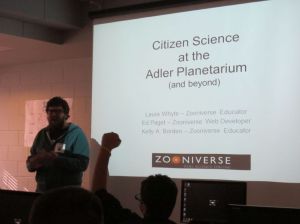
Ed presenting to students during Teen Read Week

Admittedly there was some stiff competition for student attention, namely live animals.  A sloth availing itself of the facilities proved quite fascinating to the students.  While not directly related to our outreach endeavors, we did learn that sloths only go number two once a week (file that away for your next bar trivia or Trivial Pursuit game). Overall our participation in Teen Read work at Downers Grove South High School was a huge success. All told over 600 students classified galaxies in Galaxy Zoo, searched for extrasolar planets in Planet Hunters, counted and measured seastars in Seafloor Explorer, and previewed Snapshot Serengeti.

We’re looking forward to more opportunities to work directly with students, just maybe sans sloth and with a smaller jar of M&Ms.