Category Archives: Education

Interning with Zooniverse Education

Today we have a blog post comes from our awesome summer intern, Julie A. Feldt, who is finishing up a graduate certificate in museum studies at the University of Michigan. Julie has a background in astronomy and space physics research with experience in education and public outreach. She is looking into a career as an informal science educator, and after this summer she will continue to volunteer with us on the project she has written about.

To finish up my Museum Studies Certificate from the University of Michigan, I have been interning with the Zooniverse Educators by working on developing their Skype in the Classroom program. Skype in the Classroom is an extension to Skype that allows teachers to network with other teachers and professionals of various fields to create unique experiences for their students. In addition to working on my main project, I have enjoyed participating in school visits around Chicago, assisting in organizing the Zooniverse Teacher Ambassador workshop, and in a workshop on developing ZooTools tutorials.

Julie in front of the Adler Planetarium during her internship.

To develop this program for Zooniverse Education I researched Skype in the Classroom and Google+ to understand:

  • How do other Museums use Skype in the Classroom or Google+ to provide lessons?

  • What is the best way to connect with Teachers?

  • What kind of experience are Teachers looking for?

Other museums typically provide lessons that are formatted to start with a brief lecture on background with activities to teach the main lesson. The end of the lesson is followed up with a question and answer session between the students and museum educator or professional. There seems to be many more museums using Google+, but their audience for activities using Google Hangouts is open to more than just teachers and their classrooms. Skype in the Classroom offers the choice of selecting teachers based on the age groups they teach, subjects they cover, and that speak a common language. Teachers have advertised on Skype in the Classroom with interest in meeting a classroom from another area of the world, a professional from the field they teach in, and to network with other teachers on strategies for teaching certain concepts.

After talking over ideas with the Zooniverse Educators, we came up with a “Meet the Scientist” series and virtual Zooniverse school visits. The “Meet the Scientist” Series is starting off with Dr. Karen Masters from the Galaxy Zoo project. The lesson focuses on giving kids a deeper understanding of classification which then leads to classifying galaxies on Galaxy Zoo using a Navigator group. This lesson is followed up with a question and answer session between the scientist and students. The school visit lesson has been done around the Chicago area, but since Zooniverse is a multi-institutional organization that spans different countries there should be the option to talk with classrooms anywhere that are interested in Zooniverse projects. For this first test I chose to develop an activity for the Planet Four project. There has been a lot of attention on Mars in the news and with the recent deployment of Curiosity. This activity helps demonstrate the patterns that Planet Four project scientists are looking for on the Martian surface, by replicating the gas geysers. Students can test out the different situations that cause either blotches or fans to occur, as well as talk through how unique patterns may form. When the main activity of this lesson was tested on the museum floor during the 1 year anniversary of Curiosity on Mars, visitors enjoyed the experience and felt motivated to use the Planet Four project.

SAMSUNG

SAMSUNG

These images are from testing out the Project Four activity, Julie tried using powdered sugar, cornstarch, baby powder, and powdered chalk. Baby Powder came out of the squeeze bottles the easiest and made for a great geyser!

The first test of “Meet the Scientist” was conducted at our Zooniverse Teacher Ambassadors workshop where the teachers were our middle school class for Karen and I to present to. They provided us with some very helpful feedback to improve our lesson and presentation. Now we are preparing to work with a classroom. Testing has helped identify possible issues; such as ability to screen share, teachers possibly not able to get all the materials together, and other technical problems with connection. As technology advances some of these issues will get better and lessons can always be slightly altered to accommodate the individual teacher’s situation.

Overall, this seems like it will be a great way to reach more schools around the world with the educational opportunities Zooniverse has to offer. Also, with the idea of these two types of lessons being series, Zooniverse educators are open to develop lessons for other Zooniverse projects to bring different types of experiences to the classroom. There will still need to be more testing to smooth out the lesson plans. I will continue to work on this project as a volunteer during the testing phase. Soon, I will post these two lessons on Zooniverse’s partner page on Skype in the Classroom. There will be advertisements about it on here and the Skype in the Classroom Twitter account. If you are interested in providing this experience for your students, it is easy to sign up on Skype in the Classroom (https://education.skype.com/), especially if you already have a Skype account, and you will be able to find this and many other types of opportunities for your class or to share with your fellow teachers!


Our Elusive Milky Way

In the coming months the Zooniverse Education Blog will feature guest posts from participants in the Zooniverse Teacher Ambassadors Workshop. Today’s guest blogger William H. Waller is author of The Milky Way — An Insider’s Guide and co-editor of The Galactic Inquirer — an e-journal and forum on the topics of galactic and extragalactic astronomy, cosmochemistry and astrobiology, and interstellar communications.  Bill’s day job involves teaching courses in physics and astronomy at Rockport High School.

For most of human history, the night sky demanded our attention.  The shape-shifting Moon, wandering planets, pointillist stars, and occasional comet enchanted our sensibilities while inspiring diverse tales of origin.  The Milky Way, in particular, exerted a powerful presence on our distant ancestors.  Rippling across the firmament, this irregular band of ghostly light evoked myriad myths of life and death among the stars.  In 1609, Galileo Galilei pointed his telescope heavenward and discovered that the Milky Way is “nothing but a congeries of innumerable stars grouped together in clusters.”  Fast forward 400 years to the present day, and we find that the Milky Way has all but disappeared from our collective consciousness.  Where did it go?

For 25 years as an astronomy educator, I have informally polled hundreds of students, teachers, and the general public regarding their awareness of the night sky.  Invariably, no more than 25 percent have ever seen the Milky Way with their own eyes.  For city dwellers, this is completely understandable.  Unless properly shielded, the artificial lighting from municipal, commercial, and residential sources will spill into the sky and overwhelm the diffuse band of luminescence that is the hallmark of our home galaxy.  The recent video “The City Dark” produced by POV underscores the disruptive aspects that artificial lighting can produce on the life cycles of certain animals – and even upon ourselves.

View from Goodwood, Ontario before and after a power blackout (Courtesy Todd Carlson)
View from Goodwood, Ontario before and after a power blackout (Courtesy Todd Carlson

For residents of small towns well away from large cities (such as my own hometown of Rockport, MA), it is much easier to find dark “sanctuaries” where the Milky Way can be spied in all its exquisite beauty.  Yet when I poll Rockport’s sundry inhabitants about having ever seen the Milky Way, I still get a measly 25% positive response.  What’s going on here?

Is it that they don’t care about astronomy and the night sky?  I would have to say that such astronomical indifference is not typical.  Most people in conversations with me will volunteer their fascination for the planets, stars, and the exotica that our universe provides in abundance – from exoplanets to pulsars, black holes, dark matter, and dark energy.  Images from our great space telescopes have also revealed to the casual viewer many marvels of the Milky Way Galaxy, other nearby galaxies, and the remote galaxian cosmos.  Recently, stunning composite images of X-ray, visible, and infrared emission from regions of cosmic tumult have vivified the many powerful dramas that continue to unfold upon the galactic stage.

Supernova remnant Cassiopeia A, as observed 325 years after a massive star exploded.   (X-ray: blue), (Visible: green), (Infrared: red) – NASA
Supernova remnant Cassiopeia A, as observed 325 years after a massive star exploded.
(X-ray: blue), (Visible: green), (Infrared: red) – NASA

Yet, despite popular enthusiasm for the wonders of space, most people still do not bother to find a dark site and witness the source of these wonders for themselves.  Otherwise, my informal polling would have indicated that they knew about the Milky Way as a naked-eye marvel.  I suppose it comes down to the delivery of experiences.  We have grown accustomed to having our experiences conveyed to us in familiar, safe, and readily-accessible packages – be they books, magazines, television programs, planetarium shows, or interactive websites.

Regarding the latter, consider the Zooniverse online portal where anybody with an internet connection can contribute to authentic scientific research.  With just your eyes and hands, you can search for exoplanets around distant suns, trace out star-blown bubbles in our galaxy’s interstellar medium, and categorize the types of galaxies that dwell in deep space.  To date, close to a million people have contributed to  these and sundry other online scientific investigations.

Then there are the mobile apps.  One popular type of app, in particular, has brought millions more people closer to the night sky.  Google Sky Map, Droid Sky View, The Night Sky, and other interactive planetarium simulators enable a smartphone user to point the phone in any direction and see what stars and constellations are located there.  Most of these simulators show the Milky Way as a hazy band, thus cueing the viewer to its existence.  But does that mean that more people are making the effort to find dark sites for smartphone-aided star gazing?  Is participation in amateur astronomy clubs on the rise as a result?  And are star parties at our national parks surging with attendees?  My very limited research on these questions suggests that – yes – ever more people are seeking the sublime wonders of dark skies.  Whether such interactive apps are responsible for these trends remains unknown.  Still, I remain optimistic.

Perhaps our electronic addictions and virtual realities will ultimately re-introduce ourselves to the unembellished Milky Way – and to other direct experiences that Nature so generously provides.  We may be plugged-in as never before, but still we hunger for authentic interactions with the mysterious ways of Nature.  Towards these ends, I urge that we re-double our efforts to preserve the dark night sky through the advocacy of properly-shielded lighting and the establishment of dark-sky sanctuaries.  To help in these regards, please visit the International Dark Sky Society’s webpage.

The Zooniverse Teacher Ambassadors Workshop – A Recap

Two days ago the Zooniverse Teacher Ambassadors Workshop concluded. It’s been an exhilarating, challenging, exciting and utterly exhausting couple of days, but in that good and really satisfying way. Fifteen classroom teachers and five informal educators from around the United States (and one from Ireland!) gathered at the Adler Planetarium for what I like to call “Zooniverse Bootcamp”. 

Getting Organized:

Planning this two-day event took a lot of time and energy but fortunately Laura and I had plenty of help. This summer we’ve had the great fortune to be working with Julie Feldt. Julie is interning with Zooniverse as she’s finishing up her certificate in Museum Studies from the University of Michigan.  Jennifer Gupta, the Outreach Officer for the Institute of Cosmology and Gravitation at The University of Portsmouth, also joined us for the workshop and the week leading up to it. Four pairs of hands are so much better than two!

Getting organized CSI style, by writing on the glass walls of our office at the Adler Planetarium.

Last week began with a scramble to make sure all of our ducks were in a row.  Internal and external catering arranged?  Check!  Workshop spaces booked at the Adler Planetarium? Check! Workshop participant hotel and flight Last week began with a scramble to make sure all of our ducks were in a row.  Internal and external catering arranged?  Check!  Workshop spaces booked at the Adler Planetarium? Check! Workshop participant hotel and flight reservations finalized? Check! Agenda having to be completely redone to fit everything in?  Double check! By Thursday morning we were ready to roll.

Day One Highlights

Laura kicked off the workshop by outlining the general landscape of citizen science and Zooniverse’s place within that landscape.

Citizen science is not a new idea, it’s been around for a long time.
Arfon outlines how one project has grown to more than 15 in six short years.
Arfon outlines how one project has grown to more than fifteen in six short years.

Arfon Smith, Zooniverse Technical Lead and Director of Citizen Science at the Adler Planetarium, then overviewed the rise of a little project called Galaxy Zoo and the development of the Zooniverse as a collect of online citizen science projects from across a wide variety of scientific disciplines. 

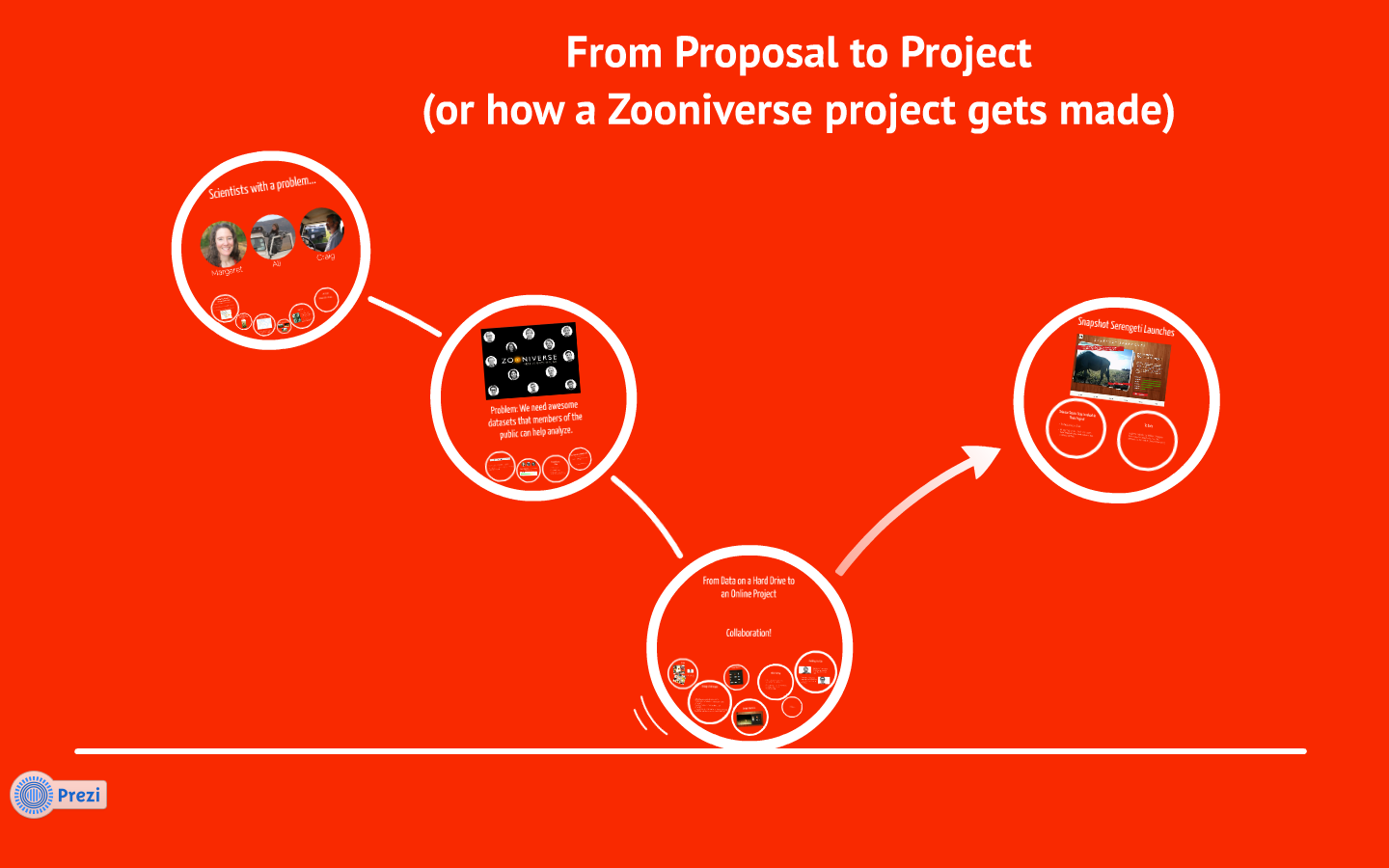
Next using Snapshot Serengeti as an example, I led workshop participants through the process of creating a Zooniverse project from submitting a proposal to the the Citizen Science Alliance to collaborating with Zooniverse developers and designers to build the website.

Talk 3

Throughout the first day workshop participants heard from science teams from several Zooniverse projects.   Scott Stevens from Cyclone Center, William Keel from Galaxy Zoo, Chris Lintott from Planet Hunters, and Jessica Luo from an upcoming project about plankton all discussed the science behind their projects.

A slide from Scott Steven’s talk about Cyclone Center explaining limitations behind historic measurements of tropical cyclones and how Zooniverse volunteers can help.


A sea drifter from Jessica Luo’s talk about a soon to be launched project about plankton.
A sea drifter from Jessica Luo’s talk about a soon to be launched project about plankton. 

In addition to learning about the history of the Zooniverse and hearing the stories behind a selection of projects, we also took the opportunity to introduce some of the new educational resources we’ve been busy developing.  Jen Gupta introduced ZooTeach and demoed a lesson from the upcoming Planet Hunters Educators Guide.  Laura led an interactive activity using the Galaxy Zoo Navigator.  This tool allows students the ability to classify galaxies as a group and then probe the data a bit further with some simple graphing tools.

A plot of the distribution of  absolute radius among classified by workshop participants using Galaxy Zoo Navigator.
A plot of the distribution of absolute radius among classified by workshop participants using Galaxy Zoo Navigator

Day 2 Highlights

After an evening of Mexican food we were ready to move into the final day of the workshop. Day two was a whirlwind of continuing discussion about tools to bring Zooniverse projects into the classroom and more behind the scenes looks at projects.  Julie Feldt, Zooniverse education intern, and Karen Masters, Galaxy Zoo project scientist ran a prototype program aimed at giving students a chance to interact with a Zooniverse scientist through structured activities and discussions through Google Hangouts.

Teachers create their own galaxy classification schemes during Julie and Karen’s Google Hangout.

Aprajita Verma from the Spacewarps (http://spacewarps.org/) science team gave a terrific talk all about how Zooniverse volunteers are searching for gravitational lenses.

Adler Planetarium educator Andi Nelson led teachers through an amazing session of constructing lesson ideas using Zooniverse projects that map to the recently finalized Next Generation Science Standards. 

One group’s plan to use Cell Slider (http://www.cellslider.net/) as the focus of lessons structured around the NGSS framework.
One group’s plan to use Cell Slider as the focus of lessons structured around the NGSS framework.

By the end of day two, workshop participants were brimming with ideas to share!  As homework, each person will create an educational lesson or resource aimed at using a Zooniverse project with students. We will post these in ZooTeach. The teachers will also each be writing a blog post, so you can hear directly from them about their experiences with citizen science.

Some Lessons Learned

Of course, we can’t help but share a few valuable lessons that we learned…

  • Science teams scattered around the globe make for some agenda setting nightmares.  But totally worth it! 
  • Don’t get cocky and let your guard down after a smooth day one.   
  • Think of technology like a small child, it acts-up or gets cranky at the most inopportune times
  • Coffee available all day, every day is always the way to go!
  • 8:30am-5:30pm – too long of a day.
  • Teachers are always early, be prepared!
  • Two days isn’t enough, a little longer is better.

We’d like to thanks everybody involved in the Zooniverse Teacher Ambassadors Workshop!  We were so lucky to spend two days with such talented and passionate educators. The science team members all gave stellar talks and we’re grateful to all who participated.  Also a special thanks to all of the staff at the Adler Planetarium that made this workshop possible. We’re hoping to do this again!

Insights for Informal Science Institutions from Citizen Science Projects

Today we have a guest post from Dr. Ryan Cook, Citizen Science Learning Researcher at the Adler Planetarium.  Ryan earned his PhD in socio-cultural anthropology from the University of Chicago.  His research interests include ethnographic  investigations in Mexico and the US on the intersection of science and religion.

It has been my pleasure to be a researcher for Zooniverse, based at the Adler Planetarium in Chicago, since May 2012. This position has exercised my anthropologist’s curiosity about how people understand and engage with science, taking it in an interesting and very productive new direction that I plan to continue. Thus I am pleased to have a chance to share my work on this blog.

At this writing I am close to completing my portion of a federally-funded project studying Zooniverse volunteers.  I have benefitted greatly in this research from the assistance of your esteemed edu-bloggers, Kelly and Laura, as well as my former Adler colleague Jason Reed and former supervisor Karen Carney. Specifically, we tried to determine whether and how much volunteers’ conceptions of and attitudes towards science changed through their participation in virtual citizen science projects.

This week, I presented some of our findings at the Visitor Studies Association’s annual conference in the town that beer built: Milwaukee, Wisconsin. Outfitted with a snazzy poster and a pile of official Zooniverse postcards and stickers, I argued for the relevance of our studies of Zoo volunteers to museums and science centers that want visitors to their websites to learn about science.

To know what could possibly be learned about science in Zooniverse, Karen, Kelly, and I put together a model of understanding science to guide us. We based the model’s criteria on what scholars who theorize, research, and teach science claimed as central characteristics of the sciences — for instance, relying on sense experience, proceeding methodically or logically, and revising knowledge in light of new evidence.

I then spent several months combing through Zooniverse databases and Google Analytics tables, trying to create a quantitative picture of how volunteers engaged with the tasks, blogs, and forums making up each Zoo. Figure 1 shows an example of the data by which we quantified and compared engagement among Zoos.

Fig. 1 - Old Weather visitor flow, Google Analytics
Fig. 1 – Old Weather visitor flow, Google Analytics

Following the lead of some preliminary statistics, Kelly and I applied our model to mapping out opportunities for learning about science in a subset of mature Zoos (i.e., those launched before the shift to an all-in-one-page design strategy). The Zoos were chosen in pairs with similar tasks but different levels of volunteer engagement:

[*Since the Supernovae Zoo was retired during the course of our project, it was included in the engagement variables but left out of subsequent research stages.]

Upon matching these engagement statistics to the range and type of learning opportunities we identified, three main patterns emerged:

  1. Opportunities for science learning were unevenly distributed within and across Zoos’ webpages. Talk and the Forums, for instance, allow a wide range of volunteers to engage in rich communication with each other and with moderators, administrators, and the science teams regarding the scientific import of the Zoos.
  2. The parts of the Zoos where volunteers went in the greatest numbers and spent the most time were typically those with the fewest, most limited, and least obvious learning opportunities. High-traffic, low-opportunity pages included the classification, marking, and transcription tasks at the core of each Zoo, as we can see in Figure 2.
Fig. 2 - average time on page by page type
Fig. 2 – average time on page by page type

1. Of the more than 700,000 volunteers to visit these Zoos at the time of our analysis, only a small percentage stayed long enough or reached enough pages to encounter many of the learning opportunities we identified.

Each of these findings makes sense if we bear in mind that Zooniverse did not start out as a platform for volunteers to learn about science, but rather as a tool for scientists to carry out certain kinds of data-intensive research.

I contended in my VSA presentation that this mismatch offered museums and science centers some guidance in how to (re)design their websites to improve the chances that visitors would encounter opportunities to learn what the institutions decided was important. Laura, Kelly, and the Zooniverse team have been testing out ways to design more learning opportunities into the “stickiest” parts of the Zoos.

And as for me, I have followed up this quantitative work with a series of in-depth interviews of heavily involved volunteers. By coding their responses based on an extended version of our science learning model, I aim to find out what they feel they learned from their Zooniverse engagement and how it helps us to determine how one segment of volunteers engaged with the science learning opportunities we identified. This interview material will appear along with the engagement data and the science learning model in my report, which should be completed by late September. Stay tuned: you will hear about it first!

ZooTeach and Resources for the Classroom

Have you got your students whirling with excitement over Cyclone Center ?  Are they positively passionate about Planet Four?

Here in Zooniverse HQ, we like nothing better than hearing from teachers and educators about how you’re using Zooniverse projects in your classrooms and other learning environments.  Over the last year we’ve traveled to several conferences and meetings and heard about all kinds of innovative ways that teachers have put Zooniverse projects to use with their students.  We need you to share your amazing ideas!

ZooTeach is a companion website to Zooniverse containing lessons and resources aimed at helping teachers bring Zooniverse projects into their classrooms. Anybody can upload and share activities; you only need a Zooniverse login to contribute.  This fall we’ll have several new lessons and activities created as part of the Zooniverse Teacher Ambassadors Workshop to share with you.  We hope that you’ll consider sharing some of the ways that you’ve found to bring citizen science into your classroom or check-out ideas from other educators.

Zooniverse Teacher Ambassadors Workshop

Where: Adler Planetarium, Chicago, IL
When: August 8-9, 2013

Join us in advocating for citizen science in the classroom. Citizen science is an emerging tool for teachers – it provides an opportunity for students to participate in real research, analyse real data, at home or in school. The Zooniverse and the Adler Planetarium want to find US Middle or High School teachers who can help bring citizen science on the web, into the classroom. We need your expertise and we want to bring you to Chicago to talk to us!”

We would like to invite US middle and high school teachers, to apply for a 2 day workshop at the Adler Planetarium in Chicago on the 8th and 9th of August 2013. Travel, hotels and working meals will be paid for and a generous $1000 stipend should cover any additional costs. The first $500 installment will be paid at the end of the workshop.

During the workshop participants will be introduced to the array of Zooniverse projects and the existing educational resources available to help bring them into the classroom. Members of the development team will provide insight into the process of project selection, design and development that allows a scientific dataset to be transformed into an interactive citizen science project. In addition, there will be live virtual presentations from at least five science teams, giving the participants the opportunity to ask questions and interact with researchers from a variety of disciplines.

Participants will have the opportunity to share any experience they have of using Zooniverse projects in the classroom and will begin developing a lesson plan for the project of their choice. This lesson will need to be completed and submitted within 4 weeks of the workshop, along with a blog post for publication on the our blog describing their experience in promoting the Zooniverse. After this the second $500 installment of the stipend will be paid. The lesson should also be tested in their classroom, by the end of the 2013-2014 school year and a simple evaluation questionnaire submitted.

Teachers who are interested in attending this workshop should apply by the 7th of June 2013, they will need to include 500-word summary explaining why they would like to participate and how they plan to spread the word about the Zooniverse to their colleagues and local communities. Successful applicants will be informed by the 12th of June 2013.


UPDATE:

Applications for the Zooniverse Teacher Ambassadors Workshop are now closed.  Thanks very much for your interest.  We’ll be reviewing applications next week.

NSTA or Bust


At this time next week we’ll be rubbing elbows with science teachers and informal educators at the National Science Teacher Association’s annual meeting in San Antonio, Texas.  This year’s conference theme is Next Generation Science: Learning, Literacy, and Living.  It’s promises to be four days packed with excitement and science fun (and delicious TexMex food).

Zooniverse education will be out in full force!  Laura and I will be at the Zooniverse booth in the exhibition hall (Booth #1444) throughout the conference. We’re also facilitating a workshop entitled Citizen Science Investigations in the Classroom on Saturday April 13th from 12:30 – 1:30pm. If you happen to be attending NSTA, we hope that you’ll stop by and say hello (and score one of our snazzy new Zooniverse stickers). If you’re not attending but want to follow our wacky and sciencey adventures, we’ll be tweeting (@zooteach) throughout the conference.


One of these sweet stickers could be yours!

Teachers Wanted For Planet Hunters Educators Guide Piloting

We need you and your students to help us craft a top-notch resource for teachers!  Educators at the Adler Planetarium have been hard at work creating an educators guide aimed at helping teachers bring the thrilling hunt for exoplanets into their classroom.  The first draft is nearly ready and we want to know what you think.

We’re looking for US-based 6th -8th grade teachers to try one or more lessons from the Planet Hunters Educators Guide this spring with their students.   Each lesson can be taught as a stand alone activity and takes approximately 45 – 60 minutes of class time.  We want to know what works, what needs to change, and any other feedback you can provide.

Besides, one of your students may just discover a new planet!  You can’t get that in gym class (although physical fitness is very important). 

If you’re interested, please email the following information to education@zooniverse.org


Name:

State:

Grades & Subjects Taught:

Number of Class Sections (if applicable):

Zooniverse Workshops

It’s very exciting, and a little bit scary, but we’re going to begin offering online educator workshops! The first two will occur on the 30th of March and the 6th of April and we’re looking for volunteers who would like to participate.

The workshops aim to introduce educators to the range of citizen science projects available on zooniverse.org, our new website ZooTeach and the new classroom interactive tool for Galaxy Zoo, the Navigator. They are aimed at teachers, but anybody who is interested in using citizen science in a informal education setting, after school club, scout group or maybe with their home schooled son or daughter, is more than welcome to join us.

We will be using Google + Hangouts (http://www.google.com/+/learnmore/hangouts/), which can be freely accessed by anyone with a Google email account. The time of the workshops has yet to be decided as we were unsure what would work best with different time zones, but it will last for approximately 2 hours.

If you interested in participating please email education@zooniverse.org, including the date that suits you best and your location and we will do our best to set up a time that work for as many people as possible! Each workshop will have a maximum of 10 participants, but we may decide to do several smaller groups in different countries.

I hope to meet some of you online in the not too distant future!

Under the Sea and On the Moon with Third Graders

We have had a great response from teachers in the Chicago area to our offer of making classroom visits. Yesterday marked out first visit to West Ridge Elementary in Chicago’s Rogers Park neighborhood.  After consulting with Ms. Tschaen, the third grade science teacher, we decided to present Seafloor Explorer and Moon Zoo to the students.  Apologies in advance for the lack of pictures, we were having way too much fun to think about proper documentation. 

One of the challenges while preparing for this school visit was figuring out a quick and easy way to explain crowdsourcing to third graders.  I scoured the web for a nifty interactive or video,but in the end decided a low-tech solution, a story, was the best solution. I told the students that when I was a kid my friends and I loved to play soccer.  One we were planning to play but my Mom told me I wasn’t allowed to until my room was clean.  When I was a kid, the floor of my room generally resembled a soup of toys, clothes, books, and papers.  Cleaning it was no small task and usually entailed the better part of a whole day.  I asked the students how they thought my friends and I solved the problem.  Every group offered the solution that we could work together to clean my room and then have time to play soccer together.  Voila! The principle of crowdsourcing quickly and easily explained.  Granted, I settled on a somewhat simplified definition, that crowdsourcing is getting a bunch people to help solve a bigger problem, but it did the trick and the students “got it”.

Next we were ready to set the stage with how Zooniverse projects utilize the efforts of many to solve problems involving large datasets.   With the first two classes, we decided to test a newly developed Seafloor Explorer classroom activity. For time’s sake we modified the activity by focusing on species identification and left out ground cover identification component.   After a 10 minute group discussion of Seafloor Explorer’s science goals and how to identify the different animals we were off and running.  Just like with the example of cleaning my room and soccer, the students called out that we needed more people to identify the 30,000,000 + images comprising this project’s dataset.  Success!  They were challenged to work together as a class to beat the time it took me to identify species on 40 different cards.  Working together each class about 1/3 of the time it took me to do it alone.  Double success!

Laura engaged the third class in lunar adventures using Moon Zoo.  Students learned a little bit about the history of moon exploration.  Next they discussed craters and the different ways we can find out information about our nearest celestial neighbor.   After a brief introduction to the Lunar Reconnaissance Orbiter, they divided into groups to explore individual portions of the moon.  Students worked together to mark any craters larger that their thumbprint on their section of the moon.  They tallied the total number of craters on their group’s individual moon section and compared them to the other groups’ moon sections. Finally students identified potential sites for a lunar lander to touchdown.

So, what did we learn from our adventures with third graders?  I’ve long suspected that, while students certainly have the ability to participate in most any Zooniverse project, it sometimes helps to introduce the project “offline”.  This may help students feel more secure when they begin participating on a project’s website.  Many teachers I’ve spoken with point out that students don’t always feel empowered in their practice of science.  By frontloading students with a little bit of a project’s background content and walking through the classification task together, students can easily see that they are more than capable to make an important contribution to current scientific research.  Working as a group also fosters a sense of community that we, as a class, are working together to help scientists make important discoveries and maybe even making some important discoveries ourselves.   I’m sure that there will be many lessons to learn over our remaining visits to Chicago-area classrooms.