Category Archives: News

An Interview with Jovian Vortex Hunters

This is a guest post by summer intern Anastasia Unitt.

Talking about the weather is a national pastime in England. When I meet Dr. Ramana Sankar on a sunny day in Oxford, we find ourselves discussing dramatic clouds and ferocious storms – in stark contrast to the empty blue skies above us. Ramana is telling me about the turbulent meteorology of our solar system’s fifth planet: Jupiter.

Jupiter is a gas giant. Its atmosphere is made of very different stuff to ours, predominantly hydrogen and helium, but it does have clouds of water vapour like we do, as well a variety of storms and hurricanes. These vortices are governed by the same physics as Earth’s own, just on a much larger scale; Jupiter’s most famous storm, the Great Red Spot, is twice the width of Earth and has raged for over 300 years. Wind speeds on the planet can approach 900 miles per hour at its poles, encouraged by jet streams formed by the planet’s 10 hour long rotations – the fastest in our solar system. For those interested in meteorology, it’s a fascinating place to study.

Ramana tells me that to research Jupiter’s weather he works with a very important colleague: Juno, a space probe launched in 2011. Five years later in 2016 it reached Jupiter. Ever since, it has been sending back data, including images which show a diverse array of weather formations, varied in form, swirling, morphing, spinning. I’m surprised by how many different colours appear in these clouds, not only orange as I expected, but also shades of blue and grey. The enormous variety of features in the images provide an opportunity to learn more about how storms work on Jupiter, and Ramana explains that to do this they need to collect observations of the weather captured in Juno’s images. There are thousands of these pictures, so he has enlisted citizen scientists on Zooniverse to look through them and annotate features. They mark storms, clouds, and anything else they notice, building a catalogue of formations. With their help Ramana can spot repeating patterns, as well as explore unusual or rare vortices.

Swirling Jovian storms, in images captured by NASA’s Juno space probe.

I find myself wondering what causes this dramatic Jovian weather, and according to Ramana astronomers are curious about this too. To answer this question, he says we need to go back to how the planet was made: “long ago, the sun formed and around it was this disc of gas and dust, which contracted to form different planets.” This compression generated enormous amounts of heat; even now, the temperature at Jupiter’s core is thought to be about 24,000°C, maintained by high internal pressure due to its immense size. As Ramana puts it: “Imagine a boiling kettle. Bubbles are coming up due to the stove heating the bottom of the pan. The storms on Jupiter are these bubbles, but rather than forming over two minutes, they form over 5-10 years.” This is in contrast to Earth, where storms form due to heat from the sun. I ask Ramana what this internally-originating heat means for his study of Jupiter’s weather, and he explains that this is something he is exploring. “The question comes down to: why are these storms distributed at specific locations, why is the heat preferentially pointed one way versus the other? Getting the catalogue of vortices and seeing where they’re forming can help us.”

With this aim in mind, citizen scientists have classified over 35,000 photographs of Jupiter’s stormy surface. When I ask Ramana what their best finding has been so far, he pauses for a moment before he responds, clearly spoilt for choice amongst the many complex vortices they have observed. He eventually lands on one particular feature: “One of my favorite types of vortex is called a brown barge, and that’s because you’d imagine vortices are generally circular, but a brown barge is very elongated. Imagine a brown cucumber, that’s essentially what it is.” Ramana explains that precisely what causes this brown colouration is a mystery. It could be chemicals present in the clouds themselves, or haze particles in the upper layers of the atmosphere reacting with sunlight. However, the citizen scientists have made an interesting discovery about these formations: “Volunteers are finding barges which are not brown. So for all this time I thought that brown barges are brown, but it turns out there are more complications. Investigating these not-so-brown barges is a new avenue for research.”

Not-so-brown barges. On the left is an image of a typical brown barge. On the right are examples of barge-like vortices without the typical brown colouration.

When not enthusing about Jupiter’s (mostly) brown cucumber-shaped storms, Ramana is quick to point to his citizen scientists as one of his favourite parts of the project. They’ve gone above and beyond their role as storm counters; some have even been digging into additional data, outside of what Ramana has provided. “A lot of volunteers kind of go into the depths. They’re pulling in all of this data from everywhere else, like news websites, even mission reports, things like that. [The] volunteers go out of their way to explore the data by themselves.”

It sounds to me like the citizen scientists have been understandably bewitched by Jupiter’s diverse and spiraling cloud formations. On the Zooniverse talk boards I can see them excitedly discussing all kinds of interesting storms and features that they have discovered. Now they have built Ramana’s catalogue of storms, I enquire what his plans are for the next steps. “The idea is to create a subset of interesting features (like the not-so-brown barges), and then either use some sort of numerical weather modelling code to study how these features formed, or we could get context images to all of these features: look one rotation before, one rotation after. How did the feature morph between those 15 hours?” He’s excited about the findings – the volume of data the citizen scientists have analysed means there’s plenty to explore going forward.

It’s fascinating to hear how much these volunteers have contributed to our understanding of the weather on a planet 365 million miles away from our own. For a while Ramana and I discuss the motivations of citizen scientists. Is it a desire to learn, an attraction to science, or simply a way to pass the time? Ramana says from his experience it’s a mixture of the three. “The bottom line that I personally have heard about from people who have done Zooniverse projects is that they just want to spend five minutes of their time doing something else that’s not for their daily lives. Log in, classify a few things, get back to work.” Unfortunately it’s also time for Ramana and I to get back to work, so we part ways. However, as I’m walking under England’s blue and (currently) cloudless sky, I find I’m carrying thoughts of Jupiter’s distant swirling storms along with me.

Would you like to be a Jovian vortex hunter? Follow the link to take part in Ramana’s project: https://www.zooniverse.org/projects/ramanakumars/jovian-vortex-hunter

Comic-Con and the Zooniverse

Guest post from Zooniverse participant Gracie Ermi:

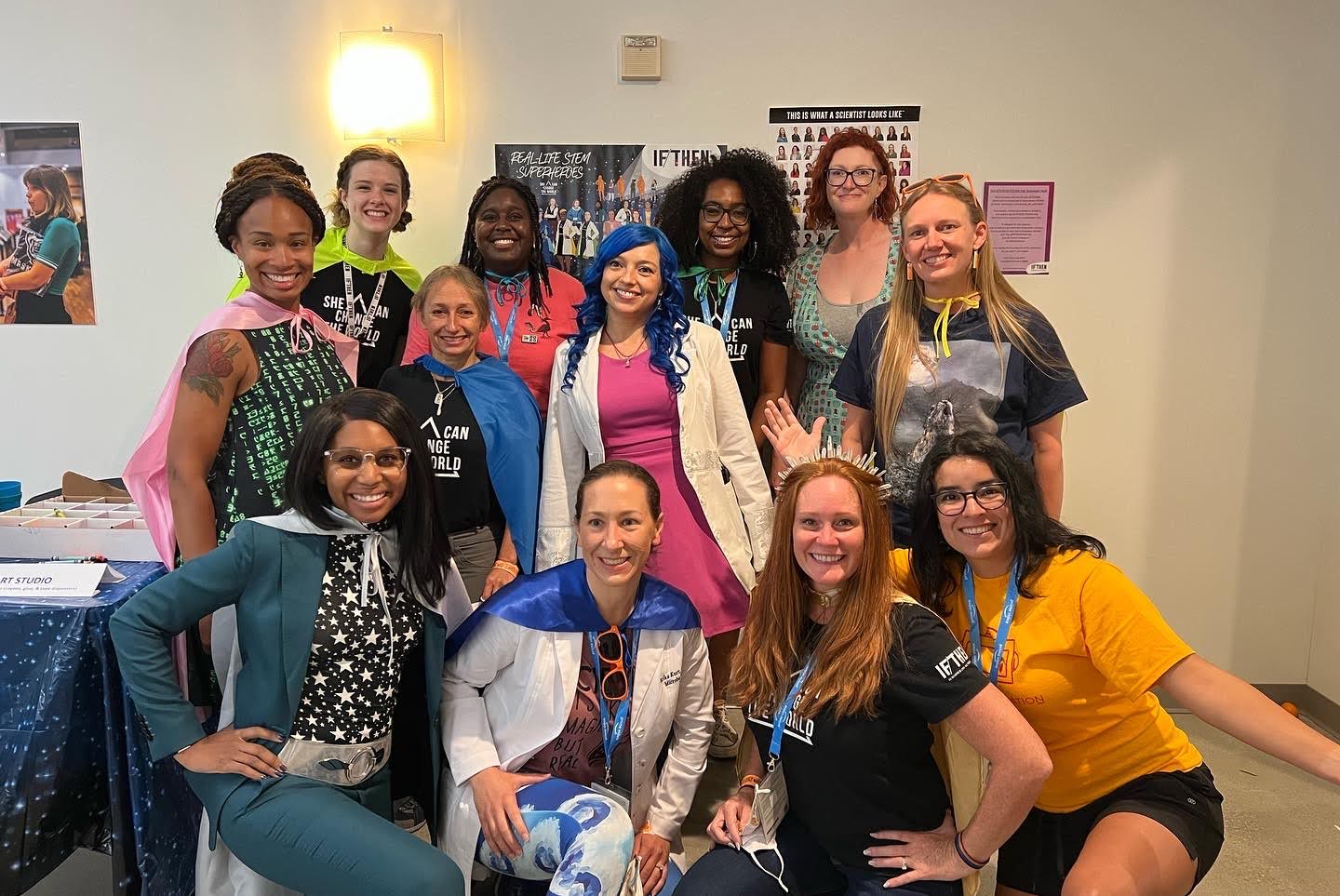
San Diego Comic-Con brings together some of the biggest fans of the most popular shows, games, comics, and films. Science is a huge source of inspiration for a lot of pop culture, so myself and 14 other scientists from around the country decided that Comic-Con would be a great venue to showcase ways that science is making a difference in the world and how it relates to our favorite media. All 15 of us are national STEM ambassadors for the IF/THEN Initiative – a program focused on increasing access to diverse STEM professionals for students, especially young girls. In addition to putting on panels about the intersection of science and pop culture, we hosted a STEAM Fair (STEAM = Science, Technology, Engineering, Arts and Math) that families in the area could attend even if they didn’t have Comic-Con tickets. At the STEAM Fair, each scientist demonstrated something from their specific field with a fun activity.

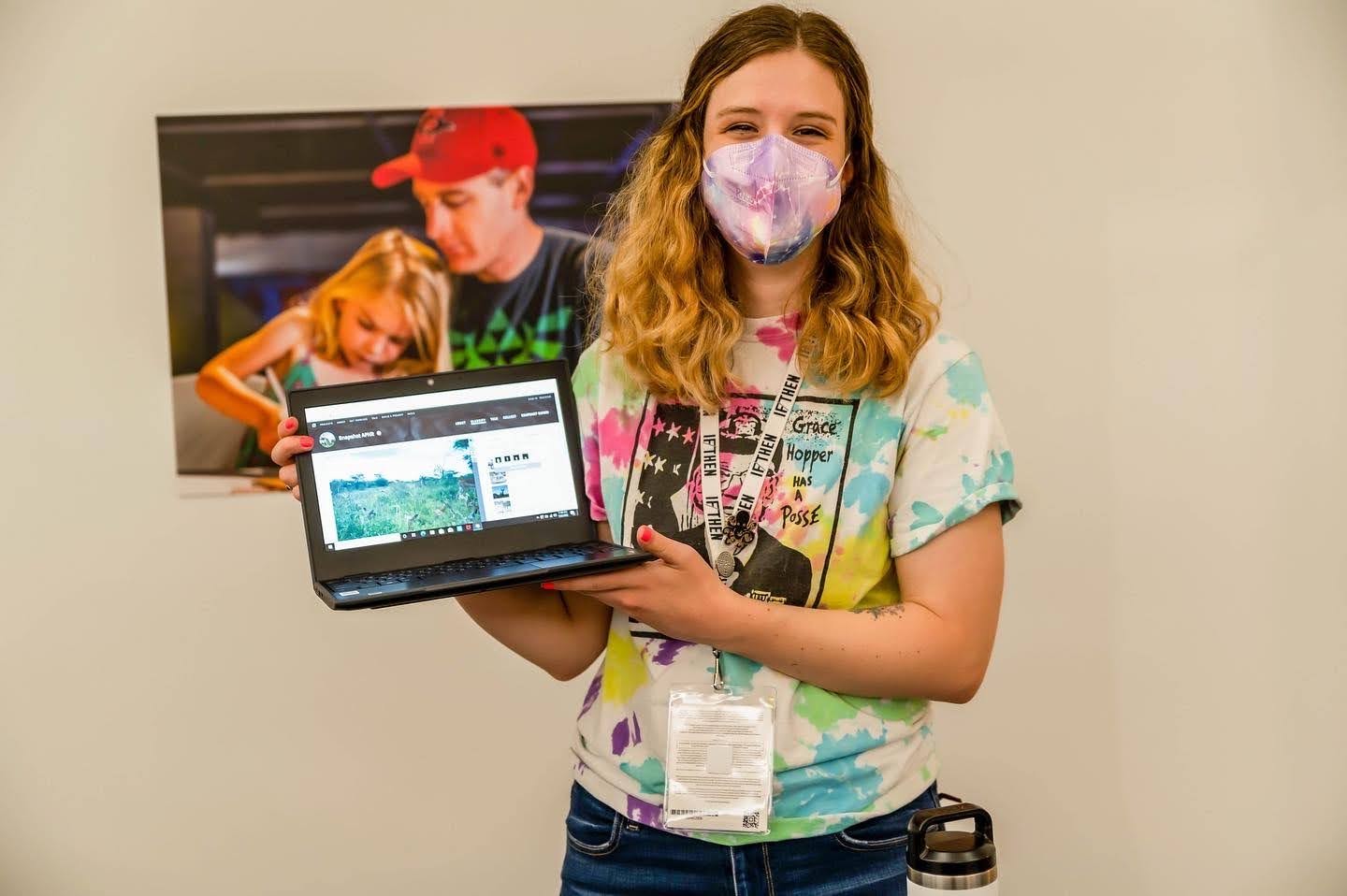
As a computer scientist who has worked on many wildlife conservation technology projects where data collection and annotation can be a big challenge, I am a huge fan of Zooniverse and the incredible generosity and human-power of this community. I thought, wouldn’t it be cool if kids who came through the STEAM fair could contribute to a real, active science project? Zooniverse was the perfect tool to use to demonstrate the types of projects I work on and to show kids that they can make a difference right now in wildlife research. I had kids identify animal species in images from the Snapshot APNR project – they loved it! Families were super excited to learn about Zooniverse (I handed out stickers so that they could remember the website if they wanted to keep exploring it at home), and some kids spent quite a while at my table, meticulously narrowing in on the species they were identifying. Everyone seemed to really enjoy getting to help out the Snapshot APNR project, and in the end around 2000 people came through the STEAM Fair over the course of 4 days. It was a huge success!

IF/THEN Ambassadors at the Comic-Con STEAM Fair. Learn more about the team at ifthensteamsquad.org!

Gracie Ermi facilitating a Zooniverse data labeling activity at the IF/THEN Comic-Con STEAM Fair

Who’s who in the Zoo – Maysa Bashraheel

In our Who’s who in the Zoo blog series we introduce you to some of the people behind the Zooniverse. This week, meet Maysa, a developer in our Oxford team

– Helen


Name: Maysa Bashraheel

Location: Oxford University, but based in Manchester.

Tell us about your role within the team 

This is my third week! I am the Zooniverse Developer Intern.

What did you do in your life before the Zooniverse?

About 4 weeks ago I was still a science teacher at a secondary school in Manchester – I came to my role after spending the last couple of years dabbling in coding and building stuff. I only realised I could potentially make a career out of a hobby in January. In a past life I was a Research Scientist for the Manchester Collaborative Centre for Inflammation Research (MCCIR) and specialised in Immunology with a focus on Transplants and specifically the heart. My bachelors is in Biomedical Science and I have a postgraduate degree in Education.

What does your typical working day involve?

Currently, I am learning a lot, I spend a lot of time familiarising myself with the codebase that makes up the Zooniverse. I am attempting to solve some issues, asking a million questions and exploring.

How would you describe the Zooniverse in one sentence?

The Zooniverse is a nurturing organisation that is committed to radical transparency and connects people from all corners of the world.

Tell us about the first Zooniverse project you were involved with

I think it was Beluga Bits! But I really have been fascinated by the Dental Disease projects and some of the interesting work around Etch-A-Cell. I think I have a thing for drawing projects.

Of all the discoveries made possible by the Zooniverse, which for you has been the most notable?

The TESS Planet Hunters discovery planetary systems was cool. My personal favourite is the Galaxy Zoo discovery of Pea Galaxies (a class of compact extremely star-forming galaxies that look like green peas!)

What’s been your most memorable Zooniverse experience?

So far, the 2022 Zooniverse Team Meeting. Truly a wonderful and productive and just overall exciting experience.

What are your top three citizen science projects? 

The Big Sleep Survey, Parasite Safari, Stall Catchers.

What advice would you give to a researcher considering creating a Zooniverse project?

The volunteers are your biggest asset!

Where do you hope citizen science and the Zooniverse will be in 10 years time?

I’m hoping it will be a part of the Education system in a massive way. I would love if homework for students outlined contributing to a citizen science project and the curriculum actively involved scientists from a spectrum of backgrounds to inspire the future generation.

When not at work, where are we most likely to find you?

Hiking! My next hike will be up Snowdon in the dark so I can watch the sunrise.

Do you have any party tricks or hidden talents?

I can do some weird stuff with my tummy.


Who’s who in the Zoo – Kat O’Brien Skerry

This week meet Kat O’Brien Skerry, our Public Engagement Officer, who has been taking Zooniverse projects into schools around the UK.

– Helen


Name: Kat O’Brien Skerry

Location: University of Oxford, UK

Tell us about your role within the team 

I joined the team in January 2022 as a Public Engagement Officer and I work on a fixed term contract bringing the Zooniverse to schools and educational settings around the country.

What did you do in your life before the Zooniverse?

My background is in STEM education having originally trained as a physics and maths teacher. I moved from there into informal education and most recently spent 5 years at the science museum in London in their learning team.

What does your typical working day involve?

My role is split between delivering workshops in schools and developing those workshops and convincing schools that they’re a great idea. So some days, I will be in classroom leading hands on activities, getting kids stuck into the Zooniverse, or facilitating zoom calls with the researchers. Some days I will be trying out experiments and explanations on anybody who I can find who appears (reasonably) willing to play. Some days I have a bit more of an office life and I’ll be finessing what we’ve done, contacting schools and all that stuff..

How would you describe the Zooniverse in one sentence?

A one stop shop for citizen science.

Tell us about the first Zooniverse project you were involved with

I first used Galaxy Zoo as an activity in a STEM club that I was running and had just as much fun playing as the kids did. Being added as an editor on projects so that I could take on this role was pretty terrifying!

What’s been your most memorable Zooniverse experience?

The feedback from one of my most recent schools was just the best. I had one pupil ask me, wide-eyed, “Did I really do actual science?” and respond to my “Of course you did!” with “Wow, maybe I could be a scientist”. I could have cried. To me, Zooniverse is a way to get kids to see themselves as scientists and seeing that impact becoming real is wonderful.

What are your top three citizen science projects? 

I’m biased by the two I work on, so Galaxy Zoo and Science Scribbler: Virus Factory. But I also have a real soft spot for the Davy Notebooks Project because I’m a big history of science fan.

What advice would you give to a researcher considering creating a Zooniverse project?

Again, I’m biased, but think about if it could be useful in outreach!

How can someone who’s never contributed to a citizen science project get started?

Give it a go! There are so many great projects out there from annual birdwatching and insect hunts which you can do at home, to more supported projects in museums if you want a bit more help as you get started.

Where do you hope citizen science and the Zooniverse will be in 10 years time?

I’d love to see citizen science embraced as a way to make science education and outreach more meaningful for both schools and researchers, and Zooniverse as a means to do so.

When not at work, where are we most likely to find you?

I’m studying for an MA in Education at the moment (specialising in STEM education) so spend a lot of time in the library. Otherwise, I am found inexpertly herding and raising a small menagerie of children, chickens and chameleons.

Do you have any party tricks or hidden talents?

I can come up with a kid friendly STEM activity for almost anything. And will. Often without being asked.

Who’s who in the Zoo – Mary Westwood

In our Who’s who in the Zoo blog series we introduce you to some of the people behind the Zooniverse.

In this edition, meet Dr Mary Westwood, a recent addition to the Zooniverse team.

– Helen


Name: Mary Westwood

Location: University of Oxford, UK

Tell us about your role within the team 

I joined the Zooniverse as a postdoctoral research assistant/project manager at the end of January 2022.

What did you do in your life before the Zooniverse?

I did a BSc and MSc in Biology at Wright State University in Ohio (where I’m from), then moved to the UK to do a PhD in Evolutionary Biology at the University of Edinburgh. Mostly I’m interested in how timing affects interactions between individuals, and towards the end of my PhD I started to dabble in bioacoustics and machine learning. Those last two topics are what led me to the Zooniverse.

What does your typical working day involve?

It varies a lot, but primarily I split my time between helping research teams get their projects up and running and doing my own research. I also get to write the weekly newsletters, which is a lot of fun.

How would you describe the Zooniverse in one sentence?

The innate curiosity and goodness of people put to very good use.

Tell us about the first Zooniverse project you were involved with

When I first checked out the Zooniverse, I wanted to see how bioacoustics projects were run on the platform. I can’t remember every project I looked into, but I do remember seeing HumBug and thinking what an incredible project it is.

Of all the discoveries made possible by the Zooniverse, which for you has been the most notable?

Research from the Penguin Watch team and volunteers has led to additional protections to marine protected areas, which is a really awesome outcome from a Zooniverse project.

What’s been your most memorable Zooniverse experience?

Best memory: all of the project launches, they’re a lot of fun.

Worst memory: mistakenly thinking I’d changed the background image of the entire Zooniverse website.

What are your top three citizen science projects? 

I love them all equally.

What advice would you give to a researcher considering creating a Zooniverse project?

Just go for it. Start building a project, play around with setting up workflows. Delete them, start again. Don’t be afraid to reach out to us for help.

How can someone who’s never contributed to a citizen science project get started?

Browse which projects we’re hosting to see what sparks your interest. Download apps like iNaturalist and Merlin Bird ID – both awesome platforms which get you out into nature (win) and help science (double win).

Where do you hope citizen science and the Zooniverse will be in 10 years time?

Everywhere. Since discovering the Zooniverse, I can’t believe everyone doesn’t already know about it.

Is there anything in the Zooniverse pipeline that you’re particularly excited about?

I’m about to experience my first Zooniverse Team Meeting. Very excited to finally get together with all of the awesome people I’ve worked with remotely over the past six months.

When not at work, where are we most likely to find you?

Somewhere outdoors and with a pint, possibly also with a book or friends.

Do you have any party tricks or hidden talents?

My party trick is strong-arming any topic of conversation into a discussion about circadian rhythms.


You can check out Mary’s Zooniverse project here: The Cricket Wing

You can hear more from Mary on Twitter.

Fun with IIIF

In this blog post, I’ll describe a recent prototyping project we (Jim O’Donnell: front-end developer; Sam Blickhan: Project Manager) carried out with our colleagues at the British Library (Mia Ridge, who I’m also collaborating with on the Collective Wisdom project) to explore IIIF compatibility for the Zooniverse Project Builder. You can read Mia’s complimentary blog post here.

History & context

While Zooniverse supports projects working with a number of different data formats (aka ‘subjects’), including video and audio, far and beyond the most frequently used data are images. Images are easy enough to drag and drop into our simple uploader (a feature of the Project Builder for adding data to your project) to create groups of subjects, or subject sets. If you want to upload your subjects with their associated metadata, however, things become slightly more complex. A subject manifest is a data table that allows you to list image file names alongside associated metadata. By including a manifest with your images to upload, the metadata will remain associated with those images within the Zooniverse platform. 

So, what happens if you already have a manifest? Can you upload any type of manifest into Zooniverse? What if you’re working with a specific set of standards? 

IIIF (pronounced “triple eye eff”) stands for International Image Interoperability Framework. It is a set of standards for image and A/V delivery across the web, from servers to different web environments. It supports viewing of images as well as interaction, and uses manifests as a major structural component. 

If you’re new to IIIF, that’s okay! To understand the work we did, you’ll need three IIIF definitions, all reproduced here from https://iiif.io/get-started/how-iiif-works/:

Manifest: the prime unit in IIIF which lists all the information that makes up a IIIF object. It communicates how to display your digital objects, and what information to display about them, including structure, to varying degrees of complexity as determined by the implementer. (For example, if the object is a book of illustrations, where each illustrated page is a canvas, and there is one specific order to the arrangement of those pages).

Canvas: the frame of reference for the display of your content, both spatial and temporal (just like a painting canvas for two-dimensional materials, or with an added time dimension for a/v content).

Annotation: a standard way to associate different types of content to whatever is on your canvas (such as a translation of a line or the name of a person in a photograph. In the IIIF model, images and other presentation content are also technically annotations onto a canvas). For more detail, see the Web Annotation Data Model.

What we did

For this effort, we worked with Mia and her colleagues at the British Library on an exploratory project to see if we could create a proof of concept for Zooniverse image upload and data export which was IIIF compatible. If successful, these two prototypes could then form the basis for an expanded effort. We used the British Library In The Spotlight Zooniverse project as a testing ground.

Data upload

First, we wanted to figure out a way to create a Zooniverse subject set from a IIIF manifest. We figured the easiest approach would be to use the manifest URL, so Jim built a tool that imports IIIF manifests via a URL pasted into the Project Builder (see image below).

This is an experimental feature, so it won’t show up in your Zooniverse project builder ‘Subject Sets’ page by default. If you want to try it out, you can preview the feature by adding subject-sets/iiif?env=production to your project builder URL. For example, if your project number is #xxx, you’d use the URL https://www.zooniverse.org/lab/xxx/subject-sets/iiif?env=production

To create a new subject set, you simply copy/paste the IIIF manifest URL into the box at the top of the image and click ‘Fetch Manifest’. The Zooniverse uploader will present a list of metadata fields from the manifest. The tick box column at the far right allows you to flag certain fields as ‘Hidden’, meaning they won’t be shown to volunteers in your project’s classification interface. Once you’ve marked everything you want to be ‘Hidden’, you click ‘Create a subject set’ to generate the new subject set from the IIIF manifest. 

Export to manifest with IIIF annotations

In the second phase of this experiment, we explored how to export Zooniverse project results as IIIF annotations. This was trickier, because the Zooniverse classification model requires multiple classifications from different volunteers, which are then typically aggregated together after being downloaded from the platform.

To export Zooniverse results as IIIF annotations, therefore, we needed to include a step that runs the appropriate in-house offline aggregation code, then convert the data to the appropriate IIIF annotation format. Because the aggregation step is necessary to produce a single annotation per task, this step is project- and workflow-specific (whereas the IIIF Manifest URL upload works for all project types). For this effort, we tested annotation publishing on the In The Spotlight Transcribe Dates workflow, which uses a simple free-text entry task. The other In The Spotlight workflow has a slight more complex task structure (rectangle marking task + text entry sub-task), which we’re hoping to be able to add to the technical documentation soon.

IIIF Technical Coordinator Glen Robson created a demo for viewing the In The Spotlight annotations in Mirador, which you can explore here: https://glenrobson.github.io/iiif_stuff/zooniverse/partof/ 

Full details and technical documentation are available at https://github.com/zooniverse/iiif-annotations.

Next steps & ways to get involved

Now, we need your feedback! The next steps for this work will include identifying community needs and interest – would you use these tools for your Zooniverse project? What features look useful (or less so)? Your feedback will help us determine our next steps. Mostly, we want to know who our potential audiences are, what task types they would most want to use, and what sort of comfort level they have, particularly when it comes to running the annotations code (from “This is great!” to “I don’t even know where to start!”). There are a lot of possible routes we could take from here, and we want to make sure our future work is in service of our project building community.

Try out the In The Spotlight project and help create real data for testing ingest processes.

Get in touch!

Finally, a massive “Thank you!” to the British Library for funding this experiment, and to Glen Robson and Josh Hadro at IIIF for their feedback on various stages of this experiment.

Web Developer Internship – Oxford 2022

The Zooniverse team in Oxford, UK, is looking for a web developer intern to join us in summer 2022. If you’re looking to learn how to build websites and apps with a team of friendly developers, or if you just want an opportunity to flex your extant coding skills in an environment that loves scientific curiosity, then come have some tea with us!

The team here in the Zooniverse want to welcome more folks into the world of software development, and in turn, we want to learn from the unique ideas and experiences you can share.

You can find the full job details at https://jobs.zooniverse.org/#oxford-web-developer-internship . Note that you don’t need any existing software development skills to apply, just a genuine interest in learning.

THE RESULTS ARE IN – Grant’s Great Leaving Challenge

The time has come to announce the winners of Grant’s Great Leaving Challenge! Many thanks to all who submitted classifications for our four featured projects over the past week. Your efforts have absolutely wowed us at the Zooniverse – not only did you meet the 100,000 classifications goal, you blew right through it. All in all, you submitted a whopping 293,692 classifications – nearly 3x our goal!

This classification challenge was a massive push forward for the projects involved, and the research teams are incredibly grateful. Grant himself was touched – he had this to say about the results of his namesake challenge:

“Over the last decade I’ve constantly been blown away by the amazing effort and commitment from Zooniverse volunteers, and yet again they have surpassed all expectations! I want to thank them for all they have done, both for this challenge, and over the entire lifetime of the project. THANK YOU!”

Here’s some data to back up just how successful this challenge was:

Figure 1. The x-axes show each day the challenge ran, while the y-axes mark the percent change in classifications from the week prior. For example, this means that for Penguin Watch, there was a 100% increase in classifications on Tuesday March 22nd compared to Tuesday March 15th.

Figure 2. Here, each plot shows the date on the x-axis and the total number of classifications for that day on the y-axis. The shaded areas indicate which days were part of the challenge, and the non-shaded white areas prior are data from the preceding week. Note that the y-axes are unequal across plots because they’ve been scaled to fit their own data.

While, in this case, I do really think the figures speak for themselves, here are some highlights:

Just two days into the challenge, daily classifications for Dingo? Bingo! more than doubled compared to one week prior. A short two days later, they reached a 300% increase from the same day the previous week. All in all, Dingo? Bingo! volunteers submitted an incredible 112,505 classifications!

Planet Hunters NGTS volunteers rode a hefty 200% increase in classifications for the first two days of the challenge. On the fifth day, they peaked at an incredible 300% increase! Overall, volunteers submitted a whopping 115,388 classifications over the course of the 6 day challenge. Remarkable!

Penguin Watch volunteers readily doubled classifications from the week prior, with a peak on the fourth day when classifications were up more than 200% from the preceding week. By the end of the challenge, volunteers had submitted a grand total of 55,787 classifications!

On day two of the challenge, Weather Rescue at Sea volunteers submitted an astonishing 350% more classifications than one week prior. On the final two days of the challenge, classifications were up by nearly 400% from the preceding week! Overall, volunteers submitted an awesome 10,012 classifications.

When pulling together this data, we were just absolutely amazed by how much effort the volunteers put into Grant’s Great Leaving Challenge. What an awesome example of the power of citizen science. From all of us at the Zooniverse and from the project teams who took part in the challenge – thank you. This has been such a fun way to send off Grant, who will be greatly missed by all!

Grant’s Great Leaving Challenge

If you subscribe to our newsletters, the name “Grant” probably sounds familiar to you. Grant (our Project Manager and basically the ‘backbone of the Zooniverse’) has been with us for nearly 9 years, and with a heavy heart we’re sad to report he’s finally moving on to his next great adventure.

To mark his departure, we’ve announced “Grant’s Great Leaving Challenge”. The goal of this challenge is to collect 100,000 new classifications for the four Featured Projects on the homepage. Starting yesterday, if you submit at least 10 classifications total for these projects your name will automatically be entered to win one of three prizes. Importantly, you must be logged-in while classifying to be eligible for the draw. The challenge will end on Sunday, March 27th at midnight (GMT), and the winners will be announced on Tuesday, March 29th.

While we aren’t divulging what the prizes are, it might tempt you to hear that they’ll be personalised by Grant himself…

Read on to learn about the four featured projects, and what you can do to help them out.

Penguin Watch
Penguins – globally loved, but under threat. Research shows that in some regions, penguin populations are in decline; but why? Begin monitoring penguins to help us answer this question. With over 100 sites to explore, we need your help now more than ever!

Planet Hunters NGTS
The Next-Generation Transit Survey have been searching for transiting exoplanets around the brightest stars in the sky. We need your help sifting through the observations flagged by the computers to search for hidden worlds that might have been missed in the NGTS team’s review. Most of the planets in the dataset have likely been found already, but you just might be the first to find a new exoplanet not known before!

Dingo? Bingo!
The Myall Lakes Dingo Project aims to develop and test non-lethal tools for dingo management, and to further our understanding and appreciation of this iconic Australian carnivore. We have 64 camera-traps across our study site, and need your help to identify the animals they detect – including dingoes.

Weather Rescue at Sea
The aim of the Weather Rescue At Sea project is to construct and extended the global surface temperature record back to the 1780s, based on the air temperature observations recorded across the planet. This will be achieved by crowd-sourcing the recovery (or data rescue) of the weather observations from historical ship logbooks, station records, weather journals and other sources, to produce a longer, and more consistent dataset of global surface temperature.

Let’s send Grant off with a bang. Happy classifying!

Engaging Crowds: new options for subject delivery & interaction

Since its founding, a well-known feature of the Zooniverse platform has been that volunteers see (& interact with) image, audio, or video files (known as ‘subjects’ in Zooniverse parlance) in an intentionally random order. A visit to help.zooniverse.org provides this description of the subject selection process:

[T]he process for selecting which subjects get shown to volunteers is very simple: it randomly selects an (unretired, unseen) subject from the linked subject sets for that workflow.

https://help.zooniverse.org/next-steps/subject-selection/

For some project types, this method can help to avoid bias in classification. For other project types, however, random subject delivery can make the task more difficult.

Transcription projects frequently use a single image as the subject-level unit. These images most often depict a single page of text (i.e., 1 subject = 1 image = 1 page of text). Depending on the source material being transcribed, that unit/page is often only part of a multi-page document, such as a letter or manuscript. In these cases, random subject delivery removes the subject (page) from its larger context (document). This can actually make successful transcription more difficult, as seeing additional uses of a word or letter can be helpful for deciphering a particular hand.

Decontextualized transcription can also be frustrating for volunteers who may want greater context for the document they’re working on. It’s more interesting to be able to read or transcribe an entire letter, rather than snippets of a whole.

This is why we’re exploring new approaches to subject delivery on Zooniverse as part of the Engaging Crowds project. Engaging Crowds aims to ‘investigate the practice of citizen research in the heritage sector‘ in collaboration with the UK National Archives, the Royal Botanic Garden Edinburgh, and the National Maritime Museum. The project is funded by the UK Arts & Humanities Research Council as one of eight foundational projects in the ‘Towards a National Collection: Opening UK Heritage to the World‘ program.

As part of this research project, we have designed and built a new indexing tool that allows volunteers to have more agency around which subject sets—and even which subjects—they want to work on, rather than receiving them randomly.

The indexing tool allows for a few levels of granularity. Volunteers can select what workflow they want to work on, as well as the subject set. These features are currently being used on HMS NHS: The Nautical Health Service, the first of three Engaging Crowds Zooniverse projects that will launch on the platform before the end of 2021.

Subject set selection screen, as seen in HMS NHS: The Nautical Health Service.

Sets that are 100% complete are ‘greyed’ out, and moved to the end of the list — this feature was based on feedback from early volunteers who found it too easy to accidentally select a completed set to work on.

In the most recent iteration of the indexing tool, selection happens at the subject level, too. Scarlets and Blues is the second Engaging Crowds project, featuring an expanded indexing tool from the version seen in HMS: NHS. Within a subject set, volunteers can select the individual subject they want to work on based on the metadata fields available. Once they have selected a subject, they can work sequentially through the rest of the set, or return to the index and choose a new subject.

Subject selection screen as seen in Scarlets and Blues.

On all subject index pages, the Status column tells volunteers whether a subject is Available (i.e. not complete and not yet seen); Already Seen (i.e. not complete, but already classified by the volunteer viewing the list); or Finished (i.e. has received enough classifications and no longer needs additional effort).

A major new feature of the indexing tool is that completed subjects remain visible, so that volunteers can retain the context of the entire document. When transcribing sequentially through a subject set, volunteers that reach a retired subject will see a pop-up message over the classify interface that notes the subject is finished, and offers available options for how to move on with the classification task, including going directly to the next classifiable subject or returning to the index to choose a new subject to classify.

Subject information banner, as seen in Scarlets and Blues.

As noted above, sequential classification can help provide context for classifying images that are part of a group, but until now has not been a common feature of the platform. To help communicate ordered subject delivery to volunteers, we have included information about the subject set–and a given subject’s place within that set–in a banner on top of the image. This subject information banner (shown above) tells volunteers where they are within the order of a specific subject set.

Possible community use cases for the indexing tool might include volunteers searching a subject set in order to work on documents written by a particular author, written within a specific year, or that are written in a certain language. Some of the inspiration for this work came from Talk posts on the Anti-Slavery Manuscripts project, in which volunteers asked how they could find letters written by certain authors whose handwriting they had become particularly adept at transcribing. Our hope is that the indexing tool will help volunteers more quickly access the type of materials in a project that speak to their interests or needs.

If you have any questions, comments, or concerns about the indexing tool, please feel free to post a comment here, or on one of our Zooniverse-wide Talk boards. This feature will not be immediately available in the Project Builder, but project teams who are interested in using the indexing tool on a future project should email contact@zooniverse.org and use ‘Indexing Tool’ in the subject line. We’re keen to continue trying out these new tools on a range of projects, with the ultimate goal of making them freely available in the Project Builder.

Frequently Asked Questions: Indexing Tool + Sequential Classification

“Will all new Zooniverse projects use this method for subject selection and sequential classification?”

No. The indexing tool is an optional feature. Teams who feel that their projects would benefit from this feature can reach out to us for more information about including the indexing tool in their projects. Those who don’t want the indexing tool will be able to carry on with random subject delivery as before.

“Why can’t I refresh the page to get a new subject?”

Projects that use sequential classification do not support loading new subjects on page refresh. If the project is using the indexing tool, you’ll need to return to the index and choose a new page. If the project is not using the indexing tool, you’ll need to classify the image in order to move forward in the order of sequence. However, the third Engaging Crowds project (a collaboration with the Royal Botanic Garden Edinburgh) will include the full suite of indexing tool features, plus an additional ‘pagination’ option that will allow volunteers to move forwards and backwards through a subject set to decide what to work on see preview image below). We’ll write a follow-up to this post once that project has launched.

A green banner with the name of the subject set and Previous and Next buttons
Subject information banner, as seen in the forthcoming Royal Botanic Garden Edinburgh project.

“How do I know if I’m getting the same page again?”

The subject information banner will give you information about where you are in a subject set. If you think you’re getting the same subject twice, first start by checking the subject information banner. If you still think you’re getting repeat subjects, send the project team a message on the appropriate Talk board. If possible, include the information from the subject information banner in your post (e.g. “I just received subject 10/30 again, but I think I already classified it!”).