Category Archives: Education

NSTA Denver – Day 2

5:45  – Woke up. Decide to swap order of presentation.

7:00 – Breakfast, it is the most important meal of the day after all.

8:00 –  Final presentation adjustments done.

8:45 – Public speaking makes me nervous sometimes so put on my favorite dress and purple tights for confidence.

9:30 –  First session of the day –  Effective Approaches for Addressing Next Generation Science Standards in the Earth and Space Science Classroom. This workshop was facilitated by members of the National Earth Science Teachers Association  (NESTA)  and began with an overview of how earth and space sciences fits in the NGSS. The presenters nicely summed up the NGSS Performance Expectations as – “involving a lot of action verbs.”  Instead of statements beginning with “students will understand” or “students will identify” these new performance expectations begin with statements  like “students who demonstrate understanding can develop and use a model to describe…” and “students who demonstrate understanding can analyze and interpret data to determine…”.

The remainder of the workshop focused on Windows to the Universe, NESTA’s learner and educator portal. There are a variety of activities available for use in the classroom. There is a yearly subscription fee if you want to download and print PDFs but activities and worksheets can be printed for free from your browser.

11:00  –  Second Session of the day –  Making the Connection Between Formal and Informal Education.  Staff from the Denver Museum of Nature & Science, the Denver Zoo, and Denver Public Schools overviewed two long-term collaborations running in the Denver metro area. Passport to Health is a bilingual school-year program targeting at 5th graders and their families.  Through classes and events in school and at the museum, over 3,000 participants receive tools and knowledge promoting healthy living.  Urban Advantage Denver , the second program highlighted, is an in-depth collaboration between local school districts and the City of Denver’s scientific cultural institutions.  This program aims to empower every 7th grade student to think and explore like a scientist.

12:30  – Time to present.  A small but enthusiastic group of 15 came to learn about a variety of Zooniverse projects and the educational resources available to bring them into the classroom.  Sadly the internet decided to be uncooperative, but luckily I had a back-up plan and plenty of screen shots.  There were lots of great questions and contact details exchanged. I can’t say much more because I tend to suffer from “post-presenting amnesia”, but it was a great session.

2:00 – Stroll around the second half of the exhibition hall successfully found candy to temporarily relieve my hunger rage.  It was great to see the Crow Canyon Archaeological Center and Cornell Lab of Ornithology promoting their excellent programs.  Totally have science education crushes on those two.

3:00 – Starving.  Back at the hotel waiting for delivery while catching up on email.

It was a great meeting, but it will be nice to be back home in Chicago.  ‘Til next time NSTA!

NSTA Denver – Day 1

5:45 –  Up and atom (sorry, I can’t resist a good Simpsons reference).  To the hotel gym for a little wake-up exercise.   Criminey, altitude does make exercise harder.

7:00 – Caffeinating and fueling up for a day of science education. Mmmm.. Oatmeal.

7:45 – Checked in and all official. Check out the fancy presenter ribbon 🙂

Science Runs Through It!
NSTA Denver- Science Runs Through It!

8:00 am –  First session of the day!  Understanding the Vision for Science Education from the NRC Framework and the Next Generation Science Standards from Brett Moulding. My takeaway from this was the idea of a “science performance”.  Just as students showcase the skills they practice in music class at a concert or a performance, so must students with science.  Students need opportunities to try out what they’ve learned by applying them.

9:00 –  Found a bench and an unoccupied outlet to catch-up on emails and work on another conference proposal.

10:30 –  Random conversation with fellow conference goers about inflatable planetarium domes. Evoked horrifying flash back of nearly being trampled by preschoolers trying to get to the front of the dome to see Elmo at outreach event several years ago.

11:30 –  Strolled through first half of the exhibit hall.  Nearly gave in and bought an I Heart Science t-shirt.

12:00 – Conference going is hard work, grabbed a bento box to fuel more science education networking!

12:30 Second session of the day – STEM! How to Create Rigorous, Authentic Learning for All.  An overview of the transformation of Preston Middle School in Colorado into a STEM-centered school.  The stand-out point was the importance of engaging faculty in STEM.  Specifically, when creating a STEM-focused school, build around the passion of the teachers. Their enthusiasm and passion will draw students in.

1:35 –  Realization that in fact I didn’t finish my slides for tomorrow’s presentation.

2:00  – Third and final session of my day – Building Collaborative Partnerships to Advance K-12 STEM Education.  A panel discussion of creating collaborations to strengthen STEM educational initiatives.   My biggest take away from this session was learning about the National Girls Collaborative Project .

3:30 – Search for afternoon coffee (thanks 7-11).

4:00 – Slides, slides, slides.  Put together the last portion of tomorrow’s presentation – Bringing the Zooniverse into the Classroom.

6:00 – A dinner of subpar Mexican food.  Perfectly good guacamole ruined by olives.

7:00-  Slides done, now to blog.

8:10 – Blog done!

More from NSTA tomorrow.

ZooTools: Going Deeper With Zooniverse Project Data

One of the best things about being an educator on the Zooniverse development team is the opportunity to interact with teachers who are using Zooniverse projects in their classroom and teachers who are interested in using Zooniverse projects in the classroom. Teachers cite several reasons about why they use these projects – Authentic data?  Check. Contributing to cutting-edge research across a variety of scientific fields?  Check.  Free?  Check. Classifying a few galaxies in Galaxy Zoo or identifying and measuring some plankton in Plankton Portal can be an exciting introduction to participating in scientific investigations with “the professionals.”  This isn’t enough though; teachers and other educators are hungry for ways to facilitate deeper student engagement with scientific data. Zooniverse educators and developers are consistently asked “How can my students dig deeper into the data on Zooniverse?”

This is where ZooTools comes into play. The Zooniverse development team has recently created ZooTools as a place where volunteers can observe, collect, and analyze data from Zooniverse citizen science projects. These tools were initially conceived as a toolkit for adult volunteers to use to make discoveries within Zooniverse data but it is becoming apparent that these would also have useful applications in formal education settings. It’s worth pointing out that these tools are currently in beta. In the world of web development beta basically means “it ain’t perfect yet.”  ZooTools is not polished and perfect; in fact it’s possible you may encounter some bugs.

Projects like Galaxy Zoo and Planet Hunters have an impressive history of “extra credit” discoveries made by volunteers.  Galaxy Zoo volunteers have made major contributions to the astronomy literature through the discovery of the green peas galaxies and Hanny’s Voorwerp .  In Planet Hunters volunteers use Talk to share methods of exploring and results from the project’s light curves.  ZooTools lowers the barrier of entry by equipping volunteers with some simple tools to look for interesting relationships and results contained within the data.  No specialist knowledge required.

We’ve only begun thinking about how ZooTools could be used in the classroom.  I started my own investigation with a question that came from a Zooniverse classroom visit from last spring.  While making observations as a class about some of the amazing animals in Snapshot Serengeti one young man asked about civets. He wanted to know If they were nocturnal. We had an interesting discussion about how you could find out this information.  The general consensus was to Google it or look it up on Wikipedia.  I wondered if you could use the data contained within Snapshot Serengeti to come up with a reasonable answer.  I was excited to roll-up my sleeves and figure out how to use these tools to find a likely answer.  Here are the steps I took…

Step 1: Log-in to Zooniverse and go to ZooTools.

Step 1

Step 2: Select a project. Currently only have a few projects have data available to explore using ZooTools.

Step 2

Step 3: Create a dashboard.

Step 3

Step 4: Name your dashboard something awesome. I called mine Civets! for obvious reasons.

Step 4

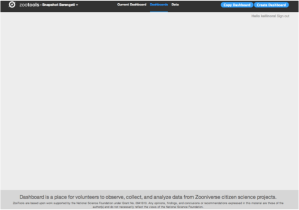
Step 5: This is your blank dashboard.

Step 5

Step 6: It’s time to select a data source. I selected Snapshot Serengeti.

Step 6

Step 7: This is the data source.

Step 7

Step 8: I wanted to be able to filter my data so I selected Filter under search type. The name of this dataset in Snapshot Serengeti 1.

Step 8

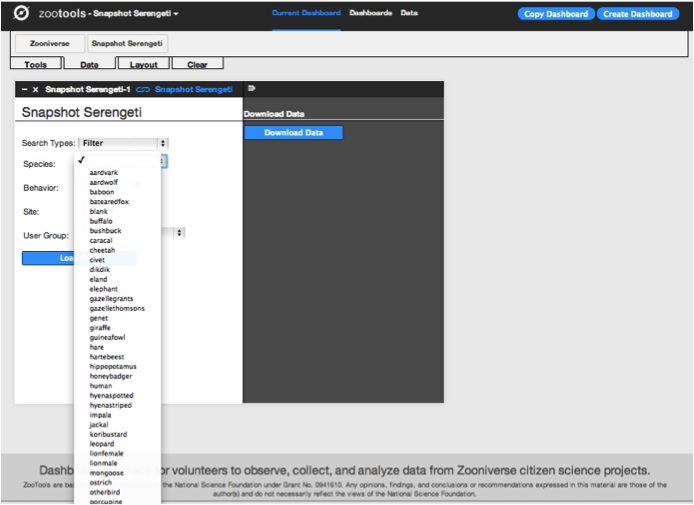
Step 9: Since I wanted to look at civets, I selected that on the species dropdown menu and then clicked Load Data. My dataset will only contain images that Snapshot Serengeti volunteers identified as civets.

Step 9

Step 10: I had my data; next it was time to select a Tool.  I selected Tools at the top of the page.

Step 10

Step 11: I selected Subject Viewer because this tool allows my to flip through different images.

Step 11

Step 12: Next I had to connect my data source to my tool. From the Data Source drop down menu I selected Snapshot Serengeti 1.

Step 12

Step 13: In order to get a good luck at the images in my dataset I clicked the icon shaped like a fork to close the pane.  I then used the arrows to advance through the images.

Step 13

I flipped through the images and kept track of the night versus day. Of the 37 images in my dataset, I observed that 34 were taken at night and 3 were taken during the day.  This led me to the conclusion that civets are likely nocturnal.  This was so much more satisfying than just going to Google or Wikipedia. A couple of other questions that I explored…

What is the distribution of animals identified at one camera trap site?

14


How many honeybadgers have been observed by Snapshot Serengeti volunteers across different camera traps?

Screen Shot 2013-11-26 at 3.17.28 PM

Of course this is just the tip of the iceberg.  Currently you can explore Galaxy Zoo, Space Warps, and Snapshot Serengeti data using ZooTools. Currently you can use ZooTools to explore data from Galaxy Zoo, Space Warps, and Snapshot Serengeti.  The specific tools and datasets available vary from project to project.  In Galaxy Zoo for example you can look at data from Galaxy Zoo classifications or from SDSS Skyserver. Hopefully you’ll be inspired to have a play with these tools!  What questions would you or your students like to explore?

Feedback from Maine Professional Development Workshops – Things to Think About for Classroom Teachers

Today’s post comer from Phil Brookhouse, a participant in last summer’s Zooniverse Teacher Ambassadors Workshop.  Phil is a Professional Development specialist with the Maine Learning Technology Initiative where all middle schools have 1;1 and half the high schools do. He taught middle school science for 30 years and is adjunct faculty for University of Southern Maine. He is the proud grandparent of 6 month old twins, Jaxon and Annabella.

I’ve been lucky to deliver workshops about Next Generation Science Standards (NGSS) and Zooniverse all over the state of Maine to teachers of many grade levels and specific disciplines. Invariably, they have recognized the value and authenticity of citizen science, and the Zooniverse projects in particular. In addition, they see the links between the 8 Practices of Science and Engineering from Appendix F of NGSS, and participation in the projects.

Of course, teachers are interested in the practicality of including these projects in their curriculum. With that in mind, folks in my workshops had a number of questions and suggestions.  With all the competition for time in class, teachers are concerned with the return on time investment directly related to student accountability. Understandably, this is due to the pressures of evaluation and assessments. In other words, what lesson time do I trade away to include taking part in Zooniverse projects? This concern with use of time was expressed in every one of the 8 workshops I conducted.

For a number of teachers, the Galaxy Zoo Navigator provided a good example of where learning could go with a project. Sure, taking part in any of the projects would help students to practice analysis of data, but how could they interact with those data collected? How accessible is the data set? As it stands now, Galaxy Zoo Navigator is the model that allows any group to “play” with data collected. The other entries to interacting with data in the projects are the blogs and discussions, but some teachers are wary of students out on the wild, wild web. So, teachers wanted a Navigator type activity to be developed for other projects.

Teachers felt that Zooteach was a good beginning to collecting lessons and units related to Zooniverse projects, but more lessons are needed, and some of the lessons needed more quality control. In today’s classroom, lessons need to have learning targets identified, as well as standards addressed. With that said, there are several high quality lessons that serve as good examples. Here’s hoping that ZooTeach continues to grow, and contributors include goals and objectives as part of their units. Teachers in the workshops have been encouraged to contribute their own lessons to ZooTeach.

Finally, teachers liked the idea that there were measurement scales included in Seafloor Explorer, but thought it would be good if the measurement tools included a readout of the values for each “specimen.”  With this, students could keep a log of their measurements and do some comparisons and analysis of their own, in addition to contributing to the database. Again, this relates to the model  that Galaxy Zoo Navigator exemplifies of working with your own data to do some inquiry.

Almost all of the teachers were positive in their evaluations of the workshops, and were either going to take more time to explore Zooniverse projects, or share the site with other teachers and their students within a month. They were impressed with the engagement factor, and the authenticity of participating in citizen science. One teacher even brought her 10 year old son to the workshop , and he was all smiles as he took part in a few projects – therefore showing the group how powerful Zooniverse is as a learning tool.

When Can I Become a Scientist?

Today’s post comes from Virginia Jones, a Zooniverse Teacher Ambassador Workshop participant.  Virginia has taught science at Bonneville High School for 28 years.  She lives in Idaho Falls, ID with her hiking partner, Cleo, a Labrador puppy. She enjoys sharing the excitement of scientific discovery with people of all ages.

Like most 6 year olds, my granddaughter is eager to learn about everything. She is especially drawn to nature and animals. In fact, she wants to be a scientist or a veterinarian when she grows up. One day she said to me, “Grandma, can you teach me science?” I told her that I could do better than that. “You can be a real scientist today, “ I said.

We logged into Zooniverse and chose Snapshot Serengeti. Some of the pictures were beautiful. Many of the pictures featured the rear end of animals, a source of endless laughter for the 6 year old citizen scientist. While I had to maneuver around the site in the beginning, she became familiar with the steps very quickly. She is a very good reader, so in no time at all she was helping with the classification and learning about the animals of the Serengeti.

Her young eyes were able to spot animals that I might have missed. We went through a series of pictures that looked like grass dancing in the wind. On the last picture, I was ready to push the nothing here button when she yelled;”there’s a bird!” I would have missed the guinea fowl in the deep grass but Anne Marie saw it immediately.

We spent a pleasant half hour identifying animals, discussing what it must be like to live in the Serengeti and arguing about which animal’s rear end we were looking at. When we finished, Anne Marie couldn’t believe how easy and fun it was to help the scientists. Maybe next time we will look at galaxy pictures and be astronomers for an afternoon with Galaxy Zoo. Perhaps the ocean will call us and we can explore the ocean floor with Seafloor Explorer. She may even be ready to look for dips in light curves to discover extra solar planets in Planet Hunters.

I am lucky that Anne Marie still needs to have some adult guidance to work in the Zooniverse. I can still spend some quality time with her and she still looks to me as an authority on all things science. It won’t be long before she is leaving her grandmother behind and making discoveries of her own.

You are never too young (with a little help) or too old to enjoy making discoveries in the Zooniverse. Everyone can have the satisfaction of advancing science as a citizen scientist.

Bringing the Unknown to Students

Next up in our series of Zooniverse Teacher Ambassador Workshop participants,  we have a guest post from Dave Pinkus.  Dave is a Science Teacher at the Biotechnology High School in Freehold, New Jersey.  Dave has been teaching High School science courses for 13 years and is the 2013-2014 Monmouth County Teacher of the Year.

I often forget what made me fall in love with science, decide to major in geology and later teach children physical science.  I don’t particularly enjoy Newton’s Laws, or Stoichiometry, or measuring Strikes and Dips.  What I fell in love with as a teenager was that there are tangible things that are unknown and I could be the one to describe them.  Through most of my career as a physics teacher, I have given very few opportunities to my students to be intimate with the truly unknown.

Last year, I created a few opportunities, including a research project and engineering design challenges.  It is very difficult to fit these activities into our busy curriculum and it is sometimes just as difficult to have the materials that are necessary.  These projects also lacked the authenticity factor of doing real research to answer something that the broader science community currently doesn’t know.

The Zooniverse sites are fabulous platforms that can deliver authentic data to our students and do not require lab equipment or much time out of our normal lessons.  The data is presented in a format that should be digestible for most grade levels.  In addition to utilizing the sites for class projects this year, I am also planning on introducing one or two of the sites at Back to School Night for my student’s parents.  I will be sure to introduce the same sites to my students on the days leading up to Back to School Night.  This can really afford an opportunity for my students and their parents to have a meaningful STEM experience, together.

One Teacher’s Zooniverse Experience


Today’s guest blogger Ricardo Pollo was a Zooniverse Teacher Ambassadors Workshop participant.  He is a teacher, sailor, and musician originally from Miami, FL. He has degrees in Environmental Studies and Sociology & Anthropology, and an MA in Comparative Sociology. He lives with his wonderful wife and amazing baby boy–in the house of their dreams–in Harwich, MA.

I first discovered Galaxy Zoo when I was a teacher in need. I was in my second year, and in a very challenging situation. I was responsible for 200 students, and I only had 90 minutes of planning time every other day, which I had to use to plan for three separate subjects. I bring this up because, back then, I simply did not have that much time to look for new and amazing ways to hook my students into our lessons.

I was teaching a course called earth/space science which, although burdened with a clunky name, was actually pretty great. The biggest problem was that about 80 percent of my students spoke English as a second language, and I needed something besides words to get them excited about our lessons. We had reached a section where we were learning about different types of galaxies, which lends itself to being wowed by. After all, I certainly was when I first learned how many of these things there were out there, and the baffling number of stars they contained. The textbook had relatively interesting pictures, but the treatment was pretty dry. So I did what I always did, and what I continue to do today: I went online and looked for lessons to loot!

In my piratical forays into the world of space education, I came across Galaxy Zoo. I think the keywords I typed were “galaxy classifications,” so it’s no wonder I stumbled across the site. But a “stumble” is not how I would have described it at the time. It shocked me like a peal of thunder on a quiet night, like the light that hits you when you leave a cave after hours of exploring in darkness. Sometimes I imagine what it would have been like to be alive during a cataclysmic meteor strike, calmly loafing on a hillside, staring at the clouds, when suddenly a giant, fiery boulder comes streaking through the atmosphere to lead us all into another geologic age. This is the effect Galaxy Zoo had on me back then, sitting in the staff room, with no other place to plan, and just trying to do something different with my kids.

The rest is honestly kind of anticlimactic. I logged on and classified a few galaxies, and fell in love, hard. I was really struck by the idea that I was looking at pictures that no one else had looked at before. It appealed to the same part of me that likes to pick up trash when I’m out for a walk in the woods: “Nobody’s gotten around to this one yet, I might as well do it.” But instead of keeping things tidy, I felt like I was helping other tired grad students (for I had been there) do something wonderful.

 I couldn’t wait to show my kids. I was so excited! The day came and I nonchalantly put the site up on the projector, and explained to them how it worked. These were pictures of actual galaxies, trillions and trillions of miles away, and we were helping scientists paint a picture of what was out there! The result was an astounding sigh. I couldn’t understand it really. This was absolutely, out of this world, cool. Why weren’t they getting into it? I know the answer now, of course. I stood up there, flipped through pictures, and showed them how to classify them. I showed them how it coincided with what we had just learned about the major types of galaxies. Then I let volunteers come up and touch the magic board themselves. Surprise, surprise, it wasn’t a huge hit.

At the time I thought it might be because some of the pictures were grainy, or maybe they weren’t really able to wrap their heads around the science. So I found another site, a collaboration between NASA and Microsoft, that was designed in part to categorize pictures sent back by Martian rovers. Here was a chance for them to see pictures of the Martian surface, and just look around. I especially loved the pictures that had a part of the rover in frame. And as a bonus, the whole site is very well designed, modeled after a combination computer game/space port. When that site didn’t go over well either, I started to think there might be something wrong with my kids. Since then, I’ve continued to use Zooniverse sites in my classes, particularly Snapshot Serengeti, Seafloor Explorer, and most recently, SpaceWarps. But I’ve always approached this as an added bonus, never as an integral part of our lesson. Some kids have responded really well to it, and I’ve heard quite a few stories of families getting into classifying together. But I never felt like I was using these websites very effectively. 

Obviously, I jumped on the chance to apply for the first Zooniverse Teacher Ambassadors Workshop. I was giddy when I found out I could go, and the experience was a remarkable one. But more than anything, I’m excited to have actual tools, not to mention tons of lesson plans, that I can use in my science classes. I wrote a plan myself, to use with the Whale.fm whale call classifying site, and I’m getting antsy to use it. Unfortunately, I don’t get to acoustics until April or May, so I’m definitely going to have to try someone else’s plan in the meantime. Lucky for me, the ZooTeach site is filled with great ideas and lessons to use. But really, I’m just thrilled that, after 5 years, that nagging feeling that this amazing tool was being totally underutilized, has finally left me. Good riddance!

Reaching Out With Skype Education

Are you looking to bring a unique experience to your classroom? Interested in citizen science and providing the opportunity for your students to talk to a research scientist?

Zooniverse education has been developing Skype in the Classroom lessons to reach classrooms around the world. Skype Education is a free resource for teachers looking to connect their students with educators, other classes, and experts across the globe. You can read more about the development of this program from our August 29th blog post.

Zooniverse will be testing a Skype in the Classroom lesson with about 5 classes between now and mid October. This lesson focuses on the Zooniverse project, Galaxy Zoo. Your students will learn about the role of classification in science and how it is used by Galaxy Zoo scientists. Dr. Karen Masters from the Institute of Cosmology and Gravitation from the University of Portsmouth, UK will be our guest speaker. This lesson is best suited for students ages 11-16.

If you’re interested in participating in these test sessions please sign-up be interested either through the Skype in the Classroom or by filling out this Google form


My Classroom Experience with Snapshot Serengeti

This post is from Debbie Soltis, a 2013 Zooniverse Teacher Ambassadors Workshop participant.  She teaches 9th grade Integrated Science and Astronomy at Chugiak High School in Chugiak, Alaska.  A 19-year classroom veteran, Mrs. Soltis enjoys presenting a variety of activities and hands-on experiences because she believes students learn best if they have fun and are motivated by authentic experiences. 

I recently uploaded my first Zooniverse lesson plan, Serengeti Ecology.  Since posting the lesson, I actually completed the lesson with my 9th grade Integrated Science students.  I also had a colleague do the lesson with his 9th graders for a total of about 80 students participating.  Two other colleagues are now also planning on using this lesson with their IS9 students. What follows are my reflections on my lesson and our students’ reactions.

My Zooniverse lesson was a supplement to the lessons I have done many times in my ecology unit.  My ecology unit always begins by trying to write a definition for life.  My students brainstorm characteristics of life and are then presented with a hands-on activity examining and testing three sand samples.  The sand samples are made using sand and salt; sand, sugar and yeast; and sand and crushed effervescent tablet.  Since the overall scientific question in the ecology unit is how do the biotic and abiotic factors interact to obtain matter and energy, another short lesson is a mini-field trip outside to observe, collect, and sort biotic and abiotic examples.

I created a worksheet for the students to complete in the computer lab while they explored Snapshot Serengeti.  Before going to the lab, I presented a modified powerpoint introduction to Zooniverse, the Serengeti project, and what they could expect. (Thanks, Kelly—good timing!)  The students loved the project!  They had no difficulties getting on the site, they were fascinated by the variety of unique pictures each of them had to explore, and they enthusiastically wanted to share with their friends or myself some of their more interesting snapshots.  One girl found a rainbow arcing over a wildebeest, another saw the butt ends of two young warthogs, and a third student replayed multiple times the three-frame sequence of a small herd of wildebeest and zebras. My colleague reported similar experiences with his students.  It was a very busy and productive period for all the students.  Several students even said they wanted to continue exploring the site at home! (And I did not even mention extra credit!)

Aside from the animals, I directed the students to look at the other biotic features in the snapshots—the grass, trees, and brush.  Observations led to inferences about the kind of climate the Serengeti has.  Overall, the students really liked the authentic scientific nature of the research being done as well as the fact they were contributing to that effort.  As I continue with predator-prey relationships, limiting factors, carrying capacity and other ecological concepts, I feel this lab has provided a real personal experience that will give them a solid foundation on which to scaffold these concepts. In summary, anyone who teaches a biology or ecology unit can use this site—it was fun, generated excitement, and provided a wonderful learning experience for all!

A Teacher’s Thoughts on Zooniverse

This is the second post in our series from educators who participated in the Zooniverse Teacher Ambassadors Workshop on August 8-9 at the Adler Planetarium.  Today’s blog post comes from Chris Brown middle school science teacher at St. Patrick of Heatherdowns school in Toledo Ohio. This is his fourth year teaching middle school and enjoys introducing students to many areas of science so they can take more interest specific classes when they go on to high school.

I recently attended “Zooniverse Teacher Boot Camp” it was an interesting and enjoyable experience. I met a lot of great teachers from all over the country and really got a feel for how much we all agree that preparing students as the next generation of scientists is of the utmost importance as they will be the ones to help save our planet. Citizen science is a way to get them started and understand that they can make a difference.

Every summer our school district gets together and has a few technology conferences where teachers present to teachers ideas and ways they can use technology in the classroom. I got some great ideas from our two days together on how I want to do that in my community. I plan on having my audience sign up for a Zooniverse account and show them some of the basic features of Zooniverse (the various projects, zooteach lesson plans, and the discussion forums). Then I really want to give them time to dive into projects that interest them or they can use in their classes. I encourage everyone to do this if they can in their area as I find it a great means to share such a great resource as Zooniverse with as many people as possible.

These projects are a great way for your students to get primary resources as many of the scientists who’s data the projects are using are willing to video chat with classes you just have to contact them. The Zooniverse educators, developers, interns, etc. are also willing to help anyway they can and appreciate any feedback or questions you have.