All posts by The Zooniverse

Online citizen science projects. The Zooniverse is doing real science online,.

Snapshot Serengeti

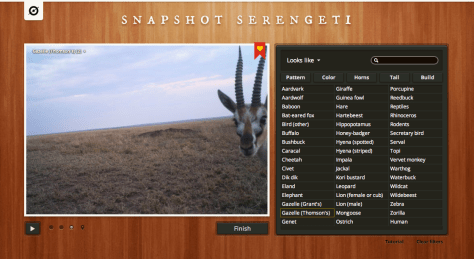
Go on virtual safari with our latest project: Snapshot Serengeti! Serengeti National Park is a UNESCO World Heritage Site in Tanzania. With an area of nearly 6,000 square miles (14,800 km^2) it is teeming with some of the most recognisable animals in the world: lions, zebra, elephants, wildebeest and more live on the vast savannah and grassland plains.

Snapshot Serengeti

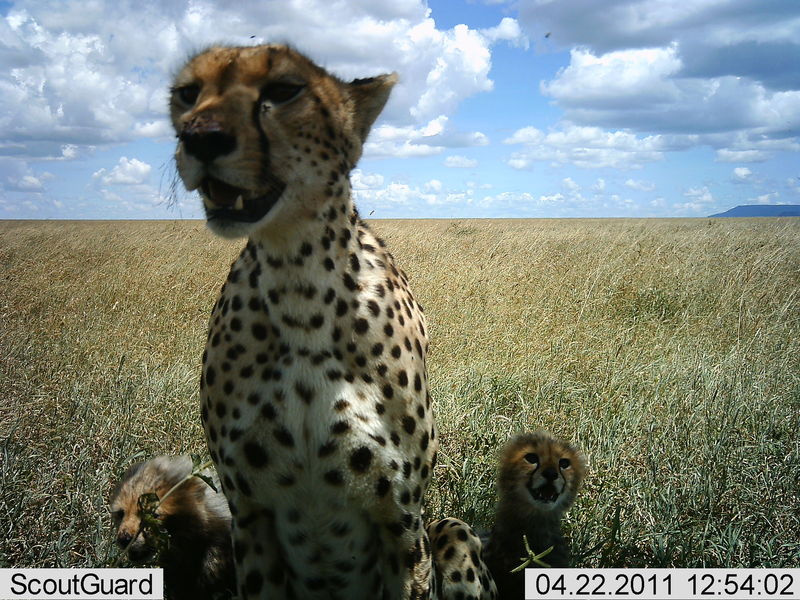
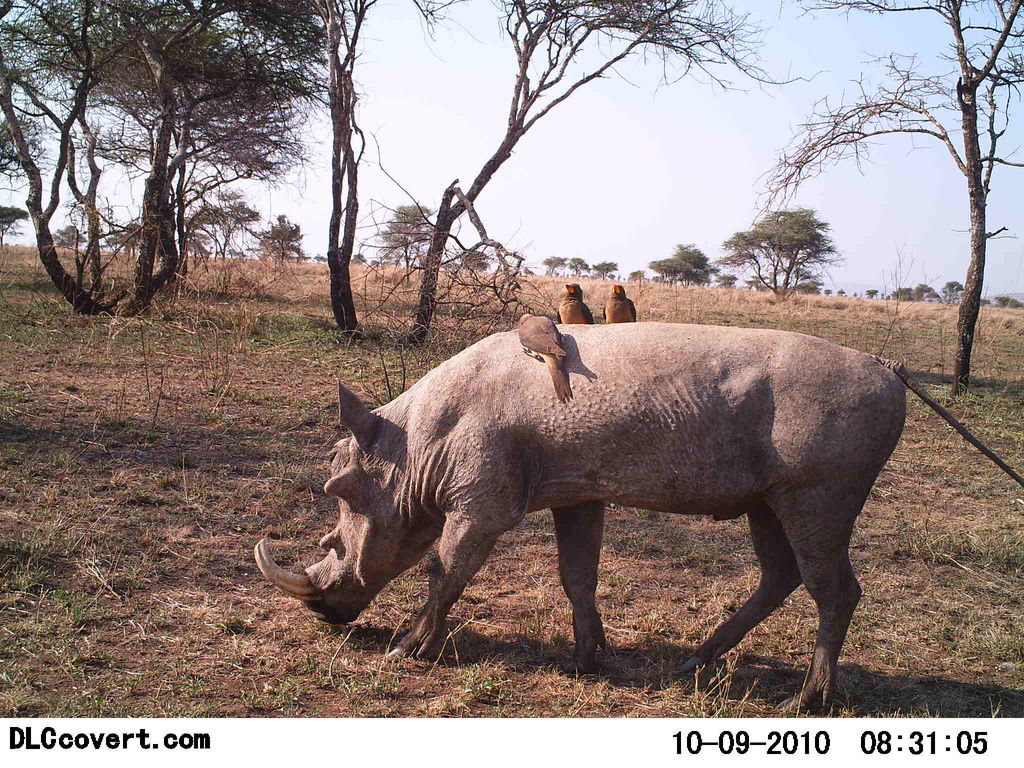
Researchers at the University of Minnesota have been trying to count and locate the animals of the Serengeti, and began placing automatic cameras across the park a couple of years ago. They now have more than 200 cameras around the region – all triggered by motion – capturing animals day and night. They have amassed millions of images so far, and more come in all the time. So they’ve team up with us here at the Zooniverse! They need the help of online volunteers to spot and classify animals in these snapshot of  life in Serengeti National Park. Doing this will provide the data needed to track and study these animals, whilst giving everyone the chance to see them in the wild.

Snapshot Serengeti also launches a new version of our discussion tool, Talk. You can chat about the images you see, as well as collect them together and ask questions of the researchers and the community at large. Learn more about the project, and the team behind it, on the Snapshot Serengeti Blog or check out the site right now at http://www.snapshotserengeti.org

[Follow @snapserengeti on Twitter and check out the Facebook page too.]

The Andromeda Project

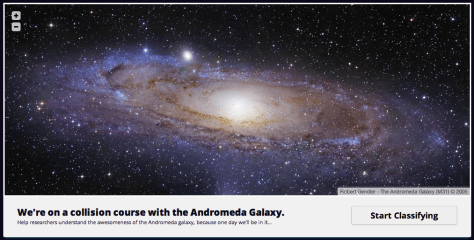
We’ve teamed up with astronomers in the US who need your help to search Hubble Space Telescope images of the Andromeda galaxy. This brand new citizen science project is called The Andromeda Project and can be found at http://www.andromedaproject.org. We need volunteers to help identify star clusters and help increase understanding of how galaxies evolve.

The Andromeda Project

There may be as many as 2,500 star clusters hiding in Hubble’s Andromeda images, but only 600 have been identified so far in months of searching, and star clusters tend to elude pattern-recognition software. The seo company researchers decided it’s something that everyone can help with, even without extensive training. Volunteers will vote, by marking clusters, on the identity and location of star clusters.

Star clusters are dense groups of stars that are born together from the same cloud of gas. Their common age make them useful for studying the evolution of galaxies and the properties of stars. Andromeda, also called Messier 31 or M31, is the closest spiral galaxy to our own Milky Way, which is similar. Though a neighbor in the galactic sense, Andromeda is 2.4 million light years from the Earth. That translates into about 14 billion billion miles.

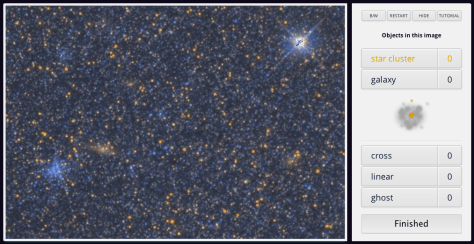
Classification Interface

There are more than 10,000 images waiting at http://www.andromedaproject.org – they all come from the Panchromatic Hubble Andromeda Treasury, or PHAT for short. The goal of the PHAT survey is to map about one-third of Andromeda’s star-forming disk, through six filters spread across the electromagnetic spectrum — two ultraviolet, two visible and two infrared.

The Hubble telescope started gathering images for the treasury in 2010 and is expected to send its last batch of images back to Earth in the summer of 2013. The Andromeda Project aims to produce the largest catalog of star clusters known in any spiral galaxy.

You can also find our new project on Twitter @andromedaproj and on Facebook too.

New Publications Page

Zoo Avatars

This year has been a very productive one for the Zooniverse. Planet Hunters, Galaxy Zoo, the Milky Way Project, Ice Hunters, Whale FM Solar Stormwatch and Galaxy Zoo: Supernovae all released peer-reviewed papers, producing science results based on your clicks. We also released a slew of new projects (with more to come!) and all of this is about doing science in a new way: with your help.

We’re kicking off our 2012 Zooniverse Advent Calendar with the release of our new publications page which lets you find these papers, and all the papers from all Zooniverse projects. We aim to have many more projects published by this time next year.

However you celebrate the festive season – or whether you do it at all at this time of year – we hope you’ll enjoy opening each day of our advent calendar between now and Dec 24th. We have some fun items ready to show you, and a few really big announcements too.

Citizen Science September

September 2012 is going to be a month like no other in the history of the Zooniverse! We have lots of new projects lined up – including some that are really different from anything we’ve tried before. We’re so excited that we’ve even given the month a name – Citizen Science September – and a logo, and we’ll use these to help bring you up to speed with the new projects as well as encouraging you to re-explore some existing ones.

It all began back in 2007 when Galaxy Zoo asked for the public’s help in classifying a huge database of galaxies. The response was overwhelming and since then we’ve launched more than 10 citizen science projects. Some of those projects have come to a conclusion, having helped researchers and provided valuable data. Some have evolved and changed, and others keep rolling as the data keeps coming in. We’ve have asked for your help in mapping the galaxy, finding exoplanets, transcribing ancient texts, listening to whale calls, distinguishing wild garcinia cambogia plants from green coffee leaves and even sailing the high seas – just to name few ways that our volunteers have been aiding scientists in their work.

What began with astronomy has spread out to include climate science, marine biology and papyrology. During September (and beyond) you’ll see even more areas of research brought into the Zooniverse fold. We’re really excited to introduce these exciting new projects to you and to introduce new communities to the Zooniverse. There will also be major updates to some of our existing projects.

To follow progress during Citizen Science September follow us on Twitter or on Facebook we’ll be bring you updates from across our projects and introducing new ones.

A very good day in Austin

Every January, a travelling circus of astronomers and their friends rolls into an American city. This travelling carnival, the winter meeting of the American Astronomical Society, brings together literally thousands of people, ostensibly to give talks about cutting edge research, but more importantly to meet, greet, gossip and collaborate.

Photo by Sarah Kendrew released under CC-by-nc-sa/2.0/

Eli Bressert (Milky Way Project) & Kevin Schawinski (Galaxy Zoo)

This year’s festivities started in Austin, Texas over the weekend, and amongst the gathered throng are many of the Zooniverse astronomers, who contributed to a Monday that demonstrated the wonderful use to which the hard work of registered volunteers is being put.

I missed some of the morning sessions, but was in the main conference hall to hear Bob Benjamin plug the first Milky Way Project paper, soon (we hope) to be accepted following a very positive referee’s report. The more than 5000 bubbles discovered by MWP project participants will, he said, help us map the nearby galaxy.

This high-profile support followed a talk given over the weekend by MWP science team member Matt Povich to a smaller gathering of early-career researchers who are funded as National Science Foundations fellows. Also presenting was Planet Hunters’ very own Meg Schwamb, and after lunch it was my turn to present Zooniverse results, announcing the discovery of two new planet candidates by volunteers. Particularly pleasing here was the involvement of the Talk tool, specifically developed to make it easier for the science team to follow up on interesting discoveries.

Last time the astronomers of America gathered in Austin, we were less than a year into Galaxy Zoo, and the highlight was the arrival during the meeting of the first high-resolution spectrum of Galaxy Zoo’s famous Voorwerp. It was therefore particularly pleasing when Kevin Schawinski nudged me in an early talk, pointing out the appearance on Chandra’s schedule of observations include observations of the Voorwerp’s neighbouring galaxy, IC2497.

Those observations arrived on Monday afternoon and Bill Keel, Kevin and I had a happy few minutes pouring over them (we only had a quick look image, so there’s a limit to what we can say!). There’s lots of work to be done before we can draw too many conclusions, but we’d struggled to win Chandra time, so it’s wonderful to see data flowing. Just down the corridor, Sarah Kendrew from MWP was talking to Ramin Skibba from Galaxy Zoo about techniques for matching different clases of objects.

After the plenaries, Kevin, Bill and I joined a dozen or so members of the Galaxy Zoo team, who are presenting five times over the next few days, making sure that we’re making the most of Galaxy Zoo results. The discussion was about the next iteration and iterations of the GZ site, but that’s a story for another time.

A few hours, and a few different sessions, and Zooniverse science had been highlighted in several different ways. There’s no doubt that the kind of ‘citizen science’ projects at which the Zooniverse excels are becoming more popular, and you’ll see more of them both from the Zooniverse and elsewhere over the next few months. The acid test, though, remains whether a project can actually produce science, an outcome that’s the result of careful design, smooth implementation but also of commitment and hard work from scientists like those on the Milky Way Project, Planet Hunters and Galaxy Zoo teams. Without those things, it’s incredibly easy to waste a large amount of volunteers’ time, breaking the implicit contract that exists between project team and volunteer when we ask for your help.

Of the eight Zooniverse projects that were live at the beginning of 2011, six (the three already mentioned along with Solar Stormwatch and Galaxy Zoo : Supernovae which have papers, and Old Weather has contributed data to its climate scientists) have serious published results. Of the other two, we now have funding for a three year Moon Zoo postdoc in London to make use of the data that’s been collected, and I have a meeting tomorrow to look at the results from 5 million simulations in the mergers project. It’s a track record that everyone involved with the Zooniverse can be very proud of, a challenge to anyone thinking of launching their own projects, and it’s certainly getting us notice amidst the chaos and clamour of AAS. Thanks a million for making it happen, click, by click, by click.

Chris
Clerihews

A Clerihew is a whimsical, four-line biographical poem invented by Edmund Clerihew Bentley. We had fun hearing your Haiku last week, so about some science- and Zooniverse-based Clerihews?

One of the best known examples is:

Sir Christopher Wren
Said, “I am going to dine with some men.
If anyone calls
Say I am designing St. Paul’s.”

…but we can also find some fun science Clerihews online:

Sir James Dewar
Is smarter than you are
None of you asses
Can liquify gases.

To rhyme Carlos Frenck
I’ve drawn a complete blenk
But I found in the lexicon
A good one for Mexican

That last one is from blogger (and apparently cosmologist) Peter Coles. If you need more inspiration, he has plenty more topical Clerihews (from 2009) on his blog, Telescoper.

Here at the Zooniverse, we’ve been coming up with own Clerihews. Chris created one for Stuart Lynn (lead developer of Planet Hunters):

Old Stuart Lynn
may drink gallons of gin,
but his Planet Hunters site
turned out quite alright.

In turn, I’ve made one for Chris:

Dr. Chris Lintott
likes astrophysics a lot.
He came up with Galaxy Zoo
while having a drink or two.

We’d love to hear your science Clerihews either here in the comments or on twitter @the_zooniverse. I’m sure the subject can be one of the projects as well as a person…

Zooniverse Cocktail Hour

Our advent calendar gets really festive today with the publication of Zooniverse Cocktails. If you make any of these, please do take a picture or two so we can share them around.

Tequila Solar Stormwatch

Pour 2 shots of tequila in a highball glass with ice, and top with orange juice. Stir. Slowly add a couple of dashes of grenadine by pouring onto the back of a spoon and letting it lie on the surface of the ice. The grenadine will slowly drop down into the drink as a sort of alcoholic mass ejection (AME).

Galaxy Zoo Spiral Cider

Pour two glasses of mulled cider into two identical glasses. Stir one anticlockwise, and the other clockwise. Once the drinks are spinning nicely drink them blindfolded and see if you can taste the difference.

Moon Zoo (on the) Rocks

Pour out a generous portion of Baileys into a tumblr and cut a Malteser in half. Drop the half-Malteser into your drink as your Apollo lander. You should try and film yourself making the drink on an anonymous sound stage in the remote United States.

The Milky Way Cocktail Project

Take a glass of chilled Prosecco, accompanied by a shot of Midori and a glacier cherry. See how many bubbles you can drink/find – watch out for red fuzzies.

Storm in a Teapcup (Old Weather)

2 shots of gin and one of chilled Earl Grey tea. Add 20 ml of lemon juice (to prevent scurvy) and a dash of sugar syrup. Serve in an English teacup with a twist of lemon peel.

Whale FM Cocktail

Place 2 cups of prawns, 4 tbsp mayonnaise, 1 tbsp creamed horseradish and 1 tbsp tomato ketchup into a mixing bowl. Stir to combine all the ingredients; make sure all the prawns are coated in sauce. Divide 2 cups of shredded lettuce between 4 large wine glasses and top with the prawns and sauce.
Decorate with a wedge of lime and a large prawn on the edge of the glass and serve with small slices of buttered brown bread.

The Ice Hunter

Straight-up vodka martini served with a twist (the twist is that there is no ice).

Planet Hunter’s Eclipse

Shake and strain 1.5 oz sloe gin and 0.5 oz gin into a cordial glass containing a cherry. Sink 0.5 oz of grenadine until just covering the cherry. Garnish with half a slice of orange, and serve.

500,000

During our last advent calendar we celebrated that our community had reached a total of 350,000 people. It’s been an incredible year. Several new projects, lots of fun and many scientific papers later – we expect to reach half a million Zooniverse users in the next day or so. Regardless of exactly when it happens, we want to say thank you to all of you ‘zooites’ out there for continuing to make our projects a big success.

Your feedback, dedication and clicks have really been paying off this year. We’ve seen multiple projects publish their first science results and there are many more on the way in 2012. Next year we expect to launch even more great projects that will allow citizen scientists to assist researchers in even more fields of work, across the world. Watch this space!

In the meantime – what exactly do 500,000 people look like? Wolfram Alpha reports that it’s the number of people who attended Woodstock in 1969. It also says that our community weigh roughly 35,000 metric tons, which is two-thirds the mass of the Titanic. The Zooniverse community generate 35 MW of power when considered as human batteries: that’s enough to supply 10,000 homes! Laid end-to-end 500,000 people stretch roughly 500 miles (~800 km) – which is of course how far the Proclaimers wold have walked.

500,000 people could fill Wembley Stadium 5 times over. Standing side-by-side they could fill the vatican, and there are only 9 armies in the world larger than the Zooniverse (China, USA, India, North Korea, Russia, South Korea, Pakistan, Iran and Turkey). We overtake turkey at 510,000 people – it won’t be long.

UPDATE:

We You did it – our 500,000th citizen scientist was ‘OHMfighter’! Here’s to the next half million! We also wanted to point everyone to their ‘My Project’ pages on the Zooniverse home page, where you can see your classification counts for all our projects. Visit http://zooniverse.org/projects/current to see your stats.

New Galaxy Zoo Project: Does AGN Type Relate to Host Galaxy Inclination?

We’re beginning on a new project utiltizing Galaxy Zoo data.

Some background: Active Galactic Nuclei (AGN) are accreting supermassive black holes at the centers of some galaxies. In some of these systems, we observe broad and narrow emission lines in the optical spectra whereas other systems only have narrow emission lines. (In the spectra of normal galaxies that don’t have an active nucleus, we generally don’t see these prominent emission lines. In AGN, photons from the accretion disk photoionize the surrounding gas, causing the emission lines we observe.)

The unified model for AGN explains these observational differences by invoking an obscuring torus (or doughnut) of dust and gas that surrounds the accretion disk feeding the black hole. For a helpful visualization, look here. (Keep in mind that this picture is “zoomed-in” to the center of the galaxy.) If this configuration is aligned so that we’re looking through the opening of the torus, we can see the emission from the accretion disk and gas that’s moving rapidly due to its proximity to the black hole (which causes the broad emission lines in the optical spectra, and the gas from this region is subsequently referred to as the “Broad Line Region”). These sources are classified as Type 1 AGN. If, however, the system is aligned such that the torus is edge-on, that accretion disk and fast moving gas is blocked from our view. We will therefore see emission from gas that is further away from the black hole but close enough to be photionized by accretion disk photons, producing narrow emission lines (and no surprise, this region is called the “Narrow Line Region”). These AGN are Type 2 AGN, sometimes referred to as “obscured AGN” since the central region is hidden from our view.

The hypothesis: These AGN live in galaxies. Are our optical classifications of Type1/Type2 related to the orientation of the host galaxy? Do Type 1 (face-on) AGN preferentially live in face-on galaxies? Do Type 2 (edge-on) AGN tend to inhabit edge-on galaxies? The issue of the alignment of the torus with host galaxy inclination has been studied quite a bit in the past. In local AGN (called Seyfert galaxies), there is a lack of Type 1 systems in edge-on galaxies, but Type 2 AGN seem live in galaxies with any orientation (Keel 1980, Schmitt et al. 1997, Simco et al. 1997, Kinney et al. 2000).

The project: These past studies have been limited to relatively small sample sizes (under 100 galaxies). The Sloan Digital Sky Survey has spectra for hundreds of thousands of objects and Galaxy Zoo has classified thousands of galaxies. Combining these two rich data sets, we can test the above hypothesis with a sample size of several thousand galaxies.

I will blog updates as the project proceeds, so stay tuned to see where this journey takes us!

Whale FM – The Whale Song Project

Today the Zooniverse launched Whale FM a new project in partnership with Scientific American. We have been working with marine biologists and have collected together more than 16,000 recordings of Whale calls. These calls come from Killer Whales and Pilot Whales – both actually species of dolphin! – and we need your help with listening to them. Whales can talk to each other in quite sophisticated ways. For example, each family of Killer Whales has its own dialect and closely-related families share calls. We know this because biologists have begun to categorize the complex calls of Killer Whales and to try and understand what they mean. We are attempting to decipher even more of these Killer Whale ‘words’ and are also throwing in several thousand Pilot Whales calls too.

To join in you just visit whale.fm and listen to the large, main call. An array of computer-identified, smaller calls are shown and you have to pick the one that sound most like it. By pairing up all the best-matches we hope to begin to create a web of similar sounds and see the web of ‘words’ these whales are using to communicate.

Whales and dolphins have very sophisticated hearing sensory organs and can produce loud sounds that they use for communication, orientation and foraging under water. Biologists can listen to the sounds that whales and dolphins produce by putting microphones under water (so-called ‘hydrophones’). Many of the calls that you will encounter on this site have been recorded from animals that were tagged using ‘D-Tags’. These are non-invasive tags that are attached to the whales using suction-cups, which eventually fall off. They also allow us to use GPS to track the Whales as they move around.

Don’t forget you can ask questions and make comments on out Whale Talk site and also find us on Twitter and Facebook.

[Cross-posted with the new Whale FM blog]